
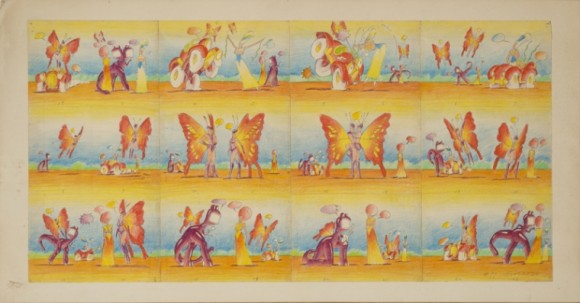

Photo: Courtesy of Andrew Edlin Gallery
The Andrew Edlin Gallery in Chelsea is showcasing a retrospective of drawings by Victor Moscoso, one of the pre-eminent graphic artists of the 20th century who is widely known for his 1960s psychedelic posters and comics. The gallery will publish a 96-page catalog for visitors to accompany the exhibition.

Photo: Courtesy of victormoscoso.com
This exhibition is the first to present the full range of Moscoso’s drawings for posters and comics, including original renderings for his renowned cover of Zap Comix #4 (1969), the Hocus Pocus story, posters for The Doors and The Who, and other seminal published editions. These works, executed as production art for printed pieces, reveal Moscoso’s dedication to expert draftsmanship in the service of graphics, as well as a sure and graceful approach to drawing everything from dinosaurs to spaceships to humans.

Photo: Courtesy of classicposters.com
Between 1967 and 1970, Moscoso designed over one hundred posters for everyone from the Grateful Dead to Jimi Hendrix to Alan Ginsberg. In doing so, he revolutionized the worlds of graphic design, typography, and rock’n’roll imagery. In 1968, Moscoso was invited by Robert Crumb to join him in Zap Comix. Moscoso’s abstract and lyrical comics debuted in issue 2 and he has remained a driving force of the Zap collective through to its final iteration, a 2014 “Complete Zap Comix” box set that sold out immediately upon its release.
Victor Moscoso’s impact on the visual culture of the psychedelic era belies his modernist training, which he used to delineate images, posters and comics that explore geometric space, animation, and cartoon icons. In 1966, Moscoso began designing posters for rock shows in the city, and by 1967 had developed his signature style, in which opposite hues of the same intensity sit next to each other to create a visual “vibration” effect and lettering is designed for its form instead of function. Moscoso’s lettering was all hand-drawn; his approach to letterforms gave negative space as much weight as the positive. This spatial confusion, along with color vibrations and Moscoso’s mysterious imagery, made his work instantly recognizable.
Moscoso’s work is on display throughout museums across the world, including at MoMA, the Louvre in Paris and The Victoria and Albert Museum in London. The exhibition will run until April 25, so be sure to visit this unique, one-of-a-kind exhibit while you can!
-by Jackie Hart