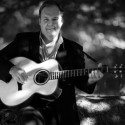
The Brilliance Shines Brightly At Rockwood Hall in the LES
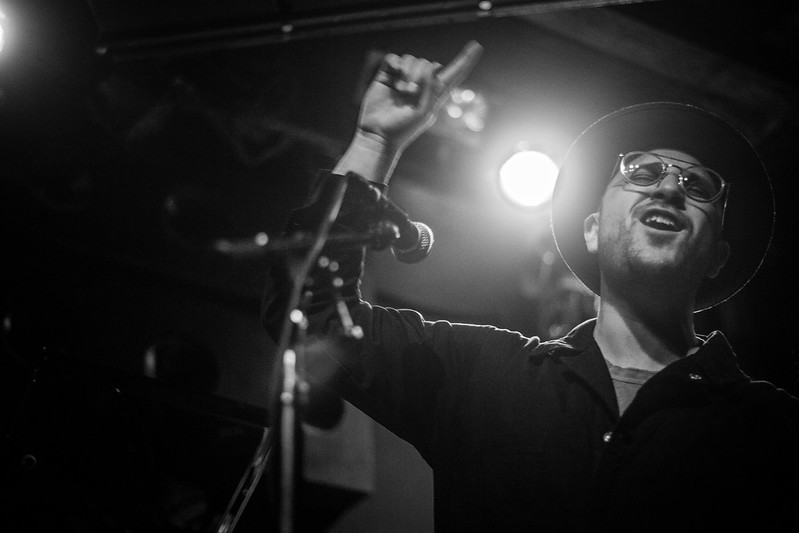
The January temperatures may have dipped below freezing the other evening, but the warmth emanating from Rockwood 2 thawed many hearts as The Brilliance took the stage.
Photo: Alice Teeple
The neoclassical/orchestral pop outfit, founded by childhood friends David Gungor and John Arndt, has seen many guises over its decade-long run. Gungor and Arndt grew up together in Wisconsin, often parting ways geographically, but finding common paths in music. Gungor currently lives in NYC, working at Trinity Grace TriBeCa; Arndt currently lives in Minneapolis (soon France) and works as a composer, film scorer, and producer.
The Brilliance is a uniquely American take on Judeo-Christian liturgical music, expanding the duo’s initial evangelical interpretations into a more urgent, universal message of peace. The Greek word here is agape, or higher love.
The Brilliance walks the walk with their message as well, having recently partnered with World Relief in their initiative to raise awareness for the DACA Dreamers. Their Dreamer Suite exploded on Spotify after a feature on New Music Friday, amassing over half a million monthly listeners and millions of streams as an independent release.
The spirit moves with Gungor and Arndt’s artistry –more importantly, it urges everyone to move toward balance and love. While most of the music world mires itself in repetition and monotone, The Brilliance is beautifully philosophical and melodic. Much like Sufjan Stevens, Arcade Fire, and U2, The Brilliance draws from spiritual allusions, seeking justice and mercy. The band takes cues from later Beatles recordings; their sweeping orchestral arrangements surrounding Gungor’s warm tenor and Arndt’s expressive piano.
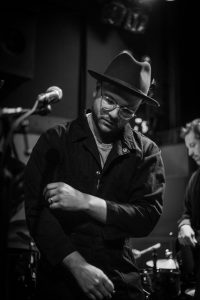
Photo: Alice Teeple
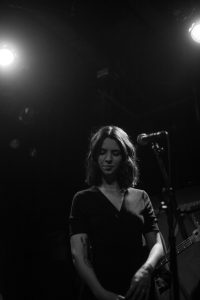
Photo: Alice Teeple
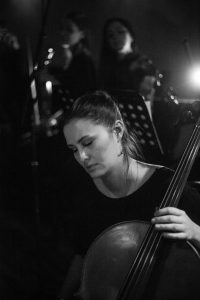
Photo: Alice Teeple
Their lyrics are deep and earnest. As William Blake’sJerusalem questioned the environmental and societal morality of the Industrial Revolution two centuries ago, The Brilliance asks humanity to take a grounding breath amidst the chaos. Be it faith in a deity, the universe, or within the Self, we must collectively navigate this planet. The Brilliance also embraces measured optimism. One song, Must Admit, opens with a recording of the haunting chorus of Parisians singing as Notre Dame burned last summer.
The shimmering Oh Dreamer, in particular, gives poetic nods to Marvin Gaye’s seminal album, What’s Going On?
We say long live liberty Pretend equality Let freedom reign Let freedom reign Does the cost of security Bankrupt our humanity? Let freedom reign
The Rockwood concert included a full string section, two backup singers, a guitarist, a bassist, a drummer, and Arndt on piano. (Gungor joked during the show that the crowded personnel was actually heavily stripped down version of the studio recording.)
Photo: Alice Teeple
The room was packed with smiling fans and family, filling the venue with a good old-fashioned sing-along for See The Love. There was barely a dry eye in the house as Gungor snapped his fingers and calmly pulled the room together.
The Brilliance confronts humanitarian and environmental crises and offers a message of hope. World Keeps Spinning acknowledges the point of critical mass as darkness engulfs the collective.
When fear becomes violence I’m drowning in the silence Light and bad, discertainty, and indifference I wanna hear the song of peace Would you sing it over me? Can you help me to speak though I stutter? We’ve got to live for more Than just the end of the world
The sweeping song is an epic collage, fusing together the most stirring elements of Electric Light Orchestra, The Beatles’ Sergeant Pepper, Bach’s Passacaglia and Fugue in C Minor, and Stravinsky’s Firebird Suite, taking the band almost into the realm of prog rock at its bridge…almost. Ambitious, yes, but the postmodern approach pays off. The album is a breath of fresh air.
Check out the beautiful World Keeps Spinning, here.
Brooklyn Sports & Entertainment is partnering with The Bowery Presents — AEG Presents’ regional partner — to acquire the operating rights and assets to Webster Hall, the legendary music and entertainment venue located in Manhattan’s East Village. The parties will assume the long-term lease to the building, which will continue to be owned by current owner, Unity Gallega.
“We are excited to build on the iconic history of Webster Hall,” said Brett Yormark, CEO of Brooklyn Sports & Entertainment. “Webster Hall provides us with an extraordinary opportunity to connect with artists early in their careers and expands BSE’s venue footprint into Manhattan. We appreciate all that the Ballinger family has done to make Webster Hall an industry leading venue and we are looking forward to working with them, The Bowery Presents and AEG Presents to make it an even greater destination for live music.”
“Partnering with The Bowery Presents and Brooklyn Sports & Entertainment to program and operate this iconic live facility will continue to enhance Webster Hall’s worldwide reputation as one of the industry’s most important venues,” said Jay Marciano, Chairman and CEO, AEG Presents.
Webster Hall has undergone several waves of transformation throughout the past century. In the 1920’s, Webster Hall notoriously held masquerade balls and was nicknamed “the Devil’s Playhouse.” RCA Records purchased Webster Hall in 1954 and renovated the venue to include a state-of-the-art acoustically-treated ballroom. Notable artists who recorded in Webster Hall’s studio during this time included Elvis Presley, Frank Sinatra, Bob Dylan (his recording debut), Harry Belafonte, Tony Bennett, and Julie Andrews.
Beginning in the 1980’s, Webster Hall reemerged as a leading rock venue in the City, hosting artists such as Eric Clapton with Keith Richards, U2 (the band’s first-ever U.S. show), Tina Turner, The Beastie Boys, Prince, Sting, Metallica, Aerosmith, KISS, B.B. King and Guns N’ Roses. The Ballinger family began running the venue in 1989.
Thailand’s leading rock band Slot Machine kicked off its first full North American tour on Apr. 1. Hitting the road alongside Japan’s Miyavi and Korea’s Kiha & The Faces on Live Nation’s Asia On Tour — which hits Irving Plaza on Apr. 23 — this is hardly Slot Machine’s big tour. Since debuting in 2004 with its self-titled album, Slot Machine has won numerous “Record Of The Year” and “Song Of The Year” awards around Thailand and Asia.
Spin The World is the latest album from Slot Machine, also the first full-length that the group recorded in English. Impressively, Spin The World was produced by Steve Lillywhite, a man behind major albums by U2, The Rolling Stones, Talking Heads, The Killers and Peter Gabriel. In support of Spin The World, Slot Machine has made further international waves by embarking on its first U.K. tour and playing at major festivals like Japan’s Fuji Rock and Korea’s Jisan Valley.
Downtown had the pleasure of conducting Q&A with the members of Slot Machine via e-mail: vocalist Karinyawat “Foet” Durongjirakan, bassist Atirath “Gak” Pintong, drummer Settharat “Auto” Phangchunan, and guitarist Janevit “Vit” Chanpanyawong. More on Slot Machine can be found at www.slotmachine.band.
Gak: After five Thai albums, we discussed with our record label ideas, on how to share our music with the world. We all felt it was the right time to cut an English album; we were ready.
Do you have a favorite song to perform live from Spin The World?
Vit: “And We Go!” This song has a lot of power to it and is great to perform live. It has a unique Northeastern Thai singing style called “Mor Lum,” which makes this song very unique on the album.
Auto: We were introduced to Steve Lillywhite when he was invited to Bangkok by the label. We talked with Steve for a while and invited him to hear us play.
Foet: We didn’t know back then about Steve’s “requirements” when deciding to work with a band. Basically, if he likes what he hears, he will be more inclined to produce an album. Luckily, he liked what he heard and we were ecstatic to find out that he would help us produce our first English album.
Located in the West Village, Analogue is a cocktail bar that has received rave reviews from the Wall Street Journal, Gothamist and DNAinfo alike. While many Manhattan bars aim to have music playing loud so that its customers have no choice but to dance and pound drinks, Analogue takes a very different approach. Whether it has a jazz trio live or its vintage Hi-Fi setup playing, Analogue keeps the music at a reasonable volume, allowing you to engage in conversation with ease. Analogue also offers a great food menu and has a lot of artwork on the walls for its patrons to look at.
Downtown had the pleasure of talking with owners Jesse Wilson and Jared Gordon, who met as students at NYU. As noted within our Q&A, Analogue is currently in the midst of expanding, although the location of its second spot has not yet been revealed. More info on all things Analogue can be found at www.analoguenyc.com.
You two met while studying at NYU. Where did the idea of opening a cocktail-centric bar come from?
Jesse Wilson: At first, the idea started when we would hang out at various bars around the Village and talk about how cool it would be to open a bar. After NYU, I moved back to San Francisco to work in finance and started to work on a business plan on the side. At that time I was also starting to notice a proliferation of cocktails and craft beers in the marketplace. I just couldn’t do it by myself due to work so kind of shelved the idea. When I moved back to New York City, Jared was ready to move on from finance himself and approached me with the idea of opening a bar. After a lot of discussion, we decided on the concept of doing a cocktail bar for a professional, grown-up crowd and Analogue was born.
Jared Gordon: We wanted to open a bar that featured the drinks we enjoy. That’s cocktails, whiskey and an occasional great beer. So that’s what we did. We pride ourselves on our cocktails and have put together an outstanding program, but we’re agnostic as to how we’re perceived or what the guest wants. As long as they’re enjoying themselves, it doesn’t matter to us whether they’re having our most complex cocktail, our rarest whiskey or just enjoying a glass of wine or a beer.
Did you have any restaurant or bar experience prior to opening Analogue?
JW: We didn’t have any experience really. Jared had a little bartending experience in the Upper East Side and had read a few books, but that was about it. We figured with our strong business backgrounds we could run the business, but we also knew we needed to hire people we trusted with experience in the hospitality industry.
JG: I’ll echo Jesse’s thoughts. I started tending bar to get a sense of the business, but I was pouring neat well vodkas at a few dives on the Upper East Side. Not quite the same level. We knew what we wanted and we knew how we wanted to treat our guests. The rest is putting a team in place to help execute that vision.
The Dorian Gray / Photo: Michael Tulipan
How would you describe Analogue to someone who hasn’t yet been there?
JW: I think the name “Analogue” fits the bar well. It’s a high-end cocktail lounge that is almost a throwback to Manhattan in the 1950s and 1960s. We do great cocktails and food and have a great atmosphere that promotes conversation amongst friends. It’s a throwback to a non-digital era, hence the name. I actually notice people come in and use their cell phones a lot less and just talk with each other. This was one of our goals when we were designing the bar.
JG: Jesse put it perfectly. It’s a comfortable bar in which to enjoy a great drink and a conversation.
Do you have a favorite drink on the menu? A favorite food item?
JW: My favorite drink is our signature called The Analogue. It was our first drink on the menu. It blends Havana Club Anejo Rum, Four Roses Bourbon, Domaine de Canton ginger liqueur, St. Elizabeth Allspice Dram, Velvet Falernum and bitters. When we opened, we wanted a bourbon-focused drink that was good for the colder fall weather in New York. When I tasted it I said to our bartender Nesha Korak, “Wow, if I could taste our bar that would be it! What should we call it?” And he responded, “Well that’s what it is then, call it Analogue.” And it’s been on our menu ever since day one.
JG: I’d say my favorite drink is whatever the team is working on at the moment. I enjoy the evolution of the individual bartenders and the program as a whole through time.
Jared Gordon & Jesse Wilson
Who is in charge of your cocktail menu? How does your team come up with cocktails?
JW: Zack Berger is our head bartender and facilitates the process for the team. The menu is a collective effort for all of our bartenders. They are always creating, and when we do a menu, they bring several of their best drinks to the table to try. We do a few rounds of internal tastings and then pick the winners. We then adjust the menu to put on the best cocktails and remove any drinks that are out of season or slow moving. It is a constant process.
JW: One of the first concerts I remember was U2 during the Joshua Tree tour back in 1987. My father took me when I was 13 years old. This was when U2 was at their peak and becoming a global phenomenon. The concert blew me away. I remember walking out of the Oakland Coliseum to the crowd and everyone was still singing “40” in unison. It’s cool to see them doing the 30 year anniversary tour now!
JG: My first concert was the Concert For Walden Woods, featuring Billy Joel, Don Henley and Sting. The seats were terrible but the music was amazing. Live music and music in general have played an important role in my life ever since.
Black Boulevardier / Photo: Michael Tulipan
What was the latest concert or music-related live event you attended?
JW: The last show I attended was The Cult here in New York. The Cult was another band I grew up listening to and they are still going strong! I like a lot of alternative, hip-hop, jazz, country, metal, pretty much any genre if it’s good.
JG: I’ll echo Jesse’s sentiments. I love everything from old school East Coast hip hop to bluegrass, metal, and classical. The last shows I’ve seen were Iron Maiden (my second time), Dave Matthews Band (my 24th) and the Governors Ball, where De La Soul was the highlight.
I understand that Analogue features live music a few days each week. Who are some of the artists that regularly play there?
JG: currently we have Nick West and the Westet on Tuesdays and Monika Oliveira on Wednesdays. Nick West is a funky bass-driven trio, and Monika has a beautiful, mellow bossanova sound.
When you don’t have musicians playing at Analogue, I know that you have music spinning. Have you always been so vinyl-centric?
JG: We spin vinyl on special occasions, and for that we have a fantastic vintage turntable and tube amplifier. We’re also starting an audio salon where we will feature some truly high end systems and some classic albums each month. Vinyl has played a role in my life since birth, when it was just called “music.” As I got older, I started my own collection by stealing my parent’s albums and it took off from there. I have about 7,000 albums at the moment, down from a peak of about 8,500. I enjoy the hunt — scouring yard sales and thrift stores and finding new music or forgotten gems. And I enjoy building and tweaking my HiFi system.
The Analogue / Photo: Michael Tulipan
Who chooses the music that is playing at Analogue?
JW: Usually our management team will set the music that is played at the venue. We are always on the lookout for new bands in the area. A lot of the bands we discovered were from around the West Village area playing at venues or outside at Washington Square Park.
The walls of Analogue are also lined with music-related photographs. Were those from a personal collection?
JG: The photographer is Roberto Rabanne, who has shot some of music’s best. The prints in our space are all originals, and the collages of Ray Charles and Bill Evans are each one of a kind.
I know that Analogue has a private room. Is that only for private events?
JW: Yes, we host a lot of events in the back such as private parties, corporate events, cocktail classes and wedding receptions.
When not busy with Analogue, how do you like to spend your free time?
JW: Sleeping! I work full-time and help manage the bar, so in my little free time, I like to relax. But now we are looking to open our second location, so a lot of free time is spent working on the new location.
JG: I recently had my first child, a little boy we named Jack. So free time is in short supply at the moment. Between him, Analogue and scouting for the next location, there aren’t enough hours in the day. When I do find some down time, I like to play music, read, cook, and yes sleep.
Analogue / Photo: Michael Tulipan
Aside from Analogue, do you have a favorite bar or restaurant in New York?
JW: I am really into craft beers right now so I appreciate a good selection of beers and a nice atmosphere. I liked Cooper’s when I lived in Chelsea. I now live on the UWS and like Gebhards, a new craft beer place near my apartment.
JG: I like dive bars. When I’m at a cocktail or whiskey bar, I find myself too focused on the menu, the setup and the service. I relax when I can kick back with a beer and a whiskey and not worry about taking notes. Parkside Lounge on Houston and Lucy’s on Avenue A are two favorites.
Finally, any last words for the kids?
JW: Don’t get caught up in all of the cocktail hype! We try to focus on making cocktails that taste great and put a lot of work into that. We don’t get caught up in all of the hoopla to try and get too clever or go over the top with our creations. A lot of our drinks are rooted in tradition, the foundation if you will. The goal is to just make quality drinks that the customers will enjoy and have a good time. At the end of the day it’s all about giving our customers the best possible experience.
In his 30-plus years as a singer, songwriter and musician, Adelmo Fornaciari — better known as Zucchero — has sold over 60 million albums. Beyond being widely-recognized as the father of Italian blues music, he is the best-selling Italian artist of all time. Collaborators of Zucchero have included Eric Clapton, Miles Davis, Luciano Pavarotti, Andrea Bocelli, Stevie Ray Vaughn, Ray Charles, Sting, and B.B. King. Collaborations like these have led to Zucchero receiving six IFPI Europe Platinum Awards, six Wind Music Awards, and two World Music Awards.
Zucchero has not stopped created new music, and his latest full-length is 2016’s Black Cat. The Universal Music title includes work with U2’s Bono, Dire Straits’ Mark Knopfler, Elvis Costello, Loney, Dear, and Avicii. In support of Black Cat, Zucchero will be touring the United States next month, including a Mar. 31 stop at The Beacon Theatre.
Downtown had the pleasure of speaking with Zucchero about Black Cat, his history with New York, and what else he has coming up. Zucchero can be visited online at www.zucchero.it and followed via Facebook, Twitter and Instagram.
Where was the first gig you ever played in New York? What do you remember about it?
Zucchero: It was 2007 at Carnegie Hall. It was a great thrill for me to play in New York. We had a great time that night.
Do you ever come to New York besides touring here? Have you recorded an album here?
Z: There are many restaurants that I love in New York, but I have a good friend Fabio who owns Serafina, and I always to one of his restaurants.
For someone who hasn’t seen you live before, why should they expect from your Beacon Theatre show?
Z: I enjoy performing for the fans and new fans. The show has a lot of energy, tracks from my new album and my hits — the crowds seem to love it!
Do you have a favorite song on your new album?
Z: It would be unfair of me to pick a favorite, but the song “Streets Of Surrender” will always have a special meaning to me. Bono wrote the lyrics and I wrote the music. It is a track inspired by the attacks at The Bataclan in Paris in 2015.
Black Cat was produced by Don Was. When did you first meet Don?
Z: When I recorded my album Fly back in 2005/2006. He is a great guy and fun to work with we have a good connection.
Once you’re doing touring in support of Black Cat, what is ahead for you?
Z: I will take some time out in Italy with my family and friends. Then I will start to think about a new album and tour!
You’ve collaborated with many of pop and rock’s top stars. Is there anyone you’re still hoping to collaborate when?
Accomplished in multiple musical fields, Rob Mathes is a noted singer, songwriter, arranger, music director and producer. As an arranger, he has worked with Bruce Springsteen, Tony Bennett, Elton John, Bono, and Panic! At The Disco, to name a few artists. As a producer, he has worked with Sting, Rod Stewart, Carly Simon, and Beth Hart. As a music director — or “MD” — he has overseen high-profile performances at the Kennedy Center, Carnegie Hall, Madison Square Garden and the Super Bowl. Rob has also released several solo albums, which has led to him having two television specials on PBS. In turn, it is not particularly surprising that he is an Emmy winner and the recipient of Grammy, Tony and Drama Desk Award nominations.
On Dec. 18, Rob Mathes brings his annual holiday concert — 23 years and concert — to the Schimmel Center. Rob’s shows are known to feature world-class musicians, as including musicians from Saturday Night Live, The Late Show With David Letterman, and Paul Simon’s band. Rob spoke to Downtown about this year’s event, what else he has coming up for him, and plenty more. More info on all things Rob can be found at www.robmathes.com.
Where did the idea for the first Rob Mathes Holiday Concert come from?
Rob Mathes: My parents raised me as a Christmas kid. Once Santa came into view, I went into a kind of heat every year almost as if I was on a new anti-depressant. I loved the cold, the dark and the lights — everything — and I always saw the Christian part of the Holiday as this story about humility and grace entering the world right when it wanted a warrior. So from my teens I wrote Christmas songs. I admit a few were cheesy early on, but many came from the better tradition of Christmas music — i.e. the Bruce Cockburn record, the Ray Charles records. I grew up as a Pete Townshend and Beatles fanatic but who also listened to Stevie Wonder, Motown and Duke Ellington’s Nutcracker Suite. It was schizophrenic but wondrous.
Eventually I started to accrue real credits and started working with great musicians in studios thanks to the legendary producer Phil Ramone, who hired me regularly as an arranger, guitarist and piano player. I decided to collect the best of this music, released a few independent CD’s, put some of these musicians together and started giving this concert. Eventually an amazing Rabbi from Stamford, Rabbi Mark Golub — who hosts a talk show on Shalom TV — started coming to the concert regularly and I promised him some music. It became a true holiday concert, the Menorah, the Manger, the sleigh and reindeer.
Did you know that it was going to become an annual tradition?
RM: I had no idea. People loved the first concert and grew attached to a few of the songs that became our “hits” so to speak, the song “William The Angel” — which I eventually ended up singing with The Boston Symphony at Symphony Hall years after the Holiday event became a perennial — and the blues-oriented “When The Baby Grew Up.”
For someone who hasn’t attended before, what should be expected? Are there particular things that happen every year?
RM: It is an odd one, Darren. The original songs fall firmly into the singer/songwriter tradition. I grew up on Dylan, The Band and Stevie, so I write an equal amount of music around both the piano and guitar and it is the kind of singer/songwriter stuff that you might hear on WFUV. On the other hand, I grew up being raised equally by my mom and aunt, identical twin sisters both of whom were classical musicians who married men they met at Yale Music School, my uncle who played with big bands and was a composer/arranger and my dad, who was a classical clarinetist but who secretly was a folk music fanatic.
Because of this, I also adore Ellington and Gil Evans, Vaughan Williams and Mahler and have written hundreds of arrangements for various horn sections and string sections. So we do straight up swing versions of some carols and even a couple of Instrumentals for my six-piece horn section — full of brilliant virtuosos — that groove like music by The Meters and The JB’s. It is quite eclectic.
Who is in your backing band this year?
RM: It is the same group that has played with me for 20 years. Will Lee, the legendary bass player and studio session star from New York City, who played on the David Letterman show since the very, very beginning, is playing bass. We have two drummers, the great Shawn Pelton from Saturday Night Live on drums and Joe Bonadio, who is also an astonishing percussionist. Billy Masters, who played with Suzanne Vega and Dar Williams for years and who was often a part of my Kennedy Center Honors band, is my guitarist. Ricky Knutsen, a composer and keyboardist from Brooklyn, has played every single show since 1993. The six Horn players are Jeff Kievit and Don Harris on trumpet, Aaron Heick and Andy Snitzer on saxes, Mike Davis and Jeff Nelson on bones. Between the six of them the credits are insane. From Sinatra to Aretha Franklin to Springsteen to Paul Simon to Nile Rodgers to The Rolling Stones, these are six of New York’s finest.
Vaneese Thomas and James “D-Train” Williams are also unsung heroes of the vocal scene in New York. D-Train had big hits in the 80s but, along with Vaneese, became one of the first calls for any background vocal session had on major records over the last 20 years. Between them they have sung with Billy Joel, Stevie Wonder, Natalie Cole, Luther Vandross, Alicia Keys, Sting, Michael Jackson, Eric Clapton, etc. It is a great band and, while the show can be said to be about music that people the age of 35 to 60 will relate to, it is not staid and tired. This is a muscular evening musically, emotionally resonant and alternately funky, warm, resonant and meditative. To say it is appropriate for all ages is both true and somewhat self-serving. That said, it is an evening/afternoon I am very proud of and a focal point in my year.
Aside from the Holiday Concert, what is coming up for you?
RM: I have been doing a lot of work with the David Lynch Foundation, having produced the Music Of David Lynch record, recorded at the ACE Theatre in L.A. last year. There will be a big David Lynch event at the Kennedy Center in the new year and I think I will MD that event. I am hoping to do some more arrangements for both Twenty One Pilots and Panic! At The Disco who I have worked closely with for years and produced one of their records. I will musically direct a tribute to Jimmy Webb at Carnegie Hall next spring. When Sting finishes touring the new record with his long-time band late next year, there are plans for a London production of his musical The Last Ship, which I orchestrated and musically directed. Other things are floating.
You are a singer, songwriter, arranger, music director and producer. Do you identify with any of those categories more than others?
RM: I always wanted to be a singer/songwriter 24 hours a day, but I was so obsessed with music and it was coming at me from all sides at home. My uncle playing Sinatra and Ellington, my dad playing Dylan and Pete Seeger, my mom and Aunt playing Gospel music and Beethoven. I wanted to understand Mahler’s 9th, Sinatra’s In The Wee Small Hours, Stevie’s Songs In The Key Of Life — my favorite record ever made — Duke Ellington’s Blues In Orbit, and Radiohead’s In Rainbows. Therefore all four of the monikers above stand and I can’t pick. Schizophrenic indeed.
You have been honored with Emmy, Grammy, Tony and Drama Desk Award honors. Which was your first nomination of note?
RM: The country artist Kathy Mattea won a Grammy for her Christmas record, the title track of which was my song “Good News.” That was not a personal Grammy nomination like my production of Bettye Lavette’s Interpretations, but it was the beginning and meant a lot. I won my Emmy Award for musically directing and arranging the Kennedy Center Honors show. That year I had done a massive multi-genre arrangement of “Here Comes The Sun” for Chris Thile, Edgar Meyer, The Silk Road Ensemble, Emanuel Ax and Jamie Laredo and James Taylor, all conducted by John Williams. That was easily one of the most astonishing moments of my life. The point was to illustrate Yo Yo Ma’s musical playground and how he crosses borders. He was one of the honorees that year. Wow!
Awards aside, is there an accomplishment that you are most proud of?
RM: There have been moments that transformed me: Accompanying Al Green on piano when he sang “Amazing Grace” at the 9/11/02 Concert For America I musically directed for NBC. Writing and conducting a full orchestral version of “I Still Haven’t Found What I’m Looking” for an African Choir, Orchestra of St. Luke’s, Bono and The Edge at Carnegie for Bono’s Red Charity last year. The first studio session writing string charts for Bruce Springsteen. He came up to me in the middle of the session at the old MSR Studios on 48th Street and told me “you’re my guy from now on.” Huge!
Musically directing and arranging the Obama Inaugural at the Lincoln Memorial. Co-producing a few records with Sting, who was a huge influence on me when I was young. Writing the National Anthem arrangement for Renée Fleming for the 2014 Super Bowl. Having Lou Reed personally thank me on his album The Raven for a simple string arrangement I did — a first. There are many more but these stand out.
Your list of credits is essentially a who’s who, between Beyonce, Bono, Elton John, Sting, Panic! At The Disco, Twenty One Pilots, Tony Bennett, Yo-Yo Ma…All sorts of genres, to say the least. How does work usually come to you? Do you have a manager or agent pitching you? Is it more word of mouth?
RM: My manager is Jonathan Daniel at Crush Management. He manages Sia, Lorde, and Fall Out Boy, among others. He has saved me in that most people like myself get called for “Adult Contemporary Music.” He has hooked me up with Butch Walker and Panic! At The Disco and Fall Out Boy and many others. He has single-handedly kept me young — to a certain extent (laughs). He is smart and unpretentious. Super-important. But a LOT of my work comes from word of mouth.
Is there anyone you haven’t yet worked with but still hope to?
RM: I would love to work as an arranger with some younger hip-hop artists, because whenever I have written string or horn charts on those records, most of which were produced by my friend Just Blaze, he TURNED THAT SHIT UP! There is a spirit in that community and that music which just will not be denied. It is the center of popular music and has been for a while. So much of it is so vital, passionate and intense that when you bring in ideas coming from an arranger’s head, they get channeled in a way very unlike just a sweet string arrangement on a pop or rock ballad you can hear in the background.
I would love to produce a record of spirituals for Mavis Staples with a big gospel choir, orchestra and rhythm section. Mavis was great to me through the years when she came to sing some of my arrangements at the Kennedy Center. We performed a concert together in Connecticut. I think it is a long shot but I would love it.
When not busy with work, how do you like to spend your free time?
RM: With my three daughters and wife — Emma, Sarah, Lily and Tammy…Studying music, I want to look at every note in Elgar’s Violin Concerto and Stravinsky’s Le Sacre VERY closely. Reading the late and long Charles Dickens novels and re-reading The Brothers Karamazov. Writing my OWN music, one of the reasons the Holiday concert is such a joy).
RM: I am completely floored by the new Bon Iver record. I don’t listen to Beyonce’s Lemonade all the time but recognize both its power and its brilliance. Solange’s new A Seat At The Table record is beautiful and vibey and my daughter and I have listened to that a lot. I just discovered the band Fink from England and love the Jules Buckley arranged record they did with the Concertgebouw Orchestra from Amsterdam. Maybe my favorite though is A Moon Shaped Pool by Radiohead. The new Lisa Batiashvili — brilliant violinist — recording of the Tchaikovsky Violin Concerto conducted by Daniel Barenboim is ridiculously great.
Finally, Rob, any last words for the kids?
RM: By kids you must mean young people. I say “get busy.” You are a better generation than we were, more talented, quicker and with more passion than I can even remember…I can’t wait to hear your music. Come to my holiday concert. You may dig it and, if you don’t, tell me what sucked and I will LISTEN. I am NOT one of the old, cranky musicians who says, “It ain’t Aretha. It ain’t the Beatles!” The talent out there is ferocious right now. I am blown away and, don’t forget, by the time Bob Dylan was 25, he had written “Hard Rain’s Gonna Fall,” “The Times They Are A-Changin’,” “Chimes Of Freedom”, and “Blowin’ In The Wind,” not to mention the albums Highway 61 Revisited, Bringing It All Back Home and Blonde On Blonde. A word for the kids? “GO!”