Categories
Art Music NYC

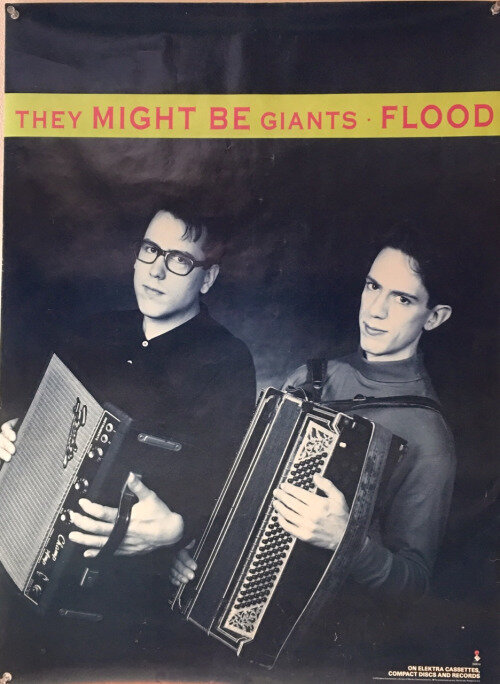
Flooded With Memories: “Flood” By They Might Be Giants Celebrates Thirty Years

Brooklyn’s ‘Ambassadors of Love’ celebrate 30 years of Flood

Scene: the deli counter at a small grocery store in Central Pennsylvania. I am seventeen and bored with the radio selection: nothing but dad rock and morose country for the next four hours. My boss is out for the day, so I sneakily switch to the college alternative station, the one that plays stuff I like.

I’m slicing tomatoes for hoagies when a bizarre tune comes on, a nasal voice with an accordion. What on earth is a Particle Man? I laugh at the renegade Amish teens wandering through the store, also listening to this mad song. One stops at the counter and says shyly in her Pennsylvania Dutch accent, “I like this music.”

I crane my neck, trying to hear the DJ say who this weird band was. Something Giants. Damn. The band’s identity was gonna take some FBI-level investigation, because there was no way I’d be allowed to call the radio station long distance. In the days before internet, any musical exposure 90s teens in my town had was introduced by radio, bootleg cassettes from cool older siblings who’d escaped, or word of mouth. Then you’d have to make a 40-mile journey to Sam Goody at the mall, or a mail-order catalogue, if you were hip to the lists.

Maybe next time, I sigh, as the boss returns. I switch the radio back to dad rock.

A few days later, a classmate, my MORTAL ENEMY, starts singing Particle Man in English class. I whirl around.

“Justin. TELL ME PLEASE! What band is that?” I grovel in adolescent histrionics, near ready to slam my fist upon his graffiti-ed desk, like Sam Spade, or Columbo.

They Might Be Giants,” he replies, slowly nodding. From that day forward, we call a silent truce in our cold war. Real ones know, as they say. The next mall excursion involves buying the coveted cassette of Flood with that hoagie-assemblage cash and indoctrinating my younger sister.

From there, I succumbed to the obsession most teen girls ascribe to musical heroes, but as most of my peers wallowed in Pearl Jam or angrily screeched along to Alanis, I latched onto …the Johns. John Linnell, with the accordion and mane of hair. John Flansburgh, with the black glasses and Fred Rogers cardigans. Sure, they were adorable, but they understood what it felt like to be a specific kind of misfit loner; the kind of kid who builds a time machine on the road less travelled. They wrote songs about James Knox Polk (which Justin and I sang to our amused history teacher), making wax recordings at the Edison Museum, and waxing poetic from the perspective of a canary-shaped nightlight. Whoever they were, they were my kind of fun.

I went to the local library to log onto the internet, patiently waiting twenty minutes for a photo to download and print to hang up in my locker. The only media mention I could find of TMBG was something in an old issue of Sassy. Suffice to say, the enigmatic lyrics of the band were catnip to my cerebral little soul, a strange secret until I started college. I’d comb over their poetry, writing ridiculously detailed lyric analyses for English 100. My instructor coolly mentioned she once worked with the wife of one of the Johns. Did she know at the time she was in the presence of ROYALTY? I wondered.

John Linnell by Alice Teeple, 2001

Then, sophomore year, I finally found my clan. One day in drawing class I noticed this guy Sean doodling the Johns on a notebook. I was delighted to have someone else to talk to about They Might Be Giants and we became friends. Later that semester, TMBG announced an appearance at a neighboring university, and we decided to go. This decision changed my life.

A whole gaggle of Sean’s friends joined us. One fellow attendee, Stef, ended up becoming my first housemate, and we later paid tribute to TMBG with a zine called Exquisite Dead Guy. I switched majors to Integrative Arts so I could direct my own music videos. Sean did an amazing cel animation for Minimum Wage off Flood, which set him off on an exciting new path in his career.

John Flansburgh by Alice Teeple, 2001

They Might Be Giants’ 2001 show in Pittsburgh was the first concert I ever photographed. They inspired me to create videos, strange illustrations, and experimental sound recordings. I even purchased an accordion on eBay, patiently teaching myself Particle Man and Bauhaus’s Bela Lugosi’s Dead. God, I wanted to be as cool as John Linnell.

Since officially forming in 1982, They Might Be Giants has spawned generations of fans through their unique artistic expression and a drive to experiment. No one else sounds like them. Originally native sons of Massachusetts, They Might Be Giants are a product of a faded, grittier New York City. Their classic videos now serve as time capsules for the ’64 World’s Fair Pavilion in Corona Park, the Chelsea Piers, and Bethesda Fountain in Central Park, but the band remains constantly innovative. They embraced the internet quickly, and their passionate cult following helped boost their popularity by the end of the 1990s. The power of crowdsourcing reared its head for the first time in 1998 when TMBG fans hijacked an early online poll by People Magazine, voting John Linnell as #9 in “The Most Beautiful People.” (He was beaten by Madonna and Hank, The Angry Drunken Dwarf.)

“It has been suggested that the internet might be a good way to vote for our elected officials,” Linnell responded in an op-ed piece for The New York Times. “If my experience is any guide, though, it appears there are still a few bugs to be worked out before you’ll be able to elect the next President while sitting at home in your underwear, unless you want Shecky Greene running the country.”

By the 2000s, They Might Be Giants finally hit its stride in the mainstream, and found a new lease on their longevity as the duo scored music for cartoons and television. Their child-friendly ditties suddenly became the soundtrack for the babies of alternative Gen X.

The Johns still regularly crank out new music and tour, selling out venues. Their upcoming show at Bowery Ballroom is already sold out, but they’re still a regular fixture in the Big Apple and beyond. The band agrees that the gateway to their music tends to be their seminal album, Flood – an apt name for the tsunami of fans it generated.

And Sean from art class? He ended up directing a couple of darling animated music videos years later for They Might Be Giants. Never say you can’t live your youthful dreams, friends. Especially with such great artistic mentors.

Thank you for thirty years of Flood, They Might Be Giants. May your “2040 World Tour” shirts come true.

SEE MORE:

The Brilliance Shines Brightly At Rockwood Hall

Mysterious Faux Food Cart Appears in Astoria

D’Angelico Guitars To Release New Products For 2020

Album of the Year: Civilian by Frank Tovey

Clan of Xymox Materializes At Le Poisson Rouge

Blake Charleton Keeps It Fresh

Categories
Business Featured Music Technology

Really Busy People: Jamie Lincoln Kitman

Photo by Joe Vaughn
Photo by Joe Vaughn

For three decades, Jamie Lincoln Kitman has been the President of The Hornblow Group USA, an artist management company currently based in Nyack. He has guided the careers of multiple artists that have won Grammys and sold millions of albums. Clients past and present include They Might Be Giants, OK Go, Violent Femmes, Meat Puppets, Yo La Tengo, The La’s, Freedy Johnston, and Mike Doughty. On the up-and-coming end, Hornblow now guides the innovative trio Moon Hooch, singer/songwriter Vandaveer, and Luaka Bop artist Delicate Steve.

Yet the music world isn’t the only field Jamie has succeeded in, as he is a well-respected writer within the automotive world. He is the winner of both the National Magazine Award for commentary and the IRE Medal for investigative magazine reporting. His writing has been featured in GQ, The Nation, Top Gear, Private Eye, The New York Times, and England’s CAR. He has written blogs for Yahoo! and NPR’s Car Talk. He also happens to be the New York bureau chief of Automobile Magazine and has a book in the works for Simon & Schuster.

I had the pleasure of working under Jamie at The Hornblow Group for a few years and was constantly in awe of the guy’s productivity. Beyond the aforementioned managerial and creative projects, he also happens to be an attorney, the father of three children and the, well, father of several dozen well-maintained cars. For kicks, he also managed to launch a record label in recent years, Hornblow Recordings; the label notably released a children’s album by Ozomatli in 2012.

When I asked Pete Smolin — Hornblow’s long-time Director of Operations — what it’s like working with Jamie, he answered: “Working with Jamie for 13 years has been an education unto itself. I’ve learned an immense amount of things from him over that time, not just about the music business, but about cars, the [Pittsburgh] Pirates, politics, and the entrepreneurial spirit. Jamie is one of the smartest and most interesting people I know and I am grateful to have the opportunity to work so closely with him.”

I had the pleasure of catching up with Jamie for a “Really Busy People” Q&A for Downtown, and his responses did not disappoint one bit. He was honest and direct yet full of relevant anecdotes and smart references. Jamie Lincoln Kitman can be followed on Twitter as @JamieKitman, while The Hornblow Group USA is live at www.hornblowgroup.com.

Photo by Milo Kitman

You’re a lawyer, have managed rock bands for almost 30 years, are an internationally renowned journalist, have a serious car collection, run a record label, and have done some real estate investing. When someone asks you what you do for a living, what do you usually say?

Jamie Lincoln Kitman: That my personality development was arrested at the age of 12. Cars and rock, what was really interesting me in early adolescence, seem to have directed my professional life. It embarrasses for its lack of seriousness, but a lot of people tell me they wish they had my job, which is probably true. I think this is because a lot of people don’t like their job, and frivolous or not, I generally enjoy mine.

In juggling so many unrelated — or so it seems — careers, what is the biggest challenge?

JLK: Time — more accurately, lack of time. Though I ought to know better, after all these years, I am starting to suspect that I must like juggling. I respond to deadlines and enjoy landing the planes. I just wish I had about 10 more IQ points.

Is there a tool or app you rely on most in order to keep all of your gigs going? Or a time management technique you rely on?

JLK: I don’t make to-do lists. I have a pretty good memory for the dumb stuff I gotta do. But my friend Bo Orloff hipped me to the BusyCal app, an aftermarket refinement of the basic iCal. Having it on all my devices has increased chances of my remembering that meeting we were having downtown at 5:00 PM. Google Maps and the Waze traffic program have helped on the transportation and endless logistics of life.

Was it always your plan to be diversified with your career? Or is that something that happened organically?

JLK: I think I probably first thought I wanted to write about cars from the age of 14, though I didn’t expect it would necessarily happen. Managing bands first crossed my mind when I was taking a class in my alternative high school about the music business with my then next door neighbor Tom Werman. He’d go on to produce the second through fourth Cheap Trick albums, as well as Ted Nugent’s seminal Cat Scratch Fever, all of which did so well that he had to move to L.A., where he soon became “Mr. 80s Hair Metal” — Motley Crue, Poison, L.A. Guns…

He took me to see Queen’s first New York performance at The Bottom Line in the Village when I was a freshman in college and at the table next to us, George Harrison was there — who we met — but it was Neil Innes of the already-defunct Bonzo Dog Band who I wanted to talk to. We arranged an interview at his rental apartment at West 72nd Street, but my cassette recorder didn’t record, so our conversation was lost to history.

Anyway, I believe it was from Tom Werman that I had the realization that you could make a living in the music business. And while I wanted to write, one take-away from a childhood as the son of a freelance writer — and later newspaper columnist — was that every extra dollar meant more hard work for you, whereas other types of professions, I imagined, might compensate you differently.

https://www.youtube.com/watch?v=TxmcqcRLn0k

After everything fell into place in terms of having clients and steady work, has there been a person who you modeled your career path after? Or a person you look at now that inspires you to keep doing what you do?

JLK: I really didn’t know any other managers before I started, and while I can say I’ve met a few incredibly brilliant, resourceful and kind-hearted managers through the years, in general I feel about them like I feel about my fellow lawyers — I yield to no man in my distaste. To be honest, I was probably inspired at first by the need to pay the rent, and later employees and of course myself, so as to support my children, a house and a burgeoning car collection.

But the starting point for my management career was the unshakeable belief that the world wouldn’t be a better place until as many people as possible knew about They Might Be Giants. Organizing disobedient political activity was a hobby of mine in high school and college. But I quickly learned that unlike the political issues then current on campus — apartheid and racism generally, nuclear power, militarism, world hunger — unlike those, people really cared about rock music. Which makes the organizer’s job so much easier.

I work and have worked with a lot of great bands, and I have to say the most successful are the ones that work the hardest. OK Go worked at an unbelievable clip, They Might Be Giants and Mike Doughty the same, year after year after years, and Moon Hooch work so hard it is mathematically-impossible. But if I had to name a person who inspired me first and longest, it would be TMBG’s John Flansburgh. His work ethic is extreme yet highly-admirable, if possibly toxic to lesser men and women, but what I love the most is his resilience. His partner in TMBG, John Linnell, whom I love dearly, is obviously a very motivated genius as well.

You don’t get to have a career, and especially in the music business, if you’re not ready to bounce back from getting kicked in the face really hard on a fairly-regular basis. You need a thick skin and a bedrock belief in the righteousness of your cause — i.e. you — that borders on the monomaniacal. In that regards, John reminds me of my dad, whose staying power and ability to get going when the going got tough through a long career as a writer, was also inspirational.

Do you have an accomplishment you’re most proud of within your music business career?

JLK: Still in business, after 30 years, with my first band, They Might Be Giants, as well as accomplished masters like Mike Doughty and Mark Heidinger of Vandaveer, and some great new bands like Delicate Steve and Moon Hooch.

Moon Hooch
Moon Hooch

Knowing what you know now, is there a skill or trait most necessary for a person to sustain a long-term career within music or entertainment?

JLK: If you’re talking about managing artists, an ability to identify music that other people will relate to is pretty key. As a manager, you’re as good as your bands, and if your band sucks — or no one cares — you have a five-alarm problem. Managers who stick around a long time tend to be associated with an artist who sticks around.

For musicians, it’s about having music other people like so much they want to tell other people about it, but it’s also as above — you need a thick skin, hyperactive work ethic, and a touch of megalomania. That core belief that unless tens of thousands of booties around the world are shaking to your music, something is seriously amiss. If there’s nobody in your band who feels that way, to the core of their being, if it’s not the central trait of at least one person’s character and personality in your camp, it’s probably not happening for you guys. Drive is so important, it’s why talent is on the list of what you need to succeed, but not necessarily at the top of it.

The majority of American music business executives tend to be based in New York City or Los Angeles, yet you are largely based in Nyack. How have you managed to do what you do outside of a major city for so long?

JLK: I am in the city all the time. Being a professional car tester affords me lots of fine new automobiles to test out on the drives in and out of New York City, with someone to pay for the parking.

Is there a field or profession you haven’t worked in or around which you one day hope to?

JLK: Well, I’m writing a book for Simon & Schuster on the history of lead in gasoline, so publishing would be one.

Any upcoming projects or events you wish plug? Anything coming up that you’re particularly proud of?

JLK: The great rock critic Michael Azerrad and I have put together a film treatment for a teen party comedy based on the life of my old clients, Meat Puppets. It’s kind of great.

When you’re not working, what do you like to do with yourself?

JLK: Cooking, light vegetable gardening, bicycling, hanging out with friends and family. I also spend a lot of time fixing broken cars. But I don’t like that.

Finally, Jamie, any last words for the kids?

JLK: To paraphrase The Jefferson Airplane, you’re only as shitty as you feel.