Categories
Art Culture Featured Miami

Domingo Zapata: Artist & Humanitarian

By R. Couri Hay


Young Artists / Old School

Artist Domingo Zapata was honored at the Brooklyn Borough President’s Latino Heritage Celebration where he received the Most Influential Artist of The Year Award. The theme of the event is Young Artists/Old School and Domingo gave the keynote speech. Zapata has also created the illustrations for The Lonely Princess by Marie Ferraro from Lightswitch Learning, which comes out in time for the holidays in November. The book is about the power of friendship, generosity, and respect for the differences between people. 

“Life is a Dream”

Domingo’s 15-story mural that wraps around the One Times Square. Features his mantra, “Life is a Dream” amidst flowers, flamingos and polo ponies. The artist said, “For me, it is an honor to be part of the story by creating Life Is a Dream, the largest mural in New York. I want to convey this message to people from all over the world who visit Times Square and who can enjoy and get to know my art.” The mural will be on view through January 1st.

‘Life is A Dream’ in Times Square

Success, Contrast & the Future of Patronage

Zapata’s early impressions as an artist, coupled with several high-profile clients, first cultivated a reputation as an artist du jour. But after 15 years and creating a portfolio of art worth over $40 million, the Spaniard’s ever-increasing success – and the artistic vision underlying it – continues to paint a decidedly different picture.

For years, Domingo Zapata has been, in a word, busy

It’s not just the paintings, which for the last decade have required perpetual work to keep any amount of inventory. It’s not the increasing number of sculpture and mural commissions that he fulfills or the expanding social media input. Nor is it his many exhibitions or the myriad number of collectors and clients, including Johnny Depp, Leonardo DiCaprio, Diana Picasso, the Missoni Family, and investment bank Goldman Sachs.

Instead, it’s what Zapata has been doing with his own time. Whether it be collaborations with global figures such as Alejandro Sanz, designing clothes for his fashion shows, donating artwork to innumerable charity events, writing a novel, painting with Pope Francis, or serving as a guest speaker at the United Nations to advocate for art education, Zapata has done it all. 

Pope Picture

The resulting image is in stark contrast to the one that Zapata’s earliest critics predicted – that of an “artist to the stars.” But Zapata’s outlook and ascent have been remarkably consistent for the past fifteen years – the duration of his career as an artist – and the predilections of the past have been unraveled year by year, painting by painting, achievement by achievement. 

As the artist himself notes, his works “contrast between the past and present, and try to make the work say something about the future.” It’s fitting, then, that Zapata himself is one such contrast, in art as in life; and with a past not steeped in fine art, but rather, in humble beginnings on the Spanish island of Mallorca.

Zapata’s Early Years

Had Zapata ambled up to a younger version of himself on Mallorca in the early 1980s, he would have likely found himself back in the garage his father worked in. And even then, it would not have been surprising to see him with paintbrush in hand. “I always loved to paint,” Zapata notes. “It’s something I was obsessed with since I was a kid. We had a car shop, and my dad fixed and painted cars, and my mom was a painter. We lived on top of the shop, so every day I lived with the paint and the fumes. The environment I grew up in was one with a creative family.”

But when it came to painting full-time, Zapata – who graduated from American University with a degree in political science – was at first more pragmatic, especially after his move to New York City in 1999, where the art scene was particularly intimidating. “Moving to New York, I never thought I had a chance. I came from this humble background, and I didn’t even know where to start. I took the first job that was available, to survive, and in those days, the jobs were in finance.”

For the next ten years, he worked in corporate, painting in his home when he could. That is, until one day in 2005, when a friend, contractor Michael Borrico, took an interest in a picture of a polo horse that Zapata had painted and placed in his office.

Blue Polo Horse

“This friend of mine came by our office and he said, ‘Oh, I love that painting, I’d love to show it to a friend of mine,’ Zapata recollects. “It was a painting of a polo horse. And I said to him ‘I did it.’ And he’s like, ‘I can’t believe you did that!’ And I said, ‘Look, I have a studio in my house; it’s a hobby. I do this.’”

Convinced he had found talent, Borrico organized a dinner and exhibition at his house, where Zapata’s work gained its first critical recognition. Various gallery representatives bought paintings, and the friend that Borrico had mentioned so casually in the office turned out to be none other than billionaire George Soros, who made a purchase of a polo painting titled “Blue Horse.” 

The feedback was overwhelmingly positive. “They all motivated me to dedicate myself to art,” Zapata said. “I quit my job and started painting. I was working in the corporate world for more than ten years, leaving a job where you were making some money. But I thought, if I don’t do it now, in my early thirties, when am I going to do it? So I went and I said, ‘fuck it, I’m going to go ahead and do it.’ And thank God it worked!”

Asked if this strange road to the beginning of his artistic career had an impact on his eventual style, Zapata answered in the affirmative. “That’s where my unconventional way of doing things came from. When I wanted to go to college, everybody said no, when I was in college, everybody said no, when I wanted to get a job, everybody said no, and when I wanted to be an artist everybody said no. So I said, you know what, I’m just going to do things my way, and nobody’s going to say no to me.”

Domingo Zapata
Superman by Domingo Zapata

2011 : Artist to Watch

He never looked back. Zapata began painting incessantly, creating works for events, commissions, and “pop-up shows:” sponsored, transitory exhibitions. In 2011, he was named Whitewall Magazine’s “Artist to Watch,” slowly cultivating a clientele ranging from typical collectors to celebrity purchasers. Small events eventually transitioned into larger gatherings, and over the years the guests at such shows ballooned into the thousands. 

As Zapata’s clientele grew, so did his opportunities. He began holding exhibits throughout the world, including appearances in Paris, Miami, Los Angeles, New York, Venice, Rome, Singapore, and Monte Carlo. From these gatherings, he generated continued interest in his work and began receiving regular commissions. Celebrity clients whom he had met along the way also continued to buy, including Johnny Depp and Leonardo DiCaprio. Such efforts bore fruit: in 2005, his paintings sold for $5,000; in 2011, $30,000; in 2015, $40,000 to $50,000. Now, in 2019, Zapata’s smaller work sells for $60,000 to $70,000, with his larger gallery pieces and sculptures regularly selling for well over $100,000 a piece. And perhaps more impressively, he has no inventory of artwork, as his works and commissions have sold out completely for the last ten years. 

Artistry: Style and Substance

Given the excitement surrounding Zapata’s artistry, one would expect the works themselves to be similarly exciting; and by no means do they disappoint. Falling roughly within the confines of neo-expressionism and pop art, Zapata’s works utilize bold use of color and exploration of themes such as sexuality, power, and opulence. But more than anything, his work is defined by contrast. Within a single showing, one might see the Mona Lisa bedecked somehow magnificently with graffiti, mixed media, and a platoon of primary colors; a pop art panda sporting backgrounds with neon geometry or sinister scenes emulating crucifixion; a garden with beautifully ornate flowers and growth breaking free of rigid outlines; bullfighter jackets, or chaquetillas, generously marked with color and text; or something as commonplace as an airplane vividly portrayed from the front, a cruel line and three blurred propellers screaming against the hues and text they appear to be suspended in. 

“I like to work in different themes,” Zapata muses, “for things that I am passionate about. And then I like to use different techniques on those themes, according to the theme. However, the strokes are always the same…so when you see my work, you will see and recognize it’s mine, it’s Domingo Zapata, because of my colors, the strokes, and messages, and the type of combination and conversation of colors.”

Zapata’s attention to such contrast is the cornerstone of many of his themes, both in how he views art and how he views reality. It can be seen in virtually every series he creates, whether it be the juxtaposition of Polaroid and acrylic in his ‘Ten’ series, for which Sofia Vergara and others have sat, or the larger-than life figures in his superhero paintings as they sit among graffiti. This, he states, is no different than how we might see it in real life. “The world we live in is about contrast,” he says emphatically. “In New York City, you can live in a twenty-million-dollar penthouse, you go downstairs, and there’s somebody sleeping in your door. These contrasts have an influence on me, because I am a contrast. I was born in a very humble family that was making an average of $800 per month for their entire lives, and I can make a painting worth more than $100,000.”

It is for such reasons, Zapata notes, that he cares so much about emulating contrast in his own style, although his background and later immigration to the United States have also heavily affected his creative process. “As a Spaniard loving art, I was brought up understanding – or,” he corrects himself, “learning, better than understanding – about Velasquez and Goya and Picasso and Dali…and then I moved to New York and had a huge influence from the pop culture of the 80s that was just kind of turning into the beginning of the 90s. So I had the end of that movement with Warhol and Basquiat. It created this passion for contrast, where I would try to take the master’s work and make it contemporary using contemporary techniques.”

When asked about how he wants his artistic style to impact others, Zapata was quick to answer:

“Everything’s possible, that dreams are possible, that if you go and work very hard you can achieve whatever you want in this life, no matter who you are or where you come from. That’s what I portray in my work. And it’s always positive and it’s always trying to make you feel good. I always say I don’t know anything, really, about business or about politics, you know, but I do know how to make this world more beautiful. Other people can make it better; I’m just going to make it beautiful if I can.

“I try to use my work to influence those people in a positive way, to make them feel good. And if they have it in their house and they wake up in the morning and they’re going through any struggles, or whatever – if they look at my painting and it makes them feel better to go to work, and to make the world better – then I’m doing my job. And that’s what I do, that’s my motif, that’s my style.”

Domingo Zapata
Letters to Panda, Acrylic on Canvas by Domingo Zapata

Patronage, the Gallery Model, & Social Media

Zapata’s unorthodox style also extends to social media. While many artists remain firmly in the gallery model, Zapata has decided to create inroads into social media sites such as Instagram, where he currently has close to 40,000 followers – and through which he has occasionally sold paintings to collectors. “I don’t have anything against galleries or the gallery model,” he said, laughing. “It’s a misinterpretation; if you Google it, you could find a Zapata at maybe sixty shows.” 

But the artist is adamant that the future lies in the past; or in the case of the art world, patronage. Pointing at the large overhead that many galleries and their artists have to deal with – whether it be from rent, staff size, shipping costs, and the like – Zapata notes that social media is providing a conduit between artists and collectors that simply didn’t exist a decade ago. “In today’s world, with social media being such a big influence, bigger than regular media, everybody looks at Instagram, Twitter, Facebook,” he says. “Now, you have all these sites which bring the collector and painter together, so they can start their own relationship. And that’s where we’re going. I don’t think these platforms are a condition-based model; they’re a service model, where they’re introducing you to the variety; they put you right in front of the source. That’s how it was done a hundred years ago, and that’s how it’s going to be for the next hundred years.”

This, he agues, is a return to patronage; social media and website users can browse through the work of a number of artists, find an artist that suits them, and meet them in person. Instead of going through a gallery, where paintings are normally viewed, the role is being taken by social media sites and more polished, art-specific services. And this, in turn, helps to bring exposure to artists who otherwise might have trouble wending their way trough the gallery model. “I think it’s amazing,” he says. “It gives an opportunity to those thousands of artists to have a chance, even if they are totally unknown. Talent prevails.”

To that end, Zapata expects that artists large and small will eventually shift to a form of digitally enhanced patronage, and he has every intention of being on the cutting edge. Pointing to artists like Picasso and Michelangelo, who both benefited immensely from traditional patronage, he also discusses how art, a much older institution than art galleries, thrived under that system. “The art world is forty thousand years of history, since the cavemen dipped their hands in blood and printed them on the cave to state ‘I exist, I am here.’ That’s the beginning of art, the beginning of the international language that everyone can understand.” While a far cry from that age, social media, he says, is once again making the language of art accessible, both for collectors and artists alike.

Sky Polo by Domingo Zapato

Philanthropy

Zapata’s desire for accessibility in art is the focal point, as it turns out, when it comes to philanthropy. In the name of practical application, he supports innumerable charitable organizations, including routinely creating or auctioning off his own works for charitable foundations for hurricane relief, funding art programs for children with impoverished backgrounds, participating in New York Fashion week for charity, and raising awareness for art education. 

Even in New York, where the art scene is alive and well, Zapata notes that 80% of public schools do not have an art program anymore, despite higher rates in previous years. “I believe that if we forget art in education, then we will be raising children without sensitivity, and those will not be children; they will be soldiers,” he says. 

To counter this issue, Zapata has been heavily involved with Pope Francis, whom he has visited, painted with, and more recently, been appointed an ambassador to the Scholas Occurentes program. As an ambassador, Zapata will meet with the pope twice a year and discusses how to further benefit the program, which unites low-income schools together to improve resource generation and increase the quality of education for its students. As an ambassador, Zapata was also able to attend a panel at the United Nations and speak about the importance of art and education at the recent Latin American summit. 

Zapata’s motivations, however numerous, come down to a simple goal, however. “To me, right now, I just want to be able to express to as many people as possible everything that speaks to my heart; to be able to use my position, and that place of influence, to do murals and sculptures which are public, for people to enjoy; and to use it to raise funds for charities and causes that I believe are important; and also grow as an artist. I’m already in the system, where I can pretty much say I’ll be doing this for the rest of my life; God forbid that something fucked up happens; but I am one of those who have that opportunity, which have been given so much. It’s my time to also give back, and at the same time, grow as an artist, and keep expressing myself. I don’t know how or what is next, but I know that I will fight like the first day to keep delivering feelings and a positive energy to anyone that is aiming to take them from me.”

Looking Forward

But fifteen years is, Zapata hopes, just scratching the surface; and though forever occupied by exhibits, painting, and his own activities, he never wants to be complacent. Indicating a distaste for being labeled, he takes inspiration from artists like Pablo Picasso, whose style changed dramatically throughout his life. “I don’t want to be stuck with description,” Zapata says decidedly. “I just want to be able to do. You have artists like Picasso who have proven themselves extraordinary through different styles and different themes throughout their entire life and career. So if you look at Picasso when he was twenty, it has nothing to do with him when he was fifty, or when he was seventy. And I think that is an example to follow. I cannot be doing the same thing…I want to work in different themes and different styles my entire career, so that I’m influenced by every moment I’m alive.”

Part of accomplishing that, Zapata says, is continuing to do what he does best. “I’m not an artist to the stars, I’m a painter,” he says simply. “I have the opportunity to paint people who are extraordinary; obviously, with some, I am going to develop synergy or friendships with them. One of the most beautiful things about this work is that I get to know people, and I’m happy to have that opportunity.” 

Spring Red Flowers Acrylic on Canvas by Domingo Zapata

And that opportunity, it seems, has enabled him to use his artistry to positively impact all that he meets – whether it’s a client personally visiting his studio, an aspiring artist who sees his work on social media, or a beneficiary of his philanthropy. Such interaction, he says, is what keeps him truly inspired.

“I believe in this world,” Zapata finally says, taking in the last breath of the interview. “My clients are celebrities, and billionaires, and collectors; but they are also children in need, and charities, and everybody who walks through Brooklyn and sees my mural. This is my collector base. This is my job.” ​

Categories
Business Featured Fitness Health

Manhattan’s Most Exclusive Gym Invades Times Square

Kirk Myers and Rhys Athayde watch the Dogpound billboard in Times Square. Photo by Jade Gomez.

Dogpound NYC employees were greeted with a treat last night: a Times Square billboard showing gym and employee highlights and flashing the Dogpound logo. Trainers watched as their faces flickered 50 feet in the air, running, lifting, and posing in Dogpound attire. They let out a cheer, echoing over the sounds of the square where many had stopped to watch. It was the first of its kind for the fledgling fitness empire, and a dizzyingly tall “thank you” to their staff.

The Dogpound was already a global phenomenon when the billboard went up. In four years, owner Kirk Myers has grown the gym into a global brand, training all over the world with celebrity clientele. They opened their second permanent location in Los Angeles only a few months ago. The Dogpound’s NYC gym–where the franchise began–is a host to more than 50 trainers, masseuses, and other employees.

Amongst the employees and other guests was celebrity/Dogpound member/investor Oliver Trevena. “It was so amazing to be a part of such a monumental moment for an incredibly inspiring brand,” he told Downtown, “To witness the team’s reaction and the energy surrounding it was unforgettable & so excited to be an investor and part of the DP family!”

Dogpound
The crew gathers before their adventure. Photo by Jade Gomez.

The trip was organized with the help of Downtown Magazine’s CEO Grace A. Capobianco. She and Myers have known each other since the magazine’s launch. Myers is Capobianco’s personal trainer as well as Downtown’s fitness editor for several years prior to the launch of the Dogpound. Capobianco said that we are extremely excited to announce that “Dogpound by Kirk Myers Fitness” will once again be heading up our print and digital fitness pages starting with the Fall 2019 issue.

At 5:45 pm, the Dogpound staff gathered outside the gym. They crowded a coach bus, laughing and chanting. Only the management and select Downtown Magazine staff knew where they were headed or why. 

30 minutes later they disembarked outside of Times Square. They were met with one of the Square’s most prominent residents, the Times Square Naked Cowboy. The stripped singer serenaded the team, turning his back to reveal a pair of Dogpound underwear worn for the occasion. The cowboy led his posse through Times Square, stopping in the center for pictures, chants, and more quiet speculation on the trip’s purpose. 

A musical eruption interrupted the affair as a dozen Dogpound-clad dancers burst into motion, clearing a space for a spontaneous dance number. The Dogpound crowd, which had grown with late arrivals and guests, was now surrounded by a sea of onlookers who stopped to snapshots of the scene. At 6:59 and 55 seconds, the music dropped and the dancers froze, their fingers pointed up at a screen towering 100 ft above the square.

The screen went black and flooded with words in Dogpound brand black and white. Disbelief evaporated as trainers saw their faces on the screen–running, lifting, biking, laughing. They pointed and called out to each other. They chanted and cheered. The energy was electric. 

“Having been born and raised in NYC by immigrant parents, Times Square is the world’s greatest stage,” says Rhys Athayde, The Dogpound’s Chief Experience Officer, “All I wanted to do was share the news with everyone. For our DP family, it was worth the wait to see the looks of shock, awe, accomplishment, and pride when we took over the heart of NYC.”

The billboard was only up for 20 minutes, but the staff sees it as a sign of more to come. As The Dogpound expands, it has its eyes on the world. For 20 minutes in the center of the world, that world had an eye on them.

Categories
Culture Design Events Featured

Times Square Hosts a 60-Foot-Long Yacht During NYCxDesign

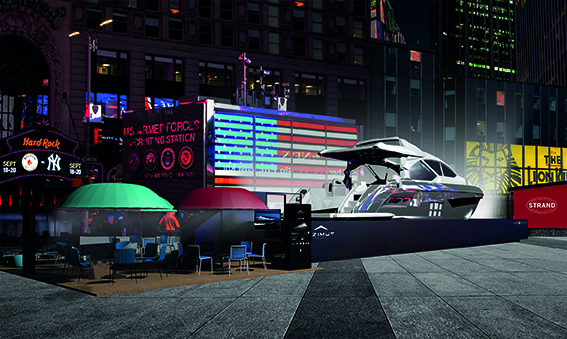
A cutting-edge megayacht manufacturing group is celebrating its 50th anniversary this year by installing a 60 foot long yacht in the heart of Times Square. Designed by Stefano Righini and Francesco Guida for Azimut Yachts, the Azimut S6 model reflects the company’s strong commitment toward disruptive design and technological innovation in the yachting industry.

Azimut Yachts in Times Square during NYCxDesign Design Pavilion.

Downtown: Tell us about Azimut Yachts! What do you do and offer?

Giovanna Vitelli, VP of Azimut Benetti Group: Azimut Benetti Group is the world’s leading builder of motor yachts. Established in 1969 by my father, Paolo Vitelli, the Group is present in 70 countries, bringing together the successful brands Azimut Yachts and Benetti Yachts, each of which serves a different market segment. The Group offers a huge range of motor yachts, with more than 45 models in production, from the smallest Sport Cruiser in the Azimut Atlantis Collection at 34 feet to Benetti’s superyachts spanning more than 328 feet.

Downtown: A little birdie told us about a mega-installation you are planning in the heart of Times Square. What can visitors expect to see and through what dates?

GV: Visitors can expect to see an award-winning Azimut yacht on display in the Times Square Plaza from May 13-22, 2019. The event is in partnership with Design Pavilion during NYCxDESIGN, the city’s annual public celebration of design. For our 50th Anniversary celebration, Azimut Benetti Group partnered with Design Pavilion to emphasize the company’s strong commitment toward disruptive design and technological innovation in the yachting industry.

Downtown: How are you planning on installing it and where exactly will it be located?

GV: The yacht will be coming in two parts and will be assembled onsite overnight. It will be in the heart of Times Square at Times Square Plaza between 43rd & 44th Streets.

Downtown: Will the public be able to tour it or just gape at a 60-foot-long yacht sitting in the middle of Times Square?

GV: On-site activations will include public education activities in partnership with One Ocean Foundation and a public announcement of the Azimut Benetti Group’s Can You See/Sea The Future, a student design competition organized with Arts Thread. Representatives of Azimut Benetti Group will also take part in Design Pavilion’s Design Talk Series, appearing at the Impact Design Summit on May 13, 2019 to address innovations in sustainability. They will also host a discussion led by New York Magazine’s Wendy Goodman focused on art & design in luxury lifestyle on May 14, 2019. These programs are free and open to the public. Registration is required. For anyone interested, please register through Design Pavilion’s website here.

Downtown: What brought about this idea and how did you manage to put this plan into action

GV: The installation aligns with a broader brand initiative deeply connected to the DNA of the company, which has always been about breaking the “traditional” rules, introducing surprising elements to the nautical world and disrupting the accepted order of things.

A yacht outside its usual context, sitting in the iconic Times Square, is definitely not your normal situation. This alters your perception of what is “normal” and what is possible –this is what we want to convey. It’s a symbolic representation of how we work and of our innovative spirit in the design and technology which distinguish our projects.

We did a similar installation outside of the Triennale de Milano during Salone del Mobile in 2018, but for our 50th Anniversary we wanted to celebrate here in New York because the US Market has been crucial to our success.

Downtown: What are some of the coolest design elements your yachts sport?

GV: Today we are in the midst of a renewed dialogue between exterior and interior spaces where the latter are becoming more and more “permeable” and are opening up towards the external environment. In 2000, we were the first to open up and “free” our cabins, removing the traditional small portholes and replacing them with lovely large windows. This wasn’t an easy change to make because it meant completely reexamining the structural aspect of the boat, but it has changed the industry.  

Our style code has become completely different from others. It is about contemporary, forward-thinking architectural design. It’s more than opulence. It’s about many small but exquisite details, rather than vast quantities of different materials. It’s about elegance and discretion rather than showy displays.

Lastly, and most importantly, as the world’s largest megayacht manufacturer, Azimut Benetti Group feels a responsibility to consistently challenge the industry to improve. From hull shape evolution to innovative propulsion and broad use of carbon fiber, Azimut Benetti Group is investing in more efficient technology for a lower consumption product.

Categories
Culture Events Featured Living

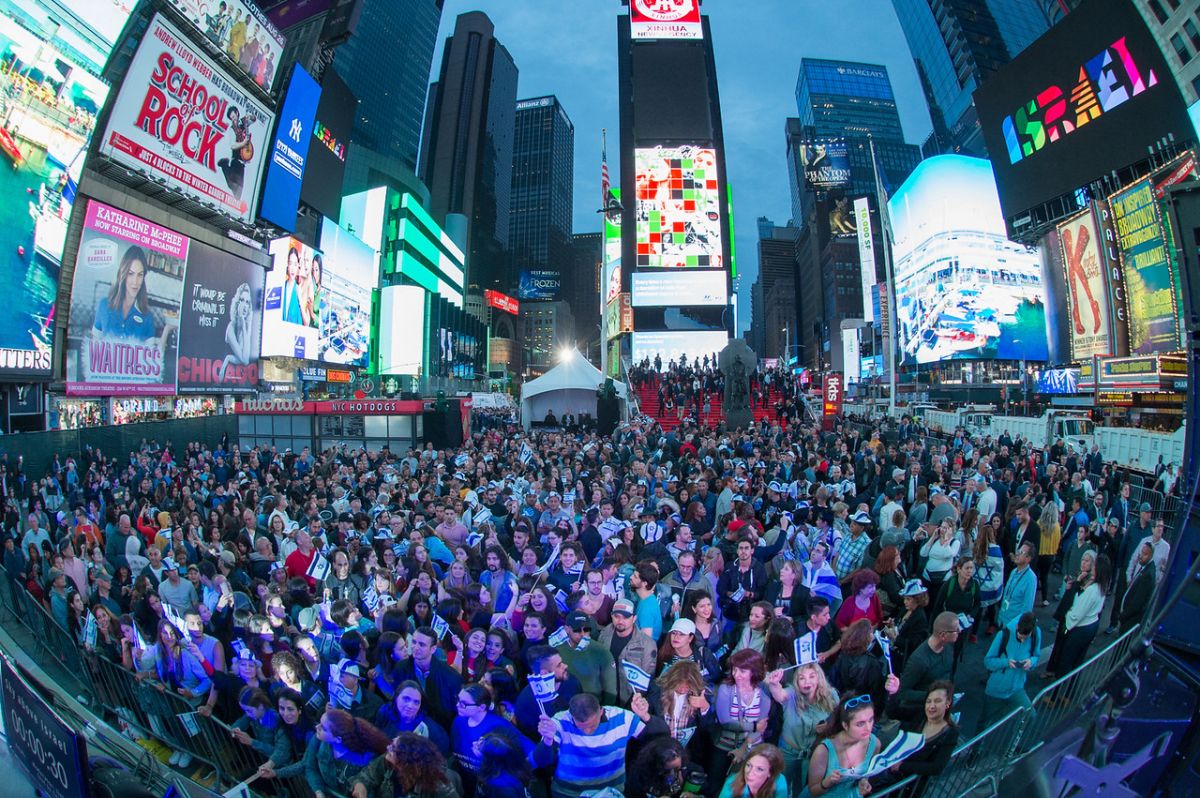
Thousands Party in Times Square for Israel’s 70th Birthday

Times Square rocked with thousands of partygoers on Sunday evening, as New Yorkers, Israelis, and tourists from around the world came together to celebrate Israel’s 70th anniversary.


Headed by Israel’s Ministry of Culture and Sport, and the Consulate General of Israel in New York, the enormous block party began at 8:00 pm with a countdown in the timeless style of New Year’s Eve parties in the square.


The beat dropped, and the party raged!

Performances by Israeli Broadway star Shiri Maimon and DJ Omri Anghel took control of the rest of the evening. Crowd favorites included hits by Omer Adam, Moshe Peretz, and Israel’s Eurovision champion Netta blasting out from the heart of the city.

Along with Maimon and Anghel on stage were Israel’s Minister for Culture and Sport Miri Regev; Israel’s Consul General to New York, Ambassador Dani Dayan; and MKs who had joined a delegation for to New York.

TIMES SQUARE CELEBRATES ISRAEL

Excitingly, Sunday night’s event marks the first time a foreign country has held a celebration in the iconic plaza. The atmosphere lived up to the best block parties Israel has to offer.

The famous screens surrounding the partygoers broadcasted spectacular images of Israel’s “History of Innovation” for much of the evening, sharing the Jewish state’s progress and prowess in science and technology. The screens also showed highlights of Israel’s stunning scenery and cultural and religious depth.

https://www.alexipix.com/Events/IsraelTimesSquare2018/AllTimesSquare/n-MhBLGp/i-rgK8fwQ/A

 Also, the crowd watched video welcomes from celebrities such as Michael Douglas and Mayim Bialik; political leaders including Senator Chuck Schumer, Governor Andrew Cuomo, and Mayor Bill de Blasio also wished the crowds “Mazal Tov”.

Preceding the party, a VIP reception was held in the Renaissance Hotel overlooking the square. Minister Regev and Ambassador Dayan hosted the evening. National anthems were performed by Gloria Gaynor and Shiri Maimon, who sang the Star-Spangled Banner and Hatikvah respectively.

SPECIAL QUOTES OF THE NIGHT

Minister for Culture and Sport, Miri Regev: “Tonight, we painted Times Square in blue and white. It was exciting to see thousands of Israelis, tourists, and locals dancing and singing Israeli music together. I would like to thank the American leadership and people for their unqualified support for the State of Israel. We have again demonstrated our strong relationship with the United States.”

Consul General of Israel in New York, Ambassador Dani Dayan: “Israel and the United States have the strongest partnership in the world, and tonight we marked it in an unprecedented way…. I am proud that we marked our country’s special birthday with so many close friends and supporters, coming from every walk of life here in New York.”

In attendance were elected officials, leaders of the Jewish community, and significant figures from the worlds of academics, business, and media.

SPECIAL GUESTS

Guests included: Congressman Jerry Nadler (D-NY), NY Assemblyman and Co-Chair of the Democratic National Committee Michael Blake, Manhattan Borough President Gale Brewer, Jewish Community Relations Council CEO Rabbi Michael Miller, and American Jewish Coalition CEO David Harris.

Categories
Business

Smartbulance’s Ralph Shulberg on phones, the MTA & more

Have you ever dropped your cell phone? Odds are that you have, and that drop led to its screen being cracked. Instead of feeling hopeless and clumsy, there is a wonderful alternative out there in the form of Smartbulance. Founded by Ralph Shulberg, Smartbulance is an economical and efficient repair service for smartphones. Customers are offered emergency repairs via pickup and drop-off as Smartbulance services all five New York City boroughs and neighboring Hudson County. And for those dropping off, Smartbulance also provides a bit of spectacle, as its team emphasizes its emergency concept by working out of an ambulance.

Ralph spoke to Downtown about what inspired him to start up the company, which is in the midst of tremendous growth. He opened up about Smartbulance’s new partnership with the MTA; the first kiosk under this collaboration launches in May. For more on all things Smartbulance, please visit www.smartbulance.com.

Before launching Smartbulance, you owned several Sprint stores. When did you first get a cell phone?

Ralph Shulberg: The answer to that question is quite ironic. I opened my first store in 1998 during my Junior year at St. John’s University while working on completing my undergrad degree. My mother had given me all her savings to get started with my first store. I didn’t get my first cell phone until four months after I opened because I was trying to keep costs down.

Out of curiosity, what kind of phone do you own? Or at least use regularly?

Ralph Shulberg: I currently use an iPhone 7. I have been using a 4.7-inch screen since the iPhone 6. The first reason for choosing that model is because of the size, it is extremely important to use the phone with one hand to accomplish a task quickly and move on. The second reason for that model is the operating software, iOS is user-friendly and stable. No wasting time trying to figure things out.


Ralph in action

How does Smartbulance different from the average retail location where someone can get their phone fixed?

Ralph Shulberg: From the consumer point of view — the average retail location:

1. Find a shop, be aware of their hours, and you should make sure that they have your item or part in stock before you go so you don’t waste a trip.
2. Once you have decided to use that shop you must travel to the shop by foot, train, or car. If by train you’re spending money and time to travel. If by car you still spend money and time but now you must look for parking and risk getting a parking ticket.
3. Once you get to the retail location you must give up your phone and either wait a minimum half hour, or if they are backed up you could wait up to three hours to get your phone back. If you don’t wait at the shop now you must leave WITHOUT A PHONE and come back later to pick it up. The entire process can take anywhere from an hour up to four hours of your day, a waste of time for consumer or small business.

Smartbulance offers several options for the consumer…

Curb Side Service
A state of the art Smartbulance repair truck and technician conveniently arrives at your location. Simply bring the unit or units down to the tech and they will perform the repair in the truck in 20 minutes or less per device. Loaner phone available. If you have a Smartbulance repair truck stationed near your office simply walk over and drop off your phone for repair.

Desk Side Service
In the event you cannot come out to a truck we offer desk side service. An experienced technician will come to your office, apartment, neighborhood coffee shop, middle earth, wherever and perform the repair or repairs in 20 minutes or less per device.

Automated Service
Smartbulance 24/7 is a fully automated self-service repair and recharge kiosk.  Located in Grand Central – 42nd street Station, in the “S” shuttle passage corridor. Drop off your broken smartphone, get a loaner and pick up a few hours later. Or pick up a portable battery pack charger, available for purchase or rental. We are planning to install these automated kiosks throughout the NYC Subway system and office building lobby’s.


Ralph in action

Does someone need to make an appointment? Or they can just walk up for a repair?

Ralph Shulberg: You can simply walk up to any Smartbulance repair truck and get your smartphone repaired quickly. You can also make an appointment on our website, www.smartbulance.com, and we show up within a two-hour time window that the customer chooses. We are currently servicing New York City’s five boroughs, and Hudson County New Jersey.

Where did the idea for the ambulance come from? Did you have the idea for the vehicle before you had the name?

Ralph Shulberg: Retail stores have been suffering a steep decline in sales and customers due to internet sales taking over. An article published on wired.com by Davey Alba on 4/27/16 stated that the smartphone market will reach saturation by the end of 2016. Market saturation is a huge problem for brick and mortar wireless carrier stores and independent retailers. Sales continue to decline while they struggle to keep up with their expenses leading to an overall decline for that business model.

I identified this trend and timing of the market saturation early in 2012. I developed a transition strategy to downsize my brick and mortar locations down to 2, apply to business school with the end goal of entering the mobile device repair industry when I graduated. I enrolled in Rutgers’ Executive MBA program in 2013. It was during this time when I realized just how busy working professionals are. They are busy with work, family life, and many had decided to go back to school thus reducing their free time even further. My classmates constantly were showing up to class with broken devices with no time to get them repaired. I asked about their IT departments and most of them laughed and explained how inefficient the repair process was for enterprise accounts. By January 2014 I had developed a business plan on how we would use state of the art repair trucks to bring the repair shop to enterprise customers, their employees, and individual customers. So the idea for the trucks came first.

I wanted to create a brand that would outlast the smartphone trend and that would be sustainable for decades to come. The name for Smartbulance came after taking a series of marketing classes during the Rutgers Executive MBA. I learned the criteria for establishing a strong sustainable brand. The name Smartbulance doesn’t necessarily mean emergency service for smartphones. Smartbulance can eventually offer emergency services for Smart Homes, Smart Cars, Smart Drones, Smart Wearables, Smart Appliances, Smart Offices, eventually Smart Cities, and all the Internet of Things. I chose the name Smartbulance because it met all the criteria listed above, the domain name was available along with all the proper social media handles, and I was able to successfully trademark all the relevant corresponding intellectual property.

I graduated with my Executive MBA from Rutgers on May 20th took 10 days off and started Smartbulance on Jun. 1, 2015 by purchasing my first truck. It took 2 weeks to customize and we were on the road and in business by Jun. 15, 2015.

Did you ever try to get actual ambulances? Those are sprinter vans that you customized, right?

Ralph Shulberg: I had spent a lot of effort researching on what was the best option. I had considered using actual ambulances. New ones were too expensive to buy, had unnecessary features, and were not set up the way that would give the customer and the technician the best experience. Used ambulances were extremely beat up and would require a lot of customization and a full mechanical overhaul. That would be a waste of time and resources. The vans were purchased completely bare and completely customized.

I created a mock-up Smartbulance in the back of one of my retail stores based on the measurements of the inside of the truck. Then with the help of my best friend George, I proceeded to make a full blueprint for what the inside of the Smartbulance would look like. I took those blueprints and sourced all the materials from multiple vendors across the county. I showed the shop my blueprints and then delivered all the materials and asked them to put it together. They thought I was crazy, but since I was a paying customer they did exactly what was asked of them and even provided additional feedback to make the first Smartbulance better.

We took the comfort of the technician and the customers interaction with the truck as top priority to create the most efficient and user friendly design for both parties. The trucks are fully insulated to keep the technician comfortable in extreme hot and cold temperatures. The trucks have awnings to project the customer from rain or the sun when they are standing by the walk-up window. The trucks have full lighting and electrical systems, white spot light on the side and back of the trucks to create a warm inviting lit environment during the darker hours of the day. There are many other state of the art features that you’ll have to see for yourself when you call a SmartBulance for your next repair.

Smartbulance will be working with the MTA. How did that relationship come about?

Ralph Shulberg: On Jan. 8, 2016 the governor made a speech to modernize the MTA and bring the MTA into the 21st century to dramatically improve the travel experience for the millions of Yew Yorkers and visitors. (https://www.governor.ny.gov/news/8th-proposal-governor-cuomo-s-2016-agenda-bring-mta-21st-century-dramatically-improve-travel)

In January, I pitched the idea to the MTA as part of the Governors initiative to have these Smartbulance branded 24/7 fully automated self-service repair and recharge rental kiosks throughout the busiest stations in the NYC Subway. After many rounds of presentations and document submissions, the MTA agreed that this will bring high value to their customers, the subway riders. We were granted full approvals, signed the contract and we were given a high-profile location for the pilot deployment. The location for the pilot program is in the Shuttle passage at the 42nd Street Grand Central Station that connects Grand Central to Times Square. There are roughly 700,000 people passing through each month.

How exactly will you be working with the MTA?

Ralph Shulberg: The subway already has a wireless network and WiFi built by Transit Wireless. Mobile usage has skyrocketed in recent years. Mobile phone ticketing is coming to the NYC subway system and is already in play for Metro North and Long Island Rail Road. Soon, you will use your phone instead of metro cards to get to get into the subway.

Once the first kiosk goes live by May 1, 2017, the plan would be to deploy the full-service technology kiosks throughout the NYC Subway, Long Island Railroad, and Metro North. The objective is to support the MTA in keeping the commuter connected to emergency services, their loved ones, work, or whatever is most important to them.

MTA collaboration aside, what is coming up for Smartbulance? More locations? Any proprietary technology?

Ralph Shulberg: We are in negotiations with a couple of high-profile global property management firms — we can’t disclose names until negotiations are complete — focused in Manhattan to install these technology kiosks in the largest commercial buildings in Manhattan as an amenity. The amenity is quickly becoming a necessity. Like this kiosk is the first of its kind, we are working on a new proprietary technology that will enhance the consumer experience for 2025 and beyond. I am just not at liberty to discuss now.

Do you have any major goals for Smartbulance? Like a certain number of locations you want open? Or the brand having a certain reach?

Ralph Shulberg: Our goals are to deploy a national network of fully-automated “Repair, Recharge, Recycle, Replace” kiosks strategically placed in mass transit systems, corporate buildings/plazas, hospitals, universities, and airports all over the U.S. Simultaneously, we will be deploying Smartbulance trucks to service the kiosks, enterprise customers, and individuals nationwide.

Who else works with you on the Smartbulance team?

Ralph Shulberg: Part of our transition strategy was to retain the key members of our Sprint retail chain and convert them into key members of our Smartbulance team. We have all worked together for at least ten years and consider Frank, Juan, Laurence, Ray, and Fernando Jr. to be my second family! Together we have close to 100 years of experience in the wireless industry. I have had the privilege to have guidance from two of my Executive MBA professors at Rutgers, Nacho and Shen. Fellow classmates Jorge, Matt, Josh, Alec, Chris, and Alex have also been a tremendous help.

When not busy with Smartbulance, how do you like to spend your free time?

Ralph Shulberg: Free time is not something I have had a lot of in the last two years building Smartbulance. I am working every waking moment to make this the biggest success in the shortest amount of time. When I do have free time, I enjoy traveling the globe and learning about new people and cultures.

Do you have a favorite restaurant in New York?

Ralph Shulberg: Whatever restaurant my wife wants to go to is my favorite restaurant. I have an amazing, supportive wife Victoria and try to make her happy every chance I get.

Finally, Ralph, any last words for the kids?

Ralph Shulberg: 1) Follow your dreams. 2) Get the best education you can without going into debt. 3) Setbacks will only better prepare you for your next success. 4) Get a good pokerface. 5) Have a strong stomach.

Categories
Culture Entertainment Miami Music

Raul Midón on his Mar. 24 show at The Highline Ballroom, living in New York & his new album

Raul Midón / Photo: Blair Allen

Since 1999, Raul Midón has released eight acclaimed studio albums. The latest of which — the aptly-titled Bad Ass And Blind — finds Raul showcasing himself as the guitar virtuoso he is known to be, while still genre-hopping and taking interesting risks. The fanbase of Raul probably includes many of your favorite musicians, as his list of collaborators includes Stevie Wonder, Shakira, Herbie Hancock, Bill Withers, and Jason Mraz; Bill specifically chose Raul to work with him on his first new composition in decades, as shown in the documentary Still Bill.

In support of Bad Ass And Blind, Raul will be headlining at The Highline Ballroom on Mar. 24, the date of the album’s release. One day prior, on Mar. 23, Raul will also be doing a guitar clinic at Guitar Center in Times Square. Downtown had the pleasure of speaking with Raul about his history with our city — he is originally from New Mexico — and what he has coming up in his career. He also talked about his surprising passion for ham radio.

More on Raul can be found at www.raulmidon.com. And Bad Ass And Blind can be pre-ordered here.

What do you remember about the first gig you ever played in New York? Where was it?

Raul Midón: As a musician? The first gig I ever played was with Shakira at Roseland. Then SNL. As a solo artist, the first gig I played was at a Chinese restaurant where the owner insisted on interrupting us during songs. She insisted that a guy had to sit in, the guy played spoons. It was also my last gig at a Chinese restaurant…

When did you first move to New York?

RM: I moved to NYC with my wife in May of 2002.

For you, is playing for a New York audience different than anywhere else?

RM: My mother was a New Yorker so it was in my blood, but since my mom passed when I was four, it was not actualized until I lived there. New York still remains one of the most relevant music scenes in the world.

For someone who hasn’t seen you live before, what should be expected from your show at The Highline Ballroom?

RM: I’m playing material from a new album where I continue to explore eclectic songwriting, rapping etc. But I also have a couple of tunes that I explore modal tunes, tunes in complex time signatures. I have a new band — young cats from Baltimore who grew up with the church and a jazz education. I’m told we’re a good-looking group!

A lot of people call you a “one-man band.” When did you transition from performing into the traditional sense into more of a self-reliant performer?

RM: When I first moved to NYC, I needed to stand out in order to be noticed, so I did my best to cultivate that by creating a rhythm section with my guitar and voice.

Aside from your gig at The Highline Ballroom, what’s coming up for you? What can you tell me about your followup to Don’t Hesitate?

RM: I just got back from Australia and Dubai. After that I am on tour for my new album, Bad Ass And Blind, on Artistry Records. I’ll be going to the Singapore Jazz Festival, Japan and the U.S. then Europe through the summer.

Is there anything you haven’t yet accomplished but still hope to?

RM: So many things! I want to write a book. I received a full scholarship for college to study writing but I chose music and went to the University of Miami.

When not busy with music, how do you like to spend your free time?

RM: You would find it boring. I’m an amateur radio enthusiast. I have a 55-foot tower in my yard in Maryland. I talk to people all over the world on the radio. Lots of times when I go abroad, a ham guy will come get me at the hotel and then we talk on their ham gear to people all over the world!

Do you have a favorite restaurant in New York?

RM: Nyonya’s in the Village. I was introduced to it by dear friends Henri and Grace! Cash only — right next to Ferraro’s Bakery! Divine Malaysian food followed by decadent Italian desserts…

Finally, Raul, any last words for the kids?

RM: Don’t do drugs! Just kidding. Kids, whatever you do, be good at it. Work at it. Study it. Be nice to each other.