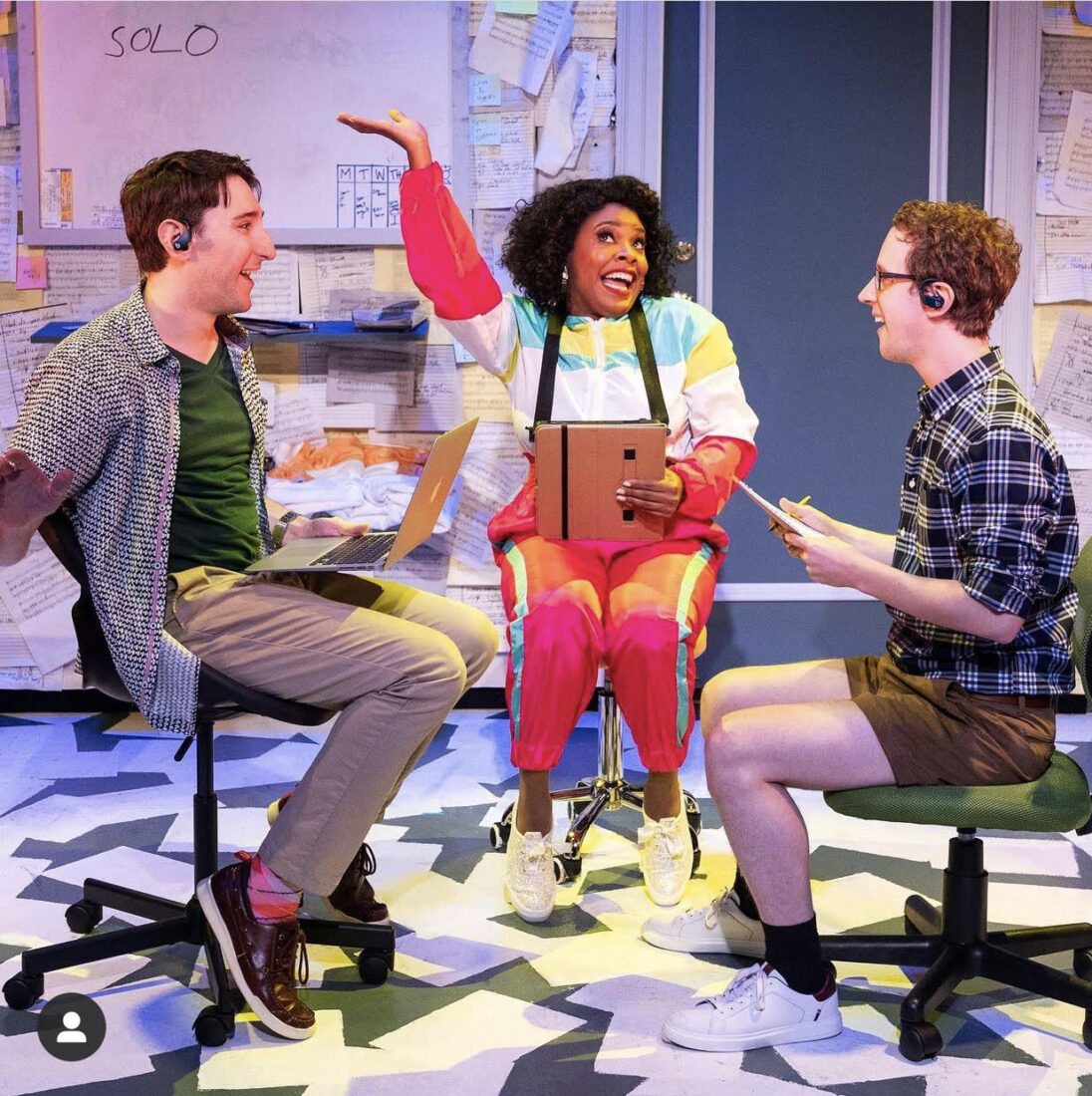
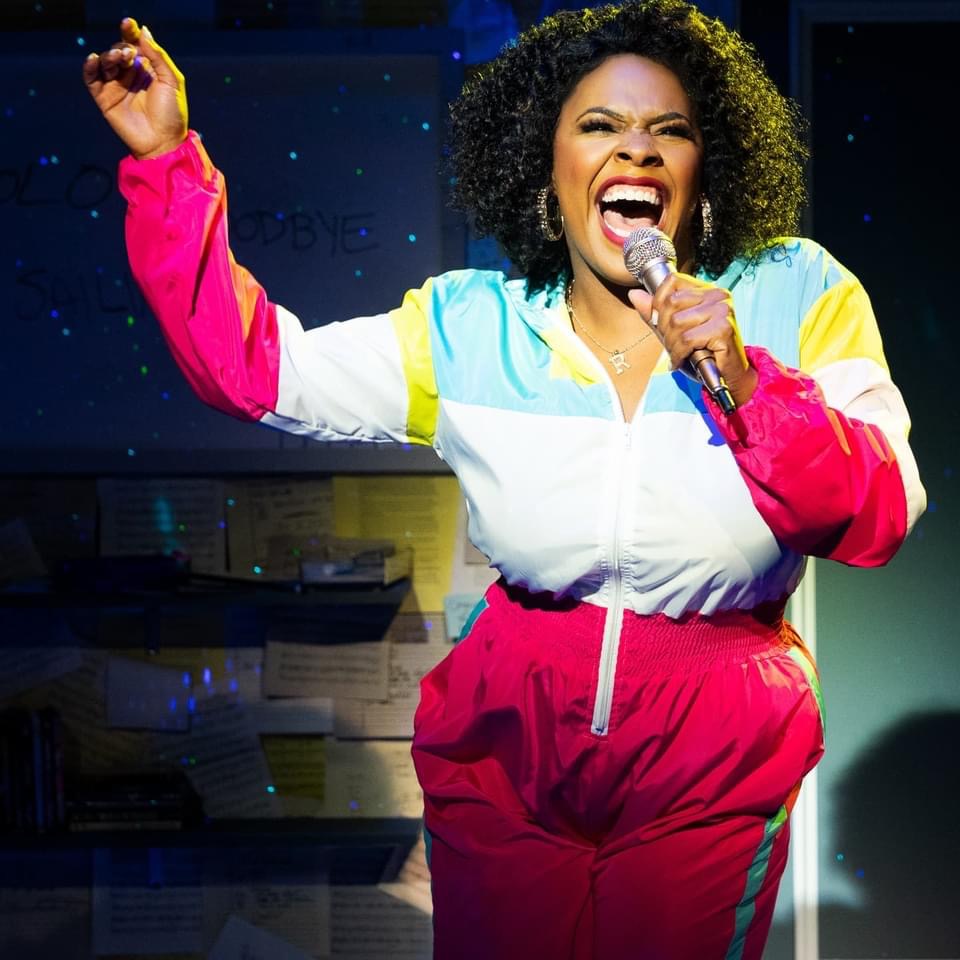
“A Commerical Jingle for Reginia Comet” is *running* an ASL-interpreted performance of their show on November 20th at 3pm. The performance is part of a partnership with Broadway SIGNs! and show producer Jo-Ann Dean. Regina Comet is the story of two nobodies dreaming of writing one hit song for everybody…and a diva. It stars Alex Wyse (Spring Awakening, Waitress) and Ben Fankhauser (Newsies) as two struggling songwriters and Bryonha Marie Parham (Prince of Broadway) as the eponymous Regina Comet. Wyse and Fankhauser also wrote and composed the book for the show. Tickets are available at reginacomet.com.
Since their opening in September, Regina Comet has drawn audiences, laughs, and rave reviews, including from this website. The show follows two struggling songwriters, so anonymous that they go unnamed in the show and are billed as “Man 2” and “Other Man,” who get the chance of a lifetime when over-the-hill diva Regina Comet hires them to write a new song to advertise her new fragrance, “Relevance.” The results are creative, endearing, and hilarious.
The November 20th ASL-interpreted show also marks one of the last performances of the show at the DR2 theatre.
So hop online now and check out A Commercial Jingle for Regina Comet, running through November 21st, 2021.
`What would you do if you finally got your chance to shine? Maybe it’s your first chance. Maybe it’s your last. In A Commercial Jingle for Regina Comet, two writers and a diva get that chance when the diva, Regina Comet, hires two jingle writers to create a song for her upcoming fragrance release, Relevance. The musical is goofy, charming, and tons of fun in a joke-a-minute journey through the emotions behind the creative process.
Regina is a star in decline. In an age of Instagram, she’s lost too many of the nuances of the 13-18 demographic that used to be her fanbase. Audiences don’t get an exact age, but we get the feeling the new tween fanbase is made up of the kids or even grandkids of the fans who once flocked to Comet’s concerts. Desperate to draw the spotlight again, her managers convince her that her best shot at teens catching her scent is through a fragrance, which she names Relevance. But all is not well: her commercial efforts have fallen short and, in a last bid to make things happen, she hires out a songwriting pair— the cheapest option available— to pen a jingle that will blast Regina’s career back into outer space. The show follows the efforts of the two songwriters— never named but billed as Man 2 and Other Man— and Comet as the three claw desperately at the promise of relevance and success.
The characters put their heads together to create One Hit Song
At the heart of the show beats Ben Fankhauser and Alex Wyse, who play Man 2 and Other Man and co-wrote the music, book, and lyrics for the show. Inspired by their real-life friendship and a desire to carve out their place in New York City theatre, the show is a comedy-of-errors reflection of the pair’s real search for musical success. And it is clear that the pair are in on the joke. When Fankhauser’s Man 2 is struck by musical inspiration, he pushes aside the show’s music director and keyboardist Alex Goldie Golden and takes over the music mid-song. To play bumbling, struggling versions of themselves in a musical with hit after hit is, to borrow a modern phrase, quite the flex.
Bryonha Marie Parham likewise shines as Regina Comet, commanding her scenes in a role she fills with perfection and enthusiasm that perfectly matches the show’s sometimes serious, sometimes absurd tone. Comet, who could be a plot device with a solo, comes alive under Parham’s stewardship, aided by the actress’s input in the creative process.
A Commerical Jingle for Regina Comet is a welcome return to live theater— light-hearted, fun, simple, and straightforward. It is the perfect way to venture back out into public, into theater, and head home laughing.
A Commerical Jingle for Regina Comet is playing at the DR2 Theatre. Learn more and get tickets at reginacomet.com
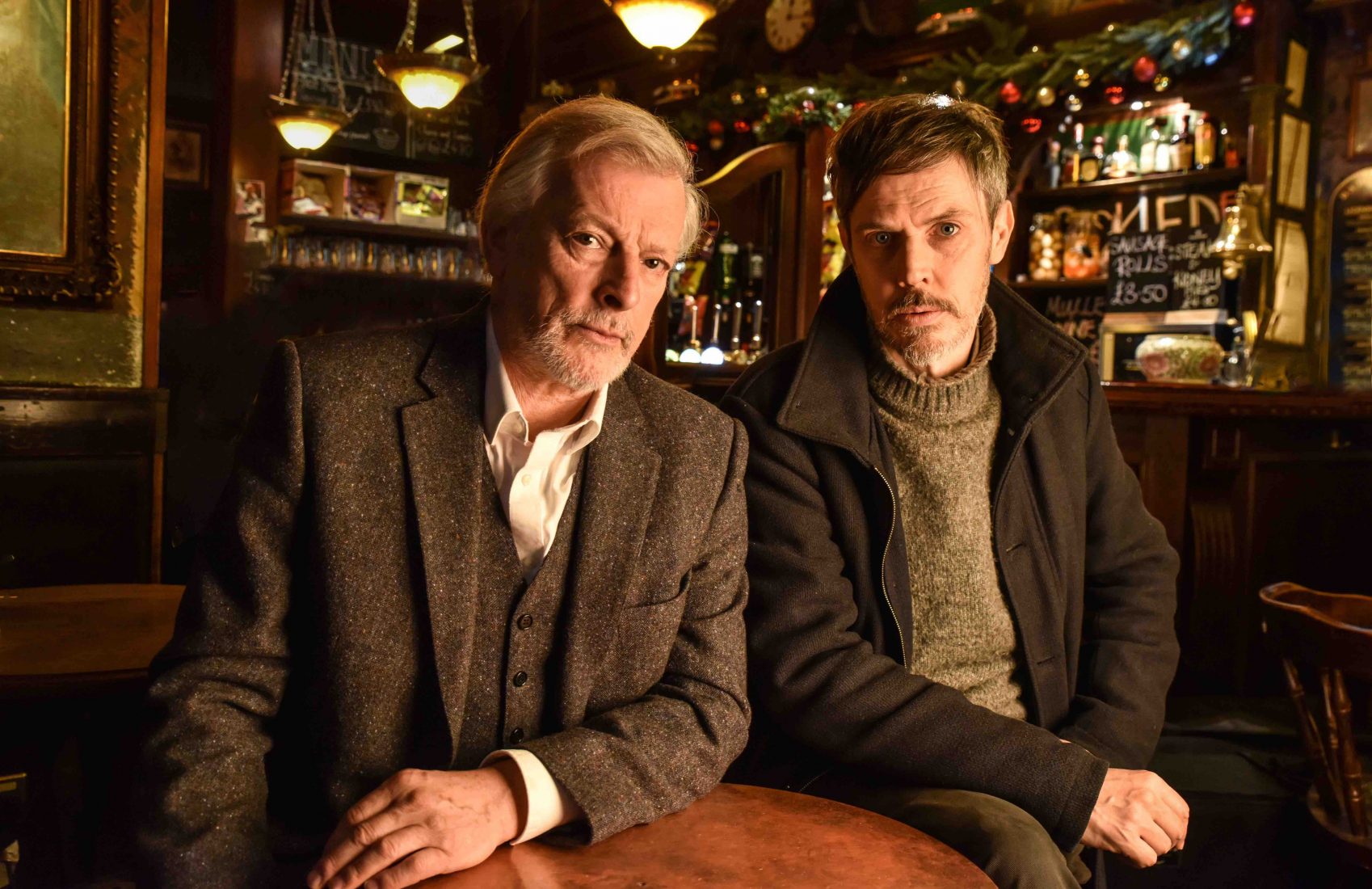
Actors David Acton and Ben Porter. Photo courtesy of Robert Day.
I don’t go to a lot of haunted houses. My “scary movie nights” aren’t that scary. So “Woman In Black – A Ghost Story in a Pub” at the McKittrick Hotel was my first time experiencing the phenomenon of scared laughter–when your throat forces out a laugh to stop you from screaming. It was an odd experience to have at a theater. Even stranger for a two-man show which spends its opening scenes convincing you that it is a friendly comedy.
The McKittrick production of Susan Hill’s bestselling thriller comes from inauspicious origins, commissioned by a provincial English theater to plug a budget hole. The resulting two-man show was a barebones ghost story with the unambitious goal of filling a three-week run around Christmas. Instead, it was a smash hit. It made its way to London’s West End, where it has remained for thirty years. The McKittrick takes advantage of the minimalist requirements of the show–and the pub atmosphere of the McKittrick’s The Club Car–to bring the show back to its humble origins. And they do so to wicked effect.
Porter, playing an actor playing young Kipps, as terror takes hold. Photo courtesy of Jenny Anderson
The original story, by Susan Hill, shows an old man named Mr. Kipps recounting for his family a haunting paranormal experience from his youth. The play reworks the plot by framing it around the relationship between the older Mr. Kipps, who has written his account, and the young acting coach who is helping him prepare to tell it. The opening scenes show Mr. Kipps (David Acton) struggling with the art of performance, urged on by a frustrated young actor (Ben Porter). The actor resolves to play the role of young Mr. Kipps, while giving all of the other roles to Kipps himself. The two build a rapport, and the show refocuses on Kipps’ story itself, bringing more thrills and suspense into the show as it goes on.
In this way, Woman in Black toes the line between hilarious and terrifying. The bond between Kipps and the actor, as well as between Acton and Porter, is charming and heartfelt. You are rooting for this poor old man to gain the courage to tell his story, and then you get it, and it is grand. And then they’ve got you. Like an arm reaching up out of a placid lake, it grabs you and pulls you beneath the surface and into a nightmare. There were screams in the theater. A lot of them. I watched audience members shift in their seats, or cover their eyes. And yes, the scared laughter, which rippled across the theater in between the terrifying punctuations.
Woman in Black is a case study in theater magic made possible in big part due to Acton and Porter. With the exception of the brief intermission, it is the two of them alone who draw the audience’s attention throughout the show. Acton especially flaunts his skill with the manic pace of his character changes, launching from secondary character to secondary character as his Mr. Kipps falls into his role as an actor. Also of note is the effects team, providing just the right lighting, sound effects, and occasional fog to set any scene on a nearly bare stage.
In the mists of the English marshes. Photo courtesy of Jenny Anderson
The Club Car, the McKittrick’s small theater and pub, matches the ambiguous early 20th-century vibe which encompasses many of their other shows. It is a great match for Woman in Black, the flashbacks of which take place at a similar vague period of “60 years ago.” To compensate for the lack of cigarette smoke which would be present at an interwar pub or jazz club, they even have hazers installed, giving your senses another subtle clue that you are somewhere in the past before NYC banned smoking indoors. While you are there, try your hand at some of their Woman in Black-themed mixed drinks, or their new Scottish pub appetizers, from bangers and mash to fish and chips. The “pub platter” makes a great choice for the indecisive, featuring pork pie, scotch egg, stilton, pickles, and nuts. It is delicious.
‘Woman in Black – A Ghost Story in a Pub’ is a thrill and a treat. There is a warning against bringing children under the age of 11, but I suggest everyone else grab a ticket. Grab a drink and a snack–and a stuffed animal if you need one–and experience the performance that had me shaking in the dark in a pub on a Wednesday evening.
The cast of
Nutcracker Rouge Credit: Mark
Shelby Perry
Are you looking for that last bit of holiday cheer? It is hiding in Bushwick. From the outside, Theatre XIV blends in with its industrial surroundings: a simple door and a dozen feet of black wall covered in posters. Your only real hint, unless there is a line outside, is the bright red enigmatic glowing sign that reads “XIV.” IT looks like a total dive.
Step through the door, though, and you will find yourself in another place and time. Decadent camp fills the foyer like 17th century Versailles put on a showing of Rocky Horror Picture Show. The decor is wood and velvet, oriental rugs and chandeliers. Guests, mostly dressed in black, mingle with cast members decked out in gold, sequins, and fur. Between them, there is hardly an eye left unlined.
Christine Flores, Nicholas Katen Credit: Mark Shelby Perry
The theatre itself is a black box, but you won’t notice. Behind the terraced half-circle seating, a realistic tree stretches out snarling branches as if to give shade. To one side as you enter, a long wooden bar a century out of time offers a wide selection of alcohol beneath a shimmering chandelier.
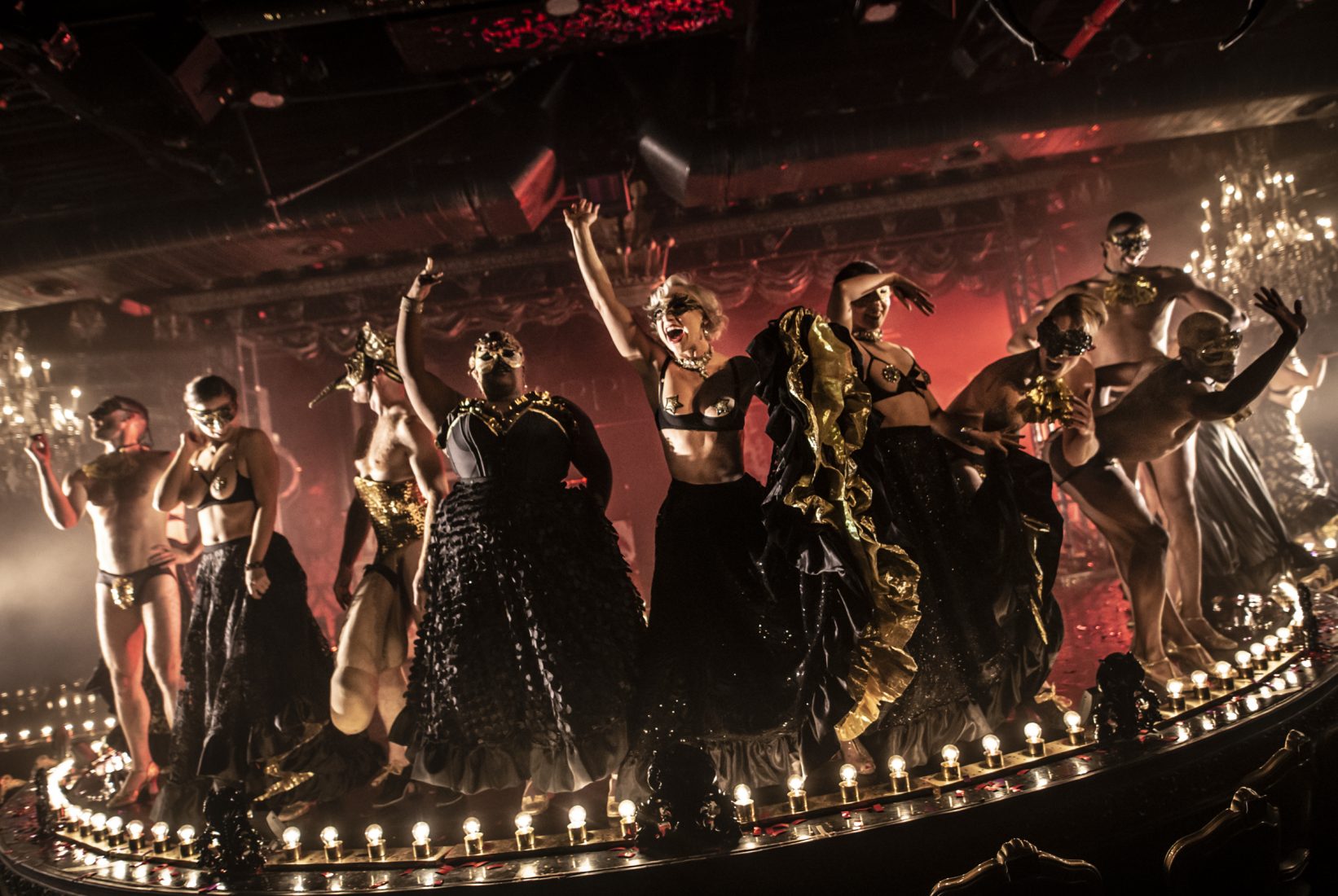
But the most arresting sight is the stage itself, which thrusts out into the crowd ringed by bare bulbs and flanked by even more chandeliers. The curtain, when down, displays a decadent scene of French aristocracy in masquerade finery. It is fitting–see foyer above.
As the show starts, the theatre fills with a mist tinted red by the stage lights. And then you’re in another world.
Nutcracker Rouge, Theatre XIV’s Christmas-themed burlesque show, is unlike anything I’ve ever experienced. There was a sense of tasteful decadence: more dancing, more singing, more ensemble, more sex appeal. It wasn’t just that there was so much ballet in this burlesque show; it was that they did ballet in heels.
And they crushed. The musical numbers resounded. The acrobatics drew gasps. The dance was elegant, beautiful, and coordinated. Most of the performers combined talents–dancing or singing while swinging from the ceiling, or performing strange feats between dance numbers. And it was all in heels. Anything you have seen done elsewhere, they can do in heels.
Albert Cadabra, Christin Flores, Ben Green, Nicholas Katen Credit: Mark Shelby Perry
Throughout, the show flows cleanly between coordinated ensemble acts to individual performances, all guided by the sugarplum fairy (Christine Flores), the show’s throughline and silent guide. Armed with a sense of childlike wonder and glee, Sugarplum explores each act with the audience. Sometimes she joins in, while other times she just watches and reacts.
If you are interested in taking a little opulence, a little decadence, a little sex, and a lot of glamour, into the new year, Nutcracker Rouge is a can’t-miss. Grab a ticket now: the holiday ends after this weekend.
And then check out their next show, Seven Sins, beginning Valentine’s Day.
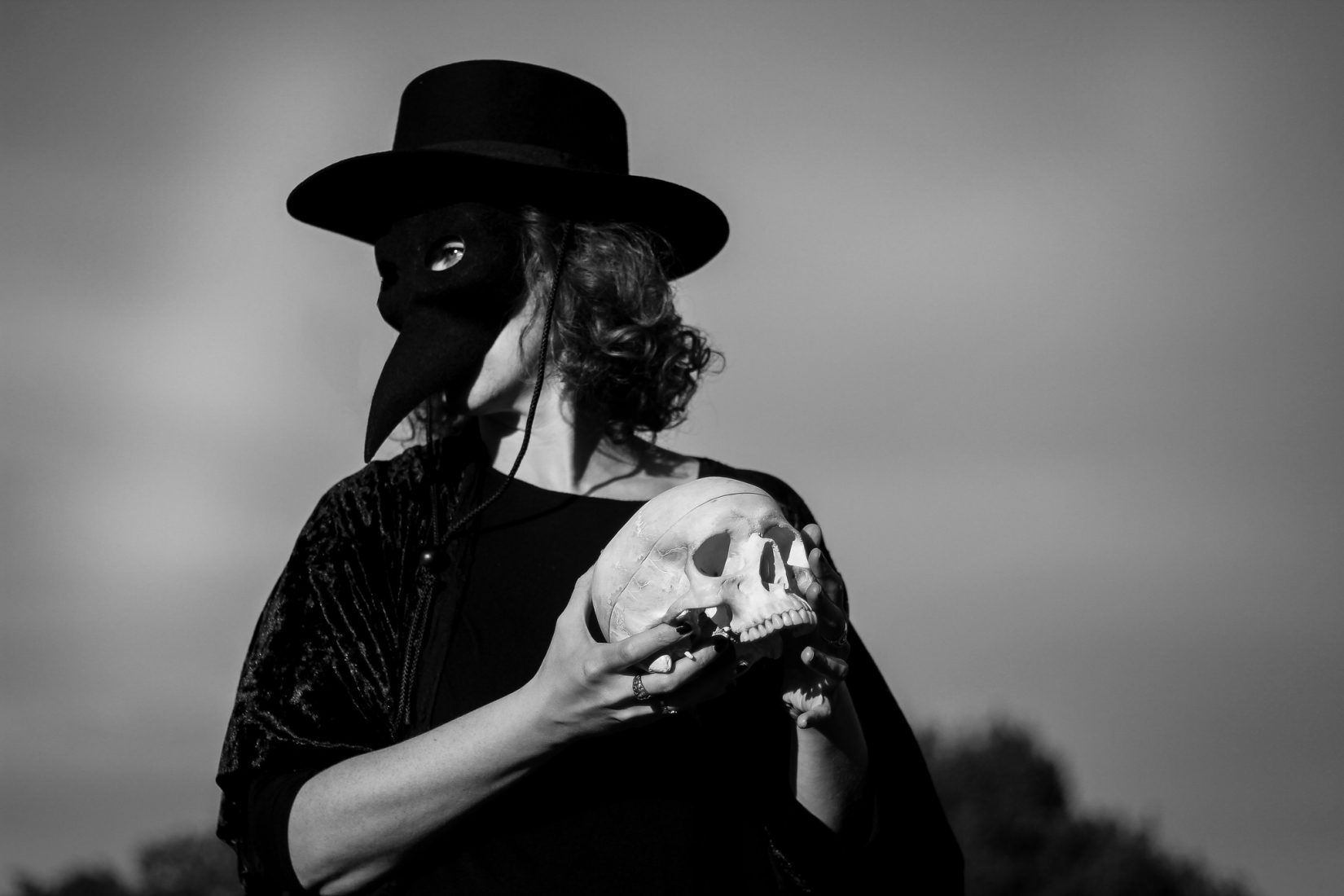
Death is not a subject one wishes to consider during the Yule season, but Adrian Sexton stares it down with her new one-woman show, DEATH! A Macabre Cabaret, premiering this weekend at Solocom.
The Titian-haired Sexton is a delightfully unique figure in the NYC comedy scene. Her passion for history, classic cinema, and music has been incorporated into her eclectic stage incarnations: Merchant Ivory films, tarot readers, a long-running improv tribute to Who’s Afraid of Virginia Woolf? …and even all four Beatles. Her character-driven comedy channels that of Tracey Ullmann, French & Saunders, and Amy Sedaris, but with a generous twist of Blackadder. She uproariously transcends time and space.
In this performance, Adrian Sexton reimagines Death as having been cursed by a wizard and forced to live out a human life (Sexton herself), enduring the experience of watching a loved one pass away. Through storytelling, humor and song, she explores the complexities of dying from her personal standpoint.
“Death is a character that has existed since the dawn of time, so it’s seen some shit!” says Sexton. “What DOES Death think? What makes Death sad? But Death’s still a heightened version of me…so I’ll throw some Duran Duran in there.”
Sexton notes that dying is still quite taboo, despite it being a universal experience for everyone. Last year, Sexton’s beloved father passed away after a long illness. She hopes to strip the mysteries and fears surrounding mortality, and wants people to cherish those moments of happiness, love and empathy that still exist in the darkest of times.
“Death is fluid and neutral. It takes king and peasant alike, so there is no empathy in death. And yet, we, the living, can show stunning compassion when someone experiences a loss. Even if you want to be alone and sad, you’re suddenly confronted with others’ feelings and hangups…which in retrospect I found quite humorous. Go away! No…stay! Also, the show takes place over Christmas, which is a ridiculous juxtaposition of joy and grief. I incorporate Christmas songs with lyrics that reflect what I was experiencing. You need to keep laughing.”
Inspiration for this show struck her at a hip-hop class at Freestyle Love Supreme Academy.
“Freestyling my truth was a revolutionary moment. I can be funny AND sad and speak honestly? At the same time? Whoa! That was the seed I needed to have the guts to write something this vulnerable.”
Sexton also credits tarot as a source of inspiration…after repeatedly pulling the Death card when applying to Solocom. She toyed around with various ideas, but all led back to the recent experience of losing her father. Director Zak Sommerfield suggested Sexton simply tell her story for the show.
‘The Death card doesn’t mean literal death. It’s about endings and new beginnings, so pulling it made me think about what my work will reflect going forward. Imagine if I pulled another card? You’d never hear from me again if I pulled the Hermit!”
Death! A Macabre Cabaret debuts Saturday, 23 November at 7:30 PM at the PIT Underground. Future performances to be determined.
Acoustician John Storyk has spent the last 50 years working with dreamers and artists to create remarkable music spaces. He’s worked on projects from Jay-Z’s “Roc The Mic” recording studio to Rio De Janeiro’s “Barra Olympic Park.” Now, he’s working on a music space to create dreamers and artists. In April, sources announced that Storyk and his studio, WSDG, would join a group effort to renovate the Harlem School of the Arts. The building, which has stood for more than 40 years, has been will be receiving a major re-vamp throughout.
The Harlem School of the Arts has been inspiring youth and building talent in Harlem for more than 50 years. Just X years before Storyk handed over his first sketch for Jimmy Hendrix’s Electric Lady Studios, concert singer Dorothy Maynor founded the HSA in TK Church across the street from the school’s current location. She believed, as the school still believes, that the arts can stimulate growth in children. To that end, it provides music, dance, theater, art, and design classes for children of all ages. A majority of these students are black or latinx, and half are on some kind of financial assistance. HSA hopes that, with the opportunities they provide, their students can grow and succeed in ways previously closed to them.
Storyk, with his wife and founding partner Beth Walters.
While the renovations to the HSA building will be extensive, Storyk and WSDG were brought on to help design the main lobby of the school, which also acts as a performance space for students. Storyk’s job will be helping to design the acoustics of the space to enhance musical or vocal performances. The most remarkable feature will be a large, slanted glass wall facing the street. The glass wall will open up the lobby space and replace a solid brick wall.
Storyk was added to the team at the recommendation of Herb Alpert, who made the renovation possible with a $6 million donation. When they needed to find an acoustician, Alpert said Storyk was the only choice. “It’s an honor to be on this team,” says Storyk, “Every now and then you get a job like this, with a social conscience and cultural coefficient. I’m not suggesting that doing a private studio for Jay-Z is not important. This is more important.”