Categories
Culture Movies

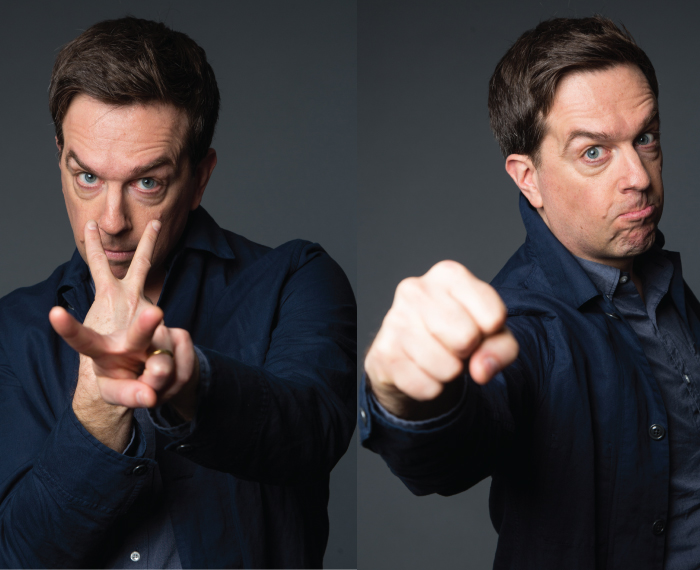
Ed Helms in “The Clapper”: A Meditation on Fame and Self Worth


In Hollywood they say if you are on time you are late. I am forty minutes early but might as well be ten late. When I walk in the studio where I am supposed to meet the players and makers of the movie
 “The Clapper,” the other writer has already taken the quiet corner in the office, and the director that I am supposed to interview is already being interviewed. A pretty brunette says “Hi! You must be the writer. Ed is being photographed right now. When he finishes, you can talk to him. We have to take him out of here fast because he is allergic to cats!”

I am here and he, Ed Helms, is here to talk about a tale that clashes with the mayhem that surrounds the promotion of a film. A tale that intersects what people think of Hollywood; a place where everyone lives in glitz and fame, with the reality of what is: a place where mere mortals, like most of us, work in an industry that moves the city. In “The Clapper,” Eddie, played by Helms, is a clapper for infomercials who sees his simple and happy life blow up when fame finds him.

As I’m trying to find a quiet place for the interview, Helms sits in a corner strumming a guitar. I pull up a chair and ask how he is doing, he looks me in the eye and says: “Fantastic” which gives me no reason to doubt that this is exactly how he feels, cat and all. I am feeling a little unsettled and since music is always grounding to me I ask if we can just keep doing this (meaning him playing and me listening quietly). He says that we may not be able to hear the recording (meaning the recording I’m supposed to be doing for our interview).

Camila Gibran: Maybe you should just become a musician instead, what do you think?

Ed Helms: I’m halfway a musician. I have a band, but maybe it’s time to just bag acting and go full time into music. 

CG: Oh yeah?

EH: Nah…I think it’s going pretty well. 

CG:  Let’s talk about acting and the stories it can tell. You are also a producer on “The Clapper.” Why did you choose this narrative?

EH: Well, this is a very powerful story to me, but ultimately it’s very funny which is what I’m drawn to. Also, there’s a tremendous amount of pathos in this story. It’s about a person who sort of becomes famous against his will. Culturally there’s this sort of belief that fame is wonderful and it’s this thing that everybody chases after, that it somehow has intrinsic value. But here’s a guy who isn’t really seeking it and ultimately it just causes a lot of blow back in his life and he doesn’t want it. I think that’s a really rare and special person who is just kind of ok with the way things are. His only ambition is to be content, and to have a healthy relationship.

CG: Which is deep down probably what every human being wants…

EH: Yes, but most of us are sort of saddled with ambition and striving and trying. So in a way, this very humble guy, who lives a very small and contained life, he is not someone we usually make movies about. He is not someone who you would pass by on the street and think, ‘I bet that person’s interesting.’ But then, when you start to peel back the layers and you look at this person, he’s complex and he’s very funny, but also he has a powerful story to tell.

CG: Today we are inundated with ways of telling stories, so many different kinds of media. Why film?

EH: I grew up with movies, I grew up loving movies, and loving television, and they were very fixed formats at that time. In the 80s and 90s. You had to go to a movie and then eventually, when I was a teenager, you could rent a movie, on a tape, and watch it at home. All of these limitations preserved this form as a convention. We had feature films and TV shows. Now, there are so many endless streams of media, and endless ways to consume media, that it can take so many different shapes and forms, playing different lengths, TV shows now have no fixed length, when you watch what would be a half hour comedy, on Netflix that can be 20 minutes, or it’s 40 minutes, it’s just whatever and that’s kind of liberating and beautiful in one way, but in the same way that a sonnet is a defined form, and a great poet is going to create a beautiful sonnet by adhering to that form, or a haiku or something, we are sort of losing those structures and I think losing limitation also endangers quality in some ways.

CG: Do you believe the classic structure of film should be preserved, to protect the quality of creative work?

EH: I think that we took for granted for so long that a film was a special thing and more then ever we can sort of look at it as a very defined art form that has built in limitations and those are beautiful and those help us construct a format that’s understood.

CG: The world is a very different place than a year ago. Has this changed what you, as a creator and performer, are drawn to?

EH: I’m still drawn to things that feel positive and uplifting at the end of the day, or really funny. I think that this movie has a lot of both. It’s a very thoughtful and deliberate meditation on fame and self worth and love, and at the end of the day, it’s a beautiful, a very hopeful funny and poignant love story. In it’s own way, it’s a fairytale, and I love that, just putting something positive out there in the world, because it feels like the world needs it. 

With that I tell him I’ve got what I need. Leslie, the photographer says she wants a few more shots with a different backdrop and without hesitation he agrees. He gets up, lays the guitar against the wall, which at some point during the interview he had stopped playing, and follows her.

I stay where I am, watching as actors, publicists, assistants move around the room striving. Thoughts linger: about being saddled with ambition and the idea that fame has some intrinsic value, about self worth, the concise way of telling a story and the contents of one’s life.

And for a moment I wonder, if we could slow down the movie of our own lives, would we then be content with what we have? And if so, on any given day as we pass each other on the street, would our thoughts be: “I bet this person is interesting.”

Photography by Leslie Hassler

Categories
Culture Movies

Dito Montiel’s The Clapper is a Glimpse into the Unnoticed Hollywood

Dito Montiel has lived A Life. A member of several successful hardcore punk bands, author of two books, screenwriter and director whose filmography is in the double digits, both Shia LaBeouf and Robert Downey Jr. played him in a movie, and yet, the only way to find any of this out is by googling him. His hat is knit, there are no scarves, bracelets nor other accouterments of past musicianship in sight, his anecdotes are of failing the NYC sanitation worker entrance exam (a job he was once happily prepared to accept), and of taking the Trailways bus to LA. The man sitting across from me is warm and gentle in a manner barely distinguishable from shyness. Had he told me he was an exam passing sanitation worker, I would have no reason to doubt him.

Svetlana Chirkova: Where does the story of Eddie, The Clapper, originate?

Dito Montiel: When I first came to Los Angeles 12 years ago, it was me and my friend Eddie, and we just needed jobs. I didn’t go with any particular aspirations; I didn’t mean to be a writer or a director. I had a friend who could get me a job and would let me sleep at his place, that was enough. We took the bus there and I went to work in the dub room while Eddie got a job as a ‘clapper’, a paid audience member. He got $75 dollars for each show, and all he had to do was clap, laugh when the sign said “laugh” and go “ooh” when it said “ooh”. I thought it was insane. He could do three shows a day and make $225 dollars. Then one time, he got to ask a question, and was paid an extra $100 dollars, he was so happy, but after he wasn’t allowed to work for the next month because his face had been seen, so he was really mad. That’s where the idea came from.

SC: You write about the forgotten working class of Hollywood in the director’s notes. Could you elaborate on that?

DM: It’s a funny thing, when you’re not from LA, everyone thinks of there being this “Hollywood Elite” which is insane because it’s a such a blue collar town. Sure there’s Steven Spielberg and Tom Cruise, but if you think every director is Steven Spielberg and every actor is Tom Cruise, you are forgetting 99% of the people working in the movies. They are plugging in lights, they’re sound people, electricians, plumbers… I never thought of the glitz of it, it was just a place I ended up. We knew of the really nice houses up in the hills, but we didn’t go up there…[laughing] if we got invited, we would’ve gone. Had we ended up in Pittsburgh, Eddie and I would’ve worked at a steel mill, you know? We didn’t go to LA to become famous people or anything, so it was fun making this movie and writing about this world.

SC: Famous has become a very desired thing to become, in an of itself.

DM: Not for Eddie [the character], I think he would be fine with it if he could still make his money, but it works in reverse for his job. It was an interesting way to look at fame without hitting anybody over the head with the message. When we originally showed a screening to a bunch of people in Hollywood, you know, actors, they couldn’t understand why he wouldn’t want to be famous. He’s not against fame, it just messed up his job. He’s a guy who prefers to simply go to work every day and live…There’s a lot to be said about having a regular job.

SC: Film has been your regular job for a number of years now. Despite it not being part of the original plan, what was it that drew you in?

DM: I don’t know how I got in to it, I really don’t. It was utterly insane, like Mr Magoo. Somehow I ended up doing this and now I do it. But as far as an art form, it’s pretty incredible, because you get to mix everything; there’s writing, there’s music, there’s acting, there is cinematography. I toured for a long time with terrible hardcore bands in vans, which is kind of like directing except you don’t see the end result. We’ll see what happens next, but I enjoy film a lot and they’re letting me do it. Until someone says ‘No’, I’ll keep doing it.

Dito wore the same knit hat to the premier, a man simply doing a job he loves which occasionally entails interviews, photographs and premiers. I never got to ask him if he has been invited to one of the nice houses in the hills yet.

Photography by Leslie Hassler

Categories
Culture Events Movies

Russell Peters Shines in The Clapper

Dispatches from the Tribeca Film Festival: A look through the lens of films to see ourselves in the other, and the other in ourselves with Russell Peters.


Russell Peters generously breaks the ice by mimicking farting sounds as he settles into an armchair, simultaneously setting the joke bar within an easy reach for me. It’s a comfortable place to begin when interviewing one of the world’s top comics whose career spans decades. He also designed his wife’s engagement ring to feature four lobster claws–or so the internet tells me.


Svetlana Chirkova: What is the world of The Clapper, in your own words?

Russell Peters: The film is about a guy, Eddie Krumble, who moves to Los Angeles and makes his money as a professional audience member. All he’s trying to do is make a living, he’s not trying to become “Hollywood”, he’s not trying to become a celebrity, he just wants to live a very simple life, and do a very simple job, then along comes this late-night talk show host, Jayme Stillerman, played by myself…

SC: You look great in a pink suit, by the way.

RP: Thank you, it may have been my own suit, actually… Anyway, my character, while doing his monologue and trying to make people laugh, unwittingly exposes Eddie as he thinks it’ll be a really funny ‘bit’ to try to find him, which in turn destroys Eddie’s life. So it’s a situation where one guy is trying to do the right thing, and the other guy, while thinking he’s doing something funny, wrecks it all.

SC: So there’s real gap in perspectives between these two as to what’s of value in life?

RP: Yeah, Stillerman is a TV cornball host, it’s his whole existence, so he really just can’t imagine how TV exposure could be bad for anybody. Eddie, on the other hand, is just trying to make his $100 dollars and the fact that his job ends up on TV is irrelevant to him. So there’s a failure to understand a very blue collar business by someone coming from the shiny, “glitzy lights” business, thinking that exposure is only going to lead to bigger and better things.

SC: This lack of mutual understanding between the so called ‘blue collar’ and the ‘glitzy lights’ classes has become a much debated topic following the election and the events since.

RP: There is no finger pointing, we are all the problem. Ultimately we all have to take credit for the problem.

SC: The world has become such a different place compared to a year ago, when this film was being made. Does the story of these characters take on a different meaning against the current backdrop?

RP: Isn’t it weird that a year ago seems like a much different time? Even 10 months ago was. We had a different president, we had a different mood, and now here we are with all this uncertainty about the future. There are so many threatening things in the world now, so many different things coming at us we don’t know what to dodge. It’s such a bizarre time. So I guess the thing that this film can offer is a glimpse back to a time when things were simpler – you know, 10 months ago.


SC: Ha. So apart from this time capsule property, what else can film offer above other forms of story telling?

RP: Film takes you into that world of escapism that we all desperately need, especially in these times. I think fewer people are going to movies nowadays, because the thought process is ‘Well, I can rent it on iTunes’, or wait to get it on Netflix, or just get a bootleg somewhere. We are detaching ourselves from tangible things which is a very bizarre thing to me. Going to the movies gives you something: to sit in a seat, to hold a ticket, to eat your popcorn and have a soda, to look at the person beside you and cheer, to be in the room full of strangers. Now we curate everything from the TV shows we watch to the music we listen to, we create a tailor made bubble. It’s hard to get that collective feeling anymore, because when you do find yourself in a group of people they too have been curated and are all in fact the same person. We are homogenizing ourselves individually. But what we forget is, back in the day, when these bubbles didn’t exit; we all talked, we had common ground, we had common things to talk about. We all just co-existed quite well with each other.

To further demonstrate his fondness for embracing the necessary discomfort of the true collective experience, the farting sounds got an encore as Russell distributed his goodbye hugs on the way out.

Photography by Leslie Hassler