Categories
Culture Featured Music

Clan of Xymox Materializes at Le Poisson Rouge

By Alice Teeple

Photos by Alice Teeple

Eyeliner? Check. Black lippie? Check. Mesh, lace and platform combats? All present and accounted for, with a gloomy rainy night for good measure.

It was undeniably a Clan of Xymox concert down in the rumbling subterranean catacombs of Le Poisson Rouge in the West Village. The venue found itself stuffed to the gills with New York City’s goths, punks, leather daddies, kohl-eyed Gen Xers, telephoto-wielding photographers…and most wonderful of all, a genteel-looking mama jacked up on Bud Light. She was over the moon to introduce the music of Xymox to her daughter. “I’m from the South, honey!” she shrieked with delight, waving to frontman Ronny Moorings. “We make our performers feel WELCOME!” She hugged everyone within her immediate radius, bumping the enthusiasm levels right up to eleven. What a fantastically eclectic crowd at this show.

NYC’s own Pawns and Chicago’s The Bellwether Syndicate (led by William Faith of The March Violets and Faith and the Muse) riled up the crowd with their outstanding sets. Thunderous, energetic, and gothic as hell, these two darkwave outfits were terrific choices to support Clan of Xymox.


Clan of Xymox
Ronny Moorings

For the uninitiated, it was a real treat to see this new material live as well as the members in great spirits. The Dutch band, featuring Moorings, Sean Gøebel, Mario Usai, and Daniel Hoffmann, made a blessed final stop in New York, wrapping up this leg of their Days of Black Tour. Clan of Xymox was finally completing a cross-continental schedule of shows. If they were fatigued from the series of sold-out gigs, they certainly showed no signs of it.

Continuously playing in various incarnations since their formation in 1981, Xymox still sounded fresh and prescient with their philosophical lyrics and screeching synths. Xymox rolled out their old tried-and-trues like A Day, Obsession, and Muscoviet Mosquito, but introduced plenty of newer tracks as well.

Moorings, with his wonderful mop of jet-black hair, was in fine form, making wry political jokes. He mischievously taunted the audience and encouraged clap-alongs, as synth player Sean Gøebel went hog wild on a melodica. At times Gøebel appeared almost otherworldly as he serenaded the crowd, twisting and turning like a mohawked, German Expressionist Pan. Hoffmann and Usai kept up the pace, basking gleefully in the stage fog. The real surprise of the night was an inspired cameo appearance by their friend Curse Mackey of Pigface.

Xymox wound up the evening with two encores, and finally sent the children of the night off to their lairs with Going Round. The set lists were divvied out to the devoted, and the Southern mama’s daughter triumphantly snagged one of  Mooring’s abandoned guitar picks.

“This will make a nice Christmas present for Mom. Maybe a necklace or something,” she said, just before the duo tackled Bellwether Syndicate’s William Faith in the lobby with big hugs and good ol’ Southern hospitality.

Yes, ma’am!

Clan of Xymox: A Day

Vixen In Disguise

See More

Blake Charleton Keeps It Fresh

Virginia

Marcs Goes “Wild” In Stunning New Video

Christine Smith Waits On The Far Side Of A Star

Adrian Sexton Draws The Death Card

Categories
Culture Featured Music

Interview With Niabi Aquena of Searmanas

Niabi Aquena of Searmanas in an interview with Downtown

Listening to the opening strains of a Searmanas song is like falling into a murky pool of lucid dreams. The ethereal vocals of Niabi Aquena gently sprinkle cinematic fairy dust over her lush soundscapes. Her work has been described as “etheric darkwave,” with nods to Sigur Rós, Fever Ray, and composer Jóhann Jóhannsson

Searmanas (pronounced SHA-mah-nas) is the Irish word for “ceremony.” Much of her poetry explores nature and ritual through unusual sonic channels; for instance, she used the radiotelephony spelling alphabet in her song Opening With Phonetics. Aquena’s live performances transform her into a priestess solemnly creating altars of noodly wires and sound waves.

“I love the exploration of the role of ceremony within both urban and rural experience,” says Aquena.  “I like showing, not telling. I’m inspired by intensity and poetry. I’m a romantic.”

Although she has called NYC home for two decades, Aquena originally hails from the Shenandoah Valley of Virginia, where the oldest mountain ranges found on earth surround the region with rolling hills and green pastures. Many of her atmospheric progressions sonically mimic that landscape. 

“I grew up in this beautiful place feeling as an outsider and a weirdo,” Aquena explains. “My mom named me from a New Age baby name book she found. I was 5’9” at age twelve; I had flaming red hair. I was different, and in rural Virginia, that was not accepted. This led way to a vulnerability founded in mettle.”

Aquena has since struck an intriguing balance with her place as a metropolitan artist, and the acknowledgment of the pastoral beauty that shaped her youth, through her mystical lyrics and transcendent electronic experiments. She is a unique fixture in the New York music scene, having shared the stage with other electronic visionaries like John Bender and Hieroglyphic Being. 

“The city certainly has taken my heart, and the rhythm of this place motivates me to my core.”

Seamanas
“The only solution I could come up with after hot compresses failed me, was an eyepatch! The pics from that show turned out cool though, so now I’m asked when I’m bringing the eyepatch back…”

Since debuting Searmanas in 2016, Niabi Aquena has been signed to Cleopatra Records and taken her project on tour all over the Midwest and East Coast. Aquena describes tour life as “grueling, but very rewarding.” On the last leg of a major tour, however, a minor crisis struck.

“I got bitten on my eyelid at someone’s place and my eye swelled up. I looked terrible but was playing a show that night. The only solution I could come up with after hot compresses failed me, was an eyepatch! The pics from that show turned out cool though, so now I’m asked when I’m bringing the eyepatch back…although it most certainly wasn’t a fashion statement!”

Aquena has lent her considerable talents to other bands such as Dead Leaf Echo and Textbeak, but she has many more plans for her solo project. 

“I’m waiting on getting a pedal. It takes the firmware from one of my favorite modular synths, but in a stompbox. Earlier this year I taught myself guitar, so I’m thinking of incorporating these two loves, modular synthesis, and guitar, together for the next iteration of Searmanas.”

Searmanas performs the Hart Bar on 7 November.

Check out Undo by Searmanas here:

See More

Lauren Light Unleashes Dark New Single, “Run”

Succumbing To Sophie Kilburn’s Indigo Fever

White Denim At Le Poisson Rouge

Karolina Rose Opens The Gates To Greytopia

Categories
Art Culture Entertainment Featured Music Technology

Synthesizer Innovators Show Brooklyn the Future and the Past

There are times, especially in New York, that you encounter profound coincidences. This June, Brooklynites and synthesizer enthusiasts got to experience classic electronic music and to look forward to two very different futures for the synth world.

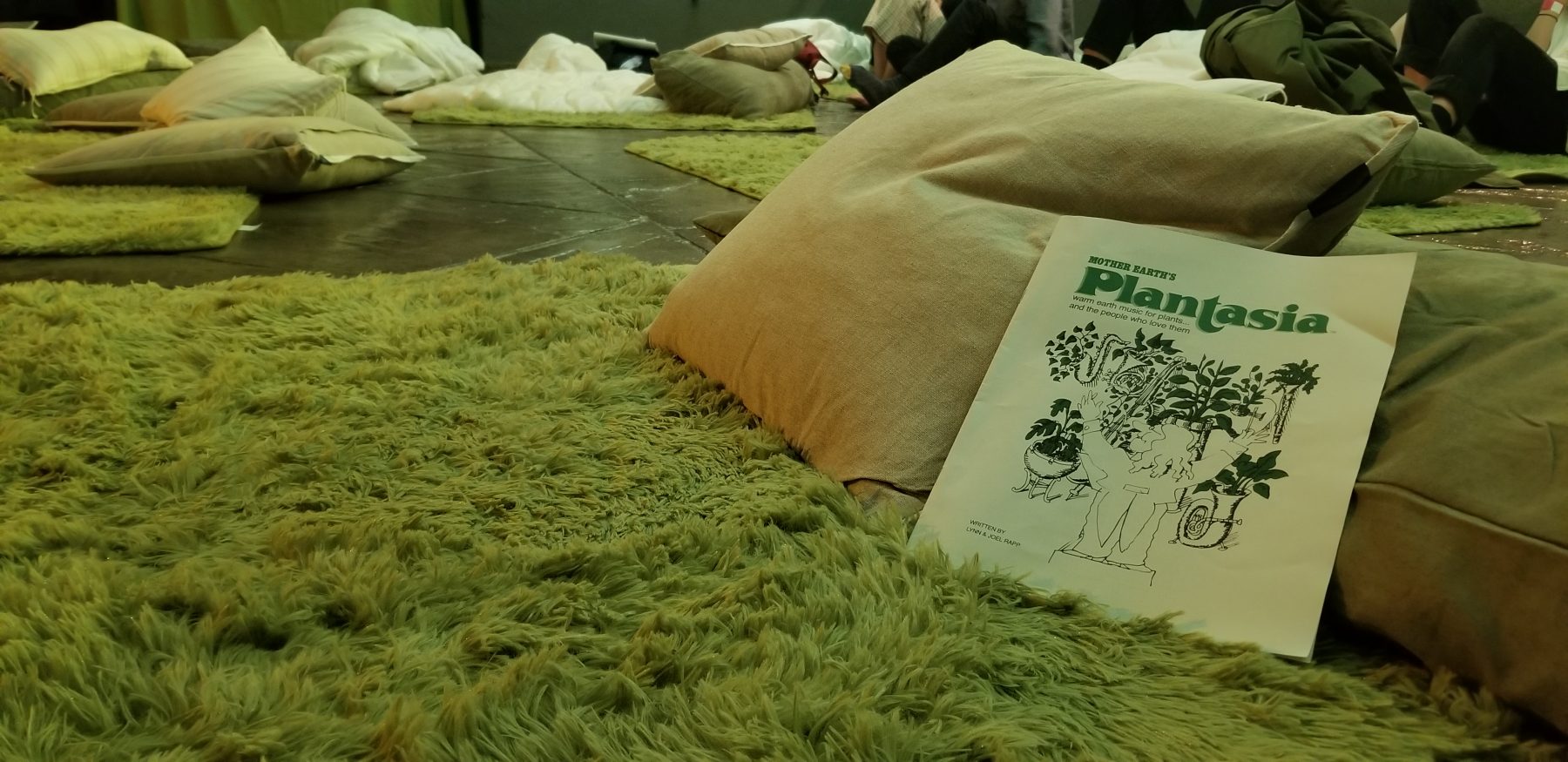
Last night, fans of plants, music, and niche cult oddities gathered at the Brooklyn Botanic Garden to experience a listening party for Mort Garson’s cult classic 1976 album Mother Earth’s Plantasia, aided by Atlas Obscura, which will be re-released this summer by Sacred Bones Records. The synthesizer-composed tracks are meant, according to Garson, to stimulate growth and well being in plants who “listen” to them. Plantasia was also one of the first albums ever composed entirely with a synthesizer.

Attendees listen to artist Mileese explain plant intelligence at the Plantasia Listening Party in Brooklyn Botanic Garden.
Attendees gather for a listening party for Mother Earth’s Plantasia, organized by the Brooklyn Botanic Garden, Atlas Obscura, and Sacred Bones Records. (Photo courtesy of Hummingbird Media)

The “listening” took place in the Garden’s conservatory, where two dozen soft green shag rugs had been laid out on the floor–looking not-accidentally like patches of grass–and covered in throw pillows. The crowd looked like what you’d expect for a listening party for a ‘70’s synthesizer soundtrack designed for botanical healing–that is, they looked like Brooklynites, but maybe a little more Woodstock-y.

As attendees lounged on the carpets and sat in chairs and listened, artist and biophilic technology designer Mileese explained some of the science and “science” behind Garson’s vision. The history of plant “intelligence” studies stretches back more than a century, with diverse experiments showing the plants’ receptivity to outside stimuli, music, and way more. Scientists measure and record the electrical data coming from the plants, trying to divine their thoughts. It turns out, plants like sex and classical music, aren’t fans of rock ‘n’ roll, and hate the evening news.

Meanwhile, just a couple weeks earlier, an entirely new generation of synthesizer stopped by our city. On June 8th and 9th, the Latvian visionaries of Gamechanger Audio visited the Brooklyn Stompbox Exhibit and Synth Expo to show off their latest invention: the Motor Synth, the world’s first synthesizer which generates sound with internal motors. For two days, more than 500 audio engineering tech enthusiasts stopped by to play with the Motor Synth, while three of Gamechanger’s co-owners –Didzis Dubovskis, Kristaps Kalva, and Ilja Krumins–ran demonstrations and took pre-orders.  

The Gamechanger Audio team poses outside of their first workshop.
The Gamechanger Audio team poses outside of the garage in Riga, Latvia, which they used as their original workshop. (Photo via gamechangeraudio.com)

“All the new advancements are usually in software stuff,” says Krumins, “So the industry is heading into software and we decided that we were gonna just disrupt everything and just say “There can be new analog instruments made, even in this day.”

As of right now, only three Motor Synths exist: two went with Gamechanger when they visited Brooklyn, and are now back in Riga; the third is in the capable hands of Jean-Michel Jarre, another pioneer who released his breakthrough synthesizer album Oxygène in France in 1976, the same year as Plantasia.

In some ways, the Motor Synth and its creators have a lot in common with the synth Garson used in 1976. Garson used a Moog Synthesizer, the first brand to sell synthesizers commercially. Created by Robert Moog in the early 1960s, they came into popularity as artists discovered the product throughout the decade. Garson himself discovered Moog in 1967 at a convention for the Audio Engineering Society.

It’s easy to recognize the shared lineage between the Moog and the Motor synth. The Moog is a multi-layer contraption covered in dials and buttons, while the Motor Synth has cut that down to a couple of dozen. They’re both black boxes, though the Moog comes up to your hip while the Motor Synth looks like it could fit in a generously-sized glove box.

It might be harder to see the common ancestor between the Motor Synth and Mileese’s grand finale at the Plantasia listening party. With a small garden of potted plants arrayed before her, all hooked up to wires and monitors, she explained that she had found a way to turn the “thoughts” of plants into music. She’d written a code which mimicked a synthesizer and which responded to changing biodata from the plants. She turned on the device and, more than 40 years after man used a synthesizer to serenade plants, the plants used a synthesizer to play back.

Mileese finished her performance and Mother Earth’s Plantasia began. Many left the room to explore the gardens as they listened. One woman wearing a hat made of rooster feathers–think like a feathery beanie–danced along with the music. Meanwhile, I wondered at two new approaches to electronic music, to synthesizer technology. In a two week spread, I was able to experience two separate futures to the fusion attempted by Garson in Mother Earth’s Plantasia: one sound drawn from spinning motors, the other from growing plants.