There’s a new food pop-up in Astoria, and it’s looking downright appetizing!
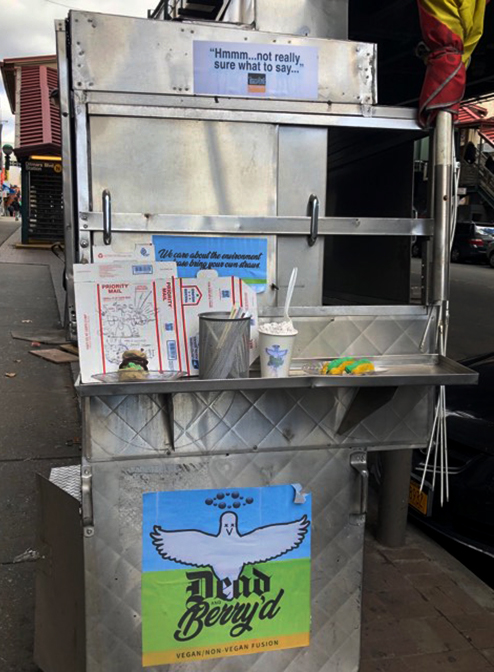
Dead and Berry’d appeared on 31st Street at an abandoned hot dog cart under the Ditmars stop this week. Its tasty “vegan/non-vegan fusion” offerings have certainly been tantalizing the block!
Photo by Hayley Bing
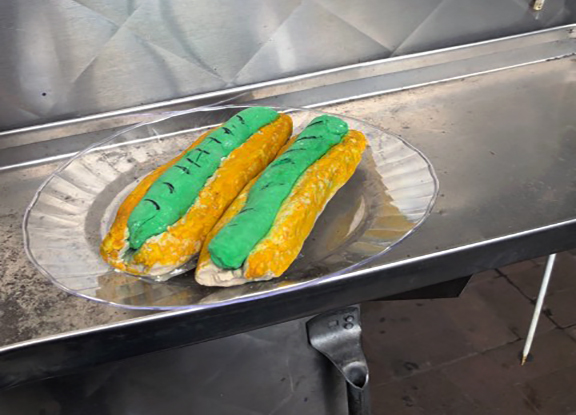
Green frankfurters, double-decker neon hamburgers, and frozen delights await the hungry masses at this formerly unloved street cart chained to a “No Parking” sign. The authentic artisan cuisine is skillfully handmade with indigestible Sculpey polymer, plated on eco-friendly thrift store china, and blends the finest in conceptual slaughter and foraging.
This forward-thinking chow wagon is committed to saving the environment and politely demands customers bring their own straws, on a sign plastered to the side of the cart. With all the roly-poly pigeons roaming the immediate area, and a farmer’s market across the street, Dead and Berry’d is committed to providing fresh farm-to-table squab for busy commuters.
Photo by Hayley Bing
The Dead and Berry’d logo alone is a masterpiece in graphic design: a KO’d pigeon with berries spinning over its head, invoking the spirit of the classic Rainbow Peace Dove poster of the great Milton Glaser, but with a tragic twist.
Their rustic menu, supplied by the neighboring Astoria post office Priority Mail rack, is artfully hand-drawn and calligraphed by a talented Anonymous…such a feast for each sense.
Astoria resident Hayley Bing, who spotted the new joint on her way to work, sent in these photos. She was one of the lucky few who got to sample the rare goods firsthand:
“The menu item they called ‘hotdog’ was reminiscent of the modeling clay I used to eat in art school on special occasions,” she says.
We aren’t sure what’s in those offerings or even the head chef’s true identity, but perhaps it’s best to keep this a beautiful mystery. Ditmars certainly needed a little zip in its step with all the new construction and changes happening to the beloved 31st Street promenade. And what a gamble! Food is flying off the shelves. By Thursday they’d sold out of their signature hot dogs, hamburgers and shakes, but we’re anxiously waiting for the next installation.
Photo by Hayley Bing
Photo by Alice Teeple
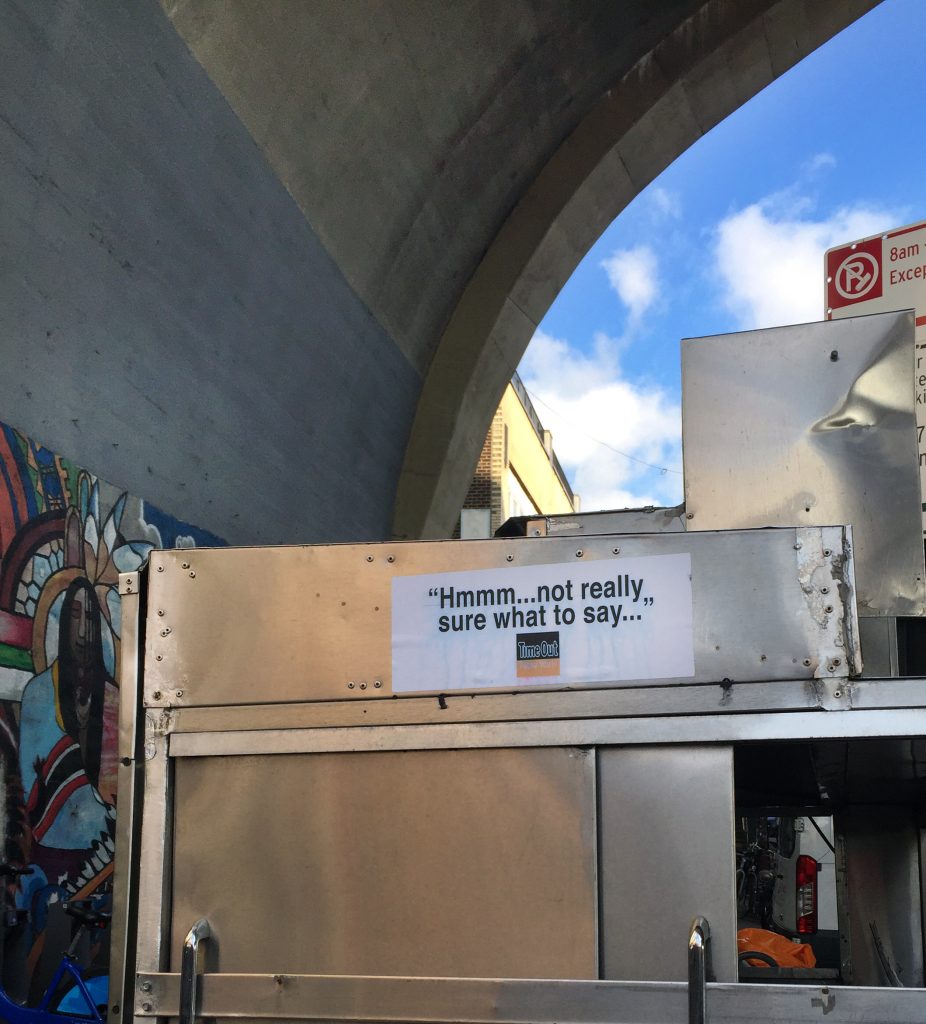
Perhaps Time Out had no idea what to say, but Downtown is ready to chow down.
BEYOND THE STREETS has packed its bags from the streets of Los Angeles and traveled to the East Coast to make its debut in one of the art capitals of the world, New York City. Known as the premier exhibition for graffiti, street art, and everything in between, BEYOND THE STREETS decided to take over the city as it’s the epicenter where this art form prevailed. Taking over 100,000 square feet and two floors in the new 25 Kent building in North Williamsburg, the exhibition showcases original artworks, paintings, sculptures, photography, and installations from more than 150 artists from around the world, including the likes of Shepard Fairey, Vhils, Takashi Murakami, MADSAKI, Maya Hayuk, Lady Pink, among others.
DABSMYLA, an Australian husband-and-wife visual artist duo, partnered up with Amelia Posada from Birch and Bone, a floral company in Los Angeles, to do a breathtaking floral installation at BEYOND THE STREET’s exhibit in Los Angeles last year. This year, the couple decided to partner up with Posada to create another floral installation, but this time with a specific theme – unintentionally perfect in time for Pride month.
Artwork by DABSMYLA. Images provided by BEYOND THE STREET
Artwork by DABSMYLA. Images provided by BEYOND THE STREET
“We’ve been working on a series of paintings that are a rainbow series like this, with the painting, it’s like gradient, yellow down to blue. And so we wanted to make this installation, something similar to that. First, we collected all the flowers we had, counted them all together, and then worked a mathematical equation on how to add more flowers so that it would make the gradient. We got all the flowers in L.A. prepared and then we were in New York to set up the installation.”
Artists such as MADSAKI and Maya Hayuk talked about their humble beginnings in discovering their connection with art. MADSAKI, a Japanese-American, was born in Japan but moved to the suburbs of New Jersey around the age of six. Upon arriving and growing up, he couldn’t speak much English, partly because he didn’t understand what was happening around him. It wasn’t until he made the connection of drawing as a form of communication.
Artwork by MADSAKI. Images provided by BEYOND THE STREET
“I started to pick up the pen or crayon or whatever, and draw anything. If I wanted to tell the kids to look at the airplane, I can’t say airplane. So I drew an airplane. That’s how I really picked up drawing because I never drew before. But when I learned that I can communicate with drawing to people without speaking the language. I was like ‘Oh this is cool, I don’t even have to talk.”
By his mid-twenties and beyond, he’s worked with painting and focusing on working with cartoonish images from his childhood and a combination of words, some containing profanity.
Hayuk, on the other hand, start diving into street art when she was hanging around New York and the SoHo area was just beginning to be built and look promising. She always enjoyed working with large wax oil sticks. “We were painting like weird words and clowns and whatever, so I wouldn’t call it street art. It was more, ‘I’m bored, let’s go painting’,” she said.
Artwork by Maya Hayuk. Images provided by BEYOND THE STREET
However, one thing that Hayuk is very adamant about is refusing to use the term ‘street art’ or putting any descriptive word before ‘art.’
“I mean when you call art, art then it’s art. And you don’t have to put the word street in front of it necessarily. If you look at a group show, it doesn’t say street art on it. It’s just a group of artist names and then you see the association between them.”
One thing that Hayuk pointed out was the differences and dynamics of the actual exhibit. As BEYOND THE STREETS New York promotes itself as a graffiti and street art show, many of the artists don’t fit that particular mold, which is probably why the insert an “and beyond” in the advertising of their brand. She did joke around at the end and inserted that she hates the term ‘urban art’ even more.
There were many other standout pieces at the exhibit, including an honorary Beastie Boys section with archival pieces designed by Cey Adams and small toy-size rail carts repurposed with graffiti plastered on them. An additional bonus to the show was a pop-up shop on the second floor that featured refreshments and merch by many of the artists featured at the show.
BEYOND THE STREETS made its mark on extending the expectations of any art exhibit you’ve ever been to.
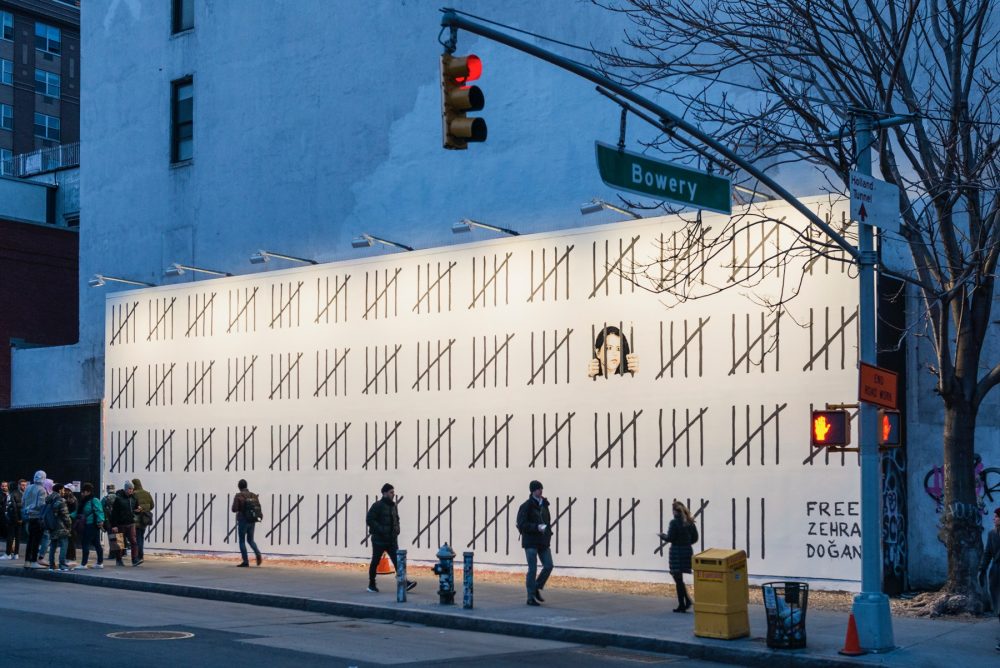
The famous Houston Bowery wall, owned and managed by Goldman Properties, has hosted a number of acclaimed artists since its reinvention in the late 70s with a mural by American pop artist Keith Haring. Featuring pieces from artists from a full range of genres and styles, the Houston Bowery wall’s newest piece is an image of protest from the once-underground and often-political artist, film director and activist Banksy.
Banksy distanced himself from the silent political majority with his sobering works featuring vandalized phone boxes, rioters throwing flowers and several other pieces that have made him a clear and consistent voice in the artistic community. Maintaining his anonymity while simultaneously gaining a massive following, Banksy’s pieces seem to pop up anywhere and everywhere, including fine art auctions where they have been sold for nearly $2 million.
Banksy’s newest piece (the Houston Bowery wall’s newest feature) is a depiction of the time spent in prison by Turkish journalist Zehra Doğan, who was sentenced to nearly three years in prison for painting a watercolor picture of the town of Nasyabin, which was destroyed in an attack by the Turkish military, and sharing it on social media. The piece’s jarring and repetitive black and white design is only broken with a bright image of Doğan behind bars and the text in the bottom right: “Free Zehra Doğan.” At night, NYC passersby have the opportunity to view Banksy’s addition to the Houston Bowery wall accompanied by an image of the original painting responsible for Doğan’s sentencing, which is projected above the mural.
Banksy hasn’t had any pieces in New York for five years, and the Houston Bowery wall is one of two pieces with which he returns back to the city and leaves his mark, with the other being a depiction of a rat running around an exercise wheel-styled clock above a former bank building at 14th Street and 6th Avenue.
For more on what’s going on in the city, visit our news section.
The streets of New York City are art galleries in and of themselves. There are murals and graffiti on every corner of the city these days. Perhaps the best thing about the street artwork, is that it’s always temporary. A huge mural can be drawn up in a matter of hours and be on display for a few weeks before it is painted over and replaced with the next work of art. The ever-changing scheme of art in New York City definitely captures the nature of life in the city. Here are a few of the hot spots for street art in downtown Manhattan worth visiting right now:
Bowery Mural Wall
Photo: Courtesy of Untapped Cities
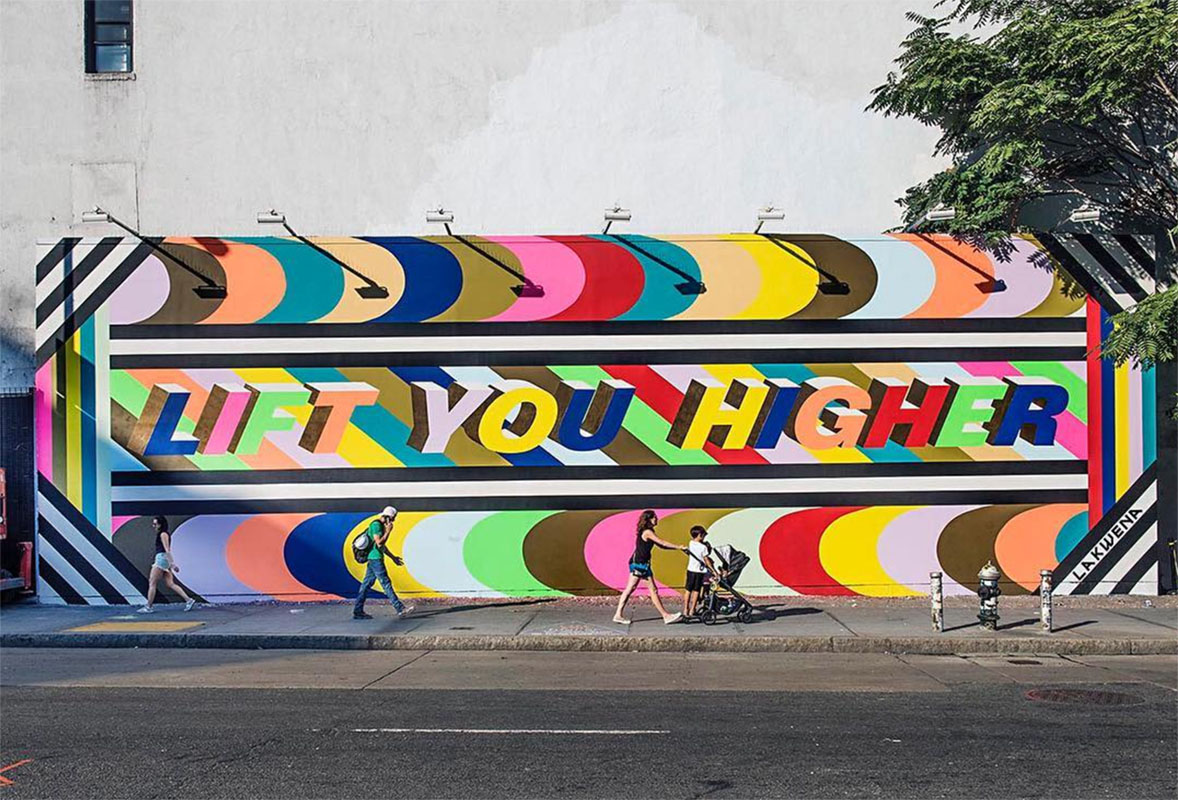
Situated on the border of SoHo, this wall which takes up nearly half of the block regularly features different, brightly-colored large-scale artwork. The Bowery Mural was made famous in the 1980’s when famous artist Keith Haring displayed his artwork here. Since then, the wall has been acquired by Goldman Global Arts, who also curates the Wynwood Walls in Miami, Florida. Currently, the mural is featuring a collaboration by artist Lakwena and Instagram promoting their #KindComments campaign. The wall is even visible at night since they’ve installed lights above the mural.
First Street Green Art Park
Photo: Courtesy of @ziggi.smalls, Mural by @jasonnaylor
What was once an abandoned building lot in downtown Manhattan is now a walk-through art gallery and garden. The Lower East Side open-air community space hosts murals, art installations, and performances. The park spans almost all the way down the block with lots of murals on display along the pathway, right along Houston St. The First Street Green Art Park works with local artists, schools, and members of its community to curate the artwork in the garden and offer sustainable programming. This gallery gives a nature element in the middle of the bustling city if you’re keen to explore a green space.
Lafayette Street
Photo: Courtesy of The L.I.S.A. Project
Get off the beaten path of Broadway, and head down Lafayette Street. This street features shops, cafes, and artwork. These few blocks best showcase the style of SoHo. The walls feature independent projects’ work like the L.I.S.A. project, and high-end brands like Gucci displaying their artsy side. It is certainly worthwhile to stroll down Lafayette and visit all the art and trendy stores in the neighborhood.
A project nearly a year in the making, 4 World Trade’s street-art inspired gallery on the building’s 69th floor is finally finished. The exhibit will feature the work of over 50 artists from New York, and around the world, in a variety of mediums.
Stickymonger, Cosmic Tower
ART4WTC is a dramatic and shift in style for the Silverstein Properties artist residency program, which they have used to decorate their unleased spaces for around the past 15 years. The idea for the art project was born when Silverstein Properties Chief Marketing Officer, Dara McQuillan, viewed a display of similar work at World Trade Gallery, and offered curator Doug Smith the opportunity to turn the 69th floor into a giant canvas.
Layer Cake + Belowkey, Joe LaPadula, Jenna Krypel, Beautiful Cleanup
Smith jumped at the chance, and since June 2016, the space’s barren cement interior has been transformed into a kaleidoscope of color propelled by each artist’s enthusiasm for their craft. The project not only seeks to revitalize the Lower Manhattan art scene and elevate street art from its humble beginnings, but also celebrate the Financial District’s progress since 9/11.
Fans of Hamilton can even find quotes from the hit musical in the very fabric of David Hollier’s$10 Bill, which faces the direction of the Trinity Church cemetery where the Founding Father himself is buried. Fortunately, Spotify — who will eventually occupy the space — plans to keep as many of the pieces as they can. Downtown recommends art fans of all ages check out the 3D tour available online to see the work of those keeping New York creative and colorful.
Walking into Vandal — the only way in is, of course, through a boutique flower shop — we’re immediately greeted by a neon-lacquered breakdancing rabbit sculpture.
If you really, really know your street art, you know that it’s is a nod to the now-discontinued “Icy Grape” Krylon spray paint color still coveted by the street artist community.
It won’t come as a surprise that Hush, the U.K.-based artist who curated the art for Vandal, drew his strongest inspirations from graphic novels, animation and — of course — some of the most well-known and well-respected street artists of our time.
“I wanted to bring the outside inside to represent street aesthetics and complement the eclectic street food-inspired menu Chef Santos has prepared,” Hush said.
When anime-inspired characters and pop-infused imagery meet, they create a certain “wallscape” that reflects the dynamism of contemporary, global street art, while paying homage to the Bowery’s artistic history. The menu, a collaboration between Chef Santos and Vandal’s Executive Chef Jonathan Kavourakis, includes nods to global street culture of locales from Chile to Thailand, Greece to Amsterdam and beyond.
There are several themes running through the seven massive murals and curated photos and paintings that house the bi-level, 22,000 square foot restaurant: the female form; the contrasts between old and new, the fusion of Eastern and Western culture.
We’ve broken down the 7 murals by artist to give you a closer look at what makes Vandal feel more like a museum than a restaurant.
Shepard Fairey
Photo: Warren Jagger
As a skateboard-obsessed art student, Frank Shepard Fairey held a part-time job in a skateboarding shop and had a strong interest in the street art culture and graffiti movement.One of the most influential street artists of our time, Shepard Fairey’s work has been used in screen-prints, stencils, stickers, masking film illustrations,, sculptures, posters, paintings, and murals. One of his most famous https://www.canadianmeds4u.com/ works includes his portrait of Barack Obama, which drew national attention and received the Brit Insurance Design of the Year Award in 2009. At VANDAL, Shepard Fairey created two large murals on facing walls by using his wheat-pasting technique and his famed, propaganda-style art.
Tristan Eaton
Photo: Warren Jagger
Born in Los Angeles, Tristan Eaton began pursuing street art as a teenager, painting everything from walls to billboards in the urban landscape wherever he lived, including London, Detroit and Brooklyn. After growing up on comic books, graffiti and skateboard culture, Tristan designed his first toy for Fisher Price at 18 years old and began working as an artist full-time. He has since become a driving force in the world of ‘Art Toys’, designing the Dunny and Munny figures for Kidrobot.
Shortly after studying at the School of Visual Arts in New York City, Tristan founded Thunderdog Studios, of which he was the President and Creative Director for 10 years. Tristan’s work can be seen in galleries around the world and in the permanent collection of the New York Museum of Modern Art. Eaton’s mural on the back wall at The Library at Vandal was painted onto four custom bookshelves and depicts retro-inspired portraits of women alongside large text that reads “FANTASTIC FANTASY.”
APEX
Photo: Warren Jagger
APEX, AKA Ricardo Richey, creates colorful abstract patterns with spray paint. As part of the Gestalt Collective that participates in collaborative canadianmeds4u.com murals in San Francisco, he’s curated projects on Bluxome Alley as well as other districts of San Francisco. At Vandal, APEX was tapped to design the mural between the lounge and rickshaw room, where he used blue and white spray paint to illustrate the lyrics to a very well-known ode to New York.
Vhils
Photo: Warren Jagger
Alexandre Farto, who goes by the name of Vhils, penetrates through countless layers of posters, dirt, and plaster to “set free the poetic images hidden beneath urban spaces” by drilling away old plaster relief forms. Born in Portugal, he was raised during a period that was deeply affected by a revolution, and it was then that he witnessed a vast amount of destruction and the very real effects of the war.
He became well-known after one of his carved portraits was revealed alongside street artist Banksy at the Cans Festival in London in 2008.
His relief portrait is chiseled into plaster and brick walls at Vandal, as they are around the world. He is also known for using etching acid, bleach, pneumatic drills, and other street art tools to reveal a wall’s layers. Vhils has two plaster relief pieces at Vandal — you’ll know them when you see them.
Will Barras
Photo: Warren Jagger
Will Barras is an artist, illustrator, and animation director who lives and works in London, where he first became part of a group of young artists working in Bristol’s renowned street-art district.A founding member of the Scrawl collective, he’s best known for his representations of fluid movement, unique narrative-driven composition, and line work. Barras has traveled extensively, live-painting and exhibiting pieces throughout Europe, the U.S., and Asia. His work at Vandal can be found behind the main back bar wall in the form of a mural depicting hands walking across a globe.
Eelus
Photo: Warren Jagger
Eelus is a stencil artist who is drawn to mysterious images of science fiction, estates, female forms, and the bizarre. His work has been described as humorous, sinister, beautiful, haunting, a daring mixture of light and dark…needless to say, he is considered a master of the street art scene. His work is instantly recognizable, with its bold, bright and sharp colors. The advantage of creating street art, Eelus said, is how it can prompt discussion of art among those who wouldn’t discuss it otherwise. His work can be seen in the Secret Garden; a large-scale piece that depicts a mysterious winged female figure and other winged black crows watch over the hidden dining room.