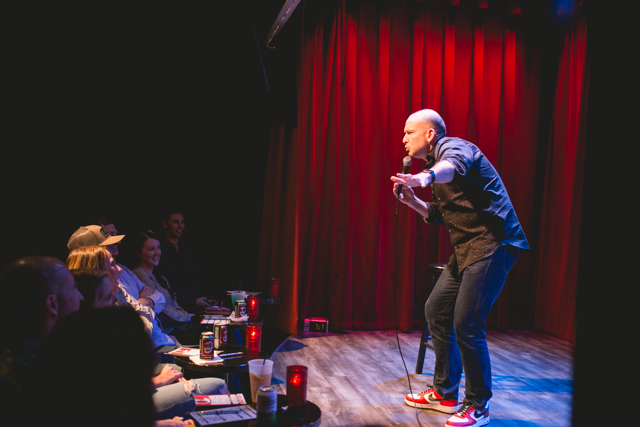
A lot of comedians have uncommon career paths (think Dr. Ken Jeong), but unlike Paul Ollinger, not many of them cannot say that they have an Ivy League MBA or worked at Yahoo! and Facebook. We chatted with the Atlanta-based comedian about his career transition, what his family thinks, and his brand new podcast, Crazy Money. New Yorkers can see Paul’s headlining debut at the legendary Caroline’s on Broadway this Wednesday at 7:30.
Downtown: Were you always a funny person?
Paul Ollinger: As one of six kids in my family, I only got 17% of my parents attention (rounding up). I had to fight for air time at our dinner table, so I hammed it up or said outrageous things to get a disproportionate number of eyes and ears pointed in my direction.
Downtown: What was the decision like leaving your corporate job to try stand up?
PO: I’ve done it twice. I left Yahoo! in 2005 (when I was single) and hosted every weekend at The Improv’s Orange County clubs in California. After two years, I got engaged, and decided I should probably go back to the corporate world (my future father-in-law agreed). In 2007, I joined a 250 person company called “Facebook,” which eventually empowered me to do whatever I wanted to with my career. Comedy was still my dream, but I feared failure and didn’t know how to get back into it. I dragged my feet, but in 2014, I started back at the open mics where I could bomb in anonymity until I earned my way onto the bigger stages.
Downtown: Who are some of your comedy inspirations?
PO: Write. Say it on stage. Prune. Re-write. Add tags. Say it on stage. Repeat 100x.
Downtown: How did being in the corporate world help you in the comedy world?
PO: My corporate career earned me the financial flexibility to follow my dream without sacrificing any of my family’s needs. There is no substitute for putting in the reps, but I’d be kidding myself if I didn’t acknowledge how much of an advantage having a nest egg is. I can afford to work as an out-of-town club’s feature act (the middle person on the show) that pays $300, or -$600, net of travel. There are plenty of other ways my corporate experience helps, but I don’t think I’d be doing this if I didn’t know how I was going to pay for my kids’ college education.
Downtown: What did your family say when you decided to go into comedy?
PO: I met my wife in the showroom at Caroline’s on Broadway. On our first date, I told her that I was going to quit my job at Yahoo! and pursue comedy. So it’s been there from the beginning, and – at the very least – I gave her an easy-out! In all seriousness, she has been nothing but supportive. She is okay with me telling jokes about our relationship onstage and is the first one to say “go for it,” when a new opportunity arises.
Downtown: Does she think you’re funny?
PO: Does any wife think her husband of a decade plus is funny?
Downtown: How did you decide to launch a podcast?
PO: I launched the Crazy Money podcast to explore how our relationship with money leads us towards or away from contentment in our careers, relationships and life in general. Having longed for wealth my whole life, its arrival was very different than I expected it to be. Awesome, but different, and I made a lot of mistakes. The show is a lighthearted approach to an important topic. I’ve already recorded episodes with Dr. Drew Pinsky (Loveline, Celebrity Rehab), three New York Times best-selling authors, and Ed Roland, the lead singer of Collective Soul. Find it on iTunes, Spotify, and Stitcher.
Downtown: What have you learned about yourself through your comedy journey?
PO: Chasing your dream is a huge privilege, but it’s freakin’ hard. To get good at a new craft, you have to suck at it for a long time first. Sucking isn’t fun, especially when you’re in middle age and were pretty good at whatever you were doing before. But there’s no avoiding the suck. You have to steer into it, and blast through it.
Downtown: What’s next?
PO: 1. Continue to improve as a dad, husband, comedian, and podcaster. 2. Be grateful for every day.
Yesterday, Apr. 6, the world lost Don Rickles. Born in New York City and raised in Jackson Heights, Don was a stand-up comedian for over 60 years. The world’s premier insult comic, Don was not only a go-to for roasts, yet also performed for multiple U.S. presidents. Also an accomplished actor (e.g. Casino, Kelly’s Heroes, Toy Story), he was the subject of an Emmy-winning documentary from John Landis a decade ago, Mr. Warmth: The Don Rickles Project. Among the talent that has already posted tributes to Don Rickles: Jim Carrey, Billy Crystal, Danny DeVito, Jimmy Kimmel, Barbra Streisand, Patton Oswalt and Judd Apatow.
Condolences go to the family and friends of Don Rickles, whose memory will surely live on thanks to YouTube.
Dick Gregory began his career as a comedian while serving in United States Army in the mid-1950s. His first big break came in 1961, when Hugh Hefner saw him perform and went on to hire him to work at the Chicago Playboy Club. An appearance on Tonight Starring Jack Paar followed not too long after, leading to countless other television bookings.
While “stand-up comedian” is how most people describe Dick Gregory, it is only one of the career paths he has excelled within. He was very active within the Civil Rights Movement, marching in Selma, and also being one of the notables involved with the National ERA March. He has written more than a dozen published books. He has appeared in movies and television shows as an actor, including Wonder Showzen. He has hosted radio programs. Dick has also thrived within the health food industry, founding Dick Gregory Health Enterprises, Inc. in 1984.
At 85 years young, Dick remains active as ever and will be playing at the B.B. King Blues Club & Grill alongside Richard Pryor’s main writer Paul Mooney on Feb. 10. Dick spoke to Downtown by phone about his history with New York, and some highlights of that chat are posted below. More on Dick — a very smart, talkative and entertaining man, to say the least — can be found at www.dickgregory.com.
When did you play New York City for the first time? What do you remember about it?
Dick Gregory: I was scared, not because of show business, but you know coming out of St. Louis and you hear about New York. I get there and I see all these fruit stores. “Hey man, where is the Mafia? Where is the gangsters?” I say, “Wait a minute, every time you walk down the street, every corner there is a fruit store.” That was the most wildest thing in New York. It is different now because you’ve got health food stores…But then every corner, there is three or four stores with people going in buying fruits and that was my biggest thing…I still can’t understand that today, every corner there is a newsstand…Wait a minute, newspapers? I never really heard anything where everybody in New York goes to buy a newspaper every morning. (laughs)
Do you remember the first club that you played at in New York?
DG: Oh yeah, The Blue Angel, probably one of the most romantic clubs in the world. I mean, that was the elite, that was like the Rolls Royce of clubs. So you go there, you see what I didn’t understand…What I found out in New York, those type of clubs people go out to spend money…They don’t eat nothing at no damn nightclub, you go to a restaurant and eat…The average bill at The Blue Angel was about, you know, maybe $2,000, because they came in there to drink. They didn’t come in to eat or get a sandwich…I hadn’t seen anything like it in my life.
You mentioned before about people eating fruit and eating healthy. New York City is very much known as one of the first places to advocate for eating healthy and eating organic. Where did your interest in that come from in the first place?
DG: Well, let me say this…I thought good nutrition is whatever you eat did not run out till you’ve had enough. Bad nutrition is when say you were still hungry. Now even back then, wasn’t nobody talking about organic, health food stores, not just in New York but nowhere…Let me tell you one of the myths about “organic.” People with little money say, “Oh I wish I could eat organic but it is too expensive.”
Well, here is what is “expensive” is: I’ve got a 20-year old car. I’d use three times more gasoline in a new car…And so “organic” is, “I am used to eating ten potatoes and now I am eating organic, all I have to eat is two and I get more nutrition with the organic than I did with the 10.” So the one thing that the industry has done a good job of is convincing people, you eat less and you get more…
Also, remember I am 85 years old. So when I was younger, you know nobody understood nothing about nutrition…I do a joke way back in the day, I said, “I go home to St. Louis, my drugged-out cousin, he is sitting on the park bench, cocaine dust on his nose, powder all over his coat, and I wake him up and say, ‘Hey man, here is an apple.’ He says, ‘Is it organic?’”
(laughs) Right.
DG: Now here is what most folks don’t know. If I am sitting with you and I cut my wrist, I bleed, right?
Sure…
DG: Once you cut an apple and people go get fruit salad, once that fruit salad is cut in the morning, it bleeds just like you do. So by the time you eat it, it ain’t got no nutrition in it and that is why when you go to the better restaurants in the world. Or in New York City, they make the salad right there at the table…
I used to drink a fifth of scotch every day, so after I changed my lifestyle and I didn’t drink, I was called a health nut. I used to smoke a full pack of cigarettes and nobody called me a health nut…so you can have some friends and you go in a bar, and you just pick a wine and drink it like the cowboys used to do. Just drink it down, give me another one then you change your lifestyle. Then you can go in and get you a six-ounce bottle of calcium and you can drink it down and they say, “You ain’t supposed to drink that much.” I say, “Nobody told me that when I was drinking whiskey.” (laughs)
Undeniably the most famous Australian stand-up comedian — and statistically the #3 comic in the world — Carl Barron has been making audiences laugh for nearly 25 years. Six years since his last live appearance in New York, Carl returns to our city later this month for a set of shows at the SoHo Playhouse. Appearing downtown on Nov. 15, 16, 18, 19 and 20, attendees will be witness to some of the most intimate shows that Carl has performed in recent memory.
In advance of his Nov. 10 show in Los Angeles, Carl spoke to Downtown about his upcoming Manhattan run and what else he has coming up. He came across as both funny and honest, which is also a good way of describing his observationally-oriented stand-up. For more info on Carl, visit www.carlbarron.com.
You performed in New York six years ago at 45 Bleecker. How was that experience?
Carl Barron: It was so good they closed the place down after I left. I guess they thought they couldn’t top it. I was nervous, but then again I usually am, even though people think I’m relaxed.
How did the opportunity to perform at SoHo Playhouse come about?
CB: We just asked.
I expect there will be some Australians in the audience at your New York shows, but I would imagine the majority of people attending have not seen you before. Do you feel any pressure to change up your material for the U.S. audiences?
CB: All I concentrate on is annunciating. I figure if they can comprehend what I’m saying they will probably laugh. I’ll try and be a little less dry and laconic as well. I guess in the end I will be unrecognizable to myself by the time I walk on-stage.
Are there any restaurants or attractions you’re hoping to visit while in New York?
CB: I like run-down places no one wants to go to. Factory walls, alley ways. I like drinking coffee sitting on a box out the back of a shop. I heard New York has lots of that kind of stuff, I can’t wait.
Photo: Jim LLE Photo
Other than doing stand-up, have you ever been to New York for a vacation or other travel?
CB: I’ve only been to New York to work. If the crowds don’t laugh this time, I guess next year it will definitely be a vacation. Be nice to relax.
After these U.S. dates, what’s coming up for you?
CB: Back to Oz and continue touring. That’s pretty much my bread and butter year round. I had a go at acting but they told me I was too good so I stopped. I didn’t want to embarrass anyone.
CB: I’d love to make a fool of myself. Sometimes I think I play it safe, so if I absolutely make an idiot of myself I know at least I’m having a go. If I had a child I would say to him or her: “I hope you grow up to be ashamed of yourself.”
CB: There is but we never really get famous people drop in. We have lots of unknown people pretending to be hot property, though — so I guess you could say “yes, yes we do.”
What was the last comedy show you attended as a fan?
CB: I saw Billy Crystal in Sydney this year. I felt nervous like I had to go up on stage. We made eye contact. that’s what I thought.
I really like your material about “living medium” and overall dig that your stand-up is observational yet personal. Is there a routine or bit that you are most proud of?
CB: I’ve always wondered why in the middle of a really long story people suddenly feel compelled to stop and tell you they are cutting it short. Why don’t they start with the short version? I don’t know it’s the short version? I won’t be annoyed if they only told me the short version. This actually annoys me.
When not busy with your career, how do you like to spend your free time?
CB: Lately I have been getting up in the morning and staring out the window while drinking a cup of tea. I’ve never felt as happy as I do when I can just stare out the window without wanting anything. Except another cup of tea.
Finally, Carl, any last words for the kids?
CB: Yeah, please don’t take anything seriously. It really is one big massive joke.
2016 has been the year of years for comedian Quincy Jones, and it’s barely halfway over. His break-out appearance of Ellen led to Quincy getting his first HBO special. He has also popped up on Conan, CNN and WTF With Marc Maron, following major features in the Los Angeles Times, GQ and the Boston Globe, leading this writer to wonder what else the Seattle native could possibly accomplish this year.
Quincy returns to the area on Jun. 30 with a headlining appearance at Brooklyn’s Littlefield. In advance of the Littlefield appearance, Quincy spoke to Downtown about his past, present and future. He can followed on Twitter and visited online at notthatquincyjones.com
The past six months have been quite the rollercoaster for you. Is this the most comfortable that you have ever felt as a comic?
Quincy Jones: Comfortable? I don’t think one can ever truly feel comfortable, but I feel a little more secure and respected as a comic.
Prior to this, did you ever feel as if you no longer had to worry about keeping a side job or doing something else for a living?
QJ: I’m a workaholic, so I always worked a few jobs especially here in Los Angeles. I now don’t have to make coffee drinks to pay rent and that’s the best feeling in the world. NO MORE LATTES! (laughs) One does still have to work to stay in this position.
Now that you’ve accomplished your goal of having a special on HBO, do you have a new goal that you are working towards?
QJ: I’m working on a show with my friends Peter and Frank. I’m also trying to hit the road a little more, working on my health, possibly writing a book, and working on an album. Trying to stay busy!
Was having a special on HBO everything you had dreamed it would be?
QJ: HBO is an amazing company and they have welcomed me in and treated me like family. It wasn’t everything I thought it would be, it was so much more! To think I’m on the channel I watch the most — man, it’s an amazing feeling!
Is that the accomplishment that you’re most proud of? Or is there something else that you look back on most fondly?
QJ: Comedically, this year has been the craziest! I think the special airing is the most, followed by being on CNN, and Conan. It just inspired me to work harder to get back on these programs or create my own.
Has the real Quincy Jones reached out to you? Or anyone else in his family?
QJ: No, but I would love to hear from Quincy Jones or Rashida. (laughs)
Do you have a favorite Quincy Jones production?
QJ: “Give Me The Night” by George Benson! The use of the guitars and keys and background singers is amazing. Makes me dance and reminds me of growing up in my mom’s house. I LOVE this song and of course every MJ collabo.
On your recent appearance on WTF, you had mentioned that getting onto that podcast was one of your goals. Do you remember the first time you had heard that show?
QJ: I first heard the show back in 2012 when I was loving Hannibal Burress and wanted to know everything about him.
How does the on-air Marc Maron compare to the off-air Marc Maron?
QJ: Marc is a really nice guy who is his honest self. He’s genuine, nice, and most importantly, funny and hardworking. Very self-aware.
You’ll be performing at Littlefield on Jun. 30. Will you be doing new material? A mix of old and new?
QJ: I’m about 40 to 45 minutes into my new hour. So it’ll be new. I just hope people come and my friends aren’t performing to empty chairs. (laughs)
What do you remember about the first time you ever performed in New York?
QJ: The Stand, and Broadway, and UCB East were the first places and I will never forget the amazing staff, crowds, and me falling head over heels in love with performing in the comedic Mecca. I felt like I had truly arrived!
When you’re not busy with your career, how do you like to spend your free time?
QJ: I love movies, shopping for vinyl I’m never home to listen to, karaoke, and traveling. Family is important, so I try to make my rounds to see them. A simple man who really just enjoys life in all of its confusing emotional splendor!
Finally, Quincy, any words for the kids?
QJ: No comic’s journey is the same. Don’t worry about who has what and when they have it. Set a goal and work towards that diligently. Remember; no one in history has ever worked hard, been kind, and gotten nothing in return. Relax, enjoy the ride and realize how much fun comedy is and we are lucky to do this even with all the B.S. that comes with it.
NEW YORK - APRIL 27: Radio personality/comedien Artie Lange attends the Howard Stern Film Festival at The Hudson Theater April 27, 2006 in New York City (Photo by Roger Kisby/Getty Images)
Having worked steadily in TV, film and radio for the past 20 years, Artie Lange is one of today’s most recognizable comics. You may have first discovered him as a cast member on MADtv, as Norm Macdonald‘s sidekick in Dirty Work or as Jackie Martling‘s replacement on The Howard Stern Show. Regardless of how you initially encountered Artie, he is still off-the-charts funny. And still challenging societal norms on a regular basis.
Fast-forwarding to 2015, Artie Lange launched a podcast – simply titled Artie Quitter – earlier this year. He currently has a third book in the works with Anthony Bozza, which isn’t surprising considering that their first two titles were on the New York Times best-seller list. Last year, Artie had a special on Comedy Central titled The Stench Of Failure. In spite of that stand-up program’s name, you’d be hard-pressed to think of someone who’s appeared on a Jimmy Fallon talk show more frequently than Artie.
Coming up in just a few weeks, Artie will be headlining two shows on October 4th during the fifth annual Hoboken Comedy Festival. Artie and I talked about the festival, among other topics, within our interview — as set up by podcast producer Dan Falato — at his spectacular Hoboken home.
Rumor has it that you don’t have e-mail or own a computer.
Artie Lange: I own computers, there’s other people in my life using them. I don’t do e-mail. I’ve never sent or received an e-mail, I text. I don’t like checking a bunch of stuff in the morning. You get up now, you check Twitter, Facebook, voicemails, e-mails — what am I, the head of Ciba-Geigy or something? I’m a comedian. People that e-mail me shit, like agents, just text me. If it’s long, they e-mail to Danny, my producer, and he just prints it out.
So you have the podcast, you have your stand-up, it looks like you’re doing one or two dates a month for the moment.
A: One or two dates a month, and I got a third book deal, which is nice. Me and my partner [Anthony Bozza] that I wrote two books with, both [New York Times] best-sellers, we got a third book and we’ll write it this year.
I believe you said on your podcast that the focus of the third book is going to be letters to athletes.
A: It’s a joke book about me being mad at athletes that cost me money gambling, and I insult them. Crazy gambling stuff.
I know that’s going to be great.
A: We have a whole chapter calling the ’86 Celtics “the ugliest team ever” and we have pictures explaining why…The last page will be a picture of me and I’ll invite the athletes to insult me, but each chapter I insult people who cost me money.
Was there pressure to do a third book that was non-fiction?
A: No, I guess I’ve got enough stories for a third book like that. When they came to me with this, because it was their idea — the book company came to me — they said “You had two best-sellers, you can probably get a third deal. We’re more interested in a lighter fare.” I said fine.
So ultimately with the podcast being a creative outlet, do you have any business aspirations for it? Are you hoping to parlay it into a radio show? Or do you just say that this is a podcast and I enjoy doing the podcast?
A: I’d like it to grow with subscribers. Obviously I want money like anybody. Right now, it’s at a point that it makes enough money where I’m happy. I would like to see it grow, but again, I have ideas for TV shows and movies. I still have a career, thank god, in mainstream show business. I’m always looking to that.
Let me ask about that, your movie Beer League was very successful…
A: Well, sort of. It made money, not a lot, because it cost so little.
But I think any movie that makes a profit is ultimately successful.
A: People really like it. Frank [Sebastiano], who I wrote it with and directed it, and I are very proud of it. For better and worse, no one fucked with us, no one gave us notes, it’s all of our jokes we wanted. It’s a Rated R comedy, the way we wanted to experience Slap Shot. People quote that movie like it’s Caddyshack, it’s crazy. I can’t believe the amount of people that love it. We’re very proud of it, I love it, it got good reviews too.
I see that it played at a film festival in New Jersey last year, which has the makings of being a cult comedy.
A: It’s in that league of a cult comedy. That and a film I did with Norm [Macdonald], Dirty Work, I consider kind of cult-ish, and I’m proud of being in a couple of cult movies.
Norm came up during today’s podcast. It’s safe to say that a lot of people think of you when they think of Norm, and a lot of people think of Norm when they think of you. But the last time you two worked together I think was The Norm Show.
A: Pretty much. Well that’s not out of any…it’s just that he lives in L.A., I’m in New York, there’s no time…We talk about stuff every once in a while. We almost did a stand-up tour, we played around with a GoFundMe thing for Dirty Work 2. We would love to [do something], just nothing’s come up.
Well, why not at least try and do something on GoFundMe?
A: Well, neither one of us are real go-getters (laughs). But it might happen, you’re right, why not?
Photo: Jeff Carton From L to R: Darren Paltrowitz, Chris Cotton, Dan Frigolette, Geno Bisconte & Artie Lange
What would it take? Someone petitioning you guys? Some people started a petition to try and get Norm the Late Late Show a while back…
A: I think he started that (laughs). Norm is one of the funniest people I’ve ever met, might be the funniest. The smartest, funniest, a true original. The worst insult you can give another comedian is that you call them a hack, derivative. Norm is the direct opposite of a hack. He’s a comic’s comic and people love him. But, you know, with me and him, people I guess think we’re a little crazy. He would be an amazing talk show host.
I agree, I thought that Sports Show [on Comedy Central] was one of the most underrated talk shows there ever was.
A: Basically, what talk show hosts do is they tell jokes and interview people. Norm is an interesting interviewer, we know that from the podcast he did, and he’s probably the best joke-teller.
So have you ever thought of taking your skills with radio and your knowledge of sports and try to become a proper sports broadcaster? Or does the possibility of censorship scare you?
A: I have no interest in that. It’s too mainstream. The sports world is very full of themselves, I learned that with the whole Joe Buck thing. They’re very uptight. It’s like they’re in a classical opera or something, they need to calm down, so I have no interest in that. DIRECTV I got in trouble with, I’m a comedian, I’m not looking to be Bob Costas.
Is it safe to say that your career is exactly where you want it to be? You work on the projects you want to work on, you have a few irons in the fire…
A: No, my career isn’t where I want it to be. Leonardo DiCaprio’s career, if I had that, then it’d be where I want it to be (laughs). You know, again, in show business, you’re always looking…I must say I am comfortable, it’s probably because I’m not a “type A “personality, I’m not a good businessman, I’m lazy, I happen to love something that I’m pretty good at that you can make pretty good money with. I’m wealthier than the average person not because I’m a good businessman, but because I make a lot of money doing stand-up, and I do a lot of it. I should have more money. I am comfortable being a C-List, under-the-radar comedian who makes good enough money to live a comfortable life. I must say there’s comfort in a little anonymity and you can be a little more rebellious. I like being an outlaw, comics like being outsiders, looking in, making fun of everything. But once we get in, we’ll take it. I guess maybe part of me is a little afraid of to go up more because I’ll be exposed for a lot of crazy shit I’ve said. I get away with a lot of shit on this show simply because it’s not that big of a show.
I think you’re selling yourself short in terms of how many people know you and pay attention to you.
A: No, I’m definitely a famous person. People recognize me and all that. But I’m a C/B- minus person on a good day and I like that.
Do you feel that, in general, that there are any misconceptions about you? I think you’re interesting in the sense that a lot of people love you unconditionally, and other people are hugely turned off by you, may be offended by some of the controversial statements and don’t understand any of the irony.
A: I think I’m very approachable. I don’t try to do that, I’m not some sort of big genius. What you see is what you get and I think most people relate to that. Other than the fact that I have an interesting career where I make good money, I don’t think I give anyone a reason to be jealous of me. I’m not the guy who’s going to steal your girlfriend, like a movie star. I think that people relate to me and come and say hi. I always am nice to people. As a comic and my persona, I can throw a little charm out of where I get away with offensive stuff more than someone who’s hatable. It doesn’t always work but mostly. I have a very loyal fanbase, they are very nice to me, I love them. There’s an affection there, you really connect to people on the radio, where people are genuinely concerned about me. So you’re right, most people are nice, and the other controversy stuff, it just goes away.
So that’s not something you dwell on?
A: I like it, especially with the political-correctness. I did a set at the Comedy Cellar last night, these young people, I try to upset them. They have such an anger, they’re so easily offended. I tried to get them mad.
Finally, Artie, any last words for the kids?
A: Try not to take yourself so seriously, some things are just jokes.