Categories
Business Finance News NYC Real Estate

A New York Story

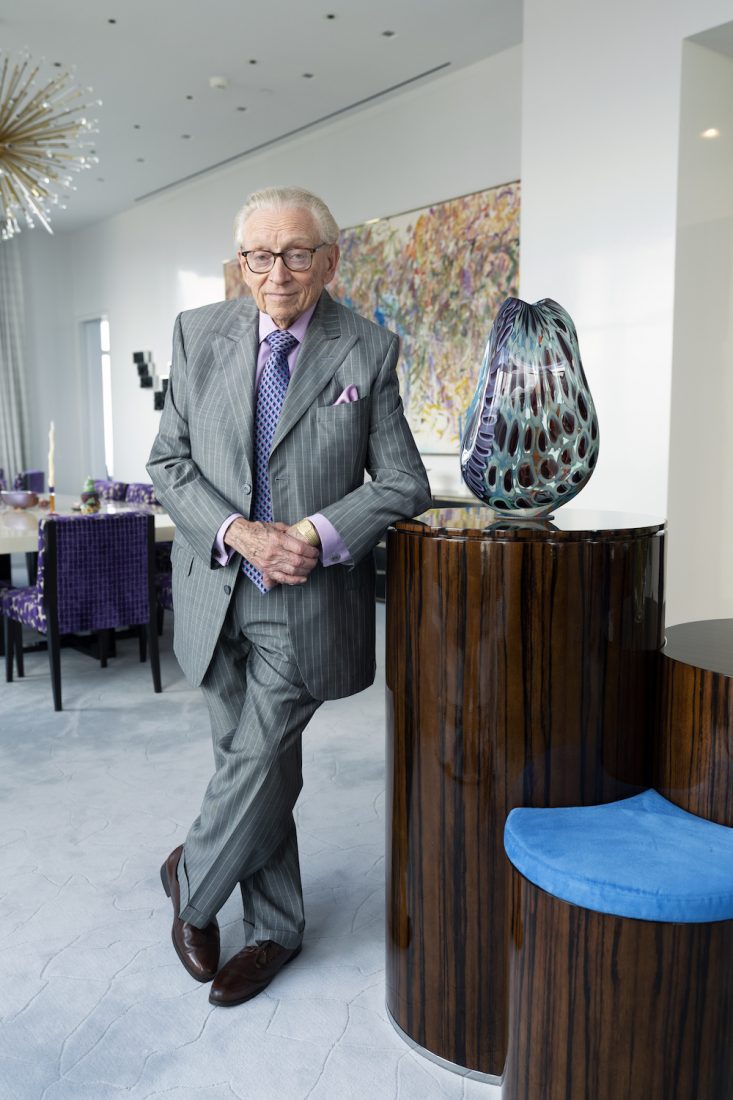
Larry Silverstein has spent a lifetime shaping the New York City skyline. He isn’t done yet.

Photography by Andrew Matusik

“BUY CORNERS,” Larry Silverstein replies without hesitation when asked what the most important lesson is that his father Harry taught him about the real-estate business. “If you buy a corner, you have frontages on at least two streets, right? And if you get lucky enough to be able to buy a block front, that gives you even more possibility.” Trained as a classical pianist, Harry had struggled to provide for the family during the Great Depression, eventually becoming a commercial real-estate broker to make ends meet.

Curious about the business, Larry went to work for his dad after graduating from N.Y.U. in 1952. “Something that hit me very early on,” he recalls, “is that I wanted to own something. I wanted to be an owner.” Lacking cash for a down payment, the Silverstein father-son duo took a page from Harry Helmsley and Lawrence Wien’s playbook, scraping together a syndicate of investors to buy their first property, a shabby industrial loft building on East 23rd Street, in 1957. It may not have been a corner property, but they made it work by converting it to office space and leasing it out to white-collar firms. “It was sink or swim,” Larry says of their first venture. “Failure was not an option.”

Silverstein, who turned 90 in May, still reports to the office almost every day, invariably dressed to the nines in a double-breasted suit with a colorful tie and matching pocket square, dispensing friendly salutations to everyone he passes along the way. But behind the elegance and old-school charm, the Brooklyn grit and street smarts remain. “It was not a very luxurious existence,” he recalls of his upbringing on the top floor of a six-story walkup in Bed-Stuy, “which wasn’t nearly as trendy of a place as it is today.”

THE REBUILDING

That Brooklyn grit would come in handy when it came to rebuilding the World Trade Center. When Silverstein acquired the Twin Towers in July 2001, he could never have imagined that within months they’d be gone—and he’d be stuck with a 99-year lease that obligated him to continue paying the Port Authority, which owns the site, $10 million a month in ground rent. The lease also stipulated that he rebuild all the office and retail space that had been destroyed on 9/11.

To make matters worse, quite a few of the two dozen companies that had insured the towers—to the tune of $3.5 billion—were refusing to pay Silverstein’s claims. It took five years of litigation and the intervention of New York governor Eliot Spitzer to finally move the needle. “I called him, and I said I can’t collect,” recalls Silverstein. “So, he brought them all to New York and told them, ‘The courts have found that these are your obligations, so if you don’t pay, you’re never gonna do business again in the state of New York.’” In May 2007, they finally agreed to pay Silverstein the $2 billion he was still owed, marking the single biggest insurance settlement in history. A tidy sum indeed, but still not nearly enough to fully rebuild the Trade Center.
Fumihiko Maki Larry Silverstein Norman Foster and Richard Rogers photo by Joe Woolhead
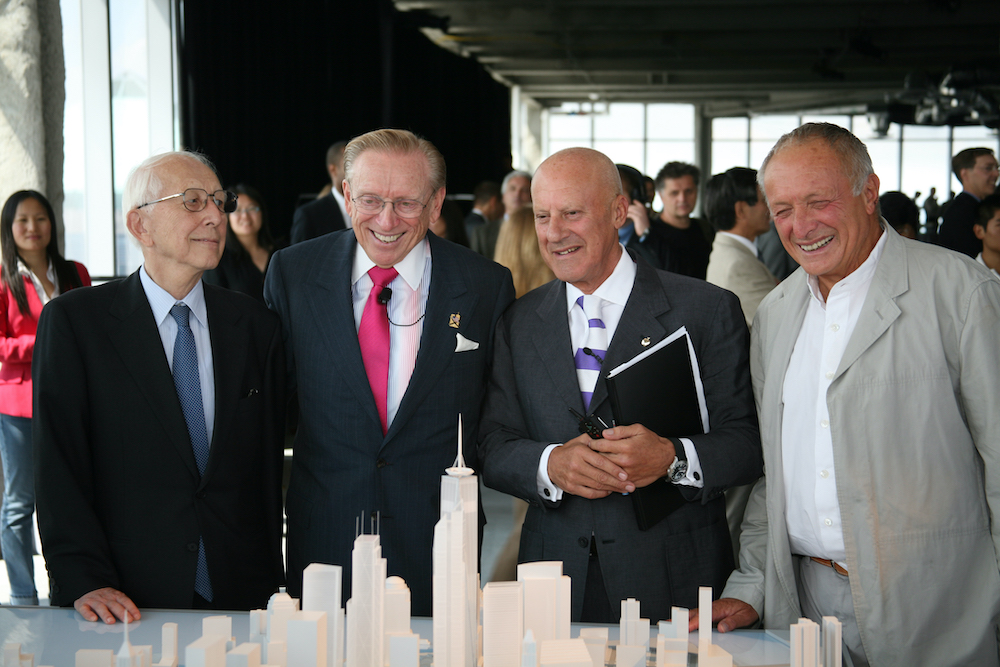
STARCHITECT LIFE: Prtizker-prize winning architects Fumihiko Maki, Lord Norman Foster, and Lord Richard Rogers, with Silverstein, in front of an architectural model of the World Trade Center campus. Maki designed 4 WTC, Foster’s 2 WTC is expected to begin soon, and Rogers designed 3 WTC. (Photo credit Joe Woolhead)

Despite the many professional battles, Silverstein says it was the “naysayers” who personally affected him the most. “The negative voices kept telling me I would never succeed,” he says. “No one will ever come down here. No one will ever rent space. Why are you wasting your time?” Yet he remained determined to rebuild. Not for personal gain—he stood to make little money from the effort and was already well beyond retirement age—but because otherwise would signal defeat. “If you don’t rebuild it, then the terrorists have won, right? I absolutely couldn’t let that happen.” When pressed if there was ever a point at which he doubted that rebuilding office towers adjacent hallowed ground was the right thing to do, his answer is immediate and unequivocal: “Never.”

“[Downtown is] young, it’s vibrant, it’s enormously exciting. Should add ten years to our lives.”
Larry Silverstein at opening of 3 WTC.
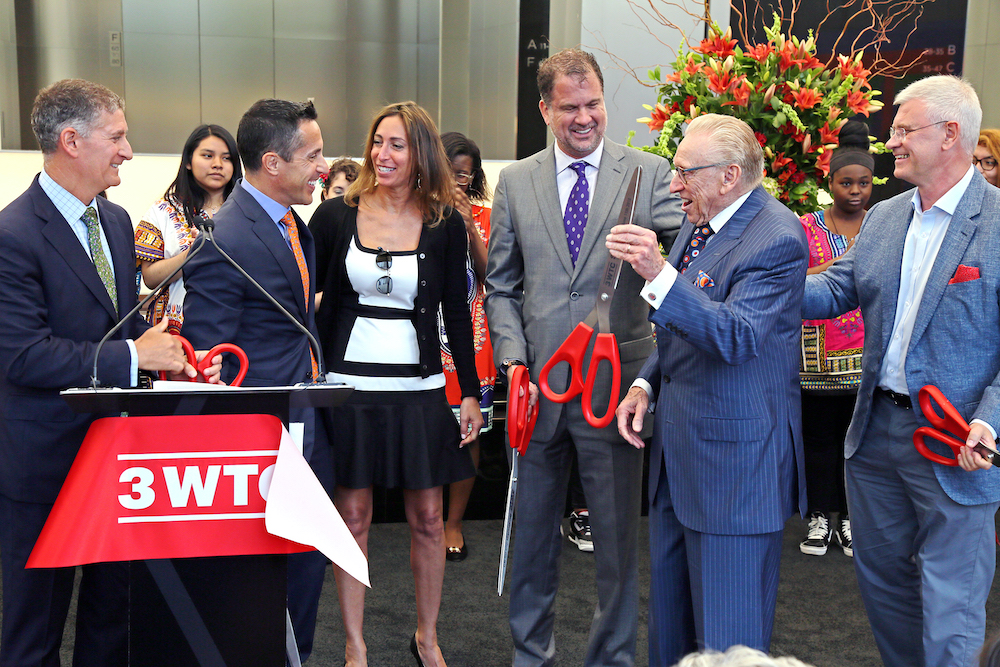
OPEN FOR BUSINESS: Silverstein at the opening of 3 World Trade Center in 2018, with CEO Marty Burger, President Tal Kerret, daughter Lisa, son Roger, and architect Richard Paul. Photograph by Joe Woolhead.


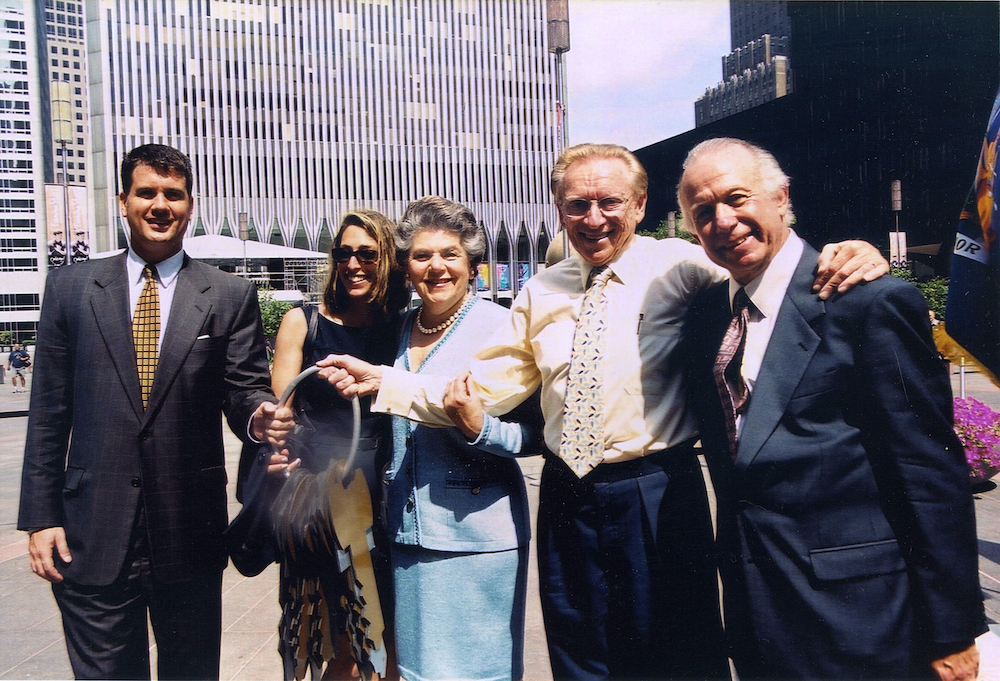
Roger, Lisa, Klara, Larry, and Lenny Boxer pose with the ceremonial keys to the World Trade Center on July 24, 2001.


NEW KID ON THE BLOCK

“When we bought the Twin Towers, this place was a ghost town,” Silverstein recalls. “After six o’clock, you could roll a bowling ball down Wall Street or any place you wanted.” But after watching the neighborhood evolve after 9/11—and after more than 30 years in the same Park Avenue apartment—Larry and his wife of 65 years, Klara, decided it was time for a change.

“Something that hit me very early on is that I wanted to own something. I wanted to be an owner.”
Larry Silvestein
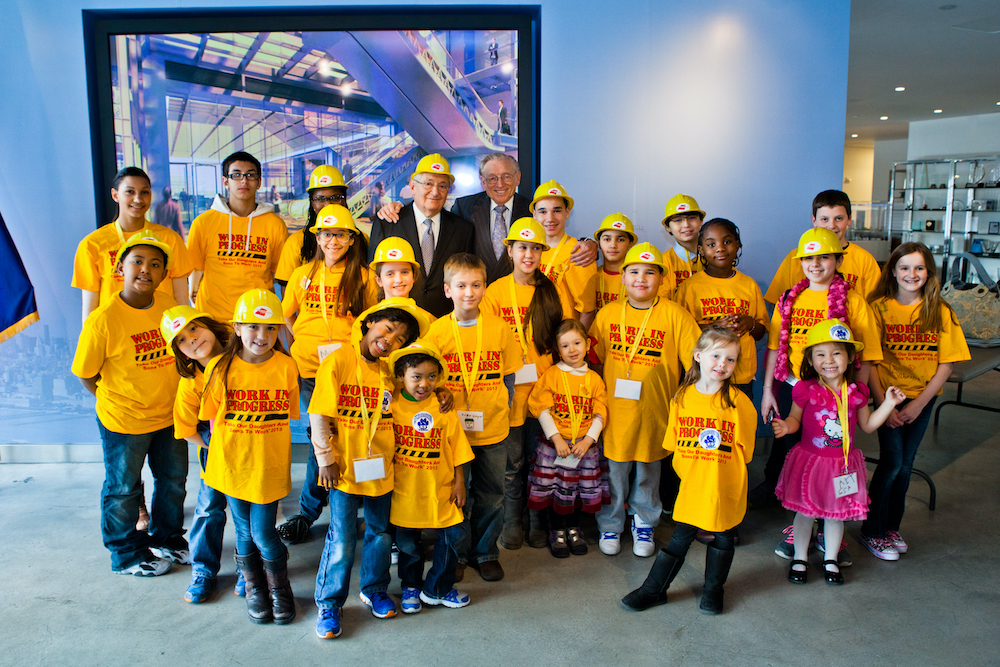
Larry Silverstein poses with the children of some of Silverstein Properties’ employees during “Take our daughters and sons to work day ” in 2013.

So, in 2018 they moved into a penthouse at 30 Park Place, one of his developments. The 82-story tower, designed by Robert A. M. Stern to look as if it could have been built a century ago, opened in 2016 and includes residences atop a Four Seasons hotel. “If you look far enough,” Silverstein jokes about the view from his 80th-floor terrace, “you can see the curvature of the earth.”

“Two things really tipped the scale in favor of moving down here,” he explains. “Number one: my grandson said, ‘Poppy, if you move down here, I’ll show you how to go to work by skateboard every morning. It’s two blocks, downhill, piece of cake.’” Number two was
the rejuvenated neighborhood. “It’s young, it’s vibrant, it’s enormously exciting. Should add ten years to our lives.” Downtown’s residential population has more than tripled since 9/11, and according to Silverstein, the area now has the highest work-live ratio in the country: 27 percent.

That ratio will soon tilt even more residential. Last February, the Port Authority awarded Silverstein—in partnership with Brookfield Properties and two other firms—the rights to build 5 World Trade Center on the site where the plagued Deutsche Bank building once stood. The sleek 900-foot-tall tower, designed by Kohn Pedersen Fox, will feature more than 1,300 residential units, a quarter of which will be set aside for households earning less than 50 percent of the neighborhood’s median income.

While significant obstacles to groundbreaking remain, so does Silverstein’s trademark eternal optimism. Not only will the new tower be a model of energy efficiency and sustainability, he says, but “the firms that take office space at the new World Trade Center will be able to house their employees in the same campus if they want to, which is pretty damn unique, right?”

PRESERVING HISTORY
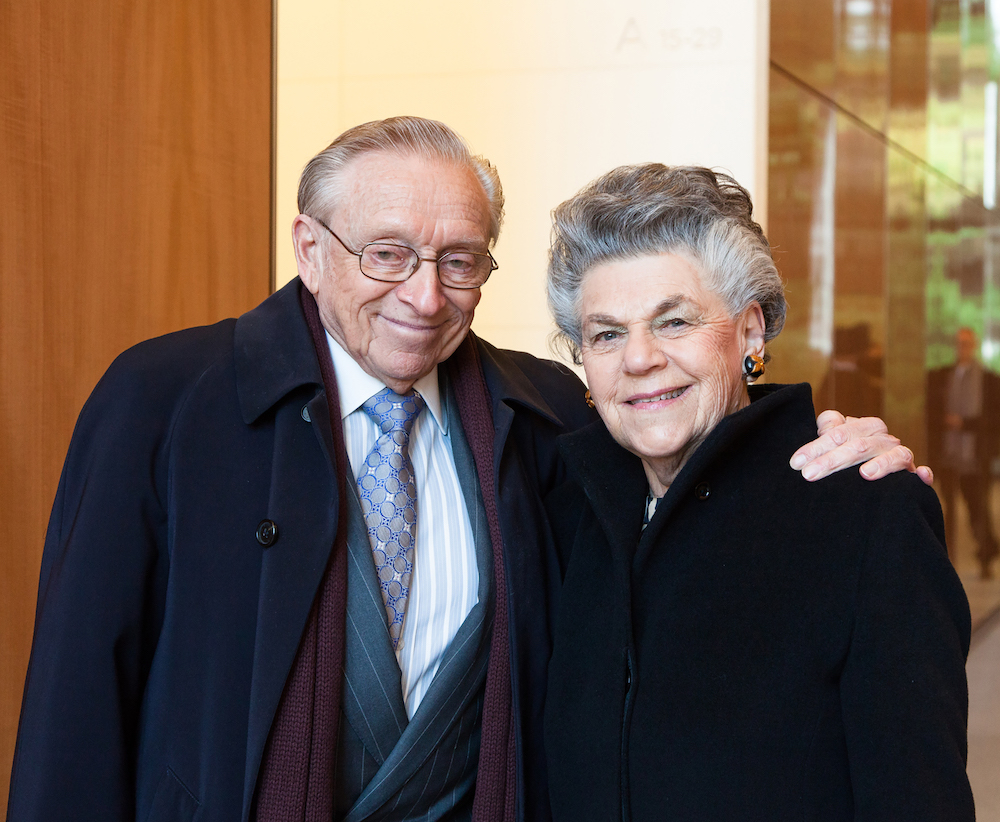
LOVE STORY: Larry and Klara Silverstein in the lobby of 4 World Trade Center.

Silverstein’s earliest memory of downtown is of the “extremely tall, very impressive buildings.” Little did he know he’d one day own one of them, 120 Broadway. Known as the Equitable Building, it became the biggest—if not the tallest— skyscraper in the world when it opened in 1915, occupying an entire city block between Cedar and Pine streets. It was so big that it spawned the city’s 1916 Zoning Resolution, which limited new construction to a percentage of lot size to ensure at least a modicum of sunlight could reach the surrounding canyons.

When Silverstein bought the landmarked building in 1980, many of its historic details had been neglected, if not concealed outright. “The previous owner had no feeling, no sensitivity to the importance of historic landmarks,” he recalls. “They hung acoustical drop ceilings without any kind of architectural detail at all. Added fluorescent lights and so forth. It was dreadful.” So, Silverstein immediately set about renovating it, carefully restoring such original details as the terra-cotta window frames and the lobby’s Tennessee-pink-marble floor, and vaulted, coffered ceiling with carved rosettes. “It makes such a difference,” he says. “Tenants appreciate what a detailed restoration can produce.”

ART & COMMERCE

Something tenants also appreciate, Silverstein says, is art. When he opened the original Seven World Trade Center, in 1987, he immediately realized he had a big problem on his hands. “I looked at the lobby, and I said to myself, I’ve gone crazy.” He explains that he had “fallen in love with” a particular carmen-red granite he’d personally selected from a Finnish quarry for the building’s façade.

But he didn’t stop there. “The entrance to the building? Carmen-red granite. The toilets? Carmen-red granite. The elevators? Carmen-red granite. Everything! Carmen-red granite. The place looked like a mausoleum.” He called Klara in a panic and asked her to come down and have a look for herself, hoping maybe she wouldn’t think it was all that bad. “One look around and she said, ‘You know what? Looks like a mausoleum.’”

They agreed the lobby could use some art to spruce it up, so they set about scouring the city for contemporary works large enough to adequately cover all that carmen-red granite. One of their first purchases was a fourteen-by- six-foot Roy Lichtenstein entablature. Works
by Frank Stella, Ross Bleckner, and Alexander Calder soon followed. “We ended up collecting a whole realm of first-class contemporary art,” he says. “That taught me something, that is art has a huge impact on people’s attitude towards buildings, a very positive attitude. It made an enormous difference.”

“We ended up collecting a whole realm of first-class contemporary art. Art has a huge impact on people’s attitudes towards buildings.”
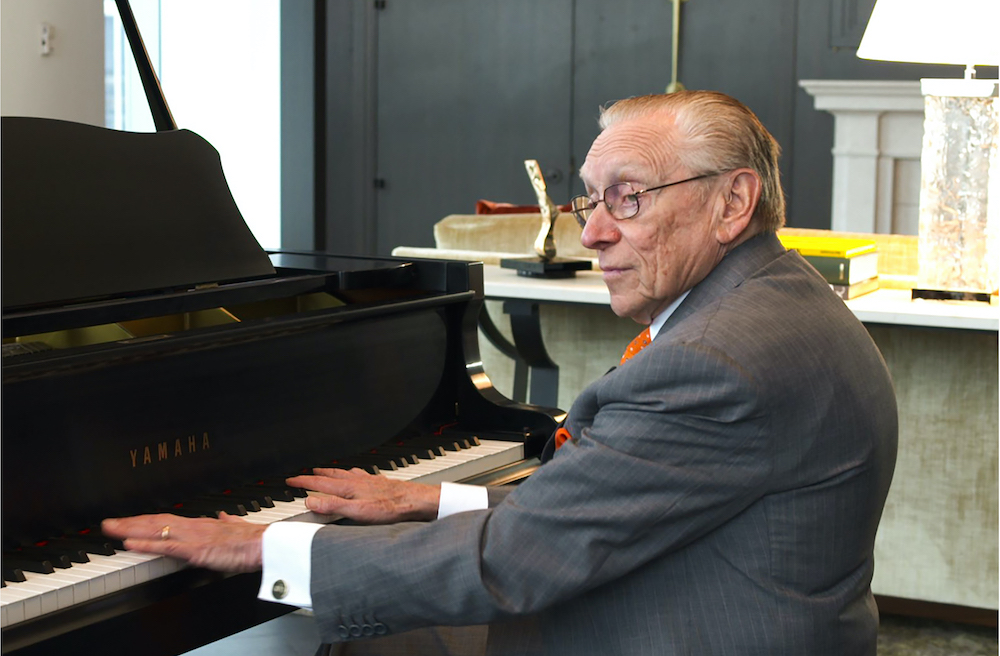
Larry Silverstein at the piano.
AT HOME: Larry Silverstein at the piano.

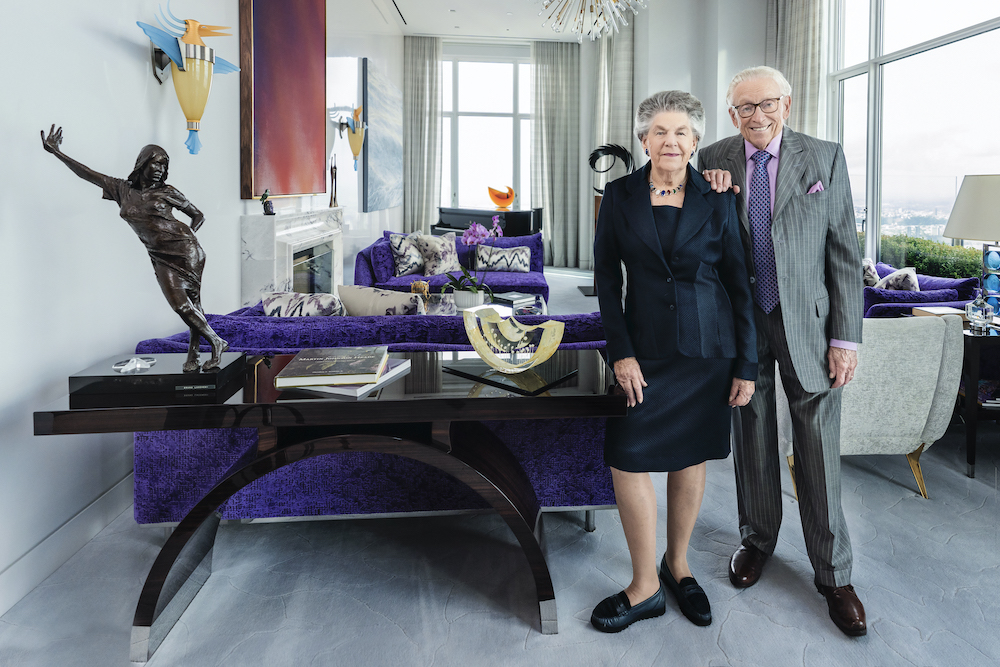
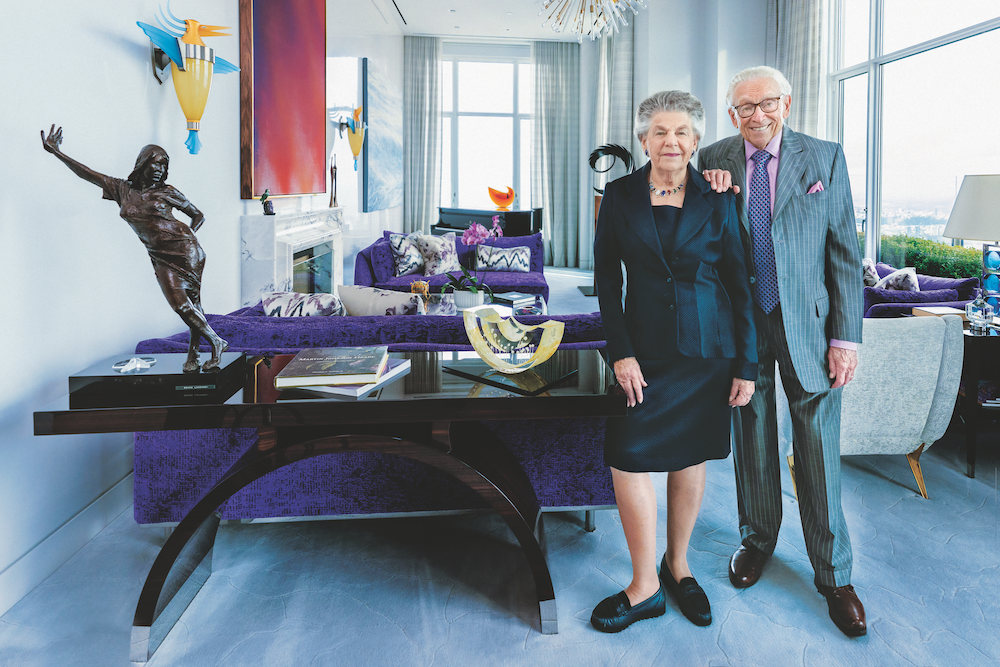
Larry with his wife Klara, in their apartment atop the Robert A.M. Stern designed 30 Park Place.

“Whether I’m still around or not, the Trade Center will be done. And what we will have put back is vastly superior, not just in terms of quality or architectural design. The parks, the neighborhood-totally transformed.”

Art plays a bigger role than ever in and around the new World Trade Center campus. Not only are there remarkable lobby installations, like Jenny Holzer’s “For 7 World Trade” and Kozo Nishino’s “Sky Memory,” Silverstein even hired street artists Stickymonger, Ben Angotti, and BoogieRez to paint the corrugated metal walls that sheathe the base of what will eventually become 2 World Trade Center, now an entrance to the transit hub.

BACK TO WORK

“There’s been no shortage of naysayers all over again,” Silverstein replies when asked if he sees parallels between post-9/11 and post-pandemic downtown. “New York is done, finished. No one’s ever coming back. The office buildings are gonna be vacant. Fold up the tent and steal away into the night.” Not surprisingly, he’s as sanguine as he was after 9/11 about the potential for recovery after covid. “Will it be 100% back to the way it was? No, I don’t think so. But people will come back. Of course. It’s gonna happen. So much comes out of talking together around the water cooler.”

And what does he think downtown will look like in another 10 years? “Well, whether I’m still around or not, the Trade Center will
be done,” he says. “And what we will have put back is vastly superior, not just in terms of quality or architectural design. The parks, the neighborhood—totally transformed.”

“Buy corners” may have been the best professional lesson Harry Silverstein imparted to his son, but it’s this bit of wisdom that endures: “Whatever you do in your life, be truthful with people,” Harry told him. “And never equivocate.” Impeccable advice for an age where truth has become all too relative. DT
Categories
Business Featured Industry News Lifestyle News NYC Travel

Governor Hochul Announces MTA Board

DOWNTOWN’s board member Elizabeth Velez was named to the board of MTA,  along with Janno Lieber as Chair and CEO of the MTA Board.

“We’ve been fortunate to work with both Elizabeth and Janno, a perfect pair to ensure the continued success for MTA, and we are excited to see what the future holds for our public transportation system. We wish them the best in their newly appointed positions,” says DOWNTOWN’s publisher and founder,  Grace A. Capobianco., 

Governor Hochul today announced Janno Lieber has been nominated to serve as Chair and CEO of the MTA Board and Elizabeth Velez has been nominated to serve on the MTA Board.

“As Governor, my first duty to New Yorkers is to ensure that those who serve our state are experienced, committed, and ready to tackle the challenges we face,” Governor Hochul said. “Janno is leading the MTA forward with expert management and vision, and Elizabeth will bring a wealth of invaluable knowledge and expertise to our challenges together. These are strong, competent leaders who will help steer the MTA through this critical time. We will continue to make appointments that ensure our transit system delivers for riders.”

“I am honored and grateful to be nominated by Governor Hochul, who has been a supporter from day one of a smart transit system that serves all New Yorkers. I look forward to working with the governor, her team, and our partners in the legislature to ensure that subways, buses, and commuter railroads continue to be an engine fueling the region’s economic recovery,” Janno Lieber said. “Elizabeth Velez has a deep understanding of the value of transportation to New Yorkers, will be an excellent addition to the board and I’m eager to work with her on important issues facing the MTA, including a historic capital program that will modernize and expand the transit network and provide enhanced equity and accessibility to New Yorkers in the years ahead.”

“I am thrilled to be nominated by Governor Hochul to the MTA Board,”  Lieber said. “The MTA is a crucial connection point for New Yorkers throughout our city. With the impending influx of infrastructure dollars, the MTA is central to not only improving essential transportation but also to create opportunities both in workforce and procurement that affect our communities.”

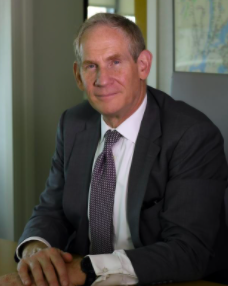
Janno Lieber will be nominated to serve as Chair and CEO of the Metropolitan Transportation Authority Board. He has been Acting Chair and CEO since July 2021.

Janno Lieber photo by MTA

In his role at MTA Construction and Development, Mr. Lieber oversaw the agency’s $55 billion five-year capital program, including State of Good Repair investments in infrastructure and facilities of New York City Transit, Long Island Rail Road, Metro-North Railroad, and MTA Bridges and Tunnels. He is responsible for upgrades to signals and other major systems, system expansions, and mega-projects such as East Side Access, the second phase of the Second Avenue Subway, and the Third Track expansion of the Long Island Rail Road mainline. He is also responsible for upgrading and professionalizing the MTA’s project management capacity and for integrating real estate planning and economic development into MTA infrastructure projects.

From 2003 to 2017, Mr. Lieber served as President of World Trade Center Properties LLC, where he was responsible for managing all aspects of the Silverstein organization’s efforts to rebuild the World Trade Center site, including planning, design, and construction issues; business, financing, and legal matters; and public affairs, government, and community relations.

Earlier in his career, he held positions in the administrations of President Bill Clinton and NYC Mayor Ed Koch and worked as an attorney in private practice.

Elizabeth Velez will be nominated to serve on the MTA Board. She is currently the President of the Velez Organization, a second-generation construction firm started in1972 by her father, Andrew Velez.


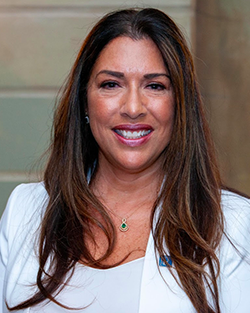
Elizabeth Velez photo by Velez Organization


To her credit are hundreds of projects which have come to fruition under her direction, including over 600 units of housing made affordable by state and federal grants in the Bronx and Harlem, and over ten billion dollars of significant educational, healthcare, and large-scale projects throughout New York.

She is a Trustee of Boricua College; an accredited private institution serving primarily Latinas through three campuses in New York. She serves on the advisory boards of numerous New York City and New York State agencies, industry non-profits, and groups supporting mentorship and scholarships for youth. She is a member of the Board for Catholic Charities and the New York City Police Foundation. She is currently serving as a Commissioner of the New York City Property Tax Reform Commission. Following Hurricane Maria’s disastrous landfall, Elizabeth was appointed to the NY Stands with Puerto Rico Recovery & Rebuilding Committee, the NY Memorial Commission for Hurricane Maria, and has spearheaded numerous workforce and economic development programs – including a satellite corporate office in Ponce Puerto Rico. On the international front, Ms. Velez is Co-Chair of Iran 180 – an organization that advocates for human rights and the end to Iran’s nuclear threat. She is a contributor to media outlets such as Matter of Fact TV with Soledad O’Brien, Fox News Latino, The New York Daily News, The Wall Street Journal, El Diario, La Prensa, Hispanic Business, ENR, City & State, and Crain’s New York Business, and most recently, DOWNTOWN Magazine.

She is an outspoken advocate for diversity and empowerment of women and a sought-after speaker on women’s leadership and work/family balance issues. In addition to numerous awards and recognition, Ms. Velez was recognized by City & State as one of the “Manhattan Power 50“.

Help us in congratulating both Janno Lieber and Elizabeth Velez.

Reposted from https://www.governor.ny.gov/news/governor-hochul-announces-nominations-mta-board

Categories
Featured News NYC

What is took to Rebuild the World Trade Center

The World Trade Center in a pivotal era of rebuilding

A wealth of information exists out there on what happened during the 9/11 attacks. Documentaries, films, podcasts, books, you name it: most are a few clicks away. Yet considerably less so exists for what happened in the wake of those attacks, how the World Trade Center was rebuilt and Lower Manhattan was transformed into the thriving commercial and residential neighborhood it is today.

Top of the World, a podcast produced by Muddhouse Media in collaboration with Silverstein Properties, explores what it took to rebuild the World Trade Center campus and many of the other centers across downtown from the eyes of the rebuilders themselves.

Larry Silverstein, Daniel Libeskind, Mayor Michael Bloomberg, and Mary Ann Tighe are among those who led the development, design, and policy-making which indelibly changed the downtown landscape as the neighborhood sought to recover.

Top of the World also comes in the wake of another crisis: as Kris Meyer, the CEO of Muddhouse Media describes the podcast as it focuses on “the rebuilding and recovery of New Yorkers, again at lower Manhattan, but bookended with the rebuild and the recovery coming out of COVID for New Yorkers.” Yet as the city’s resilience carries on following this very different type of public health crisis, we can see that the spirit of New York remains strong as ever. “As Larry Silverstein says, ‘Never count New York out,’ New Yorkers are resilient, strong, and they’re rebuilders. Just as every city in the country, in the world, has to rebuild and recover, I think we as a people have that in our DNA: to rebuild and recover and come out stronger and better than we were before,” Meyer continues.

Stories from the Rebuild

As the podcast goes through the initial design competition for architectural proposals of One World Trade Center into the many negotiations that took place between developers and the Port Authority, guest features speak through their experiences while on the front lines of it all, including the anecdotes, pitfalls, and personal successes that accompany any project of a scale like this. Meyer recalls that of the most interesting points, listening to Larry Silverstein talk about the research put into making those buildings the safest in the world: what it took to build those and the research on how to build a better building, a safer building, a greener building, a cleaner building,” stood out as a particularly distinct nod towards the future of resiliency in Lower Manhattan.

Other highlights including hearing from the artists-in-residence at the World Trade Center on their unique role in capturing life downtown during its rebuilding phase, as well as the perspectives of leading designers Michael Arad and Daniel Libeskind, architects of the 9/11 Memorial and One World Trade Center, respectively, and those of policy leaders such as Jessica Lappin of Downtown Alliance, Mayor Michael Bloomberg, and Rick Cotton of the Port Authority. With New Yorkers checking out podcasts on the streets, in the subways, and while in offices, the beauty of Top of the World is its accessibility: “If you want to continue to learn and get educated on what it took to rebuild the World Trade Center, you can do it anywhere you listen to podcasts,” Meyer emphasizes. 

Top of the World was produced by Muddhouse Media with Creative Director Mark Carey, Production Director Mike Gioscia, Head of Business Development Annie Powell, and producer Stefen Laukien at the helm. Top of the World is available on podcast streaming channels including Apple, Spotify, Stitcher, iHeart, Google, and Pandora.

Categories
Featured Lifestyle Living NYC

Silverstein Properties Team Up for Back-Together-School Shopping

It’s that time of year again, Shools In

The National Retail Federation estimates that families will spend an average of $849 on back-to-school items, almost $60 more than last year when people rushed to set up classrooms at home. College students and their families are expected to spend an average of $1,200.

Here’s a program that will help local New York parents with their back-to-school needs.

As shopIN.nyc’s local online shopping movement grows, so does the number of New York organizations eager to support the movement. Real estate firm Silverstein Properties has partnered with shopIN.nyc to launch a communications initiative to residents of its buildings across the city to spread the word about shopIN.nyc’s #BackTogether School Shopping program.

About shopIN.nyc

An online “everything” store supplied by dozens of New York City businesses offering same-day delivery in one bag, shopIN.nyc aids in strengthening neighborhoods by keeping money in the community advances sustainability in NYC and provides non-exploitative options for both stores and delivery professionals. Together, New Yorkers are showing the world our main streets (and web browsers) need not be filled with the same few big retailers.

#BackTogether School Shopping enables New Yorkers to buy the supplies their kids need all in one place, sourced from local stores. Shoppers can either find items on shopIN.nyc, load the cart and checkout, or use the free concierge service built with parents in mind. Just fill out a short form and upload your school list, pick a delivery date, and the concierge will find your items from local stores at better prices than Amazon and deliver them in one package. Shoppers can even donate a backpack to an NYC kid in need and pick a school of their choice to support through the automatic school donations program.

Silverstein Properties joins organizations including Nextdoor, the Atlantic Avenue Local Development Corporation, and NYC Next in supporting shopIN.nyc’s efforts to empower our communities to change the future of NYC for all. One of New York’s leading real estate development, investment and management firms, Silverstein’s residential properties include 30 Park Place, Silver Towers, River Place, and the Silver Suites residences on West 42nd Street.

“Residents of Silverstein Properties’ buildings use shopIN.nyc to shop the city,  our back-to-school service helps them to get supplies delivered from local stores same-day,” said Maya Komerov, shopIN.nyc CEO. “Silverstein Properties’ support in spreading the word is a game-changer. We’re proud to partner with them to make their residents aware of this community supporting tool.”


ShopIN.nyc


Maya Komerov, Founder of ShopIN.nyc, steps onto the New York Launch Pod to discuss her same-day delivery e-commerce platform that allows you to shop from stores in your neighborhood all from the comfort of your home. For more information, please contact Maya Komerov, maya@shopin.nyc, 646-491-1941

As seen on NY Launch Pod: ‘With the rise of commerce giants like Amazon, traditional brick-and-mortar retailers have suffered declining sales year after year. Despite most New Yorker’s wish to shop local and support their communities, local retailers have found it hard to compete on price and convenience and, because New Yorkers are always in a rush, oftentimes it doesn’t make sense to go to multiple stores to get everything they need. This is where ShopIN.nyc comes in. Through ShopIN.nyc Maya Komerov has created a platform that rivals the convenience of Amazon through same-day delivery and an all-in-one commerce platform that supports the small businesses which are the lifeblood of our neighborhoods. On the ShopIN.nyc platform you can choose from a range of products sold by local businesses, ShopIN.nyc then sends their delivery team to each business to put your cart together and deliver it to you by the end of the day.” NY Launch Pod


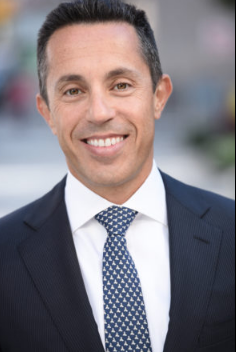
Tal Kerret, President, Silverstein Properties


“We are delighted to partner with shopIN.nyc on this important initiative,” said Tal Kerret, President, Silverstein Properties. “We believe it is important to support local businesses and retailers now more than ever. This is an easy and affordable way for parents and guardians to shop for their children’s school supplies.”

Categories
Featured NYC

HUMANS Using their Knowledge and Experience to Defeat this Disease

WE HAVE MADE INCREDIBLE PROGRESS over the last five months.

New York State was the nation’s first epicenter and now we are one of the very few states where COVID is under control. We didn’t just bend the curve, we shattered it—thanks to the effort and smart choices of all New Yorkers.

Total hospitalizations have fallen below 600, reaching record lows. We are testing more than any other state and more than any other country per capita, and thousands of contact tracers are working around the clock to trace and prevent outbreaks. Every community in the state is now in Phase 4 of reopening. Happily, the infection rate has continued to decline even as the whole state entered Phase 4, showing that our cautious and science-based approach to reopening worked.

All this progress, however, comes with a flashing caution sign. Our state still faces two dangerous threats.

The first is the threat of COVID spreading from other states. In response to this threat, we have issued a travel advisory for people coming from states with high COVID rates, but our progress remains at risk until the COVID pandemic is under control nationally.

The second threat is that we become lax and let our guard down, allowing the virus to spread. Unlike the threat from outside infections, this one is in our control. We have the ability and the duty to act responsibly. That means wearing a mask. It means not hosting or attending large and crowded parties. It means getting tested, especially if you have symptoms, and it means cooperating with contact tracers if you are positive for COVID. In brief, it means looking out for one another.

Finally, I know that for all New Yorkers, this has been an extremely trying experience— whether you lost a loved one, a job, or if you continue to lose sleep due to the stress of this pandemic. I mourn with all New Yorkers on behalf of all those lost to this virus, and I share in the anxiety, too.

But we are New York Tough.

I have no doubt that we can continue our progress in our fight against COVID by depending upon the solidarity, strength, and compassion that makes New York New York.

Ever Upward.

A letter from Governor Andrew Cuomo


HUMANS Using their Knowledge and Experience to Defeat this DiseaseHUMANS Using their Knowledge and Experience to Defeat this Disease
Larry Silverstein by Joe Woolhead


AS A LIFELONG NEW YORKER 

born during the height of the Great Depression, I have watched with utter amazement at how this incredible town has, by sheer force of will, turned itself into a worldwide colossus in business, technology, media, arts, culture, and so much more. differences between the events of 9/11, which unfolded over a span of 102 minutes, and the slow-motion crisis that is the coronavirus. At the same time, there are some striking similarities that provide both a roadmap and a source of optimism for New York’s ultimate recovery. First and foremost is the extreme heroism we are witnessing from our fellow New Yorkers on the front lines.

In 2001, it was the firefighters, police officers, and construction workers who rushed in and did what they could to protect and save complete strangers. As anyone who lived through that period can tell you, their bravery, selflessness and kinship set the tone for the entire recovery and rebuilding effort.

This time around, we are taking our cues from the doctors, nurses, and emergency responders who are serving as the models of courage, grit, and community. In 2001, New Yorkers lined the West Side Highway to salute our first responders. Today, they lean out of their windows at 7 pm each evening to applaud our healthcare workers.

Larry Silverstein, Silverstein Properties


HUMANS Using their Knowledge and Experience to Defeat this DiseaseHUMANS Using their Knowledge and Experience to Defeat this Disease
Saul Scherl Howard Hughes Seaport NYC


LIKE ALL NEIGHBORHOODS IN NEW YORK CITY, Lower Manhattan is pulling together in this time of profound global crisis. We are so proud to be part of this diverse and caring community, and continue to be inspired by the many local organizations and leaders devoted to helping our neighbors survive the pandemic and lay the groundwork for NYC’s economic recovery.

We are grateful for the opportunity to partner with nonprofits and organizations providing a lifeline amid these challenges, and we ask all who are able to please join us in supporting

the important efforts of groups like the City Council District 1 Food Pantry, with which we have worked over the past months as part of
an initiative spearheaded by Council Member Margaret Chin to provide meals and groceries to seniors and residents with limited food access; the Bowery Mission, which leads essential hunger relief services in Lower Manhattan and helped to distribute food donated by Seaport District restaurants as they prepared to close

in April; TUFF-LES housing advocates, who continue to provide food to residents in need in our area, including to the Smith Houses and 82 Rutgers Slip; Grand Street Settlement, which has been working to get groceries to vulnerable and elderly residents; and the Chinese-American Planning Council, which runs a vital program for home-bound seniors.

HHC is also committed to supporting the small businesses that fuel the Seaport economy. In partnership with Lower Manhattan property owners and led by the Downtown Alliance, we have established an emergency fund to provide area restaurants emergency cash grants as they get back on their feet.

We especially want to commend the extraordinary first responders and healthcare workers for their ongoing strength and sacrifice. We were pleased to donate PPE to New York Presbyterian-Lower Manhattan and FDNY Fire Engine 6, as well as provide meals from local restaurants to our Sanitation depot at Pier 36 and the NYPD 1st Precinct.

Seeing the work of so many after 9/11 and Superstorm Sandy, and now, on the front lines of this pandemic over the past several months, we are confident that the Seaport and Downtown will emerge stronger, more equitable, and more resilient than ever.

We look forward to continuing to work together to ensure our neighborhood and the city’s recovery.

Saul Scherl Howard Hughes Seaport NYC

Categories
Featured News

Downtown Feels Different Without Our Neighbors

Our neighbors, shoppers, visitors, and workers, but I love it all the same. Just like everywhere else in the country, many of my favorite cafes, restaurants, and shops have struggled to reopen, and their staffs are furloughed or unemployed, which is heartbreaking.

One of the things that makes downtown such a unique place is its many small businesses. They are a central part of the culture of lower Manhattan and have been from the time this island was first settled. They are the lifeblood for the tens of thousands of families living here, and for the hundreds of thousands of people who have grown accustomed to working here.

A few months ago, Silverstein Properties partnered with Brookfield, the Howard Hughes Corporation, and the Downtown Alliance to create a “Small Business Rental Assistance Grant” program, which offers immediate assistance to the local small businesses that continue to provide vital services to residents and essential workers in Lower Manhattan during the pandemic.

The program gives downtown’s small businesses, restaurants, bars, and cafes immediate access to $800,000 in grants, which we hope will help them weather this painful time. Grace and Downtown magazine have done a terrific job spotlighting essential workers and small businesses that are making a difference in our neighborhood.

Downtown’s businesses have been through a lot over the past two decades, but we are resilient, and I have no doubt that we will once again come back better and stronger than ever. Until that time, we need to stand together.

Like many of you, I was staggered and outraged when I saw the video of George Floyd being murdered by police officers in Minneapolis in May. This taking of an innocent man’s life was so horrible to witness, but I hope and pray it will lead to real and lasting change. What has happened in one form or another to members of the black community around this country is outrageous, and we can’t allow it to continue.

America must come to grips with the racial injustices that have existed here for over 400 years. It’s time to right the wrongs, heal the wounds, and come together as a nation. I believe we can and will change in ways that reflect the attitudes that many Americans have embraced and are now coming out in strength to express.

We must stand together and speak out on behalf of our families, friends, colleagues, and all those who have been the victims of murder, racism, and repression because of their skin color. We need to be supportive of each other and bring Americans together again because we’re a great nation that can accomplish incredible things when we commit to working together. It is time to unite as a country.

The opening photo of Dara McQuillan stands in front of “The Roots,” a 52-foot mural by Black-Latinx artist Cristina Martinez, located on the 79th floor of 3 World Trade Center. The mural is a tribute to the empowerment of Black and Brown women.

Summer 2020 Essentials