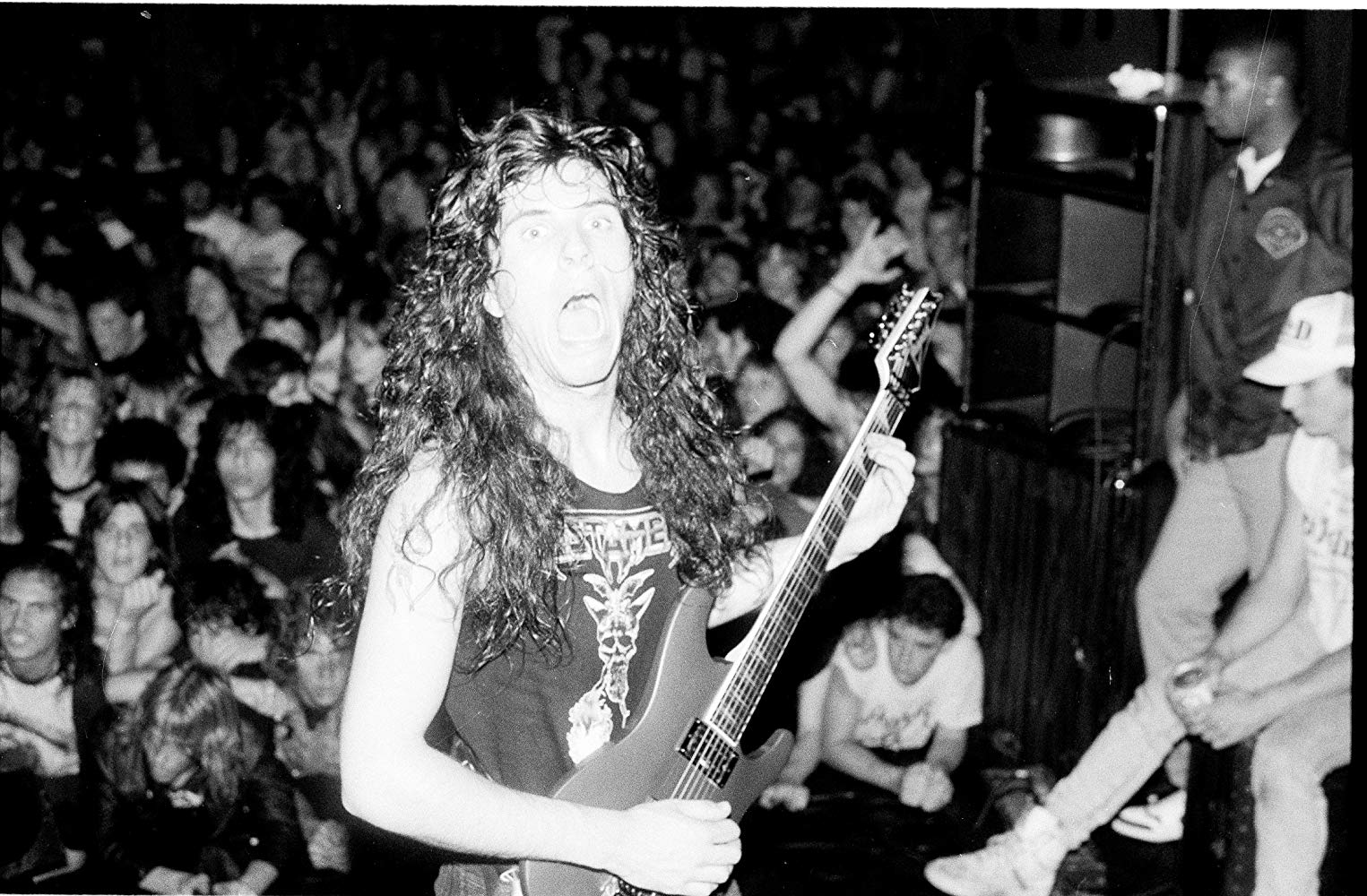
James Hetfield and Kirk Hammett of Metallica. Image from Murder in the Front Row: The San Francisco Bay Area Thrash Metal Story (2019), picture from IMDB.com
If I were writing this review in the San Francisco Bay Area in the early ‘80s, I’d be a dead man. It’s nothing personal; that’s just the way it was. I’m not a poser, but I am a casual, and that’s nearly the same crime. The local thrash metal community was tight-knit, offering fanatical support for metalheads and “death” to posers and outsiders.
Murder in the Front Row is the story of Thrash, the metal music subgenre which grew out of the Bay Area at that time. It’s the story of bands with surprisingly household names like Metallica, Megadeth, and Slayer. More than anything, it’s the story of the community that birthed these bands in a unique primordial soup of suburban angst and malaise.
MitFR is an unorthodox music documentary. Rather than focus on their globetrotting musical subjects, director Adam Dublin chose to focus on a small pocket of diehard fans who had been around since the birth of thrash metal. “From our point of view,” Dublin said, “the fans and the people who made the flyers, took the pictures, went to the shows, and hauled the gear, were as important as what the rock stars were doing.” By the time he recorded his first interview with a musician, he had already talked to dozens of fans from the scene.
Adam Dubin, Dave Ellefson, Mark Menghi, Mike Portnoy, Chuck Billy, Phil Demmel, Alex Skolnick, and Troy Sanders at an event for Murder in the Front Row: The San Francisco Bay Area Thrash Metal Story (2019). Picture from IMDB.com
Part of this unique focus comes from the subject matter. MitFR was inspired by a table book by the same name, published by original mega-fans Harald Oimoen and Brian Lew. The book was a compilation of pictures from the early 1980s, sharing a piece of near-forgotten history that behind-the-music-type histories have glossed over. The book intrigued and inspired Dublin, who fought to convince Oimoen and Lew to let him make a documentary of the story behind those photos.
The story MitFR tells also leaves out most of the drama and scandal, preferring to focus on the camaraderie of the scene and the accomplishments of the bands in their early days. “If you want to see the ‘Behind the Music,” he told a crowd when asked about his selective coverage, “you can already find that online.” He wanted to tell a happier, more heartfelt story.
The result is a love letter to the fans, to a community that supported these now-famous artists, and to the unique connection they shared. “If you go back far enough in time,” says Dublin, “there was a point in time where James Hetfield (Metallica) was just an 18-year-old kid just like the 18-year-old kids who were watching him play. He was no more famous and no more anything. And that’s the moment we wanted to accentuate.”
Founded in 1998 by Chuck Templeton, OpenTable is how more than 20 million people book their dining reservations every month. Having come a long way since the company’s early days — when only establishments in San Francisco were served — OpenTable now provides reservations for around 40,000 restaurants, including locations in Canada, France, Germany, Japan, Mexico and the United Kingdom. Not only does this remain a free service to diners, but OpenTable also holds its own in providing users with rewards points, which they can redeem for Dining Rewards.
Last month, OpenTable released its “Best Places To Dine Like A Celebrity” list. Its New York selections included Balthazar, Catch, Emilio’s Ballato, Fowler & Wells, Le Coucou, The Polo Bar, Sant Ambroeus SoHo, The Spotted Pig, Upland, and Vandal. While those selections speak for themselves, Downtown wanted to learn more about OpenTable’s operations and had the pleasure of speaking with Caroline Potter, the company’s Chief Dining Officer. Caroline is not only full of great dining recommendations — herself being a trained chef — yet also wit.
Caroline Potter: I actually worked at restaurants before that, most of my teen to adult life, on and off. My first job was as a busboy; I was the only girl on that team, so that’s what they called me! Over the course of the years, I did everything from bussing and serving to bartending and hostessing. At the French Culinary Institute, students had to spend time cooking at L’Ecole, the student-run restaurant, and it gave me great admiration and respect for the folks who work the back of the house.
CP: After graduating culinary school, I volunteered at the New York City Greenmarket, and I wound up helping with their newsletters. I met the then-editor of Edible Brooklyn and Edible Manhattan there, and I began writing for those publications. From there, a friend who worked in wine writing recommended me for this opportunity at OpenTable.
CP: I had not. The title was coined by Shannon Stubo Brayton, who headed up the comms team at OpenTable at the time. She’s now the CMO at LinkedIn, so she remains as clever as ever.
Do you remember the first time you ever used OpenTable? And where you booked a reservation for?
CP: It was in 2003, but I can’t remember what restaurant it was at, as I had a different account back then with a different email associated with it, I believe! I’ll have to have someone on our support team look it up for me. (laughs)
CP: I would love to say I spend my days dining out, but like most people, I spend a lot of time at my laptop — writing and/or editing blog content, selecting and sizing photos, answering emails, collaborating with our acquisition and engagement teams in San Francisco, and working with our social media specialist on social content for our channels, including social video, which has been really fun for us and the participating restaurants. We hear a lot from our restaurant partners and the OpenTable field team, and we work with them to support their needs, whether it be promoting a restaurant on Instagram, crafting tweets around an event, or featuring them on our blog.
What does it take for an establishment to sign with OpenTable? Is the company always seeking new establishments, or is there criteria to come onboard?
CP: Any restaurant can join OpenTable, and there are a variety of solutions available to them. For example, they can use GuestCenter, our guest and floor-management solution, or a simpler option, OpenTable Connect, which lists a restaurant on OpenTable.com.
On average, how many meals out do you have per week? Or do you make an effort to cook more because of your industry?
CP: I love to cook, but I usually reserve that for the weekends. I prefer to dine out on weeknights as I find it’s a more chill experience and there’s a lot more availability. Tuesday is the new Saturday, as I like to say. Some weeks will be four nights, others one or two depending on my schedule — and how my skinny jeans are fitting.
OpenTable responsibilities aside, do you have a favorite restaurant in New York?
CP: My favorite restaurant in New York, and beyond, is Bâtard in Tribeca. Chef Markus Glocker and managing partner John Winterman have created this perfect “choose your own adventure” dining experience at incredible prices — you can do two, three, four or more courses. The food is elegant, accessible, and sublimely-delicious. I’m obsessed with their English pie, but, honestly, everything is so flavorful and balanced – and beautiful, from the duck to the pastas to that now-iconic octopus pastrami. I honestly never really understood the appeal of schnitzel until I had Chef Glocker’s. It’s a revelation of juicy goodness. Winterman will build you a killer cheese plate, too. Meaghan Levy mixes a perfect martini, and wine director Jason Jacobeit will introduce you to the magic of Burgundy wines at a price that won’t break the bank. And the atmosphere is ideal — buzzy, flattering lighting, unfussy. It’s the place to go to have a great time any time, so don’t be surprised to find me there a LOT!
Any upcoming events or promotions coming up for OpenTable?
CP: At OpenTable, we’re proud to partner with No Kid Hungry to help end childhood hunger in America and it’s Taste Of The Nation season. The San Francisco event took place recently, and there are a bunch coming up in cities around the nation, including New York on Apr. 24. It’s a wonderful way to help support a truly worthy cause.
Is there something you wish more people knew about OpenTable?
CP: OpenTable is a great restaurant discovery tool. If you ever find yourself in a neighborhood or city — or country — you’re not familiar with, pop open the app and let it show you delicious options that are right around you. You can read verified reviews from diners who have actually dined at the restaurants they’ve reviewed, see menus, and more. So even if you’re feeling lost, we can help you find your next great meal.
When not busy with OpenTable, how do you like to spend your free time?
CP: Dining, drinking vodka martinis, gardening, sailing, and hanging with my dogs and my husband.
CP: In our eating for the Insta society, I like to remind diners to revisit their favorites. Restaurants operate on narrow profit margins — Manhattan restaurants in particular, thanks to skyrocketing commercial rents — and they depend on regular customers to stay in business. There’s nothing sadder than seeing a beloved eatery shutter only to have a chain retail store or bank take its place. Restaurants help create the character and community of a neighborhood. Support them with repeat business.
Located in the West Village, Analogue is a cocktail bar that has received rave reviews from the Wall Street Journal, Gothamist and DNAinfo alike. While many Manhattan bars aim to have music playing loud so that its customers have no choice but to dance and pound drinks, Analogue takes a very different approach. Whether it has a jazz trio live or its vintage Hi-Fi setup playing, Analogue keeps the music at a reasonable volume, allowing you to engage in conversation with ease. Analogue also offers a great food menu and has a lot of artwork on the walls for its patrons to look at.
Downtown had the pleasure of talking with owners Jesse Wilson and Jared Gordon, who met as students at NYU. As noted within our Q&A, Analogue is currently in the midst of expanding, although the location of its second spot has not yet been revealed. More info on all things Analogue can be found at www.analoguenyc.com.
You two met while studying at NYU. Where did the idea of opening a cocktail-centric bar come from?
Jesse Wilson: At first, the idea started when we would hang out at various bars around the Village and talk about how cool it would be to open a bar. After NYU, I moved back to San Francisco to work in finance and started to work on a business plan on the side. At that time I was also starting to notice a proliferation of cocktails and craft beers in the marketplace. I just couldn’t do it by myself due to work so kind of shelved the idea. When I moved back to New York City, Jared was ready to move on from finance himself and approached me with the idea of opening a bar. After a lot of discussion, we decided on the concept of doing a cocktail bar for a professional, grown-up crowd and Analogue was born.
Jared Gordon: We wanted to open a bar that featured the drinks we enjoy. That’s cocktails, whiskey and an occasional great beer. So that’s what we did. We pride ourselves on our cocktails and have put together an outstanding program, but we’re agnostic as to how we’re perceived or what the guest wants. As long as they’re enjoying themselves, it doesn’t matter to us whether they’re having our most complex cocktail, our rarest whiskey or just enjoying a glass of wine or a beer.
Did you have any restaurant or bar experience prior to opening Analogue?
JW: We didn’t have any experience really. Jared had a little bartending experience in the Upper East Side and had read a few books, but that was about it. We figured with our strong business backgrounds we could run the business, but we also knew we needed to hire people we trusted with experience in the hospitality industry.
JG: I’ll echo Jesse’s thoughts. I started tending bar to get a sense of the business, but I was pouring neat well vodkas at a few dives on the Upper East Side. Not quite the same level. We knew what we wanted and we knew how we wanted to treat our guests. The rest is putting a team in place to help execute that vision.
The Dorian Gray / Photo: Michael Tulipan
How would you describe Analogue to someone who hasn’t yet been there?
JW: I think the name “Analogue” fits the bar well. It’s a high-end cocktail lounge that is almost a throwback to Manhattan in the 1950s and 1960s. We do great cocktails and food and have a great atmosphere that promotes conversation amongst friends. It’s a throwback to a non-digital era, hence the name. I actually notice people come in and use their cell phones a lot less and just talk with each other. This was one of our goals when we were designing the bar.
JG: Jesse put it perfectly. It’s a comfortable bar in which to enjoy a great drink and a conversation.
Do you have a favorite drink on the menu? A favorite food item?
JW: My favorite drink is our signature called The Analogue. It was our first drink on the menu. It blends Havana Club Anejo Rum, Four Roses Bourbon, Domaine de Canton ginger liqueur, St. Elizabeth Allspice Dram, Velvet Falernum and bitters. When we opened, we wanted a bourbon-focused drink that was good for the colder fall weather in New York. When I tasted it I said to our bartender Nesha Korak, “Wow, if I could taste our bar that would be it! What should we call it?” And he responded, “Well that’s what it is then, call it Analogue.” And it’s been on our menu ever since day one.
JG: I’d say my favorite drink is whatever the team is working on at the moment. I enjoy the evolution of the individual bartenders and the program as a whole through time.
Jared Gordon & Jesse Wilson
Who is in charge of your cocktail menu? How does your team come up with cocktails?
JW: Zack Berger is our head bartender and facilitates the process for the team. The menu is a collective effort for all of our bartenders. They are always creating, and when we do a menu, they bring several of their best drinks to the table to try. We do a few rounds of internal tastings and then pick the winners. We then adjust the menu to put on the best cocktails and remove any drinks that are out of season or slow moving. It is a constant process.
JW: One of the first concerts I remember was U2 during the Joshua Tree tour back in 1987. My father took me when I was 13 years old. This was when U2 was at their peak and becoming a global phenomenon. The concert blew me away. I remember walking out of the Oakland Coliseum to the crowd and everyone was still singing “40” in unison. It’s cool to see them doing the 30 year anniversary tour now!
JG: My first concert was the Concert For Walden Woods, featuring Billy Joel, Don Henley and Sting. The seats were terrible but the music was amazing. Live music and music in general have played an important role in my life ever since.
Black Boulevardier / Photo: Michael Tulipan
What was the latest concert or music-related live event you attended?
JW: The last show I attended was The Cult here in New York. The Cult was another band I grew up listening to and they are still going strong! I like a lot of alternative, hip-hop, jazz, country, metal, pretty much any genre if it’s good.
JG: I’ll echo Jesse’s sentiments. I love everything from old school East Coast hip hop to bluegrass, metal, and classical. The last shows I’ve seen were Iron Maiden (my second time), Dave Matthews Band (my 24th) and the Governors Ball, where De La Soul was the highlight.
I understand that Analogue features live music a few days each week. Who are some of the artists that regularly play there?
JG: currently we have Nick West and the Westet on Tuesdays and Monika Oliveira on Wednesdays. Nick West is a funky bass-driven trio, and Monika has a beautiful, mellow bossanova sound.
When you don’t have musicians playing at Analogue, I know that you have music spinning. Have you always been so vinyl-centric?
JG: We spin vinyl on special occasions, and for that we have a fantastic vintage turntable and tube amplifier. We’re also starting an audio salon where we will feature some truly high end systems and some classic albums each month. Vinyl has played a role in my life since birth, when it was just called “music.” As I got older, I started my own collection by stealing my parent’s albums and it took off from there. I have about 7,000 albums at the moment, down from a peak of about 8,500. I enjoy the hunt — scouring yard sales and thrift stores and finding new music or forgotten gems. And I enjoy building and tweaking my HiFi system.
The Analogue / Photo: Michael Tulipan
Who chooses the music that is playing at Analogue?
JW: Usually our management team will set the music that is played at the venue. We are always on the lookout for new bands in the area. A lot of the bands we discovered were from around the West Village area playing at venues or outside at Washington Square Park.
The walls of Analogue are also lined with music-related photographs. Were those from a personal collection?
JG: The photographer is Roberto Rabanne, who has shot some of music’s best. The prints in our space are all originals, and the collages of Ray Charles and Bill Evans are each one of a kind.
I know that Analogue has a private room. Is that only for private events?
JW: Yes, we host a lot of events in the back such as private parties, corporate events, cocktail classes and wedding receptions.
When not busy with Analogue, how do you like to spend your free time?
JW: Sleeping! I work full-time and help manage the bar, so in my little free time, I like to relax. But now we are looking to open our second location, so a lot of free time is spent working on the new location.
JG: I recently had my first child, a little boy we named Jack. So free time is in short supply at the moment. Between him, Analogue and scouting for the next location, there aren’t enough hours in the day. When I do find some down time, I like to play music, read, cook, and yes sleep.
Analogue / Photo: Michael Tulipan
Aside from Analogue, do you have a favorite bar or restaurant in New York?
JW: I am really into craft beers right now so I appreciate a good selection of beers and a nice atmosphere. I liked Cooper’s when I lived in Chelsea. I now live on the UWS and like Gebhards, a new craft beer place near my apartment.
JG: I like dive bars. When I’m at a cocktail or whiskey bar, I find myself too focused on the menu, the setup and the service. I relax when I can kick back with a beer and a whiskey and not worry about taking notes. Parkside Lounge on Houston and Lucy’s on Avenue A are two favorites.
Finally, any last words for the kids?
JW: Don’t get caught up in all of the cocktail hype! We try to focus on making cocktails that taste great and put a lot of work into that. We don’t get caught up in all of the hoopla to try and get too clever or go over the top with our creations. A lot of our drinks are rooted in tradition, the foundation if you will. The goal is to just make quality drinks that the customers will enjoy and have a good time. At the end of the day it’s all about giving our customers the best possible experience.
On Mar. 12, CNN took a remarkable step forward on a few levels. With the premiere of Mostly Human With Laurie Segall, the network launched its first CNNgo original series. Unlike anything else on CNN, the new series is led by the two women who run tech at CNN, Laurie Segall and Erica Fink. Mostly Human is best described as a “real-life Black Mirror,” exploring groundbreaking topics in the tech world.
The show’s namesake, Laurie Segall, was recently named to Forbes’ 30 Under 30, having won awards for her investigative coverage. Executive producer Erica Fink has been within the CNN realm for nearly a decade, following a run as Editor-in-Chief of her alma malter’s newspapaper, the Cornell Daily Sun. Downtown had the pleasure of speaking with both Laurie and Erica about Mostly Human and plenty more. Their interviews were done individually, yet the closeness of the two writer/producers shows as their responses were often similar.
To get a taste for Mostly Human With Laurie Segall, you can check out a trailer of the show here. Both Laurie and Erica can be followed directly on Twitter.
How did you two first meet?
Erica Fink: I think the best working relationships develop by filming at swinger parties and hacker conventions. Sex, Drugs & Silicon Valley was our first in-depth series together and it took us to some interesting places — including a swinger party where attendees were scoping out prospects by app ahead of time. Let’s just say, it wasn’t the easiest place to mic guests. Since then, we’ve gone to lots of strange corners of the world in pursuit of stories about the weird ways tech has changed our lives, and the people behind the products. Mostly Human, CNN’s first streaming show, basically takes that approach and puts it on steroids.
Laurie Segall: Erica has been my partner in crime for some time. We started working with each other when I was making my way into the TV world. You get close when you do the work we do, especially the types of stories we cover. I’ll never forget when we were doing a piece on high tech sex workers in Silicon Valley. Years later, we shot a series called Sex, Drugs & Silicon Valley about polyamory, swinger parties, and drug experimentation in the Bay Area. My favorite Erica moment was watching her mic someone up at the swingers party. We’ve been in storms, protests, outside the home of a notorious kidnapper, inside hacker conferences, and at swinger parties — for work, of course. Lots of life happens in between.
Erica Fink: For fashion or Wall Street or most other industries, the interesting story that gets people talking is about a person or event that happened behind the scenes. But for tech, so much of the coverage is focused around product specs and app updates. There’s a unique opportunity to cover tech through the lens of culture. We’re living in a time where tech has changed everything about life — from love to war — and what’s exciting is the prospect of telling the stories of the people behind the innovations, and the weird and unexpected ways those innovations are changing lives.
Laurie Segall: I was fascinated by tech in 2009. I was covering business news and but in my free time started gravitating to tech events. It was a small community of weirdos in the best sense. We were coming off the financial crisis, and all of a sudden, you had this group of creative people who didn’t feel like they had to go to Wall Street to get a job. There was this group of people who just thought they could take an idea and code it into the hands of millions. I loved the creativity in all of it. And I loved the underdogs. I ended up getting to know a lot of folks as they were starting out. Some of my first on-camera interviews were with the founders of Twitter, Instagram, and Uber. It’s been fascinating to watch these ideas shape culture and shift industries.
How would you describe your new series to someone who hasn’t seen it yet?
Erica Fink: Mostly Human is basically the real-life Black Mirror. It’s about the strange and sometimes uncomfortable things that happen when tech and humanity intersect.
Laurie Segall: One episode also feels very Westworld. In the series, you see everything from people turning their dead friends into chatbots through artificial intelligence, to folks falling in love with robots. You’ll see Laurie infiltrate hacker parties, get her life threatened, and get propositioned by a robot. It’s a show about our increasingly-complicated relationship with technology. We ask some more philosophical questions like how much control does your phone have over you and take on topics people don’t really talk about. Behind every fringe story we bring you, there’s humanity. One of our favorite moments of the series is when a French woman is describing how she’s fallen in love with a robot. When asked why, she told me it’s because it would always be safe. It would never cheat, or lie. She prefers errors in script and code — not human flaws. There was something incredible human and vulnerable in that moment no matter how you judged her for her choices.
Do you have a favorite episode of the series?
Erica Fink: “I love you, Bot” is about the most extreme relationships between tech and people. We meet a woman who is madly in love with her robot and attend their engagement party, complete with champagne and macaroons. Later, we visit a pedophile ward where they’re evaluating risk by showing offenders images of children in virtual reality. It has a pretty high quotient of gut-punch moments.
Laurie Segall: “Dead, IRL” was probably my favorite episode. It was incredibly-personal. In the episode, I explore what death means in the digital age and start thinking about my digital legacy. I don’t wan’t want to give too many details but there are some incredibly-uncomfortable moments. A technologist took my personal conversations with my best friends for the last four years and using artificial intelligence, created a chatbot based off of me. Let’s just say my bot went on a bender at one point, saying some pretty insane things. It’s an episode with a lot of heart and one I think a lot of folks will relate to.
Your series isn’t entirely positive about technology’s affects on society. But aside from the series, is your life so tech-centric?
Erica Fink: I’ve probably spent too much time thinking about how my soon-to-be-born child will interact with Alexa — I’m insisting he say “please” and “thank you.” But think about that: he’s going to grow up in a time when he can demand an answer to any random piece of trivia and a cylinder in our kitchen will answer it for him. So, I guess, yes?
Laurie Segall: I would say yes. I spend too much time in front of devices and screens. Perhaps that’s why I wanted to do a series looking at our relationship with tech from another lens. I will say, I used to always love to write in notebooks and do that less with all the screens in front of me. While I love technology, I understand a growing nostalgia to take a step back.
Erica Fink: The whole thing about Mostly Human is that it’ll make you think. It’s actually hard to believe that some of this stuff has really happened. Once Laurie brings you into this world, it’s hard to get out.
Laurie Segall: The hope is every episode will make you think about something you never thought about. Once you watch one, I think you’ll want to keep going. All the topics are completely different — from the first hacker to be killed in a drone strike to the human impact of the Ashley Madison hack and how a company capitalized on human nature to try to convince people to cheat. The goal with this is for people to see something they haven’t seen, and feel like they’re accessing underground stories that they wouldn’t get anywhere else.
Laurie, a lot of your assignments have had elements of danger to them. Is there one that you are proudest of?
Laurie Segall: I’m most proud of a documentary we did on a growing form of harassment called revenge porn where victims have their intimate photos plastered across the web. It’s a horrific problem and so many people — mainly women — are afraid to speak out and feel like they lose control when it happens to them. I confronted a hacker who hacked into a teenager’s Facebook page took private photos, sold them to a website that posted them for everyone to see. I was able to get him on the phone and talk through why he did what he did. It was a powerful interview. He later spent time in jail. The documentary shed light on this type of harassment and when it came out, there were a lot of changes that happened as a result. That’s some of the most rewarding work I’ve done. You always feel like you’ve done your job right when you give someone a voice, and allow a victim to take control back. I do find myself in some odd situations for this line of work, but I love the weird, underground stories, so it’s part of the game.
Erica Fink: I like the creative process. What excites me is finding an amazing story and shaping the narrative. A really good day is when we’ve stumbled on a nugget that I know will resonate, whether it’s a character with a truly unheard of experience; or something smaller, like a clever way to phrase an idea in a script.
When not working with CNN, how do you like to spend your free time?
Erica Fink: I like to try my hand at fiction whenever the opportunity allows. Especially on days when the news business is heavy, it’s fun to come home and dream up funny conversations and circumstances.
Laurie Segall: I’m pretty biased but I have an incredible group of friends and a great boyfriend. When I’m not working, I’m hanging with my renegades or scheming with my boyfriend. I also love to write. Every so often you’ll find me solo at a coffee shop or bar writing.
What is it that draws you to living in Downtown New York?
Erica Fink: The high density of different chocolate chip cookie varietals.
Laurie Segall: A friend of mine, Tracy Malechek, was the chef at Untitled at the Whitney for some time, so I go there quite a bit. The food is amazing. I pretty much follow her wherever she goes to eat. And the bartender Rocky is one of my favorite bartenders in New York. It’s just a great place to be. I also love Meme. I dream of their lemon chicken and the people who work there are nothing short of fabulous.
Do you have tickets to any upcoming concerts or events?
Erica Fink: The birth of my child — due this week…?
Laurie Segall: Dear Evan Hansen on Broadway. It’s my third time seeing it. It’s such an incredibly-timely play, the music is beautiful and it combines everything I love — storytelling, heart, and our complicated relationship with technology.
Finally, any last words for the kids?
Erica Fink: It’s a good time to be a content creator. If you’ve got a story you’re passionate about telling, go tell it!
Laurie: Ask for what you want. It’s sometimes hard to do, but it’s led to some of the best things in my life.
When it comes to comedies, few films are as universally-respected as 1993’s Groundhog Day. The movie — co-written by Danny Rubin and director Harold Ramis and starring Bill Murray — manages to be very funny, while maintaining both heart and originality. All these years later, it retains a 96% rating on Rotten Tomatoes while holding top honors from BAFTA, the Writers Guild Of America, and the American Film Institute.
Last year, a theatrical adaptation of Groundhog Day opened at The Old Vic on London’s West End. The production was critically-acclaimed as can be, earning various “best” nominations from the Evening Standard Theatre Awards, the Critics Circle Theatre Awards, and the Laurence Olivier Awards. Fortunately for New Yorkers, a Broadway production of Groundhog Day begins previews at the August Wilson Theatre on Mar. 16; the show opens Apr. 17.
The team behind the Groundhog Day musical is very impressive, even by Broadway standards. Director Matthew Warchus was nominated for “Best Director” at the 2014 British Independent Film Awards for his work on Pride, also succeeding Kevin Spacey as the new Artistic Director of the Old Vic Theatre London that year. Choreographer Peter Darling worked on Billy Elliot The Musical and Matilda The Musical. Designer Rob Howell won the Drama Desk Award for Outstanding Set Design for Ghost The Musical and an Olivier Award for his work on Matilda The Musical in 2012. Composer Tim Minchin is another award-winning member of the Matilda team, although you may recognize him as Atticus Fetch from the show Californication. Andy Karl — who plays the Bill Murray-helmed “Phil Connors” role — received a nomination for the Tony Award for Best Featured Actor in a Musical for his work in Rocky The Musical. And those are just a few of the cast and crew members that have received major honors.
Downtown had the pleasure of chatting with Groundhog Day actor John Sanders, who will play the lovable Ned Ryerson role, as originated by Stephen Tobolowsky. John is another former Matilda cast member, beyond spending time on Broadway in Peter and the Starcatcher. Prior to moving to New York, he was a veteran of the Chicago theater scene. Beyond his work with Groundhog Day, John can be seen in the upcoming Netflix series Iron Fist.
More on John and the rest of the Groundhog Day cast can be found at www.groundhogdaymusical.com. The show can also be followed on Twitter via @GHDMusical.
Do you remember the first time you saw Groundhog Day? Was it in the theater?
John Sanders: Groundhog Day was one of my favorite movies when I was younger. I don’t remember my first viewing, I’m pretty sure it was on VHS. I’ve always loved the combination of comedy and mind-bending metaphysics in this story.
Do you have a favorite scene in the movie?
John Sanders: I love watching Bill Murray stuff pastries into his face while contemplating whether he’s a god. Who wouldn’t want to be able to eat like that with no consequences?
Aside from it being a musical, are there any major differences between the movie and the play? Or will fans of the movie be pleased either way?
John Sanders: Fans of the film will not be disappointed. First of all, we have the same writer as the movie, the brilliant Danny Rubin. He’s brought so many of the iconic lines and moments that fans of the movie will love to see and hear. But telling the story as a musical opens up a lot of new possibilities. We never attempt to explain the same-day phenomenon, but we do get to hear so much more about what’s inside these characters’ heads and hearts. And I must say my character Ned has some really surprising depth that isn’t in the film, and that’s really fun to play and to sing about.
Had you worked with any of the Groundhog Day cast before being cast in this production?
John Sanders: I have. A number of actors from my time at Matilda are here, at least five or six of us from that production. And most of the creative team from Matilda are the ones behind Groundhog Day. And of course there are the dozens of backstage crew who I’ve worked with before, and many that I’m getting to know now. I’m a California boy who worked in the Chicago theater scene for 11 years, so I sometimes have to pinch myself that I get to be part of this Broadway community.
Do you have a theory on the time loop duration of Groundhog Day? I’ve heard that it’s 10 years, and I’ve read Harold Ramis say that it was 10,000 years.
John Sanders: I think it must be longer than 10 years, since Phil changes so profoundly. It’s like we get to witness someone live an entire alternate lifetime and come out the other end a changed man. Sort of like, dare I say it, that episode of Star Trek when Patrick Stewart lives a whole life on this other planet in the space of 20 minutes. Did I just up the dork factor in here? Yes, yes I did. But I also think 10,000 years seems a little long — Phil would just be comatose and insane at the end of that, like Leo DiCaprio near the end of Inception.
John Sanders: Only through his work, which I love. But he certainly seems like a fascinating and well-rounded guy. My first encounter with him was watching him as Ned Ryerson in Groundhog Day. Since then I’ve loved him in Californication, Silicon Valley, and his Tobolowsky Files podcast. He also has a fantastic episode on The Nerdist, which I highly recommend.
Although you have worked in television and have appeared on film, what is it that draws you to theater?
John Sanders: My parents were great and took me to theatre in San Francisco when I was young. I remember being blown away by the original touring production of Les Miserables. We also saw a version of this farce called Charley’s Aunt at ATC back in the 80’s, and I remember marveling at the lead actor’s skill and physical precision. He seemed to be juggling eight things at once and walking the line between control and chaos. He had us all on the edge of our seats, and I just remember thinking I wanna do that! I wanna have an audience in the palm of my hand like that! Camera acting can be very fulfilling, but there’s nothing like performing live.
Is Broadway what inspired you to move to New York?
John Sanders: Actually, it was luck that got me here. I was a working actor in Chicago back in 2012, with a gig lined up down in Indianapolis and no plans whatsoever to move to New York. Then the casting director Jim Carnahan made a trip through Chicago looking for new people, and I wound up getting cast in the Broadway premiere of Peter and the Starcatcher. They called me up and asked if I could be at rehearsal in New York in 10 days! I had to drop everything, look for a place to live, and try to find the rehearsal hall. It was a shock to the system, but I’m so happy here now.
What was the first acting credit you ever landed that made you feel like this was a career, not just working for a little bit?
John Sanders: Well, I had always been a pretty good student, but I purposefully didn’t develop a backup plan for my acting career. I knew that if I had one, that’s what I’d end up doing since starting out in this business is so difficult. So I guess I always knew I was in it for the long haul. But the impostor syndrome started to subside when I joined the union and started paying my bills as an actor, though that didn’t happen until my early 30’s.
Groundhog Day aside, do you have any projects coming up? Appearances?
John Sanders: You may be able to see a little of me in the upcoming Netflix Marvel series Iron Fist. Other than that, I’m consumed with living the same day over and over again for now!
When not busy with acting, how do you like to spend your free time?
John Sanders: My favorite thing in the world is skiing, and I just spent a week in Aspen with my dad and a few old friends before rehearsals started. I love travelling and can’t wait to hit somewhere tropical soon.
Do you have a favorite restaurant in New York?
John Sanders: There are two places on the same block in Chelsea that I love. Dinner at Salinas on the patio. Then late nite drinks at Bathtub Gin, a crazy speakeasy hidden behind a tiny coffee stand.
What about go-to lunch spots near your theater?
John Sanders: I’m a pretty utilitarian eater when I’m working, so when I want something tasty and healthy I usually head to Dig Inn on 8th & 52nd. But if I wanna relax there’s always a burrito at Blockheads. Can’t wait till the weather changes and we can all bask in that courtyard again!
Finally, John, any last words for the kids?
John Sanders: Art done well is like science. And science done well is like art. And farts are always funny.
Last week, Common — a company offering community-minded shared housing in major cities — announced that applications are open for Common Baltic, Common’s newest and largest home located in Boerum Hill, Brooklyn. Common Baltic is the first residence to combine coliving suites with studio and one-bedroom apartments, opening Common membership up to even more residents looking to live in community with their neighbors.
“As Common has grown, we’ve found that more and more people want to live in community, even if they want more private space. That’s why we’re so excited to expand our community-driven living to a broader group of people with Common Baltic,” said Brad Hargreaves, Founder and CEO of Common. “We look forward to opening more homes like Common Baltic in the future, and continuing to build connected residential communities in cities around the country.”
Common Baltic will be home to approximately 135 Common members, including 70 in coliving suites and more in the building’s 67 studio and one-bedroom units with private bathrooms and kitchens. Many suites and apartments include balconies and outdoor space, and all units feature washer/dryers.
The residence features the communal spaces that make the Common coliving model unique, creating a community where people actually get to know their neighbors. Common Baltic includes two spacious lounges designed in the Common aesthetic, and a large roof deck with expansive views of Brooklyn. House leaders on every floor will encourage residents to come together, with programming like book clubs, potlucks, movie or wine nights, and outings to support local small businesses.
Common Baltic will help Common meet the tremendous demand experienced since the company’s launch in 2015. Prior to opening Common Baltic, Common received more than 12,000 applications for an existing 120 rooms in New York and San Francisco. In 2017, Common plans to open additional homes in Brooklyn, Washington, D.C., and other major cities.