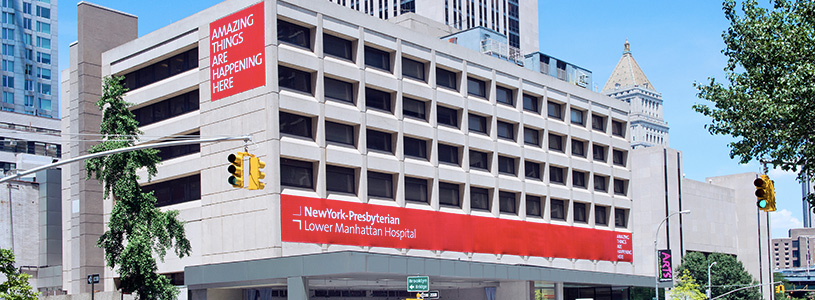
NewYork-Presbyterian Lower Manhattan Hospital is an essential part of the Downtown community. We talked with Dr. Adam Vella and Dr. Brenna Framer about the specializations of a pediatric doctor, the responsibilities at the hospital, the impact of toxicology and more.

Dr. Vella is the Director of Pediatric Emergency Medicine at NewYork-Presbyterian Lower Manhattan Hospital, Director of Quality Assurance for the Division of Pediatric Emergency Medicine at NewYork-Presbyterian/Weill Cornell Medical Center and NewYork-Presbyterian Lower Manhattan Hospital, and Assistant Professor of Clinical Emergency Medicine (interim) at Weill Cornell Medicine. What an impressive lineup of titles.
Brooklyn-born Dr. Vella was initially inclined to becoming a doctor of veterinary medicine because in high school he read a series of books by James Herriot about a veterinarian with a large animal practice, and this piqued his interest. Once he realized that veterinarians in New York focused on more cats and dogs than horses and cows, he started looking for other ways to explore the medical field, and he applied to be a premedical student. While he was studying the basic premedical sciences, he realized that he always enjoyed working with children and decided to rethink his plan.
Downtown: What makes pediatric emergency medicine different from pediatric internists and why did you choose this path?
Adam Vella: Great question. I am the type of person that is happiest when solving a problem. In this country, general pediatrics tends to focus more on well-child care meaning anticipatory guidance about health and vaccinations, and although I do practice a lot of what would be considered primary care while seeing patients in the emergency department, I enjoy working under the pressure of an emergency situation. For this reason, I decided to do an additional three-year fellowship to specialize in pediatric emergency medicine, which was one of the best decisions I have made thus far. I love the energy of emergency medicine and the challenges of establishing relationships with patients and families when they are most in need.
DT: What are your responsibilities as director of pediatric emergency medicine at NewYork-Presbyterian Lower Manhattan Hospital?
AV: As director of the pediatric emergency department at NYP Lower Manhattan Hospital I am responsible for the care of children in emergencies. Whether the care goes well or not as expected I am ultimately responsible. I recently started in this role in January of 2019 after directing the pediatric emergency department at Mount Sinai for the past 10 years and am happy to report that I have a fantastic team of physicians and nurses along with amazing support staff. NYP Lower Manhattan Hospital is a unique place as it truly is a community hospital functioning within the context of the largest health care system in New York City. There is a small town feel to the place where we all know each other well and work closely together but still have access to the best specialists in New York. I think it is the best of both worlds.
DT: What does it mean to be the director of quality assurance for your department?
AV: As I have matured as a practitioner I have been increasingly interested in health care improvement. I served as editor-in-chief for a publication titled Pediatric Emergency Medicine Practice for five years and this really opened my eyes to the importance of practicing evidence-based medicine and keeping abreast of the most recent literature related to any given health care condition. When I decided to leave Mount Sinai for NYP Lower Manhattan Hospital and Weill Cornell Medicine, I wanted to craft a position that would include this interest. Directing quality for my department means that I am in the role of scrutinizing our practice to assure that we are offering the highest quality evidence-based medical care to our patients. This involves tracking measures of quality, which I have implemented, as well as liaising with the quality leadership of NewYork-Presbyterian. I review cases to make sure we have systems in place to protect our patients from errors in practice. In this way, I am able to influence the care of all of the patients seen rather than just those I have seen personally. In fact, I have already implemented changes that will change the practice across the entire health care system, which I think is an amazing opportunity.
DT: How is it different to work in the pediatric department of a large hospital than to work in a children’s hospital?
AV: Another great question, and yes, it is different, I agree. Really it is all about advocacy for our patients. At times within the context of a large hospital, the pediatric-friendly focus can be lost in the system. At NewYork-Presbyterian, we are constantly advocating for our youngest patients within this large, complex hospital system. As pediatricians, we need to lead the way in advocating for their interests so that they are not lost in the shuffle. I trained at Children’s Hospital Los Angeles in my fellowship and was able to experience a hospital dedicated entirely to pediatric care. I strive to deliver that same level of service to our patients here within the largest health care system in New York.
DT: What have you discovered about the city in your work move from Uptown to Downtown?
AV: Well, to be honest, I work both uptown and downtown. I direct quality in pediatric emergency medicine for NewYork-Presbyterian and Weill Cornell Medicine on the Upper East Side, as well as at NYP Lower Manhattan Hospital, and working clinically at both sites. The downtown site is different in that is serves a very diverse population, including providing health care to a large Chinese population, as we are the closest hospital to Chinatown. In addition, I am seeing many tourists who are traveling from around the world to visit historic sites such as One World Trade, the 9/11 memorial and museum, Wall Street, the New York Stock Exchange, the South Street Seaport and the Brooklyn Bridge. I have truly enjoyed providing health care to this group and showing them how nice New Yorkers can be! I am also amazed by the growing community of young families moving into the financial district as it develops along with amazing new schools which have moved into our neighborhood.
______________________________________________________________________________________
Following our interview with Dr. Adam Vella, we also had the opportunity to ask Dr. Brenna Farmer a few questions about her medical career and what she is currently accomplishing through her knowledge of toxicology.

Dr. Farmer is the assistant professor of clinical emergency medicine at Weill Cornell Medicine and Site Director of the Emergency Department at NewYork-Presbyterian Lower Manhattan Hospital. She has a natural inclination towards science and enjoyed every medical field when she was training but found that her true calling was emergency medicine because she wanted a specialty that allowed her to see and help patients of all ages with a variety of different problems that require different procedures. Now in her line of work, she is able to care for patients with urgent care problems (lacerations, joint sprains, upper respiratory tract infections, etc.) as well as emergency conditions (heart attacks, bloodstream infections, strokes, or trauma) while still providing treatment for many pediatric, obstetrical, gynecologic and surgical conditions.
Downtown: How did studying toxicology help you in this path?
Brenna Farmer: My Emergency Medicine training gives me an outstanding understanding of the pathophysiology of many disease processes, allowing me to treat critically ill or injured patients. Medical toxicology builds on my understanding of pathophysiology, by giving me more knowledge on rare or adverse drug side effects, expert training in the care of overdoses, envenomations, and other poisons.
DT: What are your responsibilities as director of the emergency department at NewYork-Presbyterian Lower Manhattan Hospital?
BF: I oversee the day-to-day operations of the Emergency Department (ED), ensuring our physicians can continue to provide care to anyone in need, no matter what time of day or night. I work closely with nursing and other healthcare specialists, including primary care physicians, surgeons and gynecologists, to ensure patients get the definitive care that they need for whatever problem they have.
DT: How did you get so involved with patient safety?
BF: Patient safety and quality is a passion of mine as a physician. My dad suffered tremendously after a medical error led to a long hospitalization, followed by physical rehabilitation with multiple physical and occupational therapy sessions. I realized that someone has to advocate for patients when they themselves can’t, and medical processes need to be evaluated to find areas for improvement. As necessary, new processes need to be developed to make certain care is provided equitably, efficiently, and follows evidenced-based, scientific practice.
DT: What things do you make sure your department does in terms of patient safety?
BF: Every day, we huddle as a team to discuss any challenges of the day related to improvement processes, staffing, new processes or resources. We also include a message about how to best provide patients with a first-class experience. In addition, care teams are formed to maintain continuity of care for all patients. In many instances, these teams consist of a nurse, physician, patient care tech, and sometimes physician assistants. This structure allows us to continuously communicate a patient’s plan of care, treatments we are implementing, and if there are any concerns. Teams also spend time training and preparing for how to handle rare emergencies should they occur. Clinicians in the ED also routinely participate in educational sessions across all disciplines (nursing, physicians, and technicians). This form of continuing education helps staff perform procedures safely, with the correct equipment, at the appropriate time and during the proper situation. Another priority for our team is to know that when they raise a concern, that it will always be heard and addressed.
DT: How is NYP Lower Manhattan Hospital promoting patient safety, quality improvement, and medication safety?
BF: This is accomplished by continually working to improve processes with focuses on safety, quality, and evidence-based care, and by also working in teams across the healthcare continuum, to ensure patients are kept front and center. In addition, teams review cases to assess for any concerns to help provide the best possible care to patients. Our NewYork-Presbyterian Department of Quality and Department of Pharmacy are always seeking ways to improve and continue to offer patients the best care possible.
DT: What can people do at home to practice medication safety?
BF: Everyone needs to know what medications they take and why they take them. Keep a list or set of pictures of medication bottles in your phone that can be shown to any provider. The information on the bottles (name of prescription, dose and instructions) is extremely helpful to all healthcare providers because it helps clinicians keep patient health records current. I also recommend storing medications out of reach of children, preferably locked away, so that unintentional exposures do not happen. When grandparents come to visit, store their medications out of reach from children and locked away. Do not keep medications in your purse or pocket, they should always be out of reach of those not prescribed to take the medication. Everyone needs to know Poison Control’s phone number: 1-800-222-1222. Do not keep left-over narcotic medications in your home. Take them to pharmacies, hospitals, clinics, or even police stations, with disposal bins. This helps reduce illegal and uncontrolled access to medications that could potentially harm others.