They say that Rock n Roll is a lifestyle–a way of life. You can build cities out of it. And while Tampa, Florida wasn’t built on Rock n Roll, Tampa’s Hard Rock Hotel & Casino is. And with the completion of their expansion, Tampa, Florida, is finally ready for you to rock and roll all night and party every day.
So what would you need to live the rock star life? Glitz, glamour, and opulence. And Hard Rock is filled with it. Bright lights fill the gambling floors, offering every kind of game for every price point. Swim through the sea of lights, and you’ll find a restaurant, a venue, or recreational experience. Want a stack of pancakes? Fresh sashimi? A perfectly marbled steak? Or maybe you want to grab a drink and watch live music? It’s all there.
Seminole Hard Rock Hotel & Casino Tampa
And live music is everywhere. Hard Rock Tampa features multiple stages, ranging in size from hundreds to more than a thousand. Their largest stage holds 1500 people and hosts internationally-renowned singers, comedians, and performers. Between all of their locations, you are guaranteed a show, with more as you get closer to the weekends.
Seminole Hard Rock Hotel & Casino Tampa
If you are just there to relax, you’re also covered there. A beautiful pool ringed with cabanas, and a long poolside bar forms the center of the hotel and casino. Stop by for a swim, or a full day lounging in the sun. Finished with your tan? Hang out at the bar and watch a game over drinks. Just to the side of the pool, explore Hard Rock’s ‘Rock Spa & Salon,’ where you can treat your body and spirit with their brand new 26,000 sq ft facility. Enjoy a massage, a therapeutic facial, or a workout class in Hard Rock’s state-of-the-art fitness center. Hey–even rock stars need time to relax.
Architectural Photography
And the food. I mentioned it earlier, but it is worth mentioning again. Restaurants range from casual and cool, like the Hard Rock Cafe, to the stately, with Council Oak Steaks & Seafood. Both, by the way, feature live music. Whatever food you want, they’ve got it. A special shout-out to Council Oak Steaks & Seafood, and their supreme cuts of meat–I even follow their Executive Butcher on Instagram just to see the latest cuts. But don’t miss out on your chance to try out all 13 of their dining locations.
Council Oak Steaks & Seafood
The Seminole Hard Rock Hotel & Casino Tampa takes its Rock n Roll soul to heart. Its vast collection of memorabilia, its multiple venues, its delicious food, is all a celebration of our urge to cut loose, indulge, and treat yourself in ways that you can’t at home. If you want to rock and roll all night, Hard Rock is always open.
The Amazon is ablaze, the West Village is so thick with humidity you can practically chew the air. The time is ripe for those queued outside Le Poisson Rouge to descend underground, and bear witness to the legendary God of Hellfire, Arthur Brown.
“Who is Arthur Brown?” a friend asked. The answer requires a time machine to another volatile point in history.
It’s 1968. Arthur Brown, a soft-spoken Englishman, is recounting his recent American tour to Brian Matthew in a BBC Radio One interview. Brown languidly lists the costumes used in his act: masks, gowns, face paint…a fire helmet.
“It’s very spectacular,” Matthew interjects. “Is it dangerous to you?”
“Yes. Well, ah, we set one stage on fire. Set my gowns on fire. I burnt my face the other day.”
Arthur Brown lit so many fires in his wake that he got booted off a tour with Jimi Hendrix when venues feared incineration.
Even if Brown himself isn’t a household name, he certainly made a distinctive mark in music history. His neo-pagan theatrics, inspired by the wild antics of Screamin’ Jay Hawkins, served as a catalyst for musical newcomers in Great Britain. Despite Fire being his one major hit, the list of Brown’s imitators is staggering.
A young Londoner attended Brown’s Paris gig, cribbed his mime and drag elements, and studied with legendary performance artist Lindsay Kemp…emerging as David Bowie. The Who wrote Tommy with Brown’s operatic voice in mind; he appeared in the film as the crazed priest of a Marilyn Monroe cult. Iron Maiden borrowed Brown’s banshee screeches. Alice Cooper nicked the corpse paint. Peter Gabriel owes a thank you to Brown’s flamboyant headdresses. Ozzy Osbourne covered Fire; Lizzy Mercier Descloux’s frenzied disco version in 1979 remains a club banger today.
Photo: Alice Teeple
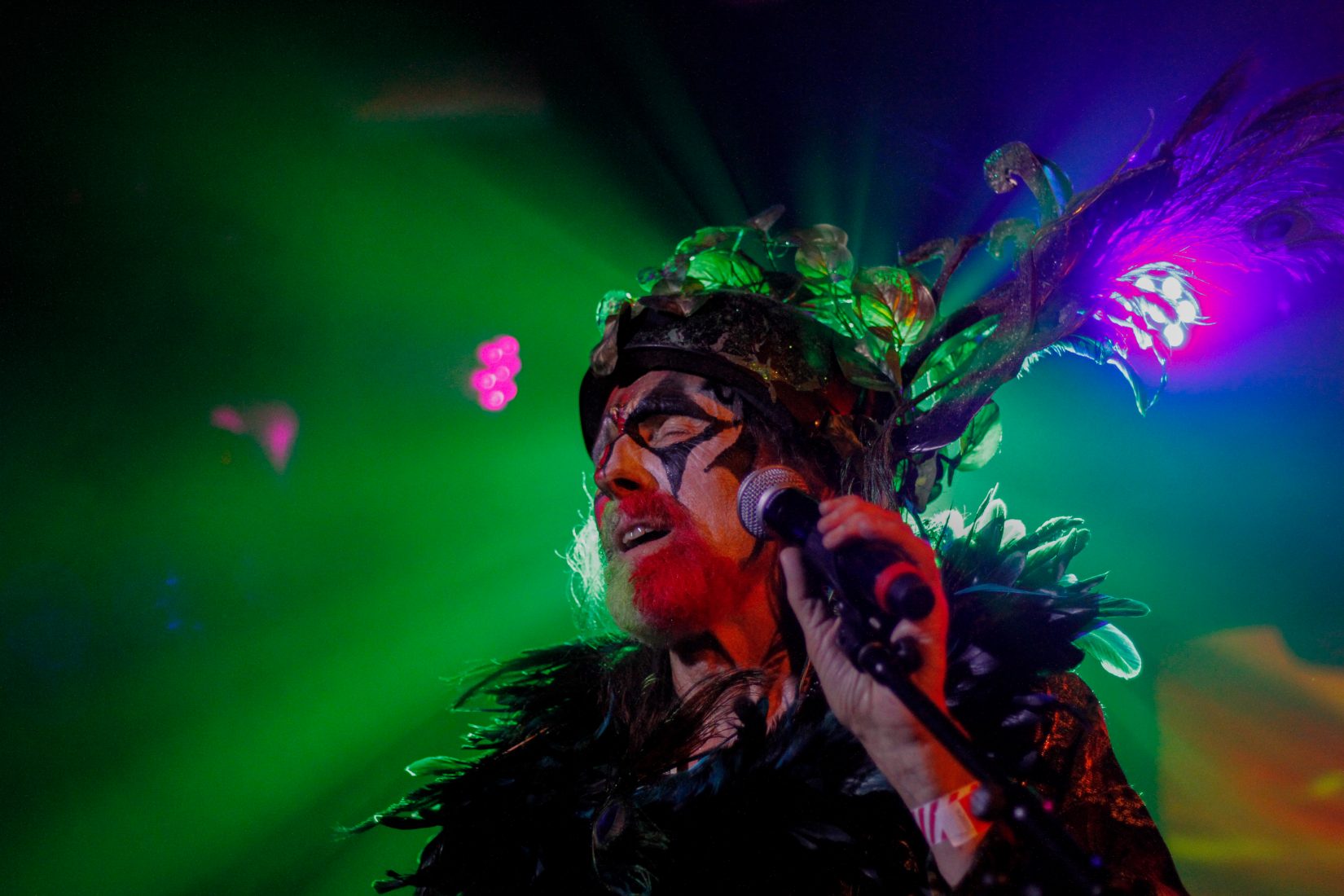
Back to Le Poisson Rouge 2019: Arthur Brown, now 77, crackles with the vocal prowess of a man five decades younger. His band, each wearing costumes, headgear and face paint, is ready for the long haul. Brown is a mystical spectacle, beginning the set with Nightmare, lyrics straight out of a William Blake painting:
Dynamic explosions in my brain
Shattered me to drops of rain
Falling from a yellow sky
Orange faces to an opened eye
After each song, he runs offstage during a musical interlude, returning draped in a different costume. Pirate shirt! Sequined tunic! Fiber-optic waistcoat! He is mischievous, jamming a microphone down his trousers for Muscle of Love, his ode to kundalini rising. Brown paid tribute to Screamin’ Jay with a screeching rendition of I Put A Spell On You. No fire helmets at this show, but he did don a massive black feather headdress during a twenty-minute performance of Fire, his frenzied keyboardist practically in trance as Brown mingles with the audience.
The show generates so much energy that one leaves feeling exhausted, rejuvenated, and wondering if Brown is, in fact, a sorcerer. The answer is…perhaps.
Bob Gruen is not only one of the most famous rock photographers, but one of its most prolific as well. If you’ve seen a photo of John Lennon wearing a “New York City” t-shirt, Bob took it. If you’ve seen a photo of Led Zeppelin standing in front of an airplane with their logo on it, Bob took that one, too. He has captured countless iconic images over the past five decades that we’ve grown accustomed to seeing on posters, shirts and the pages of books.
As a 50-year resident, Bob Gruen’s name is practically synonymous with downtown New York. Thanks to Carol Klenfner’s connection, I had the opportunity to conduct a Q&A with Gruen about his past, present and future, garnering a rare look at the man behind the lens. His work ethic is to be admired, and his “last words” are inspiring to all, not just to photographers. Much of Gruen’s classic work has recently been reissued, but there is a permanent display at Edition Hotel at 5 Madison Ave. [Editor Note: This article originally appeared in the Spring 2016 issue of Downtown Magazine.]
What was your first paying gig as a photographer?
Bob Gruen: I lived with a rock band [Glitterhouse] in the ’60s, and when they got a deal at Atlantic Records, they used my photos for their publicity. Atlantic then hired me to shoot Tommy James and the Shondells, when they were opening at a presidential rally for Hubert Humphrey.
What is it that you like most about living downtown?
BG: There is less traffic, and it’s quieter, because most of the streets are shorter and smaller than uptown, and the buildings are lower, so there’s more sky. But we’re close to everything going on in the city.
When did you first move downtown?
BG: I moved to Sullivan Street in June 1965, and I thought the Feast Of St. Anthony was a great welcome. I’ve lived in the West Village since 1970.
What is it that keeps you living in Manhattan, as opposed to moving to L.A.?
BG: I’m not moving to L.A., because I’d only last a few days there! The sun is nice, but it’s way too spread out, and there is so much traffic, it takes hours to get anywhere, and when you meet someone in L.A., they say, “How are you doing?” In New York they say, “What are you doing?” I like to be doing things.
Is your neighborhood on the verge of becoming another SoHo?
BG: I think the West Village is becoming another SoHo with high-priced shops and luxury condos, but I’m not ready to move.
Do you have a favorite venue in Manhattan for photo shoots? Or at least a favorite for concerts?
BG: I don’t really have favorite venues where I take photos, but I always like to see shows at the Beacon [Theatre], because it’s such a beautiful theater, and the sound is good. Past favorites were Max’s [Kansas City], The Bottom Line, CBGB’s and Don Hill’s, all now gone. But now, I think, for a club, I like Bowery Electric.
To you, is music good these days? Or are the best days of pop and rock behind us?
BG: I usually think the best day is today. You can’t go back, and I find good music all over town.
In October, your book on John Lennon was re-released. How does it compare to the original release?
BG: The new edition of John Lennon: The New York Years has a new cover and 16 new pages with 24 photos not published before.
Do you feel that there are any misconceptions about John? Or is there something you wish more people knew about him?
BG: John was very open about his life; I don’t think there are misconceptions. If people really want to know about John Lennon, they should read the last two interviews he gave — the BBC interview by Andy Peebles and the Playboy interview by David Sheff — both available as books. John expressed himself very clearly and had learned a lot from his five years of raising Sean [Lennon].
Do you have any exhibits in the works? Or any other books?
BG: There is a new permanent installation of 45 of my photos in the Billiard Room [in the Clocktower Restaurant] at the new Edition Hotel on 24th Street. This year, I released a new book of photos of Yoko Ono, See Hear Yoko, and there was a reissue of…TheClash. Photographs by Bob Gruen….My large 500-photo monograph, Rock Seen, is now in its 4th printing. I’m currently working on an autobiography.
Is there anyone you haven’t yet photographed but still hope to?
BG: I’ve met many very interesting people, and I can’t say there is anyone special I can think of I’d like to photograph. But I go out all the time, and I’m always happy to meet new people.
If a person were thinking of getting into photography as a proper hobby, is there a particular camera you’d recommend to start with?
BG: The camera doesn’t matter as long as you’re comfortable with it; they all do mostly the same things. It’s what you do with it that matters.
Is there a photograph or a particular shoot that you’re most proud of? Or see as your biggest accomplishment?
When you’re not busy with your career, how do you like to spend your free time?
BG: I’m busy with my career most of the time, but I like to travel and visit with my family and grandchildren now.
Finally, Bob, any last words for the kids?
BG: I always tell people that if you take a lot of pictures, you’re bound to get a good one, and if you only show the good ones, people will think you’re good. Other than that, learn from the past, look to the future, but live in the present.
In advance of the band’s upcoming 12th studio album, Revolution Radio, Green Day is hitting the road for a rare club tour. On Oct. 8, Green Day will headline Webster Hall. Prior to that, the legendary group hits close to Manhattan with a gig in Sayreville, New Jersey at Starland Ballroom on Sept. 28.
The first single off Revolution Radio, “Bang Bang” — as released on Aug. 11 — quickly hit #1 on charts in the U.S. and U.K. It is the band’s 31st entry onto the US Alternative Songs chart, tying them with Foo Fighters and Red Hot Chili Peppers for the third spot as the most charted artist in the history of the charts. The video for “Bang Bang,” as directed by Rancid’s Tim Armstrong, premiered yesterday via Rolling Stone.
Revolution Radio will be released on Oct. 7 via Green Day’s long-time record label Reprise Records.