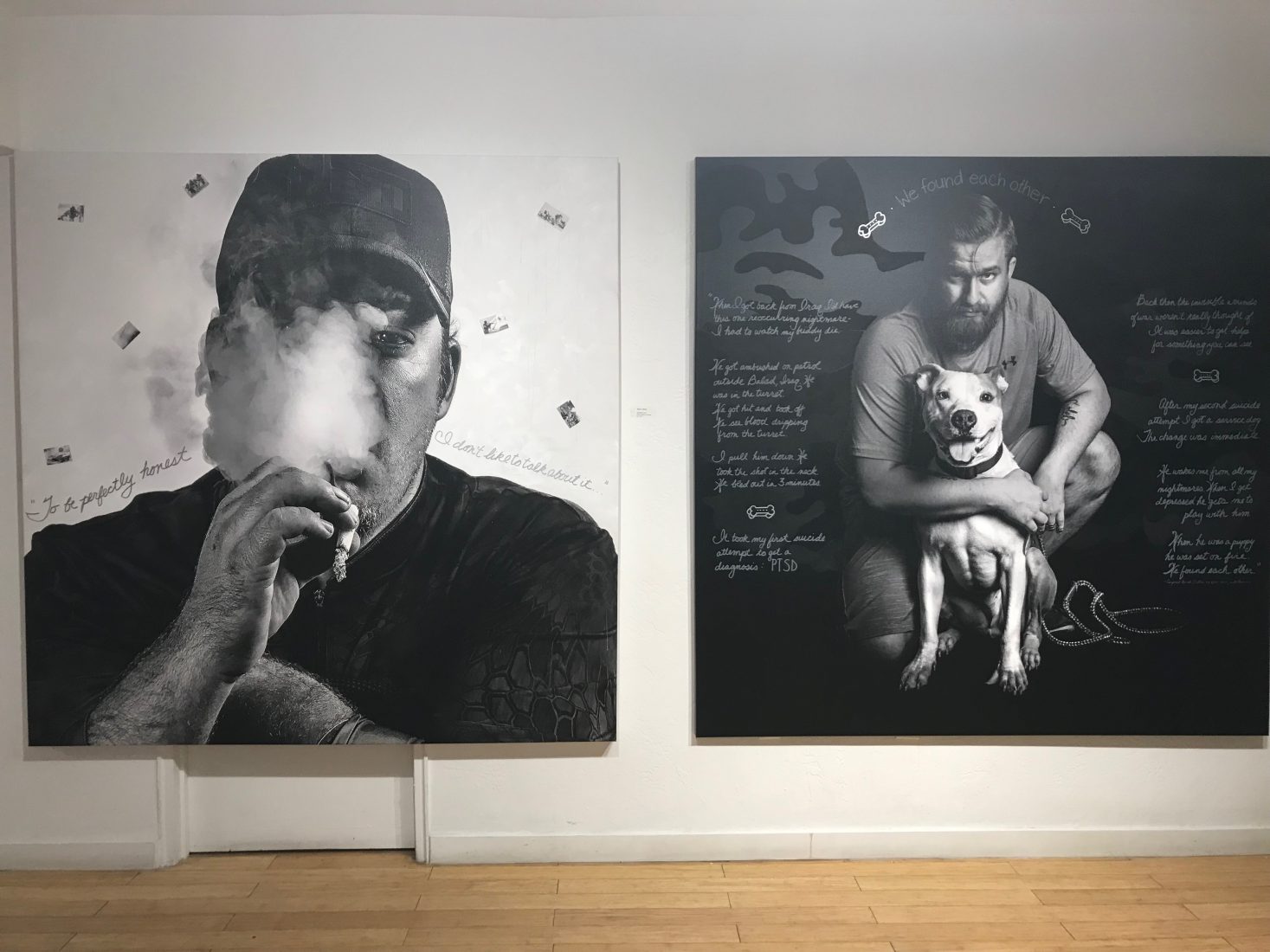
NYC artist Susan J Barron tells the story of two veterans who walked into her show, “Depicting The Invisible,” with their service dogs. They approached a portrait featuring a handsome bearded man crouched with a dog. The phrase “We found each other” haloes his head, and he is surrounded by quotes that tell his story: a friend dying in his arms overseas; relentless, vivid nightmares; two suicide attempts; and a dog trained to comfort him and wake him up, saving him from his nightmares. The veterans were visibly affected, and told Barron, “this is a portrait of us.”
Depicting The Invisible
Barron created “Depicting The Invisible” after learning that 22 US veterans commit suicide every day. “I was so shocked and appalled by the statistic,” she says, “I really felt that, if people could understand what’s going on, then they would be inspired to step up and make a difference.” Barron interviewed dozens of veterans, creating portraits to tell their stories. As the SoHo artist travels with her show, she has encountered “uncountable” veterans drawn to the images and the stories. Her goal, she says, is to give voice to the experiences her subjects have shared with her. “Every time the show travels to a new city,” she says, “it magnifies their voices.”
Conversations
When she isn’t traveling, Barron is working on a different, lighter, project. “Conversations” is a series of digital art pieces on canvas, which she creates by reassembling and mixing famous art pieces to create new meaning. Her piece “Luncheon on the Gras
s,” for example, features Edouard’s original nude woman, but sitting across from–in conversation with–an Alberto Vargas pin-up girl. “Two women painted by men over a century apart,” Barron explains, “it’s just so delightful to me.”
SoHo
The “Conversations” canvases stand nine feet tall, and span styles and eras, and are all designed from Barron’s laptop, often at her home base of SoHo House in NYC. “During the day, there’s a whole collection of people working on their laptops,” she says, “some of them are writing plays or screenplays, or they’re writing the great American novel…and some of them are creating art.” Her perfect workday, she says, includes a stop at the Whitney Museum of American Art or a walk through the local galleries.
A Test
Just before the debut of “Depicting the Invisible,” Barron faced her biggest challenge. The mother of one of her subjects called her and told her that he had taken his life, or “fallen victim to the 22,” as Barron calls it. She was heartbroken. She had spent hours talking to him and growing closer to him. Could she have known? Was it disrespectful to go through with the show? But, she says, other veterans reached out to her with sobering words of encouragement. She had to continue, they said, because Damon’s tragedy happens 22 times every day. She went through with the show, and visitors can still see Damon’s portrait, wreathed in quotes where he wrestles with his PTSD and the specter of suicide.
Inspiration
After DTI and Conversations, Barron is considering a portrait series on survivors of September 11th. She is inspired by the opportunity to tell the stories of those we might otherwise never hear. As she says, recounting the words of a former professor, “There are only so many pieces (of art) that you can make in your life, so make them count.”
Susan J Barron just finished showing Conversations at SCOPE in Miami.
Hurricane Dorian was the most intense cyclone recorded to strike the Bahamas and the worst natural disaster in the country’s history. Dr. Michael Hall, who was in D.C. riding out a category five storm during its genesis, saw the news about the destruction in the Bahamas and felt motivated to help. He joined the Third Wave Volunteers to help run their medical component during the initial recovery a few days after the Bahamian aftermath. Dr. Hall said, “What was endearing was the stoicism of the people who had lost so much and showed great dignity during Mother Nature’s fury.”
Celebrity Clients
At the Hall Longevity Clinic in Miami Beach, Dr. Michael Hall, MD provides regenerative aesthetic, and anti-aging medical treatments, as well as general medicine, travel vaccinations and basic women’s health. Over the years, he has treated members of the Saudi Arabian Royal family, the King, and Queen of Swaziland, Simon Cowell and Blaine Trump. Drake, the rapper, gave Dr. Hall a shout-out on Instagram after a visit last year.
Social Justice Warrior
Dr. Hall is trained as a family physician and eye surgeon, a healthcare policy expert, and provided humanitarian services around the world, including to the survivors the 2004 Indian Ocean tsunami, 2010 Haitian earthquake, and the recent Bahamian hurricane. He is a published author and is certified in traditional Chinese medicine. As a social justice warrior, he has made it his cause to make health care affordable and more efficient with his medical software company, Wellskor. A helicopter pilot, Dr. Hall is a designated Aviation Medical Examiner offering FAA-required exams for commercial airline pilots. His life has been a journey of curiosity, learning and fighting for social justice.
NY Presbyterian & Weill Cornell Medical Center
As a young ophthalmology resident at New York-Presbyterian -Weill Cornell Medical Center, Dr. Hall observed cases in which African American patients were treated unfairly, and sometimes became victims of malpractice due to racial profiling by doctors. He registered an official complaint with the hospital staff and was dismissed from his duties. “I was eight months away from finishing my residency, and I was literally just thrown out,” he says. He went to the US Southern District federal court and the New York State Department of Health which found the hospital was in the wrong, but his federal judge sat on the case for three years, forcing Dr. Hall to sue his judge for relief. He took it to the New York Times, which exposed the cover-up.
Dr. Michael Hall
Lower East Side Service Center
Dr. Hall next took a job as medical director at the Lower East Side Service Center, a substance abuse clinic, found that he loved it, and obtained a master’s degree in healthcare policy from NYU, transforming his career. “I wanted to look at the 30,000-foot view and really see what we’re doing; I had felt that medicine for me really was more at the global level because of Cornell. I was kind of forced into thinking differently about how to look at the patient.”
Volunteerism & Indian Ocean tsunami
He became a community and family physician, board-certified after a two-year residency and then moved to New Zealand to study their healthcare system. While working with the indigenous Maori, the 2004 Indian Ocean tsunami hit. He took two bags with gear donated from the community and flew on his own to Sri Lanka to join another doctor there. To help survivors, he worked with a church, visiting their multiple outreach centers and orphanages. Five of his Maori nurses from New Zealand also came at their own expense. “It was a beautiful experience,” he says.
Traditional Chinese & Maori medicine
While working with the Maori, Hall learned about natural and plant-based medicine, and then went on to work with indigenous peoples in Hawaii, Montana, and Maine. “I found that to be a pivotal point to understand our real human connection to one another, these tribes of people all over the world use local plants, sustainable diets and ancient implements to heal themselves. “That led him to a fellowship in traditional Chinese medicine at the University of Miami, combining a holistic component with Western medicine. “Then anti-aging just made sense because obviously it’s conscious awareness and real preventative medicine.” He attends conferences with top scientists who are “trying to crack the code on what goes on in the body as we age.”
Downtown Favorites
When Dr. Hall is in New York he likes to stop by Raoul’s for their Steak au poivre and Balthazar for their soft-boiled eggs and fresh bread and coffee. On a Sunday, you might find Dr. Hall at Lupes East LA Kitchen enjoying Margaritas and burritos with friends. hallongevity.com
Artist Domingo Zapata was honored at the Brooklyn Borough President’s Latino Heritage Celebration where he received the Most Influential Artist of The Year Award. The theme of the event is Young Artists/Old School and Domingo gave the keynote speech. Zapata has also created the illustrations for The Lonely Princess by Marie Ferraro from Lightswitch Learning, which comes out in time for the holidays in November. The book is about the power of friendship, generosity, and respect for the differences between people.
“Life is a Dream”
Domingo’s 15-story mural that wraps around the One Times Square. Features his mantra, “Life is a Dream” amidst flowers, flamingos and polo ponies. The artist said, “For me, it is an honor to be part of the story by creating Life Is a Dream, the largest mural in New York. I want to convey this message to people from all over the world who visit Times Square and who can enjoy and get to know my art.” The mural will be on view through January 1st.
‘Life is A Dream’ in Times Square
Success, Contrast & the Future of Patronage
Zapata’s early impressions as an artist, coupled with several high-profile clients, first cultivated a reputation as an artist du jour. But after 15 years and creating a portfolio of art worth over $40 million, the Spaniard’s ever-increasing success – and the artistic vision underlying it – continues to paint a decidedly different picture.
For years, Domingo Zapata has been, in a word, busy.
It’s not just the paintings, which for the last decade have required perpetual work to keep any amount of inventory. It’s not the increasing number of sculpture and mural commissions that he fulfills or the expanding social media input. Nor is it his many exhibitions or the myriad number of collectors and clients, including Johnny Depp, Leonardo DiCaprio, Diana Picasso, the Missoni Family, and investment bank Goldman Sachs.
Instead, it’s what Zapata has been doing with his own time. Whether it be collaborations with global figures such as Alejandro Sanz, designing clothes for his fashion shows, donating artwork to innumerable charity events, writing a novel, painting with Pope Francis, or serving as a guest speaker at the United Nations to advocate for art education, Zapata has done it all.
Pope Picture
The resulting image is in stark contrast to the one that Zapata’s earliest critics predicted – that of an “artist to the stars.” But Zapata’s outlook and ascent have been remarkably consistent for the past fifteen years – the duration of his career as an artist – and the predilections of the past have been unraveled year by year, painting by painting, achievement by achievement.
As the artist himself notes, his works “contrast between the past and present, and try to make the work say something about the future.” It’s fitting, then, that Zapata himself is one such contrast, in art as in life; and with a past not steeped in fine art, but rather, in humble beginnings on the Spanish island of Mallorca.
Zapata’s Early Years
Had Zapata ambled up to a younger version of himself on Mallorca in the early 1980s, he would have likely found himself back in the garage his father worked in. And even then, it would not have been surprising to see him with paintbrush in hand. “I always loved to paint,” Zapata notes. “It’s something I was obsessed with since I was a kid. We had a car shop, and my dad fixed and painted cars, and my mom was a painter. We lived on top of the shop, so every day I lived with the paint and the fumes. The environment I grew up in was one with a creative family.”
But when it came to painting full-time, Zapata – who graduated from American University with a degree in political science – was at first more pragmatic, especially after his move to New York City in 1999, where the art scene was particularly intimidating. “Moving to New York, I never thought I had a chance. I came from this humble background, and I didn’t even know where to start. I took the first job that was available, to survive, and in those days, the jobs were in finance.”
For the next ten years, he worked in corporate, painting in his home when he could. That is, until one day in 2005, when a friend, contractor Michael Borrico, took an interest in a picture of a polo horse that Zapata had painted and placed in his office.
Blue Polo Horse
“This friend of mine came by our office and he said, ‘Oh, I love that painting, I’d love to show it to a friend of mine,’ Zapata recollects. “It was a painting of a polo horse. And I said to him ‘I did it.’ And he’s like, ‘I can’t believe you did that!’ And I said, ‘Look, I have a studio in my house; it’s a hobby. I do this.’”
Convinced he had found talent, Borrico organized a dinner and exhibition at his house, where Zapata’s work gained its first critical recognition. Various gallery representatives bought paintings, and the friend that Borrico had mentioned so casually in the office turned out to be none other than billionaire George Soros, who made a purchase of a polo painting titled “Blue Horse.”
The feedback was overwhelmingly positive. “They all motivated me to dedicate myself to art,” Zapata said. “I quit my job and started painting. I was working in the corporate world for more than ten years, leaving a job where you were making some money. But I thought, if I don’t do it now, in my early thirties, when am I going to do it? So I went and I said, ‘fuck it, I’m going to go ahead and do it.’ And thank God it worked!”
Asked if this strange road to the beginning of his artistic career had an impact on his eventual style, Zapata answered in the affirmative. “That’s where my unconventional way of doing things came from. When I wanted to go to college, everybody said no, when I was in college, everybody said no, when I wanted to get a job, everybody said no, and when I wanted to be an artist everybody said no. So I said, you know what, I’m just going to do things my way, and nobody’s going to say no to me.”
Superman by Domingo Zapata
2011 : Artist to Watch
He never looked back. Zapata began painting incessantly, creating works for events, commissions, and “pop-up shows:” sponsored, transitory exhibitions. In 2011, he was named Whitewall Magazine’s “Artist to Watch,” slowly cultivating a clientele ranging from typical collectors to celebrity purchasers. Small events eventually transitioned into larger gatherings, and over the years the guests at such shows ballooned into the thousands.
As Zapata’s clientele grew, so did his opportunities. He began holding exhibits throughout the world, including appearances in Paris, Miami, Los Angeles, New York, Venice, Rome, Singapore, and Monte Carlo. From these gatherings, he generated continued interest in his work and began receiving regular commissions. Celebrity clients whom he had met along the way also continued to buy, including Johnny Depp and Leonardo DiCaprio. Such efforts bore fruit: in 2005, his paintings sold for $5,000; in 2011, $30,000; in 2015, $40,000 to $50,000. Now, in 2019, Zapata’s smaller work sells for $60,000 to $70,000, with his larger gallery pieces and sculptures regularly selling for well over $100,000 a piece. And perhaps more impressively, he has no inventory of artwork, as his works and commissions have sold out completely for the last ten years.
Artistry: Style and Substance
Given the excitement surrounding Zapata’s artistry, one would expect the works themselves to be similarly exciting; and by no means do they disappoint. Falling roughly within the confines of neo-expressionism and pop art, Zapata’s works utilize bold use of color and exploration of themes such as sexuality, power, and opulence. But more than anything, his work is defined by contrast. Within a single showing, one might see the Mona Lisa bedecked somehow magnificently with graffiti, mixed media, and a platoon of primary colors; a pop art panda sporting backgrounds with neon geometry or sinister scenes emulating crucifixion; a garden with beautifully ornate flowers and growth breaking free of rigid outlines; bullfighter jackets, or chaquetillas, generously marked with color and text; or something as commonplace as an airplane vividly portrayed from the front, a cruel line and three blurred propellers screaming against the hues and text they appear to be suspended in.
“I like to work in different themes,” Zapata muses, “for things that I am passionate about. And then I like to use different techniques on those themes, according to the theme. However, the strokes are always the same…so when you see my work, you will see and recognize it’s mine, it’s Domingo Zapata, because of my colors, the strokes, and messages, and the type of combination and conversation of colors.”
Zapata’s attention to such contrast is the cornerstone of many of his themes, both in how he views art and how he views reality. It can be seen in virtually every series he creates, whether it be the juxtaposition of Polaroid and acrylic in his ‘Ten’ series, for which Sofia Vergara and others have sat, or the larger-than life figures in his superhero paintings as they sit among graffiti. This, he states, is no different than how we might see it in real life. “The world we live in is about contrast,” he says emphatically. “In New York City, you can live in a twenty-million-dollar penthouse, you go downstairs, and there’s somebody sleeping in your door. These contrasts have an influence on me, because I am a contrast. I was born in a very humble family that was making an average of $800 per month for their entire lives, and I can make a painting worth more than $100,000.”
It is for such reasons, Zapata notes, that he cares so much about emulating contrast in his own style, although his background and later immigration to the United States have also heavily affected his creative process. “As a Spaniard loving art, I was brought up understanding – or,” he corrects himself, “learning, better than understanding – about Velasquez and Goya and Picasso and Dali…and then I moved to New York and had a huge influence from the pop culture of the 80s that was just kind of turning into the beginning of the 90s. So I had the end of that movement with Warhol and Basquiat. It created this passion for contrast, where I would try to take the master’s work and make it contemporary using contemporary techniques.”
When asked about how he wants his artistic style to impact others, Zapata was quick to answer:
“Everything’s possible, that dreams are possible, that if you go and work very hard you can achieve whatever you want in this life, no matter who you are or where you come from. That’s what I portray in my work. And it’s always positive and it’s always trying to make you feel good. I always say I don’t know anything, really, about business or about politics, you know, but I do know how to make this world more beautiful. Other people can make it better; I’m just going to make it beautiful if I can.
“I try to use my work to influence those people in a positive way, to make them feel good. And if they have it in their house and they wake up in the morning and they’re going through any struggles, or whatever – if they look at my painting and it makes them feel better to go to work, and to make the world better – then I’m doing my job. And that’s what I do, that’s my motif, that’s my style.”
Letters to Panda, Acrylic on Canvas by Domingo Zapata
Patronage, the Gallery Model, & Social Media
Zapata’s unorthodox style also extends to social media. While many artists remain firmly in the gallery model, Zapata has decided to create inroads into social media sites such as Instagram, where he currently has close to 40,000 followers – and through which he has occasionally sold paintings to collectors. “I don’t have anything against galleries or the gallery model,” he said, laughing. “It’s a misinterpretation; if you Google it, you could find a Zapata at maybe sixty shows.”
But the artist is adamant that the future lies in the past; or in the case of the art world, patronage. Pointing at the large overhead that many galleries and their artists have to deal with – whether it be from rent, staff size, shipping costs, and the like – Zapata notes that social media is providing a conduit between artists and collectors that simply didn’t exist a decade ago. “In today’s world, with social media being such a big influence, bigger than regular media, everybody looks at Instagram, Twitter, Facebook,” he says. “Now, you have all these sites which bring the collector and painter together, so they can start their own relationship. And that’s where we’re going. I don’t think these platforms are a condition-based model; they’re a service model, where they’re introducing you to the variety; they put you right in front of the source. That’s how it was done a hundred years ago, and that’s how it’s going to be for the next hundred years.”
This, he agues, is a return to patronage; social media and website users can browse through the work of a number of artists, find an artist that suits them, and meet them in person. Instead of going through a gallery, where paintings are normally viewed, the role is being taken by social media sites and more polished, art-specific services. And this, in turn, helps to bring exposure to artists who otherwise might have trouble wending their way trough the gallery model. “I think it’s amazing,” he says. “It gives an opportunity to those thousands of artists to have a chance, even if they are totally unknown. Talent prevails.”
To that end, Zapata expects that artists large and small will eventually shift to a form of digitally enhanced patronage, and he has every intention of being on the cutting edge. Pointing to artists like Picasso and Michelangelo, who both benefited immensely from traditional patronage, he also discusses how art, a much older institution than art galleries, thrived under that system. “The art world is forty thousand years of history, since the cavemen dipped their hands in blood and printed them on the cave to state ‘I exist, I am here.’ That’s the beginning of art, the beginning of the international language that everyone can understand.” While a far cry from that age, social media, he says, is once again making the language of art accessible, both for collectors and artists alike.
Sky Polo by Domingo Zapato
Philanthropy
Zapata’s desire for accessibility in art is the focal point, as it turns out, when it comes to philanthropy. In the name of practical application, he supports innumerable charitable organizations, including routinely creating or auctioning off his own works for charitable foundations for hurricane relief, funding art programs for children with impoverished backgrounds, participating in New York Fashion week for charity, and raising awareness for art education.
Even in New York, where the art scene is alive and well, Zapata notes that 80% of public schools do not have an art program anymore, despite higher rates in previous years. “I believe that if we forget art in education, then we will be raising children without sensitivity, and those will not be children; they will be soldiers,” he says.
To counter this issue, Zapata has been heavily involved with Pope Francis, whom he has visited, painted with, and more recently, been appointed an ambassador to the Scholas Occurentes program. As an ambassador, Zapata will meet with the pope twice a year and discusses how to further benefit the program, which unites low-income schools together to improve resource generation and increase the quality of education for its students. As an ambassador, Zapata was also able to attend a panel at the United Nations and speak about the importance of art and education at the recent Latin American summit.
Zapata’s motivations, however numerous, come down to a simple goal, however. “To me, right now, I just want to be able to express to as many people as possible everything that speaks to my heart; to be able to use my position, and that place of influence, to do murals and sculptures which are public, for people to enjoy; and to use it to raise funds for charities and causes that I believe are important; and also grow as an artist. I’m already in the system, where I can pretty much say I’ll be doing this for the rest of my life; God forbid that something fucked up happens; but I am one of those who have that opportunity, which have been given so much. It’s my time to also give back, and at the same time, grow as an artist, and keep expressing myself. I don’t know how or what is next, but I know that I will fight like the first day to keep delivering feelings and a positive energy to anyone that is aiming to take them from me.”
Looking Forward
But fifteen years is, Zapata hopes, just scratching the surface; and though forever occupied by exhibits, painting, and his own activities, he never wants to be complacent. Indicating a distaste for being labeled, he takes inspiration from artists like Pablo Picasso, whose style changed dramatically throughout his life. “I don’t want to be stuck with description,” Zapata says decidedly. “I just want to be able to do. You have artists like Picasso who have proven themselves extraordinary through different styles and different themes throughout their entire life and career. So if you look at Picasso when he was twenty, it has nothing to do with him when he was fifty, or when he was seventy. And I think that is an example to follow. I cannot be doing the same thing…I want to work in different themes and different styles my entire career, so that I’m influenced by every moment I’m alive.”
Part of accomplishing that, Zapata says, is continuing to do what he does best. “I’m not an artist to the stars, I’m a painter,” he says simply. “I have the opportunity to paint people who are extraordinary; obviously, with some, I am going to develop synergy or friendships with them. One of the most beautiful things about this work is that I get to know people, and I’m happy to have that opportunity.”
Spring Red Flowers Acrylic on Canvas by Domingo Zapata
And that opportunity, it seems, has enabled him to use his artistry to positively impact all that he meets – whether it’s a client personally visiting his studio, an aspiring artist who sees his work on social media, or a beneficiary of his philanthropy. Such interaction, he says, is what keeps him truly inspired.
“I believe in this world,” Zapata finally says, taking in the last breath of the interview. “My clients are celebrities, and billionaires, and collectors; but they are also children in need, and charities, and everybody who walks through Brooklyn and sees my mural. This is my collector base. This is my job.”
Dr. Sharyn Lewin performs robotic surgery with the Da Vinci Robot in Holy Name Medical Center. 2/6/17 Photo by Jeff Rhode /Holy Name Medical Center
By Fallon Harrington
Photos courtesy of Holy Name Medical Center
Dr. Sharyn Lewin
The Lewin Fund to Fight Women’s Cancers was founded in 2014 by Dr. Sharyn Lewin, a renowned gynecologic oncologist and Castle Connolly Top Doctor in New York City. This fund began through a generous gift from a woman who lost her battle to uterine cancer. Grateful for Dr. Lewin’s help, she wanted to support the expansion of Dr. Lewin’s vision and expertise to more people across the nation.
The Lewin Fund
The Lewin Fund’s mission focuses on addressing the massive unmet funding needed for research, education, prevention, and support for women with cancer. The fund is particularly focused on underserved communities. The Lewin Fund is a family fund that not only helps women with cancer but is also committed to wellness and prevention initiatives to keep women cancer-free. Lastly, the Lewin Fund strives to help not just women but also their families, supporting them in a myriad of ways as they face cancer. For example, it funds a transportation program at Mount Sinai Hospital to help women travel for chemotherapy and doctor appointments. It also funds a Bronx-based program, The BOLD Brothers/Sisters Program at Albert Einstein College of Medicine to support children whose moms and grandmothers have cancer.
Both the founder and the executive director of The Lewin Fund, Dr. Sharyn Lewin designed the organization’s strategic vision and oversees the operations. She serves as the chief ambassador, at the helm of advancing the mission to invest in grassroots initiatives and research that directly support women who are afflicted with cancer and their families. She brings more than 20 years of medical, research, and community outreach experience to her role and is a long-time advocate for women and women’s health initiatives. It also supports the ‘Woman to Woman’ program at Mount Sinai Hospital, a peer-mentoring program.
The Lewin Fund supports several innovative research projects, including the Dana-Farber Cancer Institute and Memorial Sloan-Kettering Cancer Center. It has also embarked on precision medicine studies, including ones on genetics and immunotherapy.
The Latina Summit
The Lewin Fund also focuses on prevention. It hosts free community events to help educate the community about cancer prevention and wellness. Some of the events include “Own Your Health Power Panels,” “Tell 10 Women Events,” “National Education Symposia,” and the “Latina Summit: The Impact of Cancer On a Family” to be held in NYC (165 W 46th Street) on November 21st.
Award-Winning Gynecologic Oncologist
A board-certified gynecologic oncologist, Dr. Lewin specializes in the diagnosis, treatment, and management of ovarian, endometrial, uterine, cervical, vulvar, and vaginal cancers. She currently serves as the medical director of the New Jersey-based Holy Name Medical Center’s Gynecologic Oncology Division. Dr. Lewin’s expertise includes radical operations for ovarian cancer, including upper abdominal and extended pelvic resections. She has extensive training in minimally invasive laparoscopic procedures and robotic techniques using the da Vinci Surgical System. She has research interests in novel chemotherapeutic agents, including immunotherapy and hyperthermic chemotherapy (HIPEC) for recurrent ovarian cancer.
Dr. Sharyn Lewin performs robotic surgery with the Da Vinci Robot in Holy Name Medical Center. 2/6/17 Photo by Jeff Rhode /Holy Name Medical Center
Education & Experience
Dr. Lewin is an assistant clinical professor at Mount Sinai Hospital. Prior to that, Dr. Lewin was an assistant clinical professor at Columbia University Medical Center, New-York Presbyterian Hospital. While at NYP, Dr. Lewin was the first medical director of the Woman to Woman Program, a cancer support initiative. She completed her training at Memorial Sloan-Kettering Cancer Center.
Physician of the Year
A national educator on hereditary genetics, cancer survivorship and state-of-the-art treatment for advanced ovarian cancer, Dr. Lewin has authored or co-authored over 100 articles, abstracts, book chapters, and made many presentations at scholarly conferences. She was selected for the prestigious President’s Award from the Society of Gynecologic Oncology and NYP’s prestigious Physician of the Year Award. She is a Castle Connolly Regional Top Doctor since 2015.thelewlinfund.org
Dr. Sharyn Lewin
Steven M. Cohen, Special Advisor
The Lewin Fund has many supporters from all walks of life. The fund’s voluntary board of directors carefully vets proposals for funding opportunities. Special advisors are also on hand to provide insight and support. Steven M. Cohen, a special advisor to The Lewin Fund, explains that partnering with and supporting The Lewin Fund is a deep passion for him. He is committed to helping with fundraising efforts, identifying strategic partnerships, and engaging in community outreach on behalf of the organization. With a background in technology and capital markets, Cohen plans to launch a hedge fund focused on blockchain and digital assets. This fund will have a strategic alliance with The Lewin Fund. Studies show women’s cancers, other than breast cancer, are poorly funded across the United States.
Did You Know
1 in 3 women faces cancer.
Every 6 minutes a woman in the United States is diagnosed with a gynecologic cancer.
Every 2 minutes a woman in the United States dies from cancer.
Light, in its many facets, is to artist Bentley Meeker what music is to Philip Glass. “Light is the most powerful tool we have to create any feeling,” says Meeker. Growing up between the United States, the Bahamas, and Canada, Meeker was exposed to forms of light around the world. When he moved to Manhattan at the age of 14, his passion was ignited. While living in the city he was constantly exposed to illumination; it was all around him, so he dove in. Meeker’s first book, ‘Light X Design,’ is an inspiring study in what light can be. Images of Meeker’s work fill the pages. “It’s an art book presented like a photo album, but an album for light and the infinite possibilities that lie within it,” said Meeker.
Light Sculptures
During the last decade, Meeker has had multiple museum and gallery shows of his light sculptures, including a one-man show at the Whitney Museum of Art. He was also the first artist to have a piece in the Whitney’s new downtown location. The lighting artist has exhibitions at The National Arts Club and the Southampton Arts Center. The Core Club, a private members enclave with a focus on culture and art, commissioned Meeker to create a light sculpture for their lobby.
The Temple of Whollyness, from Burning Man 2013.
Burning Man
Meeker also helps create innovative art projects at Burning Man, an iconic weeklong communal experience in the Nevada desert. Meeker has lit the Temple at Burning Man three times,he took over 300 fixtures, a mile of cable and a crew of fifteen to illuminate the festivals main temple. Seventy thousand participants from around the world were drawn to the site by Meeker’s lights over those Labor Day weekends before the Temple was burned down to signal the festival’s conclusion.
‘Temple of Promise’ from Burning Man 2015
Weed World
Meeker returned to his Canadian roots with the pot-themed show #Weedworld. Meeker created an exhilarating immersive experience in a room filled by a blizzard of marijuana leaves created with light. This installation was a part of the #Grassland exhibit that opened at the Penticton Public Art Museum in British Columbia. pentictonartgallery.comThe show featured artists who explored the culture, history and economic impact of marijuana on society. The exhibit was partially funded by the government and engaged viewers in a political conversation about legalizing marijuana in Canada. This year the artist returned with a solo show of his light sculptures, one of which was featured in the New York Times.
H in Harlem
In addition to his projects for private clients, Meeker’s public works have included “The “H” in Harlem,” a large-scale public art installation suspended under the 125th St and 12th Ave viaduct in Harlem. When Meeker isn’t creating art or lambent ambience for weddings and corporate events or taking part in festival rituals, he enjoys some downtime, playing guitar with his son Jensen.
“The “H” in Harlem”
The Vision
Bentley Meeker, lighting designer extraordinaire, converts physical spaces into inspiring environments, ensuring that weddings, galas, and special occasions feel and look as momentous as the events themselves. An early gig as a Palladium stagehand —during the golden era of Ian Schrager and Steve Rubell who also owned Studio 54 — sparked Meeker’s fascination with Vari-Lite, the world’s first moving light, and “ignited the passion that became my career,” recalled Meeker.
Bentley Meeker Lighting and Staging
In 1990, Meeker founded his company, Bentley Meeker Lighting and Staging Inc. when he’s not creating art Meeker likes to design weddings “because it’s about making the best day of someone’s life better.” Over the years, he’s lit nuptials for Chelsea Clinton, Melissa Rivers, Billy Joel, Eddie Murphy, Robert De Niro and Catherine Zeta-Jones and Michael Douglas. The versatile visionary illuminated Christian Dior’s catwalk at New York Fashion Week. Meeker also flickered the lights on some of New York’s most storied intuitions, including charity galas and movie premieres at MoMA, The Metropolitan Museum of Art and The New York Public Library, In the Hamptons he’s lit the Parrish Art Museum.Events Meeker has done this year include the MoMA Armory Party, Hudson Yards Grand Opening, Clinton Foundation Gala, Men In Black Premiere, Love Ball and Alexander Wang’s fashion show. He has also done events with Lincoln Center and the Guggenheim museum. bentleymeeker.com
Meeker is represented by the Garvey|Simon gallery and his new light sculptures are on view at his studio at 465 10th Ave. Contact (212) 722-3349 for an appointment.
The wedding of Melissa Rivers at New York’s Plaza Hotel.
Arthur Sulzberger, Glenn Hoagland, Robert DeNiro and Jane Rosenthal.
When you think of New York, you can’t help but imagine the Manhattan skyline and its busy city streets. But New York is much more than skyscrapers and urban settings.
Last Friday, the acclaimed actor and longtime advocate for the city and state he loves, Robert De Niro hosted Mohonk Preserve 50thAnniversary Gala at Three Sixty – Tribeca. It was the first New York City Benefit Gala for the state’s largest non-profit preserve.
Proceeds from the Inaugural Gala will support the Conservation for the Next Century – Campaign for the Mohonk Preserve and its initiatives: restoration of carriage roads, acquisition of the Mohonk Preserve Foothills, and designs for a new interactive visitors’ exhibit and multi-media orientation theater.
De Niro served as the honorary chairman of the event, but was far from the only renowned face. Among the more than 200 guests, were such luminaries as producer, Jane Rosenthal, New York Times Publisher Arthur Sulzberger Jr., Mary Wittenberg (President of the NYRR), interior designer, Brian McCarthy, Scott Stewart of the Corcoran Group, Bruce Littlefield (author, design specialist and lifestyle expert), Mike Keegan (CEO, M&T Bank), Noah and Maria Gottdiener (CEO and Chairman of Duff & Phelps), the preserve’s Executive Director, Glenn Hoagland, former President of the Paine Webber Group, Paul B. Guenther, DOWNTOWN’s CEO, Grace A. Capobianco, in Zac Posen, and New York publicity luminary, R Couri Hay.
The program followed a cocktail reception and comments from De Niro and others.
Robert DeNiro making his impassioned comments about the Mohonk Preserve.
“Mohonk Preserve is a shining example of the good that came come from smart sensitive care of our natural resources,” said De Niro. “Not long ago, that seemed like a good choice, now it’s a matter of life and death. We call all agree on that. This should be the first commandment—‘Don’t fuck with Nature.’”
Maybe we all should follow the advice of another famous New Yorker’s advice and “Take a Walk On The Wild Side.” But for that to happen, the first step is to take advantage of and support preserves like the Mohonk Preserve which already receives more than 150.000 each year—making it the most popular in the state.
-Xavi Ocaña
Maria and Noah Gottdiener (CEO and Chairman of Duff & Phelps).
Mohonk’s Executive Director, Glenn Hoagland and wife, Melissa Greig.
Hadrien Coumans (Co-founder of the Lenape Center) and Curtis Zunigha.

 Conversations