Categories
Music

Album of the Year: Civilian By Frank Tovey

2019 has been all so overwhelming, hasn’t it? Being trapped in this infinity loop of crisis and pundits, all at our fingertips? We mindlessly scroll through the drone of Facebook, greedily lapping up salacious headlines and fretting over our future. Is anything changing for the better? Has the ennui always existed? Humanity loves believing in a simpler past. The deluge of programming and movies rebooting old material and old scripts is played out so heavily now one wonders if innovation is allowed anymore, or if we’re just going to keep pacifying ourselves with cozy familiarity. The 1980s seem as much of a utopia now as the 1960s did when The Wonder Years premiered in 1988.

Frank Tovey saw right through the excess, saccharine and glamour of the Reagan/Thatcher era, and, much like the soothsayer of Julius Caesar, went ignored by the masses. There was no room for nostalgia here.

Fad Gadget, photo by Florence Doorgeest

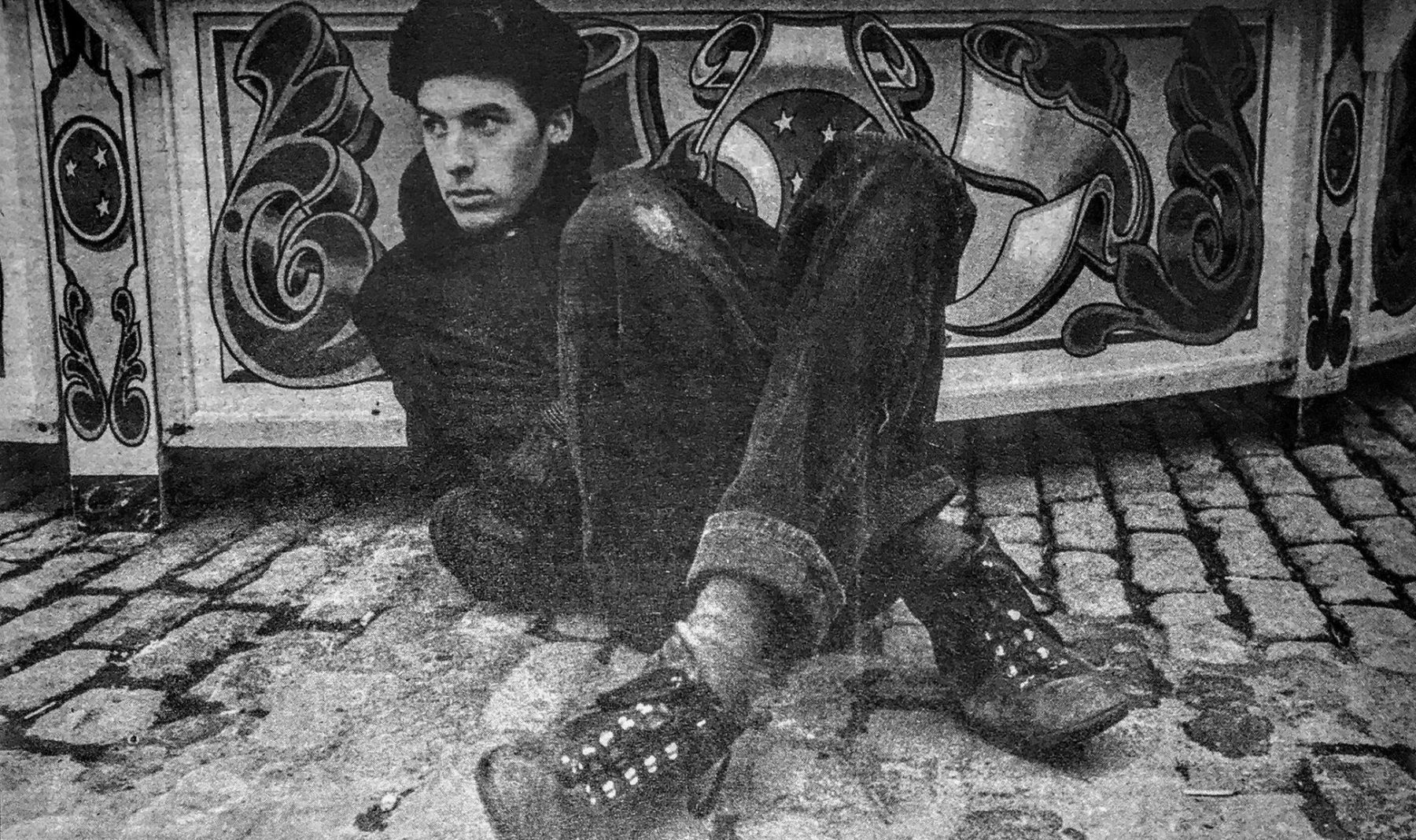
Frank Tovey’s proto-industrial band Fad Gadget, the first signed to Mute Records, boldly steered electronic music into the realm of industrial sound. Eschewing the stationary, robotic playing of his early synthwave contemporaries, Tovey shocked audiences with intense art performances: ripping out body hair, crowd surfing, being tarred and feathered, climbing rafters with a microphone stuffed in his mouth, often seriously harming himself with head gashes, black eyes and snapped tendons.

Fad Gadget albums were an eclectic mix of electric drills, drumming, Orff-inspired vocal arrangements, musique concrete, and shrieks. Tovey’s message and notorious reputation clearly threatened the suits; his lyric material found more sympathetic bedfellows with The Pogues, the Kinks, and Billy Bragg, by way of Einstürzende Neubauten and Iggy Pop. Tovey’s message was highly confrontational, bitterly anti-commercial, and deeply vulnerable. As most pop stars crooned about romantic love spats, Tovey operated on a different plane: warning humanity of the dangers of late capitalism.

Photo by Anton Corbijn

Despite never making Top of the Pops, Frank Tovey still wielded tremendous influence in the UK and West Germany. A fledgling Depeche Mode were entranced by his early performances, and signed to Mute soon after. The entire industrial genre owes him a tip of the hat, with artists like Skinny Puppy, NIN, and Marilyn Manson snatching the relay baton.

By the late 80s, however, Tovey pulled an about-face with his sound. He tucked the chaotic Fad Gadget in bed for a long nap, picked up an acoustic guitar, and penned brand new protest folk as Frank Tovey. After 1986’s Snakes and Ladders, which retained many sonic elements of Fad Gadget, and a side project called MKultra, he released the extraordinary Civilian in 1988.

The sonic switch confused his fans, the press and even his own label, but his fundamental message remained. The irony was, Tovey had always been a folk musician, albeit one with a synthesizer. His lyrics delved into humanity, the human experience, and the Everyman existing in a technologically-fueled fascism. Much like Bowie, Tovey found inspiration from various collaborators.

“It was never about transitioning from electro to folk with Frank,” says John Cutliffe of The Pyros, with whom Tovey would collaborate on his final albums. “It was about songs and sound and the musicians he surrounded himself with. His influences had always been eclectic, and his love of manipulating sounds electronically inspired so many, but that is also what we were doing with the more traditional folk and rock instruments. We would push the limits of what they could do and play…Frank didn’t care if it was a banjo or a synth. The song mattered, and the layers of sound we could use to draw out the emotion of the song was the only thing that was relevant.”

Over thirty years later, Civilian remains as prescient as ever as it slips into 42-minute slow motion tumble of Western civilization’s house of cards. This was not a world Tovey wanted for his beloved children.

Civilian is a hypnotic channeling of rage at corporate greed and corruption. The album opens with New Jerusalem, a screeching cacophony of crowd chants and a droning, nightmarish recounting of a fascist police state and street violence. It is a bleak, paranoid scene of innocents falling victim to the militaristic whims of “big enterprise.”

Ultramarine bitterly attacks the Hollywood glorification of the American military complex:

Liberation comes

In jeans and Coca-Cola

Liberty this bullet’s

Got your name on it

You make the films

And you’re making history

Napalm burger bars

Popcorn victory

Tovey darkly closes Ultramarine with his own Wonder Years-style monologue, recounting a childhood memory of watching a Buddhist monk die by self-immolation on live television. So much for the veil of nostalgia.

From The City To The Isle of Dogs examines the gentrification of London neighborhoods already present by 1988, the continuing erasure of local culture, and the demise of the middle class. The jaunty banjo number Bridge Street Shuffle wryly predicts the horrific spectacle of human suffering via reality television.

I’ve got two tickets, front row seats
For the riverside
We can take a picnic
And watch the suicides

The Brotherhood lambasts the corrupt patriarchal power of fraternal societies. Diana echoes the wrenching pleas of infidelity forgiveness. Unknown Civilian explores the post-war home front, and the silent suffering of shell-shocked veterans.

Civilian as a whole is a horrifying, clairvoyant glimpse at Western society on the precipice of complete breakdown.

In 2002, Frank Tovey’s earnest heart suddenly gave out, and he shuffled off this mortal coil. By then, however, he had already tilled the parched earth for the greedy saplings of a post-9/11 dystopia. Too bad no one heeded his warnings when Civilian was first released, but it deserves a fresh listen. You won’t find a more perfect soundtrack to close out these chaotic 2010s.

Mute Records would be wise to re-release this treasure. It’s time. Fad loves you.

Bridge Street Shuffle:

https://www.youtube.com/watch?v=jRD6ba1JPZo

Ultramarine:

See More

Clan of Xymox Materializes At Le Poisson Rouge

Blake Charleton Keeps It Fresh

Virginia Marcs Goes “Wild” In Stunning New Video
Christine Smith Waits On The Far Side Of A Star

Adrian Sexton Draws The Death Card

Categories
Art Culture Featured Miami

Depictions and Conversations with Susan J Barron

Susan J Barron

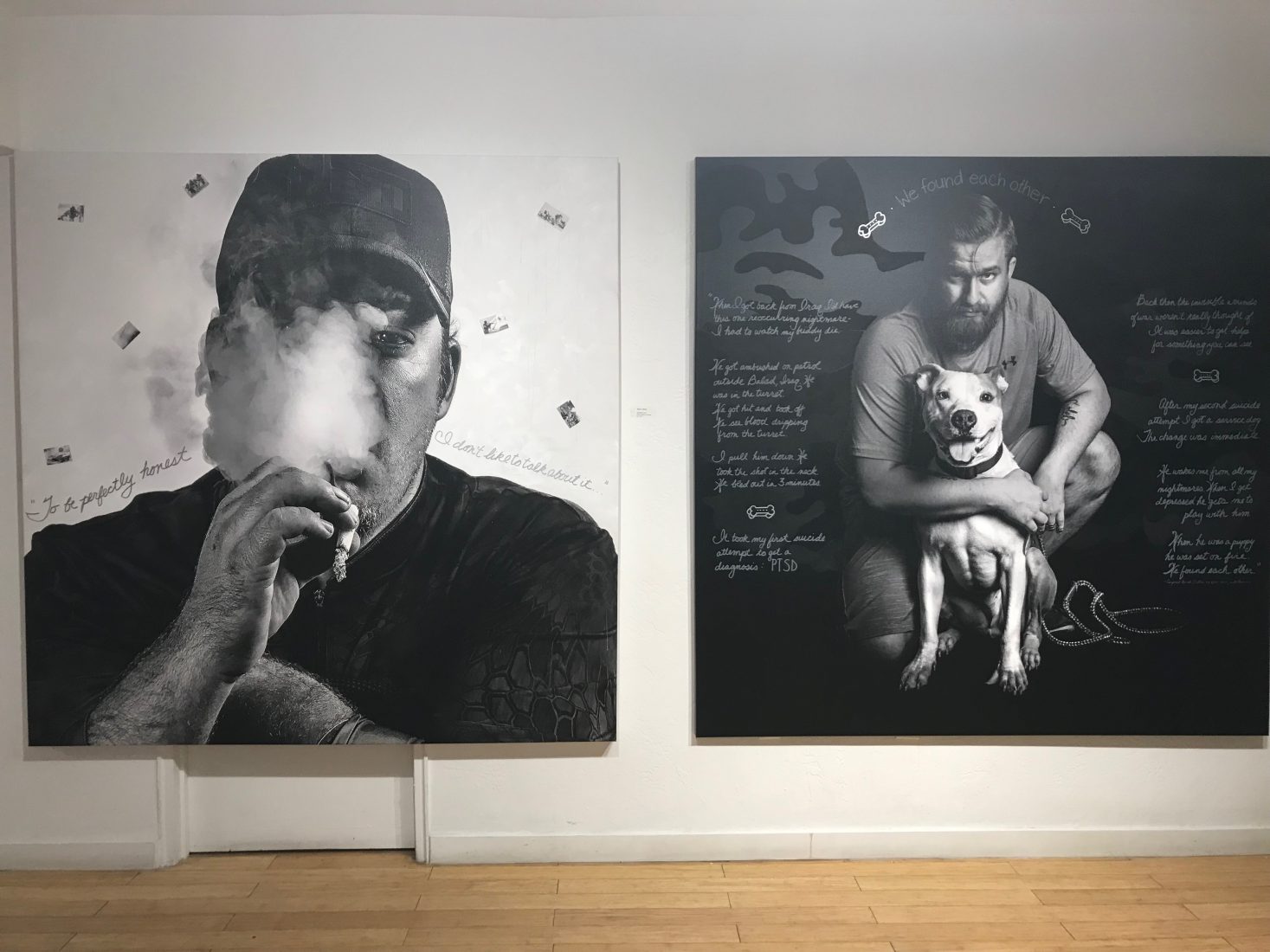
NYC artist Susan J Barron tells the story of two veterans who walked into her show, “Depicting The Invisible,” with their service dogs. They approached a portrait featuring a handsome bearded man crouched with a dog. The phrase “We found each other” haloes his head, and he is surrounded by quotes that tell his story: a friend dying in his arms overseas; relentless, vivid nightmares; two suicide attempts; and a dog trained to comfort him and wake him up, saving him from his nightmares. The veterans were visibly affected, and told Barron, “this is a portrait of us.”

Susan J Barron

Depicting The Invisible

Barron created “Depicting The Invisible” after learning that 22 US veterans commit suicide every day. “I was so shocked and appalled by the statistic,” she says, “I really felt that, if people could understand what’s going on, then they would be inspired to step up and make a difference.” Barron interviewed dozens of veterans, creating portraits to tell their stories. As the SoHo artist travels with her show, she has encountered “uncountable” veterans drawn to the images and the stories. Her goal, she says, is to give voice to the experiences her subjects have shared with her. “Every time the show travels to a new city,” she says, “it magnifies their voices.”


Depictions and Conversations with Susan J BarronConversations

Conversations by Susan J Barron

When she isn’t traveling, Barron is working on a different, lighter, project. “Conversations” is a series of digital art pieces on canvas, which she creates by reassembling and mixing famous art pieces to create new meaning. Her piece “Luncheon on the Gras

s,” for example, features Edouard’s original nude woman, but sitting across from–in conversation with–an Alberto Vargas pin-up girl. “Two women painted by men over a century apart,” Barron explains, “it’s just so delightful to me.” 

SoHo

The “Conversations” canvases stand nine feet tall, and span styles and eras, and are all designed from Barron’s laptop, often at her home base of SoHo House in NYC. “During the day, there’s a whole collection of people working on their laptops,” she says, “some of them are writing plays or screenplays, or they’re writing the great American novel…and some of them are creating art.” Her perfect workday, she says, includes a stop at the Whitney Museum of American Art or a walk through the local galleries.

A Test

Just before the debut of “Depicting the Invisible,” Barron faced her biggest challenge. The mother of one of her subjects called her and told her that he had taken his life, or “fallen victim to the 22,” as Barron calls it. She was heartbroken. She had spent hours talking to him and growing closer to him. Could she have known? Was it disrespectful to go through with the show? But, she says, other veterans reached out to her with sobering words of encouragement. She had to continue, they said, because Damon’s tragedy happens 22 times every day. She went through with the show, and visitors can still see Damon’s portrait, wreathed in quotes where he wrestles with his PTSD and the specter of suicide. 

Inspiration

After DTI and Conversations, Barron is considering a portrait series on survivors of September 11th. She is inspired by the opportunity to tell the stories of those we might otherwise never hear. As she says, recounting the words of a former professor, “There are only so many pieces (of art) that you can make in your life, so make them count.”

Susan J Barron just finished showing Conversations at SCOPE in Miami.

See More

NYC Experiences: Sketch and The City

Categories
Featured Living News

Helaina Hovitz Talks Lower Manhattan, Her New Book “After 9/11,” & Being A Career Writer

Helaina Hovitz / Photo: Justin McCallum

A prolific writer and editor, the work of Helaina Hovitz has appeared within dozens of popular outlets. A New York native based in lower Manhattan, Helaina has contributed to the New York Times, Salon, Newsday, New York Observer, Forbes, Huffington Post and Recovery.org, to name a few key outlets; Downtown has proudly featured her work on more than a few occasions this year. She is also the co-founder of the very refreshing Headlines For The Hopeful.

Helaina’s latest project is her newly-released memoir, After 9/11: One Girl’s Journey Through Darkness To A New Beginning, through Carrel Books. After 9/11 covers Helaina’s life before, during and after September 11, 2001. However, it’s about a lot more than 9/11, discussing recovery and other themes that have made her the person that she is today.

Downtown had the pleasure of talking with Helaina about After 9/11 and plenty more. Helaina can be visited online at www.HelainaHovitz.com. She can also be followed on Twitter and Facebook.

After 9-11

How would you describe your book to someone who hasn’t read it?

Helaina Hovitz: After 9/11 is a coming of age story, not just my own, but that of several children growing up in the shadow of the World Trade Center. At ages 11, 12 and 13, our brains are trying to make sense of the world around us and how we relate to it, and trauma changes how we feel about and respond to nearly everything. That day was the catalyst for so much else that would take place after. The impact it had on people physically, emotionally and mentally was ongoing, even though we all very much wanted to just “move on.”

Outside of a direct correlation to September 11 or Post Traumatic Stress Disorder, what else do you think might resonate?

HH: The entire book is not about 9/11, nor is everything that I describe or include the direct result of my experience with 9/11 and its aftermath. I felt it was important to write about the entire scope of my life from early childhood to present day to give a sense of how trauma manifests in the bigger picture of an otherwise “normal” life. For that reason, it is relatable in many ways: my first love, high school bullies, my special relationship with my grandma, my first drink, my first dog, my admiration for the “cool” professor in college…There is a lot more to this story than the title would suggest, and at the same time, it is incredibly-accurate: this is what my life looked like over the past 15 years. This book was actually a hard sell because so many industry folks just wrote it off as “9/11 literature.” I always wondered what the reaction would have been if my personal trauma didn’t happen to be one of the worst global acts of war in human history.

Helaina Hovitz / Photo: Celestina Ando Photography

Is there something that you’re hoping for readers to come away with after finishing the book?

HH: The ability to identify and know they are not alone, in still struggling with what they saw and felt and lived through that day. We all have our traumas and those moments that change our lives forever, and, in both subtle and obvious ways, influence the way we think and the choices we make. Maybe they’ll consider therapy for something they thought they should be “over” already, or realize you can be an alcoholic at any age, and that no, it isn’t a badge of honor. I hope they also realize that no matter how bad things are, there is always hope if we keep searching for answers, for help, for support, and know where to look.

Was there a lot of pain in writing a book like this? Or did it turn out to be therapeutic process?

HH: Absolutely the latter, I had lived the most painful parts already and this was another way that I was able to heal them. Between when I first decided to write the book, the times I said, “Okay, now it’s finished,” and the final copy you’re holding, I was still growing, changing, and learning. With memoir, your story is never really over. You just have to decide where to stop the book.

A Young Helaina Hovitz

Were there parts within the book that you were hesitant to reveal?

HH: Please excuse the pun, but — as in real life — I’m literally an open book. In the interest of being relatable and honest, I included things that my mother was not happy about, and I don’t think any mother would be. But the point is, I wasn’t hesitant to reveal anything because that’s who I was, not who I am. Hopefully, people recognize that serious change is possible, and it will foster a sense of compassion rather than judgment; not just for the girl I was, but for the person the reader is now.

Do you have aspirations of writing another book?

HH: If this is the one book I ever write, that’s okay with me. Do I have another book in me? I may have a dozen.

When not busy with your writing career, how do you like to spend free time?

HH: What’s “free time?” Is that something new the kids are doing these days, like Snapchat? (laughs)

As a dog owner, what are some of your favorite spots downtown?

HH: It’s not up to me, it’s up to Wiley. He strongly prefers pooping on the cobblestones at the Seaport, but also enjoys the brisk walk to the Worth Street Vet….until he realize that once again, “Oh crap, he’s at the vet.” How did he not see this coming again?

As a food writer, do you have a restaurant that you count on for a perfect meal?

HH: I have the privilege of trying so many new places that questions like this one are always hard to answer. I love variety and trying new things, and I’ve gotten to experience certain places and foods that I may never have had the chance to otherwise. Locally, I’m more inclined to show love to restaurants on the east side than west, and I do have some regular favorites, but you’ll have to ask me personally about those so you can tell the owner that Helaina sent you!

Helaina Hovitz with Wiley / Photo: Justin McCallum

Where did the idea for Headlines For The Hopeful come from?

HH: I always knew I wanted to be a journalist. At the same time, the news was always horrifying and re-traumatizing: suicide bombers, Orange Alerts, nuclear war, anthrax scares, weapons of mass destruction, bomb scares. In high school, as editor of the school paper, I was drawn to stories that felt meaningful, important, positive…I had always felt older and more sensitive to a number of issues that other teenagers didn’t seem to care about.

Fast forward a few years, and none of the places I freelanced for would let me write stories about non-profits or charities, about people turning their lives around to do good with them, the hopeful stories of the world, so I got a day job and started giving it away for free to Forbes and Huffington Post. Fast forward another couple of years, and with no business experience whatsoever, I found a team of three people who believed in the need for this type of inspiring but meaningful content, reported well, produced well, focusing on real solutions to serious social issues, and here we are!

Finally, Helaina, any last words for the kids?

HH: Not all therapists are chronic head-nodders who ask questions, take notes and send you on your way. If you feel like something just isn’t right, or you could use some support, do your research online and find a therapist who you think you’ll gel with, and who does skills-based treatment. If at first you don’t succeed, keep trying. But never give up on yourself. Oh, and don’t scoff when they ask about your childhood!