Categories
Culture Featured Music

Blake Charleton Keeps It Fresh

By Alice Teeple

Photos by Alice Teeple

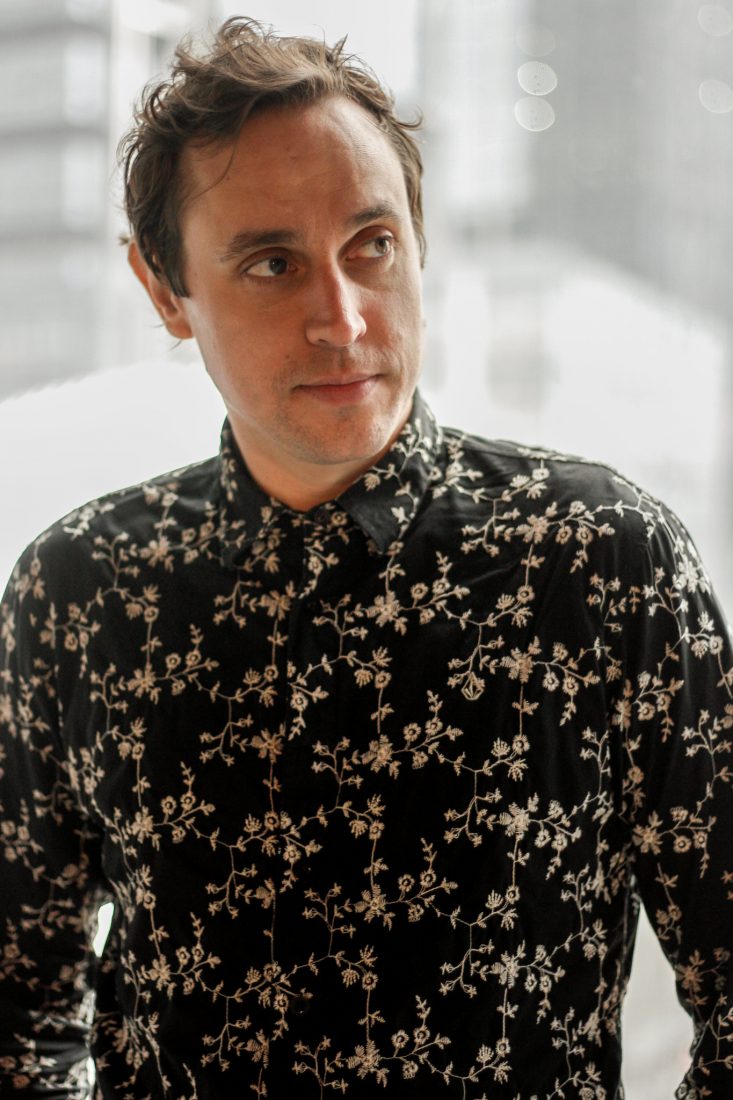
What sounds blare from passing cars as you walk down the street? The wham-boom of eardrum-shattering bass. Monotonous mumble rap. The prefab autotune wasteland beckoning erstwhile partygoers. The dreamy music of Blake Charleton (Akudama, Poison Party) is a melodic breath of fresh air.

Charleton is currently one of NYC’s most prolific songwriters, a one-man Tin Pan Alley, who performed a gorgeous set this fall at Downtown’s World Trade Center music festival. The genial, energetic Charleton is responsible for a staggering repertoire, ranging from mythology-inspired folk, to psychedelic disco, to Baroque pop. He is a master of his craft and The tarot’s Fool, incorporating choirs, musique concrete, and samples from classic films.

“My biggest influences are Paul Simon, Lindsey Buckingham, Karen Carpenter, the Gilberto family that recorded The Girl From Ipanema, even the Wu-Tang Clan,” Charleton notes.

Blake Charleton has been pursuing music since age eleven, after discovering an ability to remember lyrics to songs from movies and the radio.

Blake Charleton

“I grew up very isolated,” he muses. “I would feel emotion, romanticism, and desperation in melodies. Music was the only thing that made me feel those feelings, and as a lonely child it was comforting, almost like an imaginary friend.”

Charleton made good on his childhood ambition. He penned songs for his four bands, as well as eight solo albums. As is the case with most geniuses, however, Charleton endured his share of struggling artist tropes. His music frequently explores darker themes with the veneer of Old Hollywood. Charleton oozes authenticity and pathos, with a sonorous bass reminiscent of Neil Hannon of The Divine Comedy.

He once found himself shocked by the power of his own voice: “I was playing a house party, and two of my peers had begun striking each other in the face. This brawl was getting bloody, fast. I screamed into the mic for them to stop, and without missing a beat, the two boys paused. I felt completely control of my surroundings. It was intoxicating.”

Charleton admits working democratically can be challenging but rewarding, and welcomes collaboration. “Creativity comes from all people, not just from the famous or those considered to be talented,” he adds.

“I take long breaks and step away from songwriting more often than not. I don’t ever seem to find myself working on something big, like a concept album. I’ll wake up with a melody in my head, and then add music to it, feel it out, write lyrics, and voila! It becomes something.”

What’s next for Charleton? Film scoring. He admits to being an avid people-watcher.

“I can see an expression on someone’s face and hear a melody, “ he says. “My mind works in mysterious ways when dealing in music. I love seeing someone noticeably happy, just on top of their shit, alongside someone that struggles to smile or keep it together. I start to create a story in my mind of what their private life must be like.”

But he’s in no hurry to jump into the next phase. “I’m just taking it one day at a time, kinda stepping back and letting life unfold.”

Blake Charleton is completely independent and his entire solo magnum opus is available for purchase here.

Blake Charleton

Videos:

See More

Virginia Marcs Goes “Wild” In Stunning New Video

Christine Smith Waits On The Far Side Of A Star
Adrian Sexton Draws The Death Card

Niabi Aquena of Searmanas Comes to NYC

Categories
Culture Featured Music

Interview With Niabi Aquena of Searmanas

Niabi Aquena of Searmanas in an interview with Downtown

Listening to the opening strains of a Searmanas song is like falling into a murky pool of lucid dreams. The ethereal vocals of Niabi Aquena gently sprinkle cinematic fairy dust over her lush soundscapes. Her work has been described as “etheric darkwave,” with nods to Sigur Rós, Fever Ray, and composer Jóhann Jóhannsson

Searmanas (pronounced SHA-mah-nas) is the Irish word for “ceremony.” Much of her poetry explores nature and ritual through unusual sonic channels; for instance, she used the radiotelephony spelling alphabet in her song Opening With Phonetics. Aquena’s live performances transform her into a priestess solemnly creating altars of noodly wires and sound waves.

“I love the exploration of the role of ceremony within both urban and rural experience,” says Aquena.  “I like showing, not telling. I’m inspired by intensity and poetry. I’m a romantic.”

Although she has called NYC home for two decades, Aquena originally hails from the Shenandoah Valley of Virginia, where the oldest mountain ranges found on earth surround the region with rolling hills and green pastures. Many of her atmospheric progressions sonically mimic that landscape. 

“I grew up in this beautiful place feeling as an outsider and a weirdo,” Aquena explains. “My mom named me from a New Age baby name book she found. I was 5’9” at age twelve; I had flaming red hair. I was different, and in rural Virginia, that was not accepted. This led way to a vulnerability founded in mettle.”

Aquena has since struck an intriguing balance with her place as a metropolitan artist, and the acknowledgment of the pastoral beauty that shaped her youth, through her mystical lyrics and transcendent electronic experiments. She is a unique fixture in the New York music scene, having shared the stage with other electronic visionaries like John Bender and Hieroglyphic Being. 

“The city certainly has taken my heart, and the rhythm of this place motivates me to my core.”

Seamanas
“The only solution I could come up with after hot compresses failed me, was an eyepatch! The pics from that show turned out cool though, so now I’m asked when I’m bringing the eyepatch back…”

Since debuting Searmanas in 2016, Niabi Aquena has been signed to Cleopatra Records and taken her project on tour all over the Midwest and East Coast. Aquena describes tour life as “grueling, but very rewarding.” On the last leg of a major tour, however, a minor crisis struck.

“I got bitten on my eyelid at someone’s place and my eye swelled up. I looked terrible but was playing a show that night. The only solution I could come up with after hot compresses failed me, was an eyepatch! The pics from that show turned out cool though, so now I’m asked when I’m bringing the eyepatch back…although it most certainly wasn’t a fashion statement!”

Aquena has lent her considerable talents to other bands such as Dead Leaf Echo and Textbeak, but she has many more plans for her solo project. 

“I’m waiting on getting a pedal. It takes the firmware from one of my favorite modular synths, but in a stompbox. Earlier this year I taught myself guitar, so I’m thinking of incorporating these two loves, modular synthesis, and guitar, together for the next iteration of Searmanas.”

Searmanas performs the Hart Bar on 7 November.

Check out Undo by Searmanas here:

See More

Lauren Light Unleashes Dark New Single, “Run”

Succumbing To Sophie Kilburn’s Indigo Fever

White Denim At Le Poisson Rouge

Karolina Rose Opens The Gates To Greytopia

Categories
Culture Featured Music

Miss Eaves Is A Font of Wild Creativity

By Alice Teeple

Photos by Alice Teeple

Miss Eaves

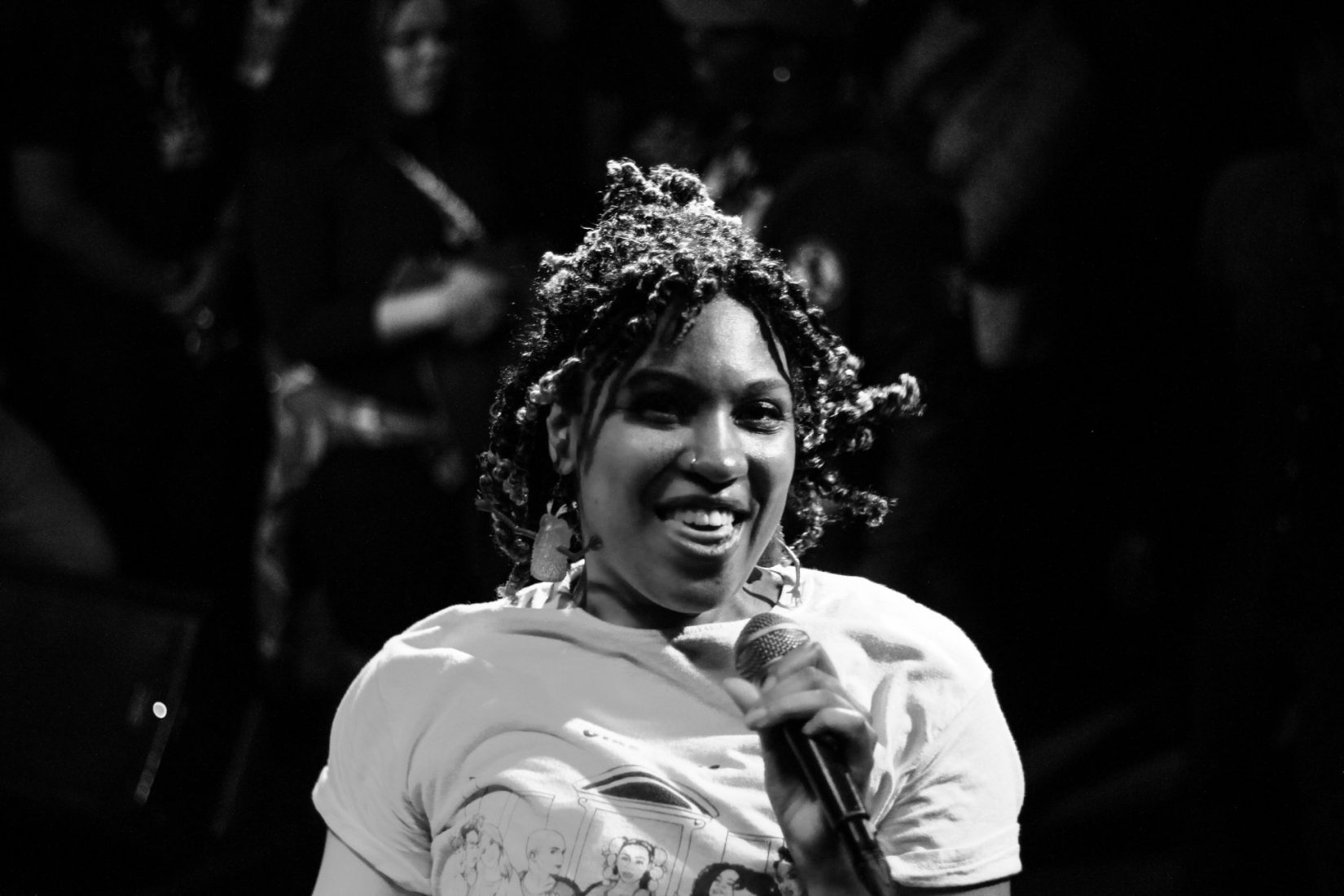
There is a tour de force coming straight out of Bed-Stuy, usually seen with some giant french fries dangling from her ears.

Her name is Miss Eaves. You may have read about her in the New York Times, Jezebel, or Glamour…or perhaps one of your friends sent you a link to her 2017 viral video Thunder Thighs, a balls-out anthem to body positivity that captivated over two million people.

Miss Eaves is a vivid onstage treasure. There is nothing precious about her performances. In a society hell-bent on silence and censorship in the name of propriety, Miss Eaves lets it all hang out in a stream of unfettered truths.

Her shows are a potent mix of John Waters, Amy Sedaris, and Missy Elliott. She is shocking, blunt, and funny as hell. She also isn’t shy on stage, playfully confronting her audience, calling out bad behavior and celebrating the good stuff of being human. 

Miss Eaves

Despite her comical joie de vivre delivery, Miss Eaves still wields the power to shock…and she has a lot to discuss. Ghosters, manchildren, masturbation and the absurdity of self-hatred are all fair game for this modern-day Puck. From Fuccboi Salute, an anthem for the Tinder Generation, to Thunder Thighs, a bop about being comfortable in your skin, her raps resonate with anyone striking out with romance and true connection. 

Miss Eaves recently dropped a new EP, called sad, written during the throes of Seasonal Affective Disorder.  Since the album release, Miss Eaves spent this summer globetrotting all over Europe, Canada, and the US. Her April show at the Bowery Electric in NYC was a mix of uproarious laughter and, with the merry announcement of Bush For The Push, a song about pubic hair grooming…the shifty discomfort of your grade 4 sex-ed class. 

“Don’t tell me I’m too hairy to eat

‘Cause I’m all natural: Bon Appetit!

In addition to her eight-year career as a feminist rapper, Miss Eaves’ alter-ego, Shanthony Exum, is an accomplished multimedia artist. She is also proudly DIY, self-funding her projects and occasionally collaborating with other talented artists and designers. She is particularly supportive of small businesses, particularly those that are queer-owned.

Miss Eaves recently released a video for Left Swipe Left, describing the depressing nature of Tinder dating. It will undoubtedly have you chanting along during your next attempt at online love….but “it’s ok, tho’.” 

Eaves recently took her creative design sense to the streets with a clever guerrilla marketing campaign. Xeroxed street flyers of Eaves trapped in a cardboard Tinder world with the frantic heading “DATE ME! PLEAAAASE!” appeared in Manhattan and Brooklyn, complete with pull-off tabs linking to the video. Eaves hung them herself, documenting the results on her Facebook feed.

sad is now available on all streaming platforms. Get that plate of cheese and chocolate out and play this jam loud. You’re gonna be fine and she’ll tell you why.