Categories
Art Culture Entertainment Featured NYC Theater

A Musical Success for Regina Comet

`What would you do if you finally got your chance to shine? Maybe it’s your first chance. Maybe it’s your last. In A Commercial Jingle for Regina Comet, two writers and a diva get that chance when the diva, Regina Comet, hires two jingle writers to create a song for her upcoming fragrance release, Relevance. The musical is goofy, charming, and tons of fun in a joke-a-minute journey through the emotions behind the creative process. 

Regina is a star in decline. In an age of Instagram, she’s lost too many of the nuances of the 13-18 demographic that used to be her fanbase. Audiences don’t get an exact age, but we get the feeling the new tween fanbase is made up of the kids or even grandkids of the fans who once flocked to Comet’s concerts. Desperate to draw the spotlight again, her managers convince her that her best shot at teens catching her scent is through a fragrance, which she names Relevance. But all is not well: her commercial efforts have fallen short and, in a last bid to make things happen, she hires out a songwriting pair— the cheapest option available— to pen a jingle that will blast Regina’s career back into outer space. The show follows the efforts of the two songwriters— never named but billed as Man 2 and Other Man— and Comet as the three claw desperately at the promise of relevance and success. 

The characters put their heads together to create One Hit Song

At the heart of the show beats Ben Fankhauser and Alex Wyse, who play Man 2 and Other Man and co-wrote the music, book, and lyrics for the show. Inspired by their real-life friendship and a desire to carve out their place in New York City theatre, the show is a comedy-of-errors reflection of the pair’s real search for musical success. And it is clear that the pair are in on the joke. When Fankhauser’s Man 2 is struck by musical inspiration, he pushes aside the show’s music director and keyboardist Alex Goldie Golden and takes over the music mid-song. To play bumbling, struggling versions of themselves in a musical with hit after hit is, to borrow a modern phrase, quite the flex. 

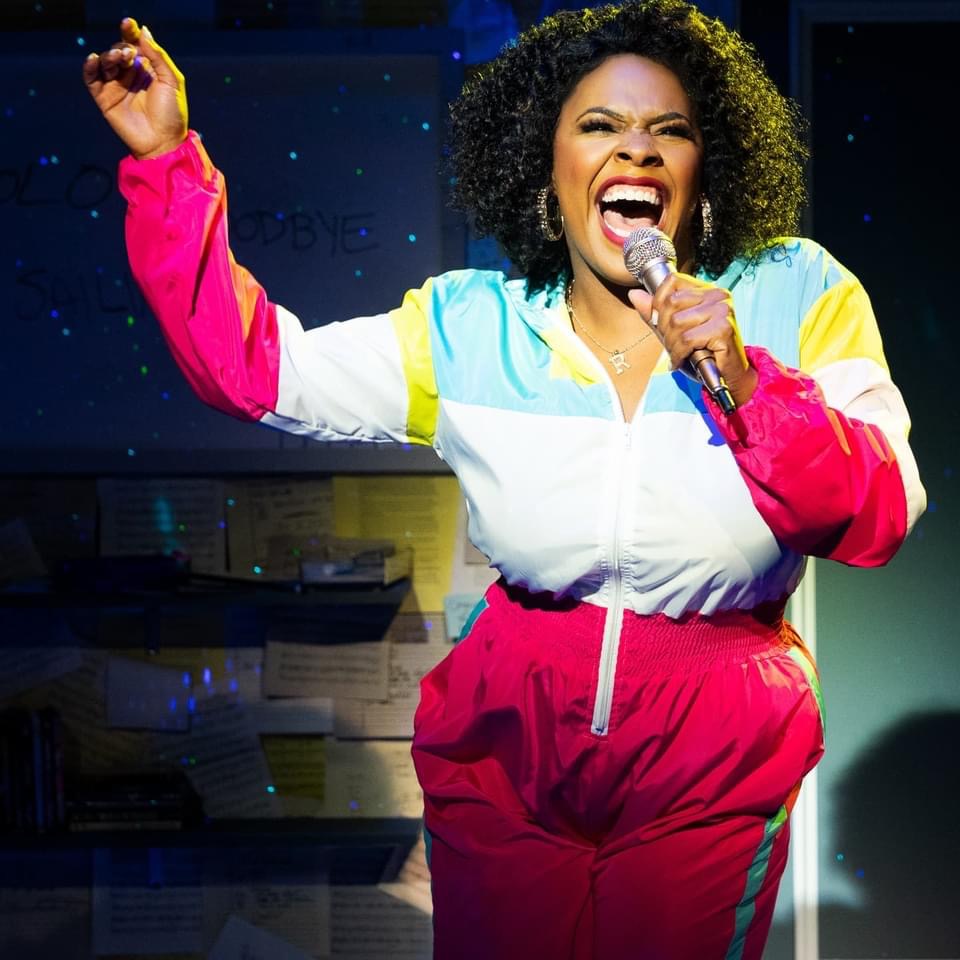
Bryonha Marie Parham likewise shines as Regina Comet, commanding her scenes in a role she fills with perfection and enthusiasm that perfectly matches the show’s sometimes serious, sometimes absurd tone. Comet, who could be a plot device with a solo, comes alive under Parham’s stewardship, aided by the actress’s input in the creative process.

A Commerical Jingle for Regina Comet is a welcome return to live theater— light-hearted, fun, simple, and straightforward. It is the perfect way to venture back out into public, into theater, and head home laughing. 

A Commerical Jingle for Regina Comet is playing at the DR2 Theatre. Learn more and get tickets at reginacomet.com

Categories
Culture Entertainment Featured Music NYC Theater

Downtown Q&A: Hyung-ki Joo and Ron Losby

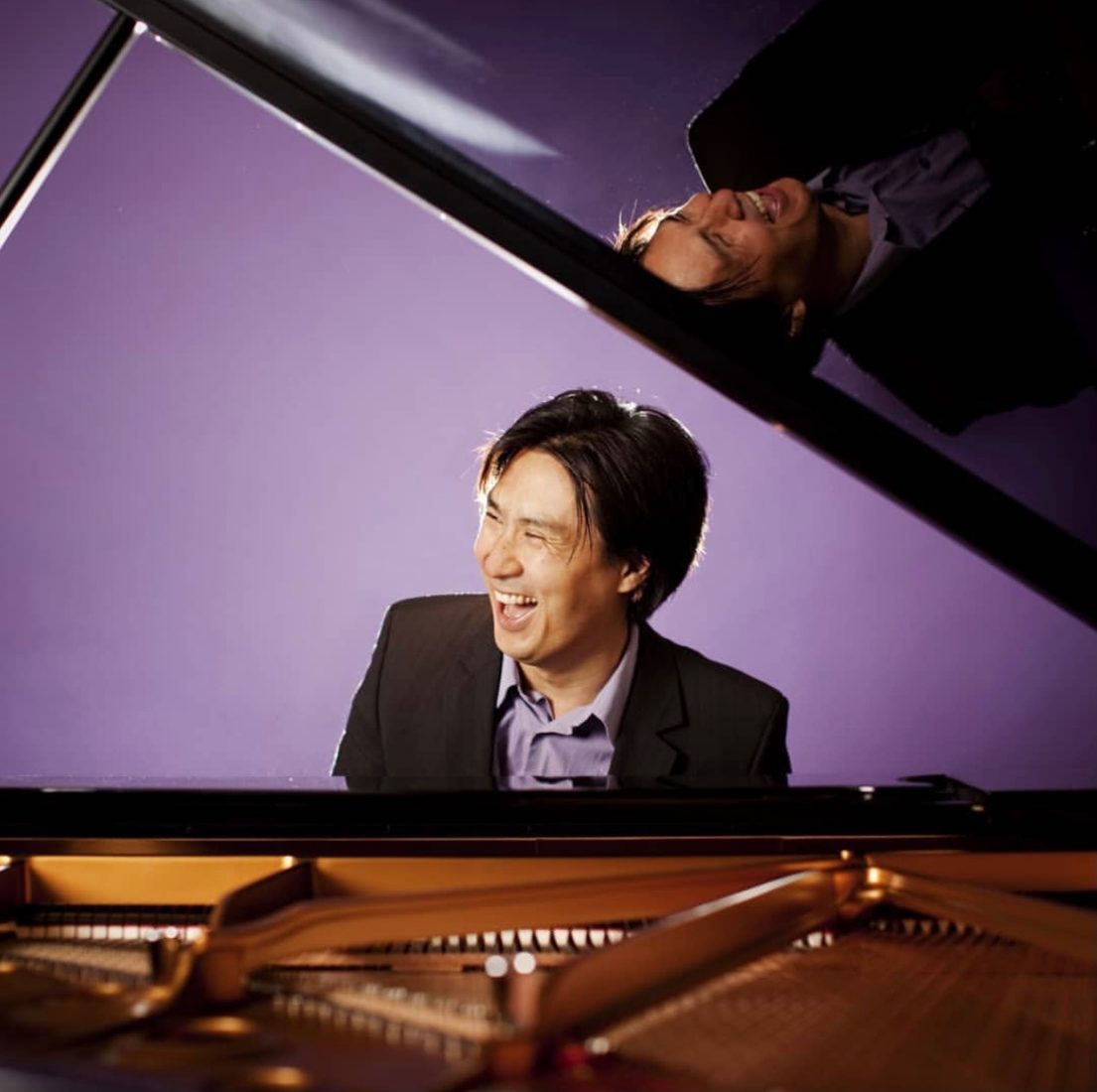
June 21st was Global Make Music Day, and in celebration, Steinway and Sons put on a special performance from several world-class artists, including British-Korean composer-pianist, Hyung-ki Joo. The show took place in The World Trade Center’s Oculus. Joo premiered his “Chandeliers”, a hauntingly evocative piece written in memoriam of 9/11, at the site at which the tragic event occurred. The premiere also marked the triumphant return of live music in New York City, coming out of the dark times of the last year and a half. We spoke to Hyung-ki as well as Ron Losby, the esteemed CEO of Steinway & Son’s for a Downtown Q&A.

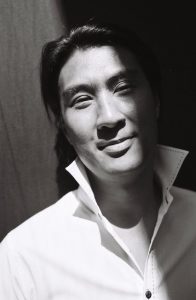
Hyung-ki Joo
Downtown: What does global music day mean to you?

Hyung-ki Joo: Ideally, we should be celebrating music every day, all over the world. Music needs to be more respected and treasured.  Since the start of the “Corona-era,” I feel as though Art and Music have been disrespected and devalued. Even before Corona hit, far too many places in the world, including the affluent Western World, had no educational classes for music in schools.  I believe that music should be a part of every child’s life and I don’t say this because I’m a musician. There are plenty of studies that show how important music is for brain growth, cognitive skills, social and developmental skills.  Music is one of the very few things that bind us as a human race. In a band, or an orchestra, you can have players of all colors, nations, and creeds, and despite their backgrounds, they can make good music together. I believe that musical literacy should be a human right, and as Nietzsche said, “Without music, life would be meaningless.”

DT: Playing your song at the memorial campus for 911 must-have evoked a profound feeling. Would you share any of how you felt with our readers?

HJ: I never imagined that “Chandeliers” would be performed at The World Trade Center, the site that inspired the piece. To see something new and positive existing in the place where so much devastation took place in 2001 is a testament to the New Yorkers and the many others who suffered on that horrible day. To me, the new World Trade Center signifies hope and light.

DT: You wrote this beautiful piece to honor the memory of 911. How did this come about, and how long did it take you to write it?

HJ: 2001 was a year of immense change throughout the world as well as for me. After 9/11, everything changed. I was living in New York at the time and one of the things that struck me most profoundly was, despite the darkness that was towering over us all, light prevailed. I remember vigils and ceremonies aglow with candlelight and lanterns. There was a genuine spirit of solidarity that was touching to witness and experience; especially in a city where aggression and apathy are normalized. I pictured swirling chandeliers hanging from the skyscrapers and thus I began to write this musical sonnet for piano: Chandeliers.

DT: Where were you on 911 and how did you learn about this tragedy?

HJ: I was living in New York at the time. Everyone was glued to TV sets- it was impossible to miss.

DT: What was it like having your music played in our stunning Oculus?

HJ: I was honored that my new book of 10 piano pieces, under the album title, “Chandeliers”, was given a World Premiere at the Oculus. The premiere was given by 8 pianists from my Alma Mater, The Manhattan School of Music.

The 8 pianists were: Ryan Bridge, Xiyu Deng, Elham Fanous, Claudia Hu, Yan Li, Keiju Mori, Yi Zeng, William Zhang.

“Chandeliers” was performed beautifully by the marvelous pianist, Elina Christova, who also studied with me at Manhattan School of Music.

DT: What is your favorite place in downtown New York City?

HJ: Well, the Oculus is definitely one of the most stunning works of architecture in downtown, NYC.

I love the Wild Horses of Sable Island Gallery in Soho.

And one of my all-time favorite places to relax and enjoy a meal is the Olive Tree Cafe in Greenwich Village.

The “Earth Room” is also a unique place I quite enjoy.

DT: You are not only known for your music but also your comedic zaniness, we hear that it’s infectious. Where does this come from, and do you always include this in your performance?

HJ: Victor Borge said that “Laughter is the shortest distance between two people.” Classical concerts alienate audiences because the atmosphere is too elitist and intimidating. Concert Halls, presenters, and Orchestras need to find a new way to connect to today’s generation or the halls will be empty soon. It is 2021, and we are playing music that was created between 1700 and 1950. Laughter is healing, and it helps to put people at ease. I don’t always include “comedic zaniness” in every performance I do, but it is important to make the audience feel at ease and welcomed. In the time of Liszt and Schubert, there was no divide between the artist and the audience, and it is a shame we have lost this tradition. Composers like Mozart, Rossini, Haydn, Prokofiev, and many others, did not put on a comedy hat, and then put on a serious hat. Humor and Non-Humor [were] just two sides of the same coin, and those composers didn’t take their craft less seriously when they were writing humorous music. I always found that classical musicians do not take the humor in music seriously enough! When I started my duo with Aleksey Igudesman, we simply wanted to make concerts that we would want to go to ourselves. And to have the element of surprise back when we go to concerts, I think that everyone should produce concerts that they would like to attend themselves. Just think of the variety and fun we all will have!
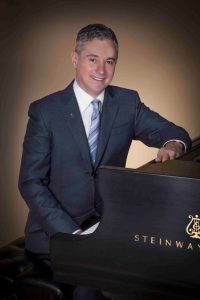
 

Ron Losby

Downtown: How did Steinway become involved in this concert at Oculus?

Ron Losby: I heard about the event from Hyung-ki Joo, who is a Steinway Artist and a good friend. “Make Music Day” is obviously something that Steinway & Sons wholeheartedly supports, with such a noble goal of spreading the beauty and power of music to everyone. Upon hearing of the event, I let Hyung-ki know that we could support their piano needs for the event – and assist in any way needed. 

DT: Steinway has had a stellar reputation since it opened more than 150 years ago, tell us your secret?

RL: For Steinway & Sons, the secret has really been [the] continuous improvement of our piano and innovation. Since the early days, Steinway has innovated within its factory – always utilizing the best mix of handcraftsmanship and technology to build a piano that is always a little bit better than the one we built last year, the year before that, and so on. But we have also innovated with our product. The clearest example there is the introduction of Spirio, the world’s finest high-resolution player piano. Now, with the touch of an iPad, even non-pianists can listen to concert-level performances on demand, on an acoustic Steinway. And for the pianists out there it is, of course, still a fully playable Steinway.  

DT: We have worked with many celebrities who were brand ambassadors for Steinway and Sons, how are they chosen?

RL: Steinway Artists apply to be on the roster and a very interesting thing is that they are not paid endorsers, but choose to be Steinway Artists for the love of their craft and the instrument that we provide. All Steinway Artists actually own a Steinway, which is a part of the requirement to joining our roster of talented and acclaimed pianists. 

DT: What is it like to be in The Oculus as a grand performance space?

RL: The Oculus is a spectacular feat of design and engineering – creating a space that is beautiful and modern, but also very practical and usable. It has a certain look to it that is a part concert hall and part coliseum … so it seemed a very appropriate space for today’s musical performance meant to be shared with the masses. 

 For more Downtown Q&A, click here.
Categories
NYC Uncategorized

Of Dreams, Desires & Dragons

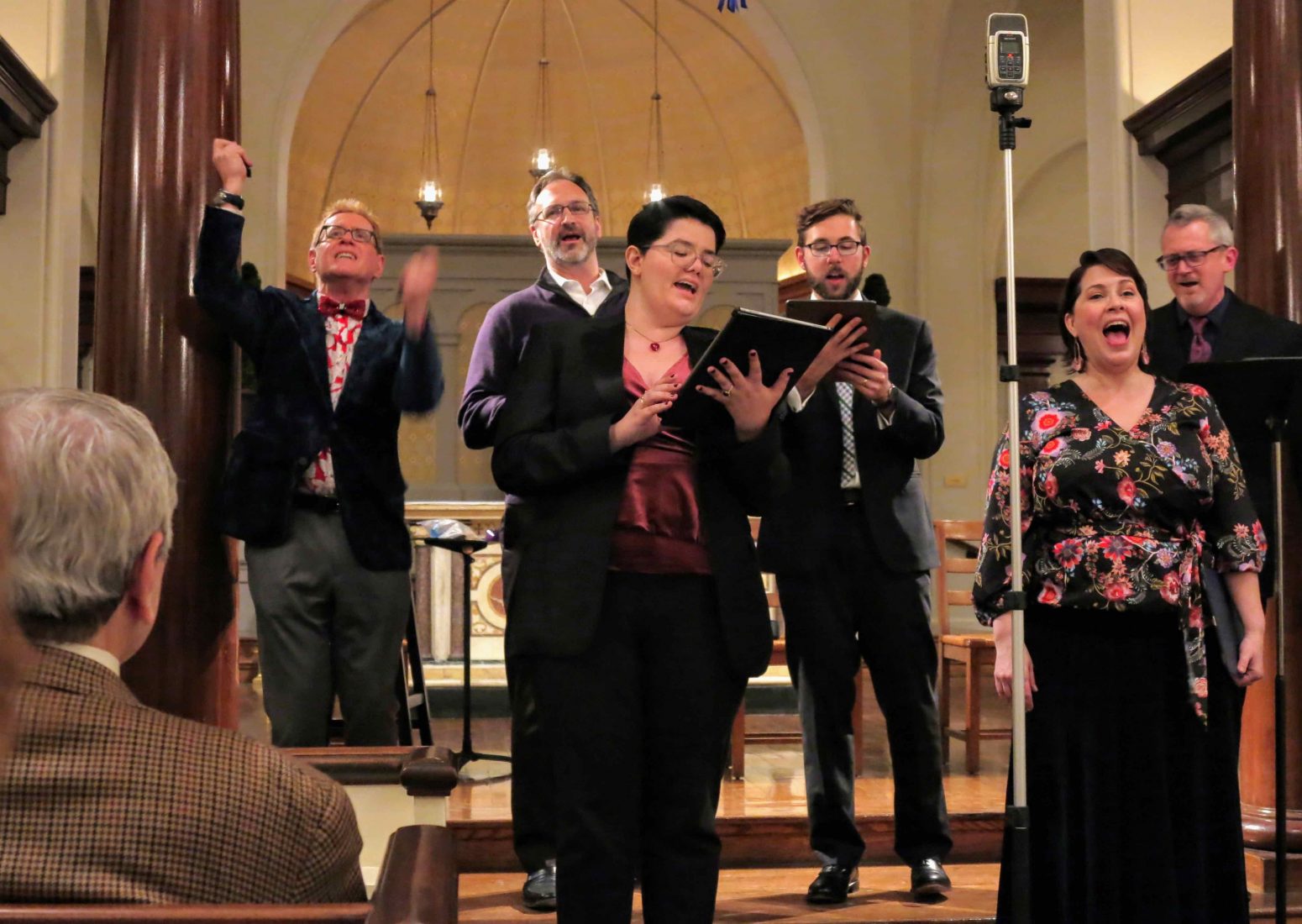
This March, the Grammy-nominated Western Wind Vocal Sextet will present “Of Dreams, Desires & Dragons: Music by Women from Hildegarde to Joni Mitchell” on Saturday, March 28 at 8:00 PM. The concert celebrates Women’s History Month with a rich assortment of music by classical and modern women composers.

The program features the world premiere of “Certain Dragons” by Martha Sullivan, a Medieval chant by Hildegarde von Bingen, Renaissance and Baroque works by Casulana, Cazzolani, Strozzi, and Aleotti, part-songs by Fanny Hensel, Rebecca Clarke, and Amy Beach, contemporary works by Tania León and Liz Hanna and songs by Joni Mitchell.

The Western Wind singers are sopranos Linda Lee Jones and Elizabeth van Os, countertenor Eric S. Brenner, tenors Todd Frizzell and David Vanderwal and baritone Elijah Blaisdell. They will be joined by guest artists Richard Kolb on lute/theorbo and Patricia Ann Neely on viola da gamba. 

Western Wind begins its 51st year in 2020. Since 1969, this Grammy nominated vocal sextet has devoted itself to the special beauty and variety of a cappella music. The New York Times has called them “A kaleidoscopic tapestry of vocal hues.” The ensemble’s repertoire reveals its diverse background, from Renaissance motets to Fifties rock’n’roll, medieval carols to Duke Ellington, complex works by avant-garde composers to the simplest folk melodies. Visit them at http://www.westernwind.org.

WHERE AND WHEN:

Saturday, March 28, 2020 at 8:00 PM

Church of St. Luke in the Field, 487 Hudson Street (between Christopher and Barrow Streets at the intersection of Grove Street, West Village)

Tickets:  $35 gen. Adm., $20 students & seniors, $50 priority seating.

Patron & sponsor tickets:  $100 ($50 deductible), $250 ($200 deductible) and $500 ($450 deductible).

Purchase tickets: http://www.westernwind.org/store.html?tix  212-873-2848
More info: http://www.westernwind.org/concerts.html

Ensemble’s website:  www.westernwind.org

Running time: 90 min. including intermission.

See More

Danny Garcia’s New Documentary Examines The Death of Rolling Stone Brian Jones 

Song Premiere: Janita Says Yes To A New Beginning With “I Do”

Do You See What I See?

Music Pioneer Gary Wilson Finds Himself In The Twilight Zone

Categories
Culture Featured Theater

What Bloody Man Is That?

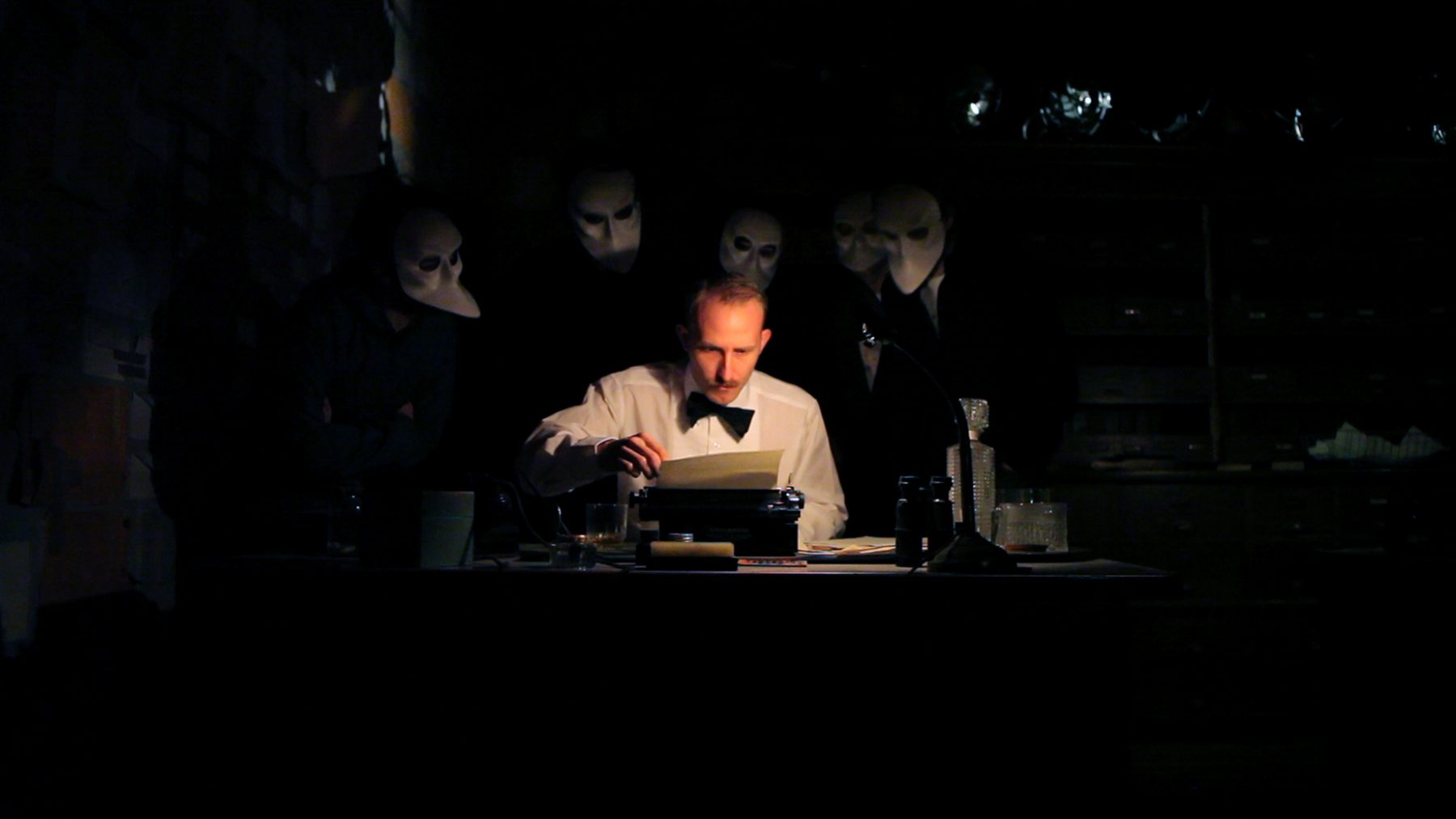
The McKittrick Hotel’s flagship production, Sleep No More, has spent the last few years gaining fame and notoriety for its witchy mystique. It takes Shakespeare’s Macbeth and passes it through dreamlike noir to create a thrilling modern dance experience unlike any other. Masked guests follow actors through a six-story building like silent spirits as Shakespeare’s tragedy unfolds simultaneously across the building. It is a feat of performance, but also of engineering, costuming, choreography, and design. As Sleep No More announces an expansion through September 13th, Downtown got a chance to speak with Maxine Doyle from Punchdrunk UK, the Co-Director and Choreographer for Sleep No More, about the origins of the ghostly play. 

Sleep No More
Performer Robin Roemer. Photo courtesy of The McKittrick Hotel.

Origins

Sleep No More came from humble origins: a small production in 2003 inside an old victorian boys school. The cast was only 10 people for the 10-night performance, splitting 40 people between less than a dozen rooms. 

The original idea, Doyle says, came from Artistic Director Felix Barrett’s love of Bernard Herbert’s soundtracks to Alfred Hitchcock films, and the way that Hitchcock marries the aesthetic of noir with the kind of psychology that you can see in Macbeth. “I think it was a text we both really loved in terms of its characters and we looked more at the sort of domestic human absences of the play–the themes of ambition and guilt and particularly the sort of dramatic, codependent relationship between Macbeth and lady Macbeth. And then, of course, the really interesting sort of layer of the supernatural.”

After the close of the initial run of SNM, Punchdrunk crossed the pond for another, longer showing in Boston, Massachusetts, at the American Repertory Theater. The show ran there for four months, from October, 2009 until February 2010. By that time, Punchdrunk UK had turned its eyes to NYC. 

Punchdrunk did not build the McKittrick Hotel. According to Doyle, the site had been empty for several years following its occupation by various nightclubs of “dubious” repute. But the building’s shady reputation and open space finally allowed Sleep No More to stretch its legs. 

Sleep No More
Photo courtesy of The McKittrick Hotel

The Labor We Delight In

The current iteration of Sleep No More, which began in 2011, features approximately 25 actors and dancers. The shows run for three hours apiece, with every scene except for the beginning and the end being performed three times during each run. Each of these performances is done without breaks for any of the performers. “It’s the relationship of the audience with the performer that is very specific within this sort of form,” says Doyle, “the audience can follow a performer all the way through, they could stick with one performer if they wanted to for three hours.” In fact, doing so increases your chance of being pulled in for a one-on-one, where a performer takes a single audience member away from the rest for a scene performed for them alone. “The idea is that you need to feel like these characters live in this building–that there isn’t any beginning and there isn’t any end. And, and there’s a sort of hypnotic drive of this loop, almost a sort of purgatorial structure that the characters find themselves within.”

Casting for Sleep No More is rigorous. Most of the cast turns over every six months, and auditions can mean 1000 auditions for five roles during a two-week period. Once selected, a performer goes through eight weeks of training, learning two different roles in the cast. They will go through classes in body conditioning, contemporary dance, and yoga, but also through a kind of intellectual training. They read through the original play, of course, but also theories surrounding the play, and works by Hitchcock and David Lynch whose works are heavy influences.  

If you have seen the show, you know that parts of the performance can be brutal on the body (a scene with a man performing with his head on a table and his feet on the ceiling comes to mind), and so all performers must be prepared to perform perfectly under that strain. Sometimes twice. “I would say 85% of the company are dancers. I would sort of call them dance actors, but their training, instinct, physicality skill, comes from a sort of contemporary dance background.”

If you haven’t seen Sleep No More, now is your chance. Check here for dates and times for shows, and experience one of the most unique shows you can see in NYC. 

See More

Do You See What I See?

Categories
Bars Culture Featured Theater

Strange Tales of Lonely Houses

I don’t go to a lot of haunted houses. My “scary movie nights” aren’t that scary. So “Woman In Black – A Ghost Story in a Pub” at the McKittrick Hotel was my first time experiencing the phenomenon of scared laughter–when your throat forces out a laugh to stop you from screaming. It was an odd experience to have at a theater. Even stranger for a two-man show which spends its opening scenes convincing you that it is a friendly comedy. 

The McKittrick production of Susan Hill’s bestselling thriller comes from inauspicious origins, commissioned by a provincial English theater to plug a budget hole. The resulting two-man show was a barebones ghost story with the unambitious goal of filling a three-week run around Christmas. Instead, it was a smash hit. It made its way to London’s West End, where it has remained for thirty years. The McKittrick takes advantage of the minimalist requirements of the show–and the pub atmosphere of the McKittrick’s The Club Car–to bring the show back to its humble origins. And they do so to wicked effect. 

Porter, playing an actor playing young Kipps, as terror takes hold. Photo courtesy of Jenny Anderson

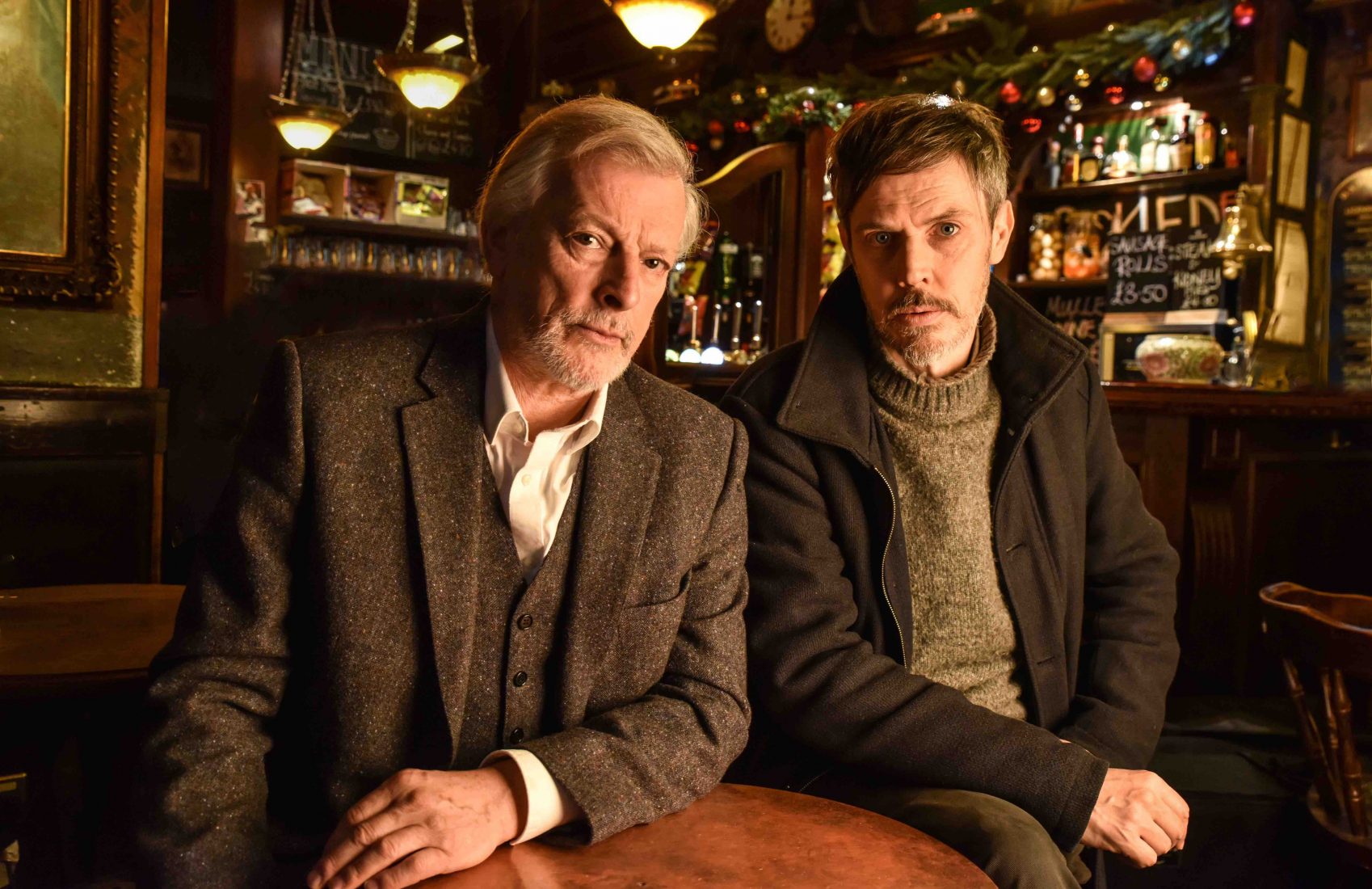
The original story, by Susan Hill, shows an old man named Mr. Kipps recounting for his family a haunting paranormal experience from his youth. The play reworks the plot by framing it around the relationship between the older Mr. Kipps, who has written his account, and the young acting coach who is helping him prepare to tell it. The opening scenes show Mr. Kipps (David Acton) struggling with the art of performance, urged on by a frustrated young actor (Ben Porter). The actor resolves to play the role of young Mr. Kipps, while giving all of the other roles to Kipps himself. The two build a rapport, and the show refocuses on Kipps’ story itself, bringing more thrills and suspense into the show as it goes on.

In this way, Woman in Black toes the line between hilarious and terrifying. The bond between Kipps and the actor, as well as between Acton and Porter, is charming and heartfelt. You are rooting for this poor old man to gain the courage to tell his story, and then you get it, and it is grand. And then they’ve got you. Like an arm reaching up out of a placid lake, it grabs you and pulls you beneath the surface and into a nightmare. There were screams in the theater. A lot of them. I watched audience members shift in their seats, or cover their eyes. And yes, the scared laughter, which rippled across the theater in between the terrifying punctuations. 

Woman in Black is a case study in theater magic made possible in big part due to Acton and Porter. With the exception of the brief intermission, it is the two of them alone who draw the audience’s attention throughout the show. Acton especially flaunts his skill with the manic pace of his character changes, launching from secondary character to secondary character as his Mr. Kipps falls into his role as an actor. Also of note is the effects team, providing just the right lighting, sound effects, and occasional fog to set any scene on a nearly bare stage.

In the mists of the English marshes. Photo courtesy of Jenny Anderson

The Club Car, the McKittrick’s small theater and pub, matches the ambiguous early 20th-century vibe which encompasses many of their other shows. It is a great match for Woman in Black, the flashbacks of which take place at a similar vague period of “60 years ago.” To compensate for the lack of cigarette smoke which would be present at an interwar pub or jazz club, they even have hazers installed, giving your senses another subtle clue that you are somewhere in the past before NYC banned smoking indoors. While you are there, try your hand at some of their Woman in Black-themed mixed drinks, or their new Scottish pub appetizers, from bangers and mash to fish and chips. The “pub platter” makes a great choice for the indecisive, featuring pork pie, scotch egg, stilton, pickles, and nuts. It is delicious. 

‘Woman in Black – A Ghost Story in a Pub’ is a thrill and a treat. There is a warning against bringing children under the age of 11, but I suggest everyone else grab a ticket. Grab a drink and a snack–and a stuffed animal if you need one–and experience the performance that had me shaking in the dark in a pub on a Wednesday evening. 

See More

Bowie homage by Raquel Cion returns to the East Village

At Theatre XIV, The Holiday Spirit Lives On

Categories
Culture Entertainment Featured

At Theatre XIV, The Holiday Spirit Lives On

Are you looking for that last bit of holiday cheer? It is hiding in Bushwick. From the outside, Theatre XIV blends in with its industrial surroundings: a simple door and a dozen feet of black wall covered in posters. Your only real hint, unless there is a line outside, is the bright red enigmatic glowing sign that reads “XIV.” IT looks like a total dive. 

Step through the door, though, and you will find yourself in another place and time. Decadent camp fills the foyer like 17th century Versailles put on a showing of Rocky Horror Picture Show. The decor is wood and velvet, oriental rugs and chandeliers. Guests, mostly dressed in black, mingle with cast members decked out in gold, sequins, and fur. Between them, there is hardly an eye left unlined. 

Nutcracker Rouge
Christine Flores, Nicholas Katen Credit: Mark Shelby Perry

The theatre itself is a black box, but you won’t notice. Behind the terraced half-circle seating, a realistic tree stretches out snarling branches as if to give shade. To one side as you enter, a long wooden bar a century out of time offers a wide selection of alcohol beneath a shimmering chandelier. 

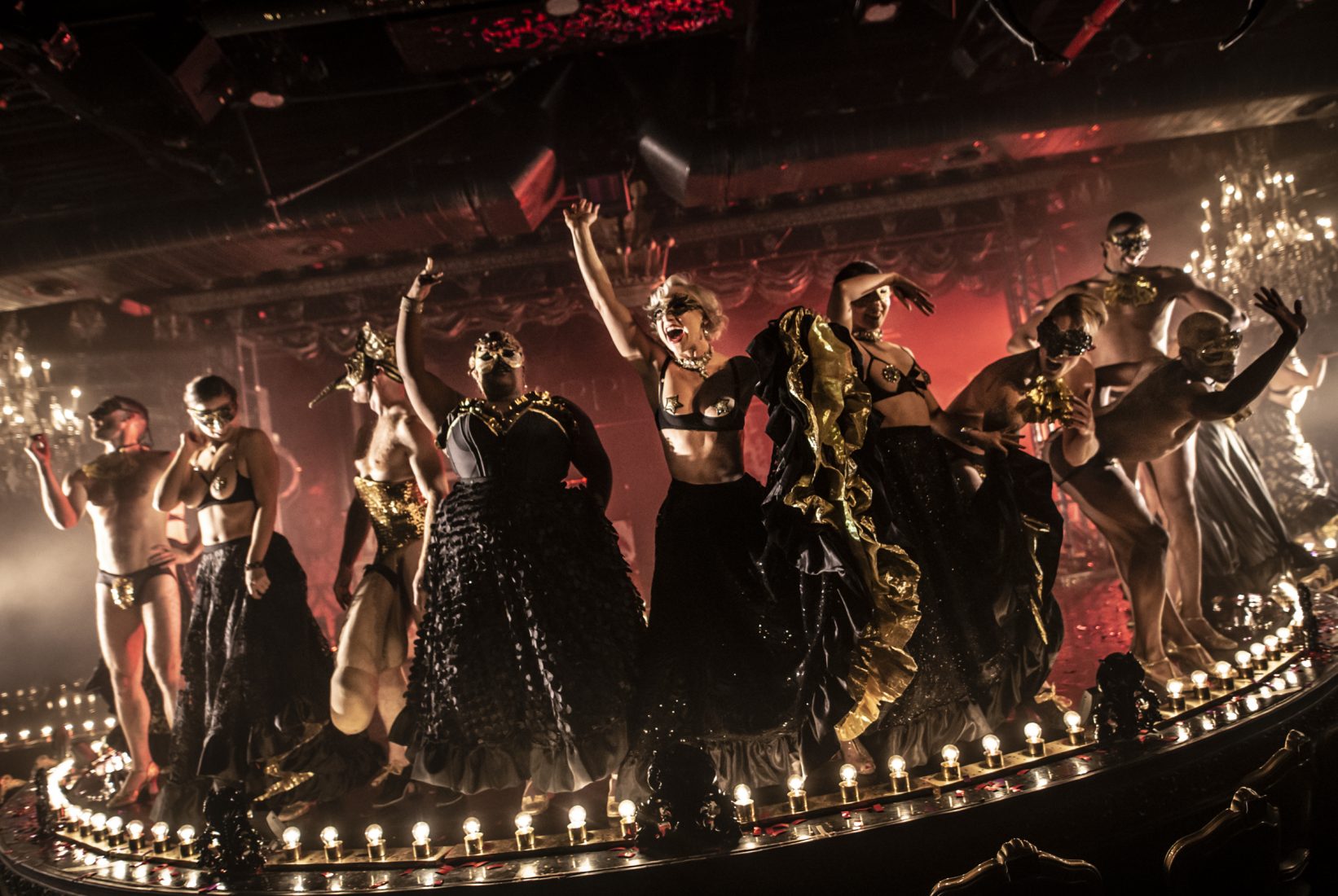
But the most arresting sight is the stage itself, which thrusts out into the crowd ringed by bare bulbs and flanked by even more chandeliers. The curtain, when down, displays a decadent scene of French aristocracy in masquerade finery. It is fitting–see foyer above. 

As the show starts, the theatre fills with a mist tinted red by the stage lights. And then you’re in another world. 

Nutcracker Rouge, Theatre XIV’s Christmas-themed burlesque show, is unlike anything I’ve ever experienced. There was a sense of tasteful decadence: more dancing, more singing, more ensemble, more sex appeal. It wasn’t just that there was so much ballet in this burlesque show; it was that they did ballet in heels. 

And they crushed. The musical numbers resounded. The acrobatics drew gasps. The dance was elegant, beautiful, and coordinated. Most of the performers combined talents–dancing or singing while swinging from the ceiling, or performing strange feats between dance numbers. And it was all in heels. Anything you have seen done elsewhere, they can do in heels.

Nutcracker Rouge
Albert Cadabra, Christin Flores, Ben Green, Nicholas Katen Credit: Mark Shelby Perry

Throughout, the show flows cleanly between coordinated ensemble acts to individual performances, all guided by the sugarplum fairy (Christine Flores), the show’s throughline and silent guide. Armed with a sense of childlike wonder and glee, Sugarplum explores each act with the audience. Sometimes she joins in, while other times she just watches and reacts. 

If you are interested in taking a little opulence, a little decadence, a little sex, and a lot of glamour, into the new year, Nutcracker Rouge is a can’t-miss. Grab a ticket now: the holiday ends after this weekend.

And then check out their next show, Seven Sins, beginning Valentine’s Day.

See More

Arts Brookfield Brings Back The Acclaimed “Silent Film/Live Music” Series

Bowie homage by Raquel Cion returns to the East Village