Categories
Culture NYC

3 Ways to Help Discover Your Own Art Style


Art harkens back almost as long as humanity itself. While we generally think of things really taking off around the Renaissance, archeologists have discovered cave paintings that date back to our earliest days. One thing is clear from all this: Expression is fundamental to our species.

Of course, a lot has changed over the years. From ancient Greece to the modern art galleries throughout New York today, trends and movements come and go. For most of us, there are a few signature styles that move us the most.

It’s hard to know why; art just speaks to you or it doesn’t. Trying to describe the reasons why one painting is better than the painting next to it can be difficult — perhaps even a fool’s errand. But even if you can’t exactly put your finger on it, here are a few ways to help cultivate more understanding and help identify your personal art style.

1. Look Around at Everything

Keep your eyes wide open. Indeed, the easiest way to find out what you like and feel inspired by is to tune your eyes on everything around you. It sounds simple, but too many people cut themselves off from the wider art world and only ever end up seeing a few styles. Now, you don’t necessarily have to become a student who memorizes all the different art movements, but if you simply try to get a good sample of everything that’s out there, you’ll be able to find something you love.

2. Do A Little Bit of Homework

While just looking — in museums, in books, or online — is a great way to find out what you like, try to go a little further. You might realize you like Impressionism after seeing a few Monets. He may be the father of the field and seen as the greatest example of that style, but that doesn’t mean he is the greatest to you. If you do a little research, you’ll learn more about Renoir, Winslow Homer, Manet, and many more. Chances are, one of the “lesser” masters may be the one who stands out most and truly inspires you to fall in love with fine art.

3. Make Some Connections

The more you learn, the more you’ll likely want to discover. The best art is timeless, but there is always a distinct history involved. Certain trends quite naturally lead to the next progression. The push — and perhaps mastery — of Realism directly sparked the push toward Abstract art, for example, as more and more people wanted to see the world in a different way. 

Meantime, Cubism was instrumental in the development of Art Deco. As you discover how everything is interrelated, it will be easier to understand the “why” behind things on some level, and this can inspire a deeper appreciation for what, at first, may have just looked like a pretty picture on the wall.

The Definition of Art Style

As with a lot of things tied to art, discovering your personal style and taste represents an aspect of duality. Ultimately, you’ll mostly be moved merely by the visual aspect and will like what you like — and there’s no reason to challenge it or apologize.

Still, a deeper understanding can lead to a larger appreciation. You don’t need a Ph.D. or to know the name of every work displayed in the Louvre. Ignorance isn’t a virtue, though, and you’ll learn a lot if you put forth the effort.

Like most things, the more effort you put in, the more you’ll get out of it. Don’t overthink things too much, but keep your eyes open and do a little homework. In time, this lifelong journey will bear more and more fruit — and you’ll truly start to feel like you’ve found an art style all your own.


Categories
Art Culture Featured Miami

Depictions and Conversations with Susan J Barron

Susan J Barron

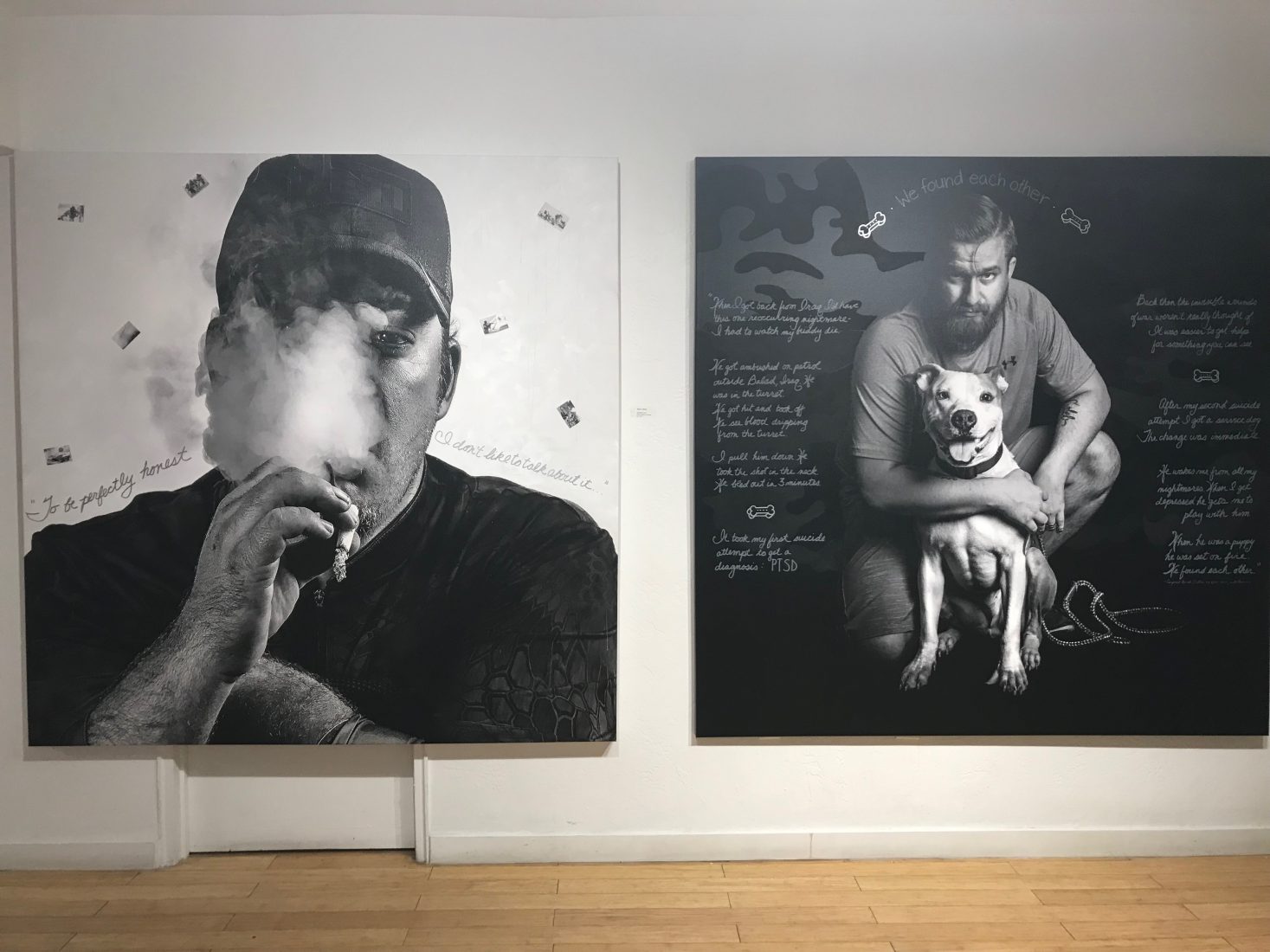
NYC artist Susan J Barron tells the story of two veterans who walked into her show, “Depicting The Invisible,” with their service dogs. They approached a portrait featuring a handsome bearded man crouched with a dog. The phrase “We found each other” haloes his head, and he is surrounded by quotes that tell his story: a friend dying in his arms overseas; relentless, vivid nightmares; two suicide attempts; and a dog trained to comfort him and wake him up, saving him from his nightmares. The veterans were visibly affected, and told Barron, “this is a portrait of us.”

Susan J Barron

Depicting The Invisible

Barron created “Depicting The Invisible” after learning that 22 US veterans commit suicide every day. “I was so shocked and appalled by the statistic,” she says, “I really felt that, if people could understand what’s going on, then they would be inspired to step up and make a difference.” Barron interviewed dozens of veterans, creating portraits to tell their stories. As the SoHo artist travels with her show, she has encountered “uncountable” veterans drawn to the images and the stories. Her goal, she says, is to give voice to the experiences her subjects have shared with her. “Every time the show travels to a new city,” she says, “it magnifies their voices.”


Depictions and Conversations with Susan J BarronConversations

Conversations by Susan J Barron

When she isn’t traveling, Barron is working on a different, lighter, project. “Conversations” is a series of digital art pieces on canvas, which she creates by reassembling and mixing famous art pieces to create new meaning. Her piece “Luncheon on the Gras

s,” for example, features Edouard’s original nude woman, but sitting across from–in conversation with–an Alberto Vargas pin-up girl. “Two women painted by men over a century apart,” Barron explains, “it’s just so delightful to me.” 

SoHo

The “Conversations” canvases stand nine feet tall, and span styles and eras, and are all designed from Barron’s laptop, often at her home base of SoHo House in NYC. “During the day, there’s a whole collection of people working on their laptops,” she says, “some of them are writing plays or screenplays, or they’re writing the great American novel…and some of them are creating art.” Her perfect workday, she says, includes a stop at the Whitney Museum of American Art or a walk through the local galleries.

A Test

Just before the debut of “Depicting the Invisible,” Barron faced her biggest challenge. The mother of one of her subjects called her and told her that he had taken his life, or “fallen victim to the 22,” as Barron calls it. She was heartbroken. She had spent hours talking to him and growing closer to him. Could she have known? Was it disrespectful to go through with the show? But, she says, other veterans reached out to her with sobering words of encouragement. She had to continue, they said, because Damon’s tragedy happens 22 times every day. She went through with the show, and visitors can still see Damon’s portrait, wreathed in quotes where he wrestles with his PTSD and the specter of suicide. 

Inspiration

After DTI and Conversations, Barron is considering a portrait series on survivors of September 11th. She is inspired by the opportunity to tell the stories of those we might otherwise never hear. As she says, recounting the words of a former professor, “There are only so many pieces (of art) that you can make in your life, so make them count.”

Susan J Barron just finished showing Conversations at SCOPE in Miami.

See More

NYC Experiences: Sketch and The City