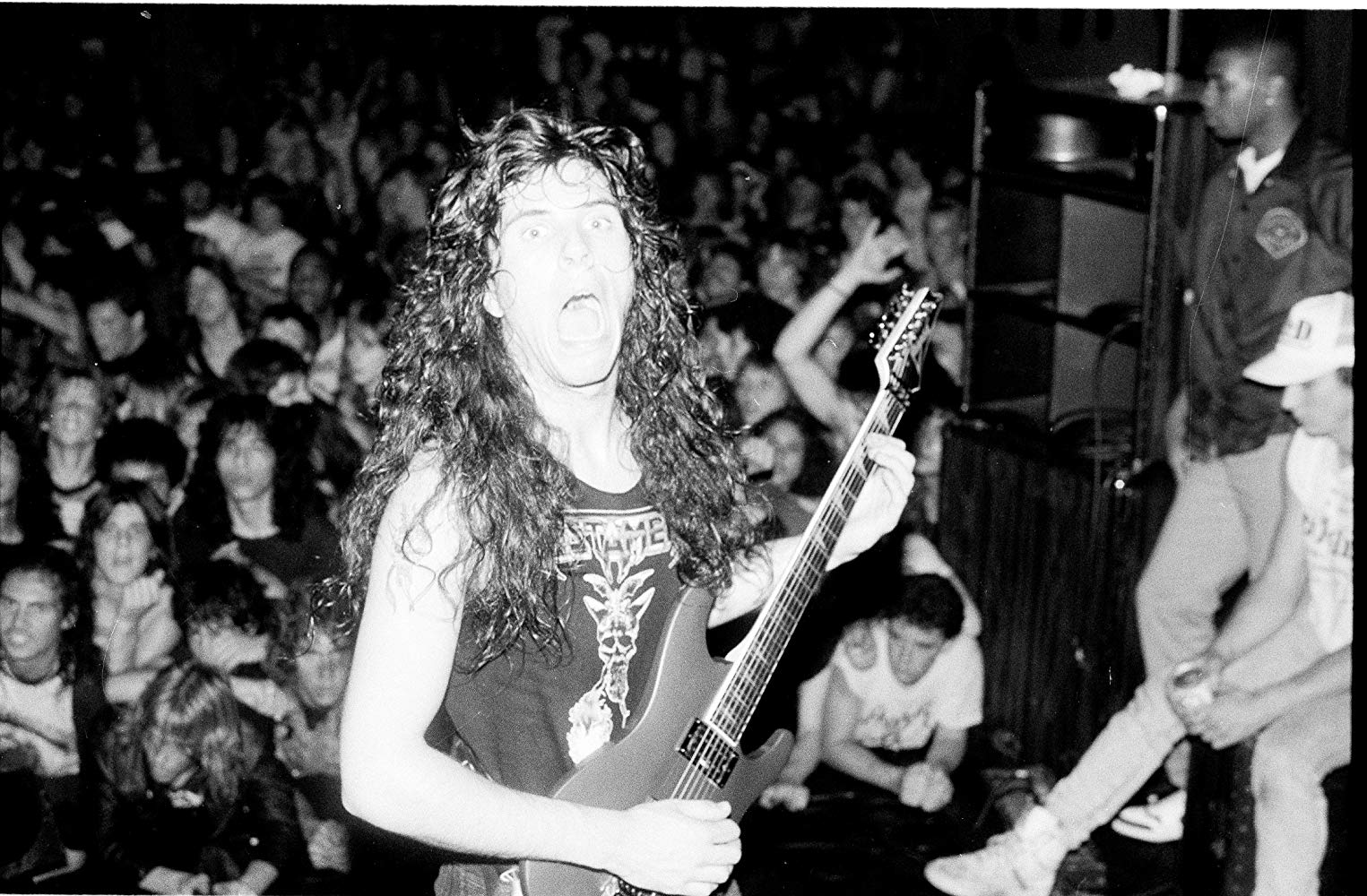
James Hetfield and Kirk Hammett of Metallica. Image from Murder in the Front Row: The San Francisco Bay Area Thrash Metal Story (2019), picture from IMDB.com
If I were writing this review in the San Francisco Bay Area in the early ‘80s, I’d be a dead man. It’s nothing personal; that’s just the way it was. I’m not a poser, but I am a casual, and that’s nearly the same crime. The local thrash metal community was tight-knit, offering fanatical support for metalheads and “death” to posers and outsiders.
Murder in the Front Row is the story of Thrash, the metal music subgenre which grew out of the Bay Area at that time. It’s the story of bands with surprisingly household names like Metallica, Megadeth, and Slayer. More than anything, it’s the story of the community that birthed these bands in a unique primordial soup of suburban angst and malaise.
MitFR is an unorthodox music documentary. Rather than focus on their globetrotting musical subjects, director Adam Dublin chose to focus on a small pocket of diehard fans who had been around since the birth of thrash metal. “From our point of view,” Dublin said, “the fans and the people who made the flyers, took the pictures, went to the shows, and hauled the gear, were as important as what the rock stars were doing.” By the time he recorded his first interview with a musician, he had already talked to dozens of fans from the scene.
Adam Dubin, Dave Ellefson, Mark Menghi, Mike Portnoy, Chuck Billy, Phil Demmel, Alex Skolnick, and Troy Sanders at an event for Murder in the Front Row: The San Francisco Bay Area Thrash Metal Story (2019). Picture from IMDB.com
Part of this unique focus comes from the subject matter. MitFR was inspired by a table book by the same name, published by original mega-fans Harald Oimoen and Brian Lew. The book was a compilation of pictures from the early 1980s, sharing a piece of near-forgotten history that behind-the-music-type histories have glossed over. The book intrigued and inspired Dublin, who fought to convince Oimoen and Lew to let him make a documentary of the story behind those photos.
The story MitFR tells also leaves out most of the drama and scandal, preferring to focus on the camaraderie of the scene and the accomplishments of the bands in their early days. “If you want to see the ‘Behind the Music,” he told a crowd when asked about his selective coverage, “you can already find that online.” He wanted to tell a happier, more heartfelt story.
The result is a love letter to the fans, to a community that supported these now-famous artists, and to the unique connection they shared. “If you go back far enough in time,” says Dublin, “there was a point in time where James Hetfield (Metallica) was just an 18-year-old kid just like the 18-year-old kids who were watching him play. He was no more famous and no more anything. And that’s the moment we wanted to accentuate.”
During the fall and winter seasons, you are most likely doing all of your reading indoors, commute included. When the weather gets warmer in New York, reading is something that many people choose to do outdoors, whether at the beach, at a park or on a rooftop. In turn, Downtown has some books to recommend to its readers:
Well-known to reality TV watchers of HGTV, Robert and Cortney Novogratz known how to redesign living spaces of all kinds. This hardcover book offers up plenty of design tips, no matter the size, locale and/or climate of your home.
A unique cookbook, Salad For President is a wonderful collection of inventive recipes and conversations with architects, musicians and all sorts of artists. Artist spaces all over the world are visited by Julia, as Laurie Anderson, photographer Willie Wegman, The Boredoms’ Shinji Masuko, and ceramicist Yui Tsujimura all participated.
Hal David co-wrote some of the biggest love songs of all time, including “Raindrops Keep Fallin’ On My Head,” “What The World Needs Now Is Love,” “There Is Always Something There To Remind Me,” and “To All The Girls I’ve Loved Before.” Hal’s wife Eunice has written a book in tribute to her late husband, offering insight into how some of his biggest hits were written and what it was like being married to the legendary lyricist.
It is often said that without The Sex Pistols, there would be no punk rock, and as the founding guitarist of The Sex Pistols, a lot of rock music’s roots go back to Steve Jones. In this memoir, the host of Jonesy’s Jukebox covers all facets of his life — he has done plenty as a musician, producer, actor and host since the Pistols disbanded for the first time in the late 1970s — and fortunately, for our entertainment, he writes just like he speaks.
Chef Nikki Dinki has a major fanbase as a result of her many appearances on television. But unlike many chefs, she has a wonderful story about learning how to eat well. Meat On The Side isn’t preaching for anyone to become a vegetarian — quite the opposite — but it does show how anyone can easily start eating more vegetables and wind up loving it.
Asterios Kokkinos is a prolific podcaster and writer, and this faux-catalog has hundreds of jokes within its 56 pages. Anyone who read toy catalogs — or even classified ads — during their formative years will love the attention to detail shown in Toys “4” Cheap. As an aside, Asterios’ followers on Patreon can get a podcast made exclusively for them.
As the mother of Foo Fighters founder (and Nirvana drummer) Dave Grohl, Virginia Hanlon Grohl helped raise one of rock’s biggest names. For this book, Virginia speaks to the mothers of Dr. Dre, Amy Winehouse, R.E.M.’s Michael Stipe, Maroon 5’s Adam Levine, The Beastie Boys’ Mike D, and the Haim sisters, sharing a lot of heart-warming tales in the process. And of course Dave wrote the book’s foreword.
California native and photographer Michael Zagaris photographed nearly every big name in rock that came through San Francisco in the 1970s and 1980s, including The Clash, The Grateful Dead, Blondie, Eric Clapton, and Led Zeppelin. This collection — which awesomely-features Lou Reed on the cover — contains a lot of previously-unseen work and is said to be the first in a series of collaborations between Michael and Reel Art Press.
Black Sabbath may have recently wrapped its farewell tour, but the British quartet remains popular as ever in 2017. This coffee table book looks beautiful, containing over 150 photos within its glossy pages. The whole pre-farewell history of Black Sabbath is tracked in What Evil Lurks, which contains a foreword from Machine Head’s Robb Flynn.
If Black Sabbath isn’t as heavy as your metal goes, then check out the debut comic from the band Slayer. The story was based on Slayer music videos. Available in print, Kindle and comiXology formats; beyond this comic series, the band will be on tour with Lamb Of God and Behemoth this summer.
When it comes to Geoff Tate, forget everything you would expect from a hard rock vocalist. He has a multi-octave vocal range. He is very well-read. He makes wine. He enjoys the house restoration process. And 35 years after he co-founded Queensrÿche — whose hits like “Silent Lucidity,” “I Don’t Believe In Love” and “Jet City Woman” remain classic rock radio staples — Geoff is still touring and recording in peak form.
Geoff Tate makes a return to New York City on Feb. 20 with a headlining appearance at City Winery. As part of The Whole Story “Ryche” Acoustic Tour, Geoff will be fronting a seven-piece acoustic band and playing songs from all 17 of his albums. Downtown spoke with the Washington native about his City Winery appearance, his history with New York, and what else he has coming up. Beyond www.geofftate.com, more on Geoff Tate can be found by following him on Twitter via @GeoffTate.
Where was the first concert you ever played in New York City? What do you remember about it?
Geoff Tate: My first concert in New York City was at the Beacon Theatre in 1983. It was my first tour and everything was new and exciting. The theatre, at that time, was fairly run down and dirty. It smelled of stale beer, vomit, urine, cigarette smoke and sweat. The audience was young, angry and physical, punching the air with their fists in a staccato rhythm while my band baptized them with 115 decibels of metal.
GT: This Acoustic Tour is one of the most enjoyable tours I have ever done. The intimacy of the venue really showcases the players abilities and talent. The audience experiences the true emotion of the song in such detail. Every note and each breath is on display.
There are more people in your acoustic backing band than in your typical backing band, yet most artists perform acoustically in a scaled-down format. Is this your first acoustic tour?
GT: When I was in Queensrÿche, we regularly performed acoustically. In fact, almost every song I’ve written, was first written on acoustic guitar or piano. What I wanted for this tour was to have acoustic instrumentation that could creatively represent the songs. Orchestra instruments play a major role in my recorded music, so I wanted to have violin, cello and acoustic bass for the tour.
Another notable thing about your City Winery show is that you make wine. Where did your interest in wine begin? Was it always in your tour rider?
GT: I made my first wine when I was 14 and I’ve been into it ever since. When I became a traveling musician and began visiting the great wine making regions of the world, I was inspired and decided to release my own wine, and in 2007 my brand Insania was released. We make a red which is a Pinot Noir and a white, which is a Pinot Grigio.
You were a part of Hear ‘n Aid. Looking back, was that an enjoyable experience? Or at least as fun as the music video made it look to be?
GT: I was very honored to be part of the Hear ‘n Aid project. It was a very challenging project to lead and Ronnie Dio did a fine job of bringing many great musicians together for a wonderful cause.
When not busy on tour, how do you like to spend your free time?
GT: When I’m not making a record, touring or working on my Insania wine project, my wife and I enjoy house restoration. We recently acquired our second project home. It’s a 110-year old Dutch Colonial Revival. It’s all original, which is rare. We are modernizing it with thought and restraint.
Is there something you wish more people knew about Geoff Tate?
GT: No, not really. It seems my life is an open book.
Do you have a favorite restaurant in New York?
GT: It’s a tie between Nomad, because of the roast chicken and The Rolling Stones inspiration, and Trattoria Trecolori for some of the best Italian food I’ve ever had.
Finally, Geoff, any last words for the kids?
GT: Thanks to everyone who has come out to my shows throughout the years and bought my records. I hope to see you at the show at City Winery.ᐧ
Derek Oliver began his A&R career with Atlantic Records in the late 1980s. He became Vice President of A&R at Atco Records shortly after and then Senior Vice President of A&R at Elektra Records. His next destination was Roadrunner Records’ A&R department. Notable artists that Derek signed and/or worked with include Pantera, Dream Theater, Mötley Crüe, Metallica, AC/DC, Bad Company, The Cult, and Better Than Ezra.
After leaving Roadrunner in 2007, Derek launched his own record label, Rock Candy Records. While most labels aim to discover new talent, Derek takes a different sort of path with Rock Candy, reissuing titles from other record companies that have since gone out of print. In turn, he has released hundreds of albums, including work from Sammy Hagar, Rick Springfield, Survivor, Quiet Riot, Damn Yankees, Ratt, The Babys, and REO Speedwagon. Upcoming releases include music from Mahogany Rush, Alannah Myles, Dokken, and Bad English.
Downtown caught up with Derek to learn about his music industry journey, which included plenty of years in New York. Rock Candy Records can be visited online at www.rockcandyrecords.com and followed via Facebook.
You worked in A&R at Atco Records, a New York-based label. Is there anything you miss about living and working in New York?
DO: All I miss are my friends and colleagues. New York and London share the same manic pace so the difference is minimal.
DO: It would have to be MSG or the Beacon, of course.
Is there a signing from your Atco days that you are most proud of?
DO: All of them were very precious to me. Of the ones that hit big, I’d say Pantera and Dream Theater. Of the ones that got away, they would be the Mother Station and Jamie Kyle.
What led you to decide to move back to England? Did Rock Candy factor into that?
DO: I felt that I’d run out of track in New York City and there were mitigating circumstances personally that assisted the transition. Rock Candy was always in the back of my mind so yes, in all fairness it was a contributing factor.
What was the first album put out by Rock Candy?
DO: That would be Riot Narita — CANDY001. Oddly, nobody had reissued that record previously. It was a top seller for Rock Candy.
How many titles has Rock Candy put out at this point? Seems like there have been hundreds of releases…
DO: We’re up at about 325 with many more in the pipeline. 2017 will be a great year what with the U.S. expansion and some other projects in the pipeline.
As a reissue label, I’m assuming there’s criteria for what you put out to have had some success beyond being great music. Are there still a lot of titles left to reissue?
DO: If I live to be 150, I still won’t have enough years in me to reach the point where there is nothing left to reissue. There are so many great records in my collection that crashed and burnt and remain hidden from the masses. My mission in life is to shine a spotlight on every single one of them.
Rock Candy has released vinyl titles for the band Angel, but I’m not aware of Rock Candy putting out too many other vinyl releases. What is it about the band Angel that drew you to them?
DO: Angel were a unique band with a brilliant catalogue. They should have been massively-popular but they never broke through despite having everything in place, including an amazing look. Truly one of the greatest loses to mankind as far as I’m concerned.
Rock Candy started up a North American operation back in October. Does that mean that there’s an office in New York? Or you just have a distributor here?
DO: No office. I have consultants and the distributor RED handles all the nuts and bolts. Staying lean and mean is very much the way forward in this day and age.
What’s coming up for Rock Candy in the coming months? Any new releases or merchandise you can talk about?
DO: Well, we are scheduling releases from a number of class acts including Mahogany Rush, Warrant, 707, Creed, Valentine, D’Molls, Alannah Myles, Malice, Shaw Blades, Dokken, REX, Bad English, Bang Tango, King Kobra and a host of others.
When not busy with music, how do you like to spend your free time?
DO: I don’t have any free time. Rock Candy is my life. Building the brand is my main concern. I have no other interests.
Rock Candy aside, do you have a favorite new release of 2016?
DO: New music is pretty much a waste of space. The frontline business, as I knew it, is over — anyone can record in their bedroom and release the tracks online. The majesty and mystery of creating and unleashing new music has been drained to the point where anything that is good is hailed by internet trolls as the second coming. I have no interest in joining in with the great unwashed.
Frankly, I grew up listening to some of the greatest rock music of all time — Little Feat, Steely Dan, Kansas…even the hair-metal was incredible. Early Mötley Crüe, Dokken, Scorpions, Iron Maiden, Judas Priest. They were artists to celebrate. It was a time when great music rose to the top by virtue of originality rather than through digital marketing campaigns.
Finally, Derek, any last words for the kids?
DO: Make every day count and listen to every piece of pre-internet age music you can possible find.
Having formed from the roots of the band Shell Shock, Crowbar debuted in 1991 with the album Obedience Thru Suffering. The New Orleans band’s 1993 self-titled album was produced by Pantera frontman Phil Anselmo and two of its videos achieved airplay via Beavis & Butthead. Crowbar has remained steadily active in the 23 years since its self-titled album, even though frontman Kirk Windstein had also participated in other bands of note, including Down, Valume Nob, and Kingdom Of Sorrow.
2016 brings the 11th full-length studio release from Crowbar, The Serpent Only Lies, which hits stores on Oct. 28. Prior to that, Crowbar — which also includes bassist Todd “Sexy T” Strange, guitarist Matthew Brunson and drummer Tommy Buckley — will play locally on Sept. 26 at Saint Vitus. Kirk spoke to Downtown about the past, present and future of Crowbar, as kindly arranged by Bill Meis at Entertainment One Music.
Having been born in England, how did you wind up in Louisiana?
Kirk Windstein: My father was in the U.S. Air Force and I was born on the air force base in England. My parents were both from New Orleans so we came home.
At what point in your career was it apparent that Crowbar was going to be more than just a hobby?
KW: In the very beginning. I was very determined for it to be my livelihood. I had to put it on hold sometimes for Down but always came back to it. Now I’m totally focused on what I started.
Where was the first gig you ever played in New York?
For your upcoming show at Saint Vitus, what should be expected?
KW: Well, first of all, expect nothing but a show that delivers 100%. I totally feel that we are finally complete as a band. I truly think that having Todd Strange — Sexy T — back was the missing link. He started this with me and I’m so happy that he came back!
That’s not your first gig in Brooklyn, right?
KW: No, I’ve played Brooklyn way too many times to count. (laughs) It’s awesome!
A lot of people describe Crowbar as “sludge metal.” Do you ever wish that you could play more mellow music?
KW: Not with Crowbar. But I will do something “mellow” as a side project pretty soon .
Crowbar is one of the rare bands to have more than one music video featured on Beavis & Butthead. Did that show impact your career at all?
KW: It was a very big impact. We were always big fans of the show and really thought it was cool that we could be a part of something that they made fun of. It brought a lot of attention to us. Fans always talk about seeing us on there.
Crowbar has been signed to eOne for six years now, in a day and age when most artists go from album to album. What is it that keeps you working with eOne?
KW: They are great people! They are not just a “record company” They are actual fans of the band that appreciate our work. They promote better than any label that we have been with by far!
KW: “Surviving The Abyss” is my favorite right now. It changes daily, though. I’m very proud of this album so it’s hard to pick a favorite song. They each have something special about them.
Have you ever encountered anyone from the Canadian band Crowbar? What about the professional wrestler Crowbar?
KW: No to both questions. It would be interesting to meet the Canadian band though, especially being such opposite styles of music.
Is there a professional accomplishment you’re most proud of?
KW: Still making music and making a living off of being a musician. It’s so difficult nowadays. I thank God everyday for this!
Do you have any projects coming up outside of Crowbar?
KW: Nothing set in stone as of now.
When not busy with music, how do you like to spend your free time?
KW: I love to spend time with my family. A lot of my free time the band actually hangs out together too.
Having sold over 10 million albums, Extreme was one of the world’s most popular hard rock bands in the early 1990s. While many people first discovered Extreme through hit ballads like “More Than Words” and “Hole Hearted,” the Boston-based quartet had hard rock hits before and after that; “Kid Ego,” “Get The Funk Out” and “Rest In Peace” being three notable examples. Extreme went on hiatus in 1996, not regrouping again until 2004. The studio album Saudades De Rock followed in 2007 as did a live DVD in 2009, Take Us Alive. A follow-up to Saudades is currently in the works.
Lead singer Gary Cherone has stayed very busy since Extreme took its first break in 1996. He replaced Sammy Hagar in Van Halen, leading to 1998’s Van Halen III album. He has also released recordings as the frontman of Tribe Of Judah, Cherone, and Hurtsmile. Outside of the studio, for the sake of fun, he has been part of two Who tribute bands that have toured in our region. Meanwhile, Extreme guitarist Nuno Bettencourt has been playing guitar with Rihanna for the past seven years; more than 15 years earlier, he had notably collaborated with another top R&B singer when he played guitar on the Janet Jackson hit “Black Cat.”
In support of the forthcoming Pornograffiti Live 25 / Metal Meltdown DVD by Extreme — which also includes drummer Kevin “kFigg” Figueiredo and original bassist Pat Badger — Gary caught up with Downtown for some Q&A. The DVD, which hits stores on Sept. 23, was produced by the award-winning production company Rock Fuel Media in association with Loud & Proud Records. Extreme can be followed online at www.extreme-band.com, beyond keeping up Twitter and Facebook pages.
As someone that’s been around the world quite a few times, what is it that keeps you based in Boston all these years later?
Gary Cherone: First and foremost — family. Plus I was born and raised here, it’s got a certain rhythm, the four seasons, the “Baaston” accents, even the screwed-up roads are unique. I guess you have to live here to love it.
What do you remember about the first gig you ever played in New York City?
GC: I don’t remember if it was the first, but I do remember The Cat Club. Small, dirty, everything you’d expect. The crowd was great, the band had a good night and hung out with Ace Frehley after the show. It was a thrill!
Your new DVD includes a documentary called Rockshow, and the concert on there itself is a celebration of the Pornograffiti album. For you, is it fun to look back at the past?
GC: For us, it was something we’ve never done before — play the whole record top to bottom in chronological order. A bit challenging because some of the songs we never played or haven’t played for 20 years, but the band ended up having a blast. We also encored with quite a few songs from the catalog, so it ended up being one of our favorite shows we put together.
Do you look back at a particular era of your career as the most fun?
GC: I try to look forward and not back, but when I do, I always remember “the firsts.” First club, first record deal and record, first tour, first video, first girl…oh sorry, getting carried away! I guess the milestones in the band’s career as well as the highlights — touring with Aerosmith, Budokan, the Freddie Mercury Tribute. OK, enough.
Is a follow-up to Saudedes De Rock still in the works? I’d imagine that a lot of songs have been written for it.
GC: Yes, there are a lot of songs written and the band continues to record. We know we are overdue for new material, but we want to make it the best thing to date, and we will not disappoint.
Has Nuno’s playing with Rihanna for the past seven years or so at all influenced the kind of music he’s written for Extreme?
GC: We all bring in different influences when we get together. That’s what keeps it interesting, but it all ends up somehow sounding like Extreme, whatever that is!
You’ve been the singer in two different tribute bands to The Who over the years, SlipKid and Amazing Journey. Is that your favorite band?
GC: Very difficult question to answer. I have a few “favorite bands” and they’re one of them and, certainly one of the most influential.
I’m sure you’re tired of talking about the Van Halen era of your career, but I personally thought you filled the role very well and did the best with what you could. More than a decade and a half later, is there anything you wish more people knew about your Van Halen tenure?
GC: I’ve said this before — if I were to do it all over again, I would have liked to tour with the band before we recorded the record. Looking back, I always thought there were some good songs on the record, but could have been more cohesive. We became more of a band when we were on tour.
Not a lot is known about you besides your musical career, do you have artistic aspirations beyond music?
GC: I’m a pretty reclusive sod, so yes and no.
Finally, Gary, any last words for the kids?
GC: I’ve always said Extreme may not have as many fans as some of the other bands, but we do have the most loyal and loving. They have suffered long through the years patiently waiting for the band to reunite, and when we did, they were there to remind us of their love! I and we will never stop thanking you, we truly do love and appreciate you!