
Categories
Culture Entertainment NYC

Downtown Q&A: Illusionist and Mentalist Matias Letelier

In 2011, magician and illusionist Matias Letelier followed the love of his life and now wife, Marlana to the United States.

Her “souvenir from Chile”, as he calls himself, Matias became a proponent of the American dream. Since then, he has been practicing magic for 23 years, professionally since 2005.

Today, Matias is known as one of the most elite magicians in the country, and you can be a part of the magic, right here in NYC.

 

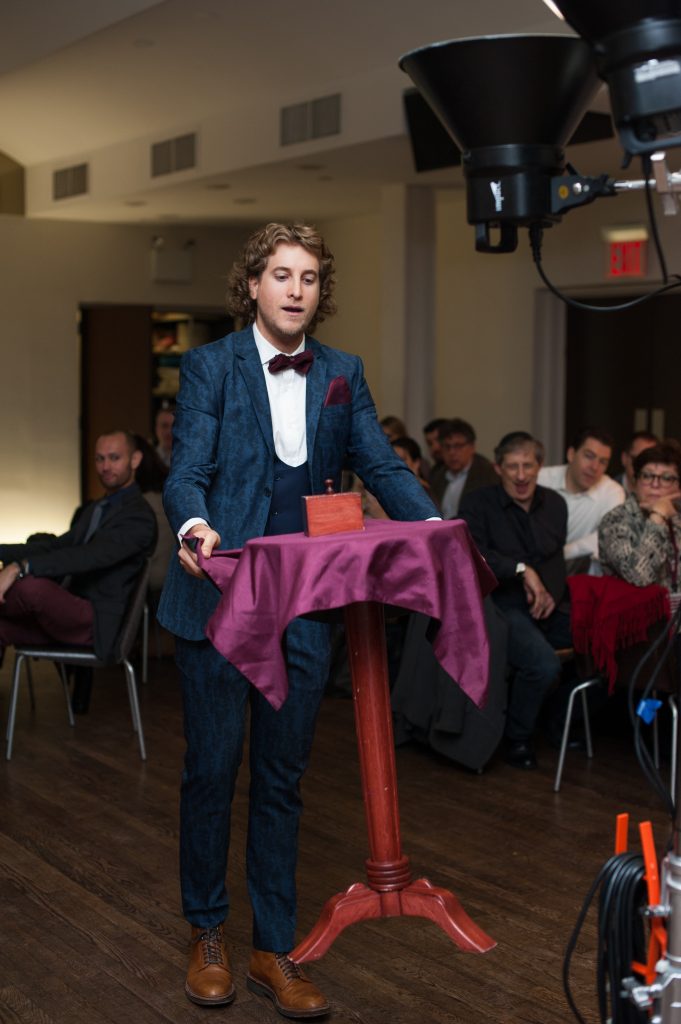
Matias Performing at one of his “Pick Pocket” events

Magical Beginnings

Matias Letelier’s story of getting involved in magic is a divine one. It began with an inherited magic library and has manifested into his career. Matias enlightens us with the fact that the practice of magic by showing it has meaning and spirituality, with deep roots and religious ties.

He now shares his talents with New York City, as the city’s resident magician, brimming with Infectious charisma, charm, and friendliness. As a dedicated man to his craft, Matias did not stop amid the pandemic. He put smiles back on faces and put the awe back into people’s hearts with his Zoom magic sessions.

Our very own Grace A. Capobianco recently paid a visit to Matias’s show, “Speakeasy Magick” at the McKittrick Hotel, and decided his story – and his talents – shan’t go unshared.
Downtown: What inspired you to become an illusionist & mentalist?

Matias Letelier: I never, ever, ever, thought about pursuing magic as a career. But while I was studying business, there were 4 elements that inspired me to become an illusionist & mentalist:

1) I inherited a magic library from my uncle who suffered an accident and passed away in 2004. He was a businessman but also an extremely talented magician (he did it as a hobby). Imagine myself getting so many magic books!

2) After his accident, every time I performed for his daughter (who was 3 by then) she would “see” her dad and invited him to join the show. It was crazy, and my grandmother and mom (who are fervent Christians) told me it was almost like a miracle! So I started doing a trick in his memory in every show… and thought about continuing his legacy.

3)  Along with my friends at the Business school, spending 2 weeks each summer and winter in lower-income areas of our country helping them fix their houses, and then in the afternoon, we would teach them about marketing, finance, accountability, and other business skills. Then in the late afternoon, we would have some fun activities and I was in charge of the entertainment for being a magician. The shows were very simple but with so much heart that people were super excited. This is where I learned that I had a way to connect with people which made them feel happy.

4) Finally, at the business school one of my teachers told me “you should mix your passion/hobby with marketing… then you’ll have a unique business”. I thought to myself “I have the passion, the magic skills, and marketing knowledge, and most importantly, I have the story of my uncle… maybe I should do magic for a living”… 16 years after, here I am. I’m so happy and thankful for all the many blessings I’ve received so far.


DT: What is the difference between magic, and illusionism?

ML: For me, there are magicians and illusionists. Magicians were the real deal in ancient times. But they have nothing to do with the modern illusionist. While magicians were pursuing the enlightenment or spiritual connection with the divinity (God, samadhi, Heaven, etc), the illusionist tried to create the “illusion” that they were able to do the same as these magicians. For example, an ancient magician would have the ability to “read” someone’s mind and body and know exactly what was happening with them. Then they will recommend a course of action. On the other side, mentalists (which is an area in illusionism), do a few tricks to pretend they can read someone’s mind, just to reveal the number you were thinking of or the name of a loved one. In other words, magic was meant to achieve a higher state of consciousness associated with your spiritual life, while illusionists just try to entertain you.


DT: Can you tell us a bit about your performance styles and what kind of events you cover?

ML: My performance style includes strolling close-up magic and stage performances with big illusions. Although in recent years I’ve started incorporating many elements from mentalism. And I’ve done it all: private yachts in the Caribbean, cruise ships, big theaters, small theaters, clubs, hotels, private events, and corporate events all over the world.


DT: What do your performances entail? Which “trick” is the biggest crowd-pleaser?

ML: I focus on high energy and interactions. For me, the most important part is to connect with the audience. I usually become friends with my audience (even in a 10 min routine), and then it feels like I’m a friend showing them some secret skills. I have a  very warm approach to the audience, more so than other magicians, this is a great benefit.


DT: It appears that you can speak four languages: native Spanish, fluent English, medium Portuguese, and basic French. Does that ever come in handy when practicing magic?

ML: Not so much when practicing, but definitely when performing. Many times I have international audiences, clients will book me because they know that I can speak different languages. People feel much more comfortable when I speak their language. Besides, it’s fun for me and they enjoy the extra effort, when I pronounce the words correctly. Even though I might not be able to do a full show in French, the fact that I can do a few tricks and communicate with them, shows them I care. People care about you when you show them that you truly care about them and make the effort.


DT: What gets you the most excited about performing?

ML: I don’t smoke, I don’t do drugs, I don’t drink. Seriously. But when I’m out performing I get a “magicians’ high”. My wife says it is because I perform with passion. I’m not focusing on the clock. I’m just out there enjoying myself, getting to know new people, learning from their stories, and sharing some magic. It makes me so happy, and I feel my audience feed off of that energy the same way I feed on their reactions and energy. To experience that is one of my favorite and exciting things during my preformance.


DT: You base your work mostly out of New York City. Where is your favorite spot to perform?

ML: Even though I’ve been lucky to bring my magic all over the world, my favorite spot in NY is Speakeasy Magick at the famous McKittrick Hotel. Todd Robbins invited me to be part of this along with the best magicians in NYC – and I’m not telling you this because I’m part of the show – but this is without a doubt, the best magic show in NYC. Why? Because we created a unique experience that happens right in front of you, in the club car at the McKittrick Hotel, a place that is so cool that you have to experience it to see what everyone is talking about. This show always puts a smile on my face, plus everyone behind the show, including all the amazing performers, and staff, are simply the best.


DT: What do you love most about NYC?

ML: Do we have time? (laugh). So many things. The diversity of cultures, all the entertainment options, the great restaurants, the social life, the fact that the different social classes mix in every block, all the activities happening in every corner no matter where you are, Speakeasy Magick, and, of course, from here you can travel anywhere in the world. I mean, how can you not love this city?


For more on entertainment from Downtown, click here.


To read our Downtown Q&A with musician Seth Kessel, click here.
Categories
Culture Featured Theater

What Bloody Man Is That?

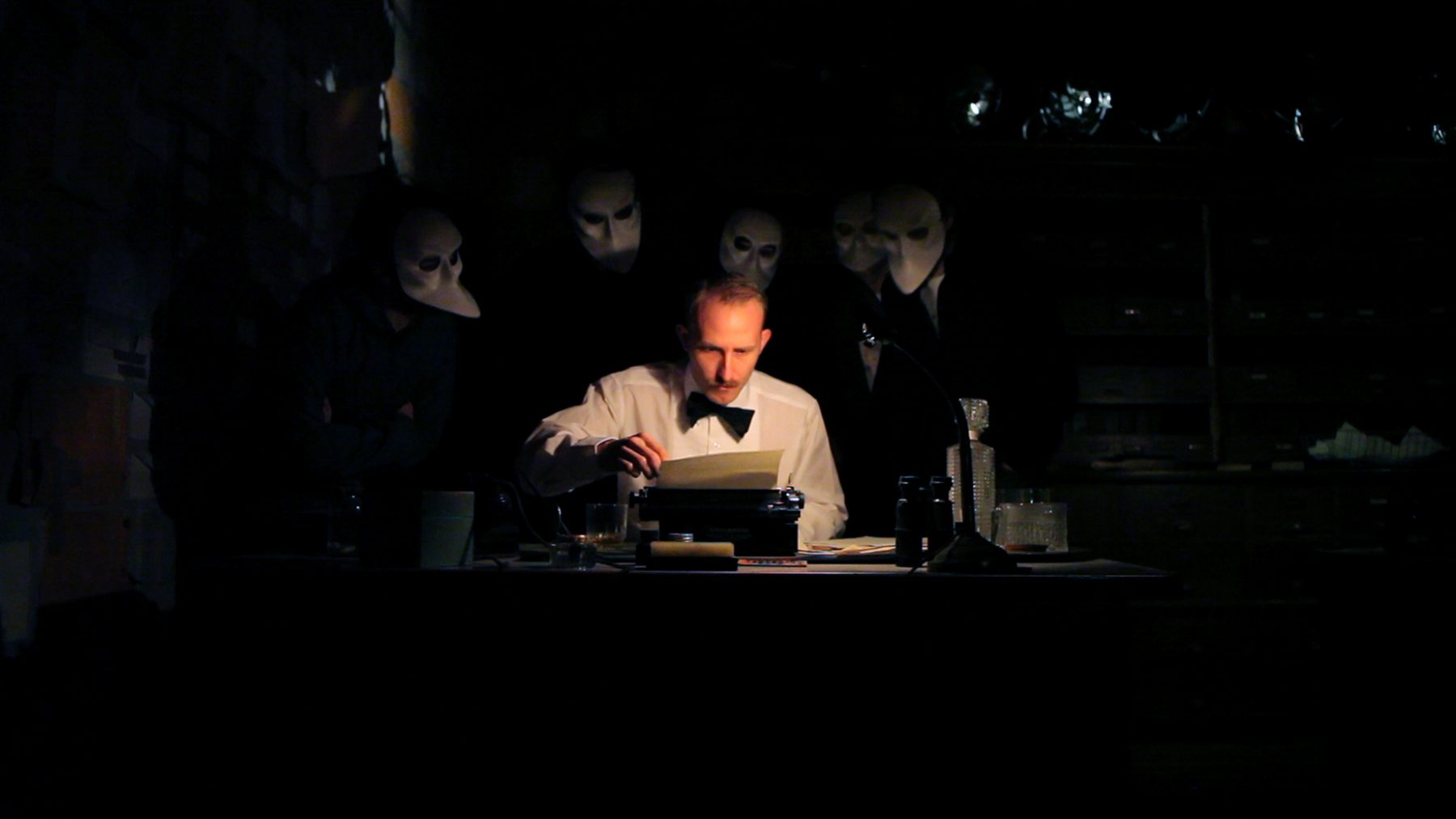
The McKittrick Hotel’s flagship production, Sleep No More, has spent the last few years gaining fame and notoriety for its witchy mystique. It takes Shakespeare’s Macbeth and passes it through dreamlike noir to create a thrilling modern dance experience unlike any other. Masked guests follow actors through a six-story building like silent spirits as Shakespeare’s tragedy unfolds simultaneously across the building. It is a feat of performance, but also of engineering, costuming, choreography, and design. As Sleep No More announces an expansion through September 13th, Downtown got a chance to speak with Maxine Doyle from Punchdrunk UK, the Co-Director and Choreographer for Sleep No More, about the origins of the ghostly play. 

Sleep No More
Performer Robin Roemer. Photo courtesy of The McKittrick Hotel.

Origins

Sleep No More came from humble origins: a small production in 2003 inside an old victorian boys school. The cast was only 10 people for the 10-night performance, splitting 40 people between less than a dozen rooms. 

The original idea, Doyle says, came from Artistic Director Felix Barrett’s love of Bernard Herbert’s soundtracks to Alfred Hitchcock films, and the way that Hitchcock marries the aesthetic of noir with the kind of psychology that you can see in Macbeth. “I think it was a text we both really loved in terms of its characters and we looked more at the sort of domestic human absences of the play–the themes of ambition and guilt and particularly the sort of dramatic, codependent relationship between Macbeth and lady Macbeth. And then, of course, the really interesting sort of layer of the supernatural.”

After the close of the initial run of SNM, Punchdrunk crossed the pond for another, longer showing in Boston, Massachusetts, at the American Repertory Theater. The show ran there for four months, from October, 2009 until February 2010. By that time, Punchdrunk UK had turned its eyes to NYC. 

Punchdrunk did not build the McKittrick Hotel. According to Doyle, the site had been empty for several years following its occupation by various nightclubs of “dubious” repute. But the building’s shady reputation and open space finally allowed Sleep No More to stretch its legs. 

Sleep No More
Photo courtesy of The McKittrick Hotel

The Labor We Delight In

The current iteration of Sleep No More, which began in 2011, features approximately 25 actors and dancers. The shows run for three hours apiece, with every scene except for the beginning and the end being performed three times during each run. Each of these performances is done without breaks for any of the performers. “It’s the relationship of the audience with the performer that is very specific within this sort of form,” says Doyle, “the audience can follow a performer all the way through, they could stick with one performer if they wanted to for three hours.” In fact, doing so increases your chance of being pulled in for a one-on-one, where a performer takes a single audience member away from the rest for a scene performed for them alone. “The idea is that you need to feel like these characters live in this building–that there isn’t any beginning and there isn’t any end. And, and there’s a sort of hypnotic drive of this loop, almost a sort of purgatorial structure that the characters find themselves within.”

Casting for Sleep No More is rigorous. Most of the cast turns over every six months, and auditions can mean 1000 auditions for five roles during a two-week period. Once selected, a performer goes through eight weeks of training, learning two different roles in the cast. They will go through classes in body conditioning, contemporary dance, and yoga, but also through a kind of intellectual training. They read through the original play, of course, but also theories surrounding the play, and works by Hitchcock and David Lynch whose works are heavy influences.  

If you have seen the show, you know that parts of the performance can be brutal on the body (a scene with a man performing with his head on a table and his feet on the ceiling comes to mind), and so all performers must be prepared to perform perfectly under that strain. Sometimes twice. “I would say 85% of the company are dancers. I would sort of call them dance actors, but their training, instinct, physicality skill, comes from a sort of contemporary dance background.”

If you haven’t seen Sleep No More, now is your chance. Check here for dates and times for shows, and experience one of the most unique shows you can see in NYC. 

See More

Do You See What I See?

Categories
Culture Entertainment Featured

Mentalist Jason Suran is Ready to Blow (and Read) Your Mind

Downtown’s favorite mentalist Jason Suran has traveled the world performing his mind-reading and magic on stage, television, and even for corporate events. We spoke with him about how he got started, how he develops a new act, and his new Séance experience.

Photo by Alex Knight Studio

Downtown: Were you always interested in magic and tricks?

Jason Suran:  I wish I could say I’ve been doing magic since I was a child, but the truth is I really didn’t develop an interest in it until college. I was studying theatre nine hours a day, three days a week and filling the other two days with psychology and history classes, so magic became this sort of meditative hobby that I could practice at my own pace with no pressure attached to it. Then I started exploring mentalism, and it was just this perfect intersection of all the things I was interested in. In a way, I’m glad it took me until college to find it because it gave me time to develop other interests and passions first. 

Downtown: Did you ever think you would end up sharing your skills in a corporate setting?

JS: It had crossed my mind, but I always knew it needed to be under the right circumstances. There were a lot of companies who wanted to hire me as a human lie detector, and I had no interest in that because you can never live up to that expectation off stage. To me, the wonderful thing about mentalism is how quickly it creates rapport between total strangers and makes the audience feel like you’ve known them their entire lives. That is what I wanted to bring to the corporate world, and I try to work with companies who are interested in that as well. 

Photo by Alex Knight Studio

Downtown: How do you approach close up versus your stage show?

JS: Well for one thing, there’s a lot less room for error on stage. When you’re on stage, the audience is seeing everything, so every word and action has to be meticulously planned. Close up is more like jazz. You can improvise and take chances. I started out as a close up performer and when I first started doing stage shows, it took a while for me to learn I couldn’t just wander off and start reading minds in the aisles because nobody could see what the hell I was doing. I’ve gotten better at staying on the stage, but that’s still where my impulses go. I’m constantly thinking about how to make my stage work feel more personal. I think there’s just something special about standing a foot away from someone and showing them something completely impossible. 

Downtown: What is the at home seance show you are developing?

JS: The show is called “The Other Side,” and it’s a modern spin on a victorian Séance. Each night, fourteen audience members are invited to a complimentary cocktail party, taken through the history of spiritualism and then ultimately participate in a Séance of their own. I’ve performed iterations of the show for nearly four years, but this is the first time it will be performed for an extended run. The “in home” element was really an idea of necessity. We wanted to take our time finding the show a permanent venue so while we searched, we decided to workshop it in private apartments throughout the city. It was a fascinating learning experience because, historically, that’s how many Séances were done. An aristocrat would hire a medium to come to his or her home and create this experience in their parlor for their friends and family. In a way, these mediums were perfecting the art of site specific theatre before it even existed. 

Photo by Alex Knight Studio

Downtown: Where can people see you now?

JS: I’m excited to say that “The Other Side” will be playing at the Norwood Club now through August before moving to a new location in the fall! Tickets are available at facetheotherside.com

Downtown: What is different about your new show?

JS: I think what makes “The Other Side” special is that it really does have something to offer regardless of whether or not you believe in ghosts. As a skeptic myself, I’m much more interested in how Séances brought people together and sparked the cultural imagination than with whether or not they were “real”. I think that mystery is half the fun. 

Downtown: How do you develop your show/act?

JS: For me, it usually starts with a story. A lot of my act is built around personal or historical stories that I think are interesting and worth telling. Then it becomes a question of how can magic (or more often mentalism) improve the telling of this story? And if it can’t, I either scrap the idea or sometimes just tell the story on its own. There’s nothing worse than forcing magic onto art that doesn’t need it. I don’t think anyone would have enjoyed Hamlet more as a card trick.

Photo by Alex Knight Studio

Downtown: How do you keep it interesting for yourself from night to night?

JS: The great thing about a mind-reading show is it’s literally different every single night. There are a few moments where I may be trying to influence someone to make a certain choice, but by and large I have absolutely no idea what people are going to think of before the show begins so I’m getting to experience the show with them. That said, anytime the act starts to feel too comfortable I’ll always try and push myself to take a risk even if that means doing something I know might not have a 100 percent chance of working out. 

Downtown: Chicago or NY pizza?

JS: Oh Chicago without a doubt. Jon Stewart once accused deep dish of basically being tomato soup in a bread bowl, and I honestly didn’t realize he meant it as an insult. 

Downtown: Favorite venue Downtown?

JS: It sounds silly, but the Regal Cinema in Battery Park is probably one of my favorite places to go when I have a day off. I’m a film nerd at heart, and, in addition to being a great theatre, that whole neighborhood just feels so different from the rest of the island. It reminds me of Chicago. The streets are wide and when the movie is over you can grab a milkshake from Shake Shack and just walk along the waterfront, which I think is one of the nicest walks in New York’s City.

You can follow Jason on Instagram at @jasonsuran.

Categories
Culture Entertainment Music

Nathan East on his new album “Reverence,” playing with top artists, New York City & more

Nathan East / Photo: Alysse Gafkjen

Screen Shot 2016-11-21 at 2.48.51 PM

Whether or not you know Nathan East by name, you have heard plenty of his music. That was him playing bass on “Get Lucky” by Daft Punk. That was him playing bass on “Easy Lover” by Phil Collins, a song that he also co-wrote. That was also him on Eric Clapton’s Grammy-winning MTV Unplugged album. And that is without discussing his collaborations with Michael Jackson, Elton John, Barry White, Toto, Lionel Richie, Randy Newman and hundreds of other notable artists.

While world tours and session work would be enough for many artists, Nathan East has also stepped out as a solo artist in recent years. A follow-up to 2015’s The New Cool, the forthcoming Reverence features an all-star line-up of collaborators. A cover of Earth, Wind & Fire’s “Serpentire Fire,” for example, features Eric Clapton on guitar, Phil Collins on drums and members of EW&F on bass, vocals and percussion. First single “Feels Like Home” includes Yolanda Adams on vocals. Philip Bailey from Earth, Wind & Fire also appears on a cover of Stevie Wonder’s “Higher Ground.” Nathan’s son Noah can be heard on “Somewhere Over The Rainbow.” Reverence will hit stores via the Yamaha Entertainment Group on Jan. 20.

Nathan spoke to Downtown about his past, present and future, all of which very interesting. He can be visited online at www.nathaneast.com and also followed on Facebook, Twitter and Instagram.

Who was the first prominent artist you had toured with? Was it Barry White?

Nathan East: Yes, Barry White was my first employer on a major U.S. tour. He heard a band that I was in called Power and hired our entire group on the spot to tour with him and the Love Unlimited Orchestra. I was 16 years old performing at Madison Square Garden, The Apollo Theater and The Kennedy Center. Needless to say, it was a thrill!

You have notably played on over 2,000 releases. Is there one that you view most proudly? Or one that you look back at as being your first big break?

NE: From the beginning of 1980, I found myself practically living in the studios of Los Angeles recording as many as 25 to 30 sessions per week, everything from commercials and jingles to albums and motion picture soundtracks. I played bass on many of the Barry White albums and hits, but he didn’t credit the musicians on his recordings for fear that someone might try to steal his sound. The Hubert Laws Family album was one of my early recordings that I was very proud of. The Philip Bailey Chinese Wall album gave birth to the song “Easy Lover” that I was very proud to have co-written with Philip and Phil Collins. There are so many that I view proudly including all the Anita Baker recordings and Fourplay albums, but one of the most significant recordings may have been the Eric Clapton Unplugged album, which sold almost 30 million copies worldwide. It contained the classic song “Tears in Heaven,” written for his son Conor.

Are there any sessions that you did a ghost musician? Andy Timmons, for example, told me in an interview that he played on a song by the purple dinosaur Barney…

NE: I was called in to play on a Judas Priest album but was not credited. Their bass player was in recovery at the time.

https://www.youtube.com/watch?v=GJrkhSmXXi8

Most people know you primarily as a bassist, but you’ve written hit songs for artists. When did you start writing music versus playing bass?

NE: In the mid-70s I wrote my first recorded song called “With All My Love,” which became the title track of trumpeter Bruce Cameron’s album. That song was my entry into ASCAP and I pretty much started writing music at about the same time I started playing bass.

I know you played cello before bass. Did you ever take piano lessons? Or try to expand to learn other instruments?

NE: I did take piano lessons as a child, and I have limited skills on the rhythm instruments such as guitar and drums.

Yamaha makes your basses and releases your albums. How did you first encounter Yamaha?

NE: In the early 80s I remember visiting Abraham Laboriel at A&M Studios, and of course he can make any bass sound amazing, but that day he was playing his Yamaha bass and I was very impressed with the sound! He put me in touch with Yamaha and that was the beginning of our long relationship.

Do you have a favorite song on your new album?

NE: That’s sort of like asking if you have a favorite child. They are all favorites, but I must say I am partial to the version of “Over The Rainbow” that I recorded featuring my son Noah on piano. Also, a new version of the Earth Wind & Fire classic “Serpentine Fire” is one that I’m very happy with the way it turned out.

How does the new album compare to your solo debut?

NE: I don’t like to compare albums as they are musical expressions and reflections of different times in your life, but I must say I love this album equally as much as I love the first!

Why did you wait until 2014 to put out your first solo album?

NE: To be honest, it was my desire for the past couple decades to release my own solo album. However, I found myself too busy working and touring all over the world and making music with such an enjoyable variety of artists.

Is there anything you haven’t yet accomplished but still hope to?

NE: I’ve recently been doing some voiceover work, which is a lot of fun. I would also like to start a foundation for education to give underprivileged kids opportunities to attend college.

Will you be playing any U.S. shows in support of the new album?

NE: Absolutely!

Where was the first gig you ever played in New York City?

NE: Madison Square Garden with Barry White. We also played the Apollo Theater.

Do you have a favorite restaurant in New York?

NE: Oh, there are so many, like Nobu, which I really enjoy. But one of my recent favorites is Pepolino’s in SoHo.

When you’re not busy with music, how do you like to spend your free time?

NE: I love spending time with my family more than anything else! I also enjoy photography, I’m a private pilot and I enjoy performing magic.

Finally, Nathan, any last words for the kids?

NE: Be passionate about whatever it is you want to do, and try to live life to the fullest — it goes by quickly!