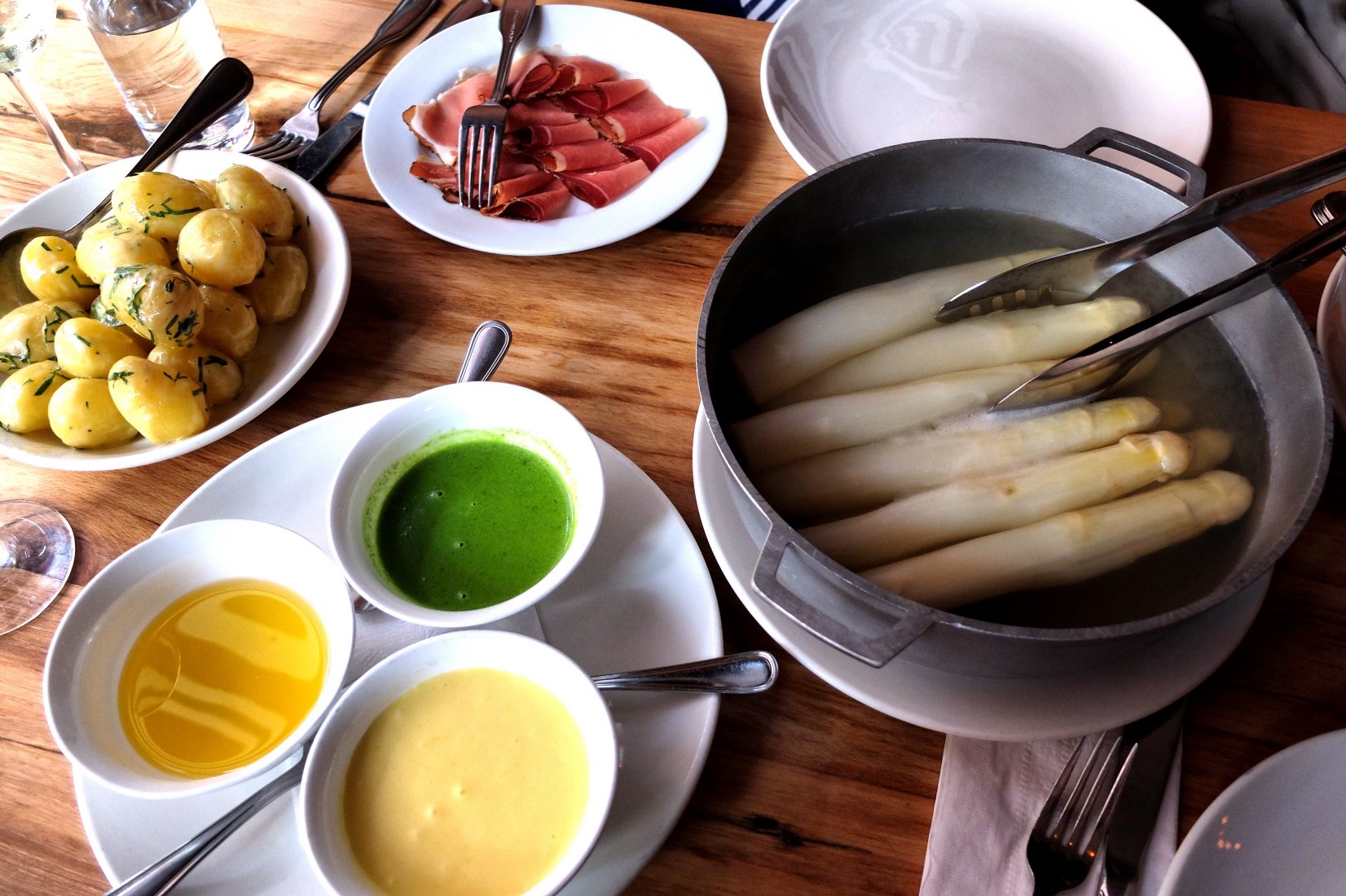
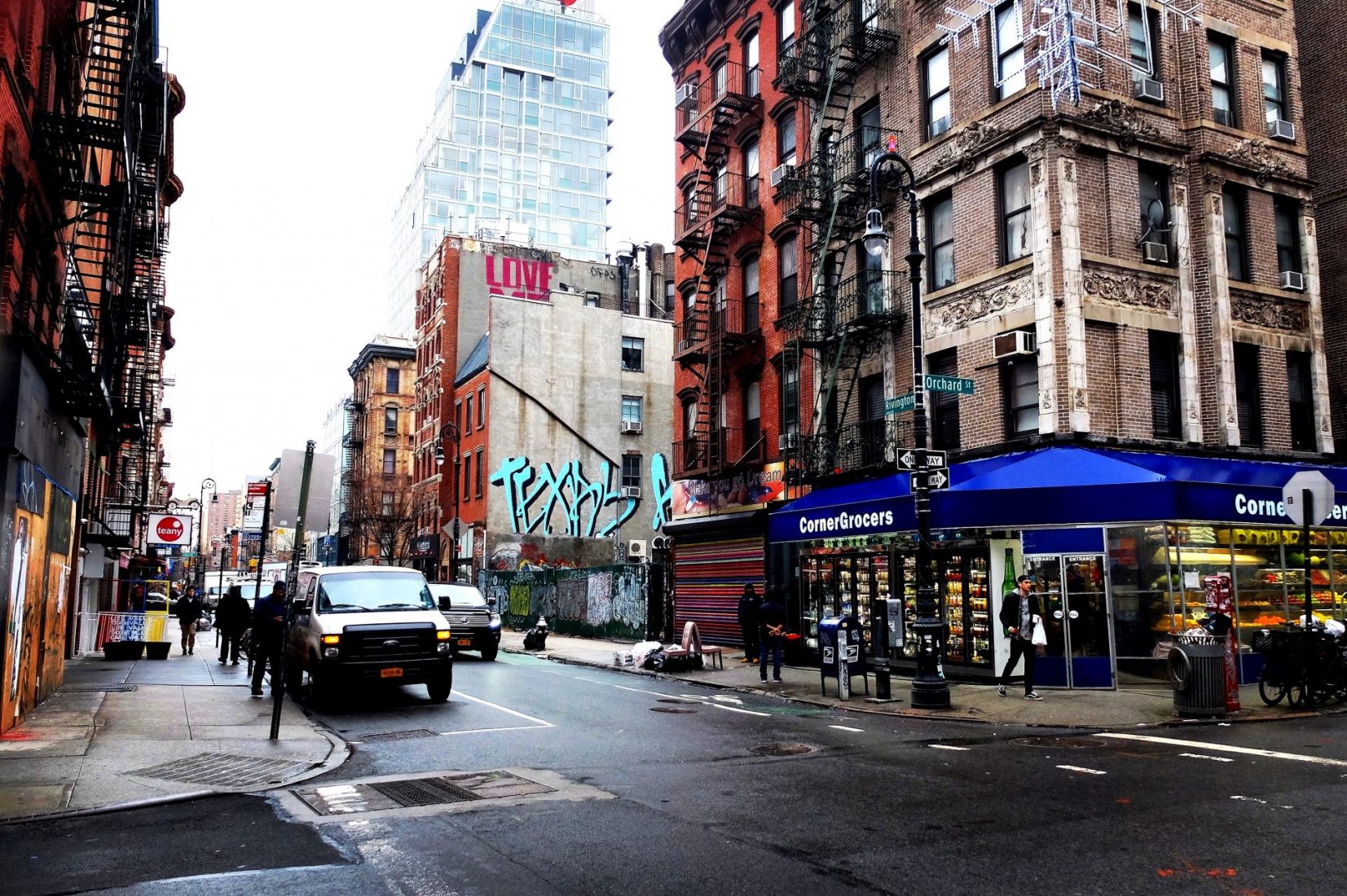
“Our white asparagus is flown in from Europe every Thursday,” says Emmy-winning, and charming, Chef Erwin Schröttner co-owner and founder of Cafe Katja on Orchard Street. The rare and valuable delicacy’s short season lasts through mid-June, so the time to enjoy them is now.
At Cafe Katja, Chef Erwin serves the crisp, delicately flavored white asparagus stalks warm, with a variety of accompaniments including a delicious, eggy-but-light hollandaise and new potatoes, on a bed of frisée with a lemon vinaigrette, with a traditional pairing of Tiroler speck and drawn butter, and with ever so lightly smoked salmon and an herbaceous, bright green garlic sauce. To complement the white asparagus, Chef recommends a full-bodied Austrian wine Gebeshuber 2015 Muschelkalk Rotgipfler, or a delicious sparkling sec, Szigeti Grüner Veltliner.
White asparagus, or spargel, is celebrated with festivals throughout Europe, especially in Germany and Austria, where Chef Erwin grew up on a farm that has been in his family for hundreds of years. “We grew up in heaven in the foothills of the Alps,” he says, “with the freshest food, and learning the traditional ways of caring for animals and the land.” He recalls that his father, before butchering a pig for the family larder, would spend 15 minutes with the animal, thanking it, and paying respect. It is those memories of home, and the delicious food his mother and grandmother prepared for the family table, that inspired him to leave the world of 5-star restaurants and hospitality, and open Cafe Katja – a comfortably elegant neighborhood place named after his daughter, serving Austrian specialties.
Apfel strudel with schlag
Don’t sleep on this celebration of white asparagus, and other Austrian specialties like wiener schnitzel, house-made liverwurst, sausages, pickles, and pretzels – the white asparagus season ends in June. And save room for dessert. The cafe serves a stellar apfel strudel, with schlag, of course.
Smoked salmon
Cafe Katja does not take reservations, and is located at 79 Orchard Street. You can also learn more about Austrian cooking and traditions on Erwin Cooks, Chef Erwin Schröttner’s Emmy-winning PBS show.
Beloved Japanese dessert shop Bonsai Kakigōri could formerly only be found at the Canal Street Market and pop-ups like Smorgasburg. They recently opened their first solo brick-and-mortar shop on the Lower East Side with their beloved shaved ice desserts and an expanded menu featuring drinks, toasts, and snacks like katsu sandwiches. The place is already a star on Instagram, and the team is getting involved with the local community.
In the spirit of celebrating and giving back to their community, Bonsai Kakigōri will host a pay-what-you-wish community day on Saturday, May 4th to benefit the Lower Eastside Girls Club of NY, a community center that offers programs in the arts, sciences, leadership, entrepreneurship, and wellness for girls in middle and high school. From 11:00am – 10:00pm, guests can enjoy Bonsai Kakigōri’s new menu items to support the local organization.
Photo by Ethan Covey
They are also kicking off their monthly chef collaborations this week. The first one partners with chef Ivan Orkin of Ivan Ramen and debuts on Thursday, May 2nd and will be available all month. Co-owners of Bonsai, Theo Friedman and Gaston Becherano, teamed up with Ivan Orkin and his team to create Ivan’s Quadruple Coffee Crunch Surprise Kakigōri, made with a cold brew, smoked almonds, salted coffee caramel, coffee jelly, and espresso mousse. Stop by on Bonsai Community Day or any other day to try this coffee filled special!
Bonsai Kakigōri 100 Stanton Street at Ludlow Street
Luxury women’s brand SNIDEL teamed up with the legendary rock band Queen for an extremely limited collection of pullovers, totes, and phone cases available only at their Lower East Side flagship store. If your Oscar party requires you to dress in theme with the nominees, this collection is a perfect way for you to show your love of Bohemian Rhapsody and its five nominations. Peep the items below then head to 144 Orchard Street to pick up an item from the exclusive collection.
It’s that time of year: Resolution 2019 is upon us, and I have a good one. And bonus, it’s something you can do every day and doesn’t involve going carb free or buying expensive workout gear. This year, why not make an effort to support your local business owners? It’s easy to do. Instead of heading to Amazon Prime for your best friend’s birthday gift, spend an afternoon wandering around the Lower East Side to find the perfect bauble. Actually, that is two resolutions in one – everyone knows that walking around New York counts as a workout.
Supporting local business is important, but equally important are the memories and attachments you are creating. Some of my happiest New York memories involve shopping. Here’s one. In 1994, I was an associate managing editor at House Beautiful magazine, and Steve and I were newly engaged. Money was tight, but we didn’t care. As the cliché goes, we were poor but happy.
One of our favorite ways to spend a Saturday was to wander around the Village. We usually started in the East Village and worked our way West, looking for new shops, revisiting old favorites, and fantasizing about living in one of those beautiful brownstones. In the West Village, we would have dinner at MacDougal’s Café – a coffee shop with good French onion soup, a decent burger, and endless refills of coffee. In those days you could eat well for under $20, and even treat yourself to a cappuccino without having to take out a second mortgage. I know, I know, it’s a nostalgia trip but bear with me.
MacDougal Street was a great place to wander. The ghosts of Bob Dylan, Eleanor Roosevelt, Louisa May Alcott, Jack Kerouac, Richie Havens, Lenny Bruce, and so many others bumped shoulders with young hopefuls, writers, musicians, poets…well at least that’s the way I remember it. It’s not that the historic buildings don’t still stand, it’s just that young hopefuls can’t afford the neighborhood anymore. But back to my shopping memory.
C’est Magnifique on MacDougal Street
Of all the shops on MacDougal Street, the best of the best was C’est Magnifique. The Albrizio family opened there in the late fifties, and they made jewelry for people like Iggy Pop, Keith Richards, and Madonna. Famous faces adorned the walls of the tiny shop, but the amazing thing about the Albrizio family was that they treated everyone the same – like family. The window was FILLED with treasures. Inside, cases lined the walls and counters brimmed with vintage and new pieces. The shop was busy with people dropping off jewelry for repair, ordering something custom, or just hanging out listening to Alfred Albrizio Jr’s stories.
Christmas cuff from C’est Magnifique, 1994
In the winter of 1994, with money tight, Steve wanted to buy me a Christmas present. He picked out a beautiful sterling cuff with an oval Lapis cabochon at C’est Magnifique. But he didn’t have enough cash to buy the piece. Al could see how much he wanted it, so he let Steve have it for the cash he had in his pocket, and told him to pay the rest when he could. Months later, when some money came in, Steve went back to the shop to pay the balance, and he remembers that Al was surprised that he had come back.
We never forgot that kindness. It was a very good Christmas because of the generosity of a guy who understood the true spirit of the season. We purchased many beautiful items from Al, and they are my favorite pieces to this day. When the shop on MacDougal closed because of rising rents, they moved to East 9th Street, and ultimately closed after Al’s untimely death in 2014.
Earrings from Sterling Assault
Nowadays, we are so happy that Alfred Albrizio III is continuing his family tradition with Sterling Assault, creating new designs and reproducing some of the classics he helped create at C’est Magnifique. His jewelry is available exclusively at I Need More on Orchard Street, or through his website. Check it out. You can’t get it on Amazon, believe me.
There’s a lot of talk nowadays about how to preserve the New York of song and story. But still every day we see whole blocks of empty storefronts, new construction, and chain stores moving in. Shopping local is critical, but to be fair, it isn’t just shopping local that is going to save this town. A bill for commercial “rent control” was originally introduced by Ruth Messinger in 1986, and it’s under review again, with current Speaker Corey Johnson signaling his support. I don’t know if that’s the answer but I do know that something needs to be done. Every week an old favorite seems to close. This week will mark the last for the Cornelia Street Cafe, a Village staple since the seventies. In 2017, the New York Times reported that their rent was $33,000 a month. You do the math.
While our city government decides where their loyalties lie, you can help. Support your local businesses. Try to avoid chain stores. Buy your coffee from a bodega. Shop for Christmas and birthday presents the way I always did and still do, walking and wandering, and making friends. Seek out small businesses and local owners who are the lifeblood of this city.
Make it your Resolution 2019. And every year after that.
Look for my weekly blogpost, THOUGHT PATTERNS, here, and follow me on Instagram @debmartinnyc
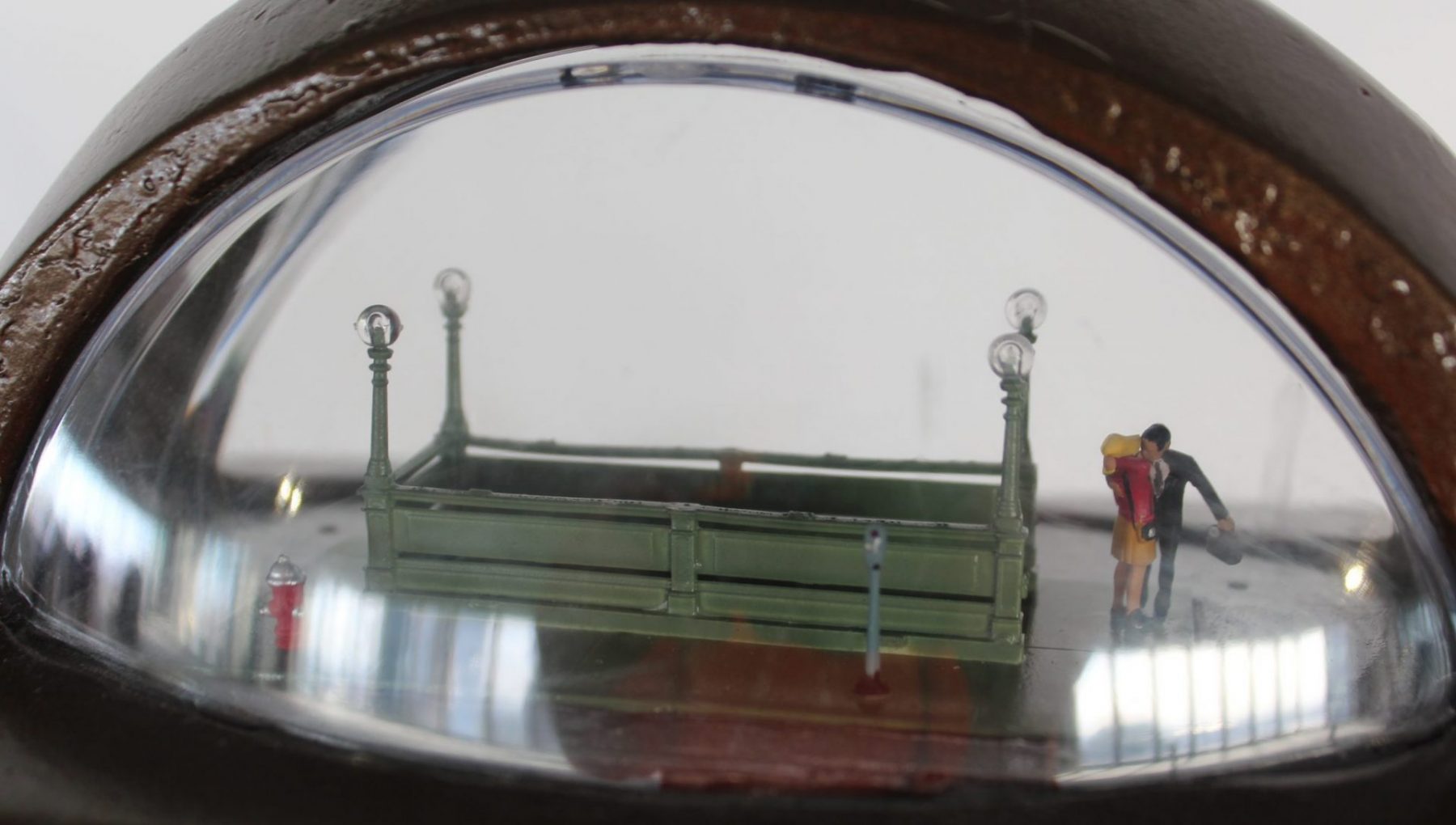
Expired NYC, currently on view at Castle Fitzjohns gallery on the Lower East Side, is an exhibit of artist Conrad Stojak’s upcycled parking meters. Stojak calls the iconic meters “reliquaries containing memories of my life.” They house dioramas of New York moments, from a celebration of punk rock at legendary club CBGBs to a tiny Jackson Pollack painting a masterpiece.
Expired NYC on the Lower East Side
Stojak originated the concept three years ago when he turned ugly broken parking meters in his neighborhood into street art. He worked through the night to create his dioramas. “Usually the guts of the meters were removed by the parking authority, so I was just working with the shells. And they only lasted a couple of days because people would steal or deface them.” Eventually he decided to turn the temporary works into something more permanent. He contacted the city to find out what was happening to the meters once they were removed from the street. The city was selling the meters in lots of 20,000 pieces. Conrad says, “I told them there was no way I could use 20,000 parking meters. I mean, those things are heavy.” Eventually he convinced them to donate a much smaller quantity.
Everyday objects
Expired NYC on the Lower East Side
Stojak cuts the heavy shells open in order to build the dioramas inside, then reassembles the meters. He paints them in a mix of spray paint and enamel. Some of the meters have many layers of paint. The dioramas are created mostly from tiny figures from model train kits that he buys online. Some contain found objects. In addition, Stojak found an online source for the glass domes.
Expired NYC on the Lower East Side
Memories of New York
Says Stojak, “They are very personal, and represent my memories of New York. They show my favorite artists, movies, as well as the experiences I had growing up here.” The 34 meters include tributes to Andy Warhol’s Campbell Soup can, Jackson Pollack, and Rockefeller Center. Additionally, some of the meters feature bi-level dioramas that descend into the body and are viewable through a window. And some, like the Studio 54 tribute, have moving parts and lights. “I found the perfect size disco ball for that one,” he says. For the Pollack tribute, Stojak watched videos of the artist at work and replicated his technique for the surface. He took the Venom meter to a friend’s place upstate and shot a couple of real bullet holes in the face.
Expired NYC on the Lower East Side
“I love mixed media and assemblage, and that is what I do. These meters are such a part of growing up in the city, and they are pieces of art in their own way.”
Expired, NYC is open through October 30, 2018; castlefitzjohns.com
Boom for Real: The Late Teenage Years of Jean-Michel Basquiat opened tonight at IFC Center, in Greenwich Village. The documentary, by filmmaker Sara Driver, explores the artist’s early life on the streets of New York, and how the city, and the time, shaped his work. Driver, who was part of the Downtown scene, says, “I wanted Basquiat to be a touchstone throughout the film. I saw what Alexis Adler had saved from when she lived with him. After Hurricane Sandy I went to her house and she said, ‘Sara I just pulled all of this stuff out of storage and I have all this work of Jean-Michel’s, his writings, and his notebooks.'” Driver continues, “She had forgotten about it for 30 years. And then I remembered I had a box of clothes he painted. When I looked at all of it I saw it was an insight into him and his experimenting and finding his way as an young artist, but it was also about our city.”
Boom for Real, the Late Teenage Years of Jean-Michel Basquiat
The film is a visual time capsule of pre-gentrification New York in the 1970’s and early 1980’s when fires burned in barrels and on street corners, and buildings lay empty and gutted. The middle class had flown to the suburbs, and the streets were empty and silent. Punk rock, art, and performance coalesced and formed at places like CBGBs, Max’s Kansas City, the Mudd Club, and Club 57.
Through rare film clips, photos, and interviews with former and current denizens of Downtown such as Fab 5 Freddy, Jim Jarmusch, Alexis Adler, Diego Cortez, and Lee Quinones, among others, the film explores Basquiat’s beginnings through the lens of the scene in Lower Manhattan, where new ideas about art, music, performance, film, media were percolating and merging together to create a new type of artist. Says Driver, “Everyone was a musician. Everyone was into painting, everyone wanted to write poetry. All mediums feed each other. Basquiat wasn’t unique in that, we all did it.”
But, Driver says, this film is not meant to be a nostalgia trip.
It is, instead, a modern-day fable, with lessons for today’s gadget-driven world. “The city was dangerous so you had to have your antennae up all the time, to see where the danger was lurking. And you were always observing things on the street, which also gave you these incredible gifts. But I don’t think people are observing as much today. They are wrapped up in their phones.” She continues, “Basquiat spelled out his feelings through SAMO, and in his paintings and writings. He observed everything. It’s astounding how relevant he is. The work is still as fresh as it ever was. Great artists are always prophet-like.”
She continues, “I remember going to a Carlo McCormick show at Grey Gallery, about Downtown from 1974 to 1984. That was the first time I saw it all together: performance art, films, poetry. He had gathered everybody, and I realized how much we germinated each other.” She says, “We really fed each other and our love of ideas. Diego Cortez said it was like café culture in the 1920’s in Paris, or Berlin in the 1930’s. You had different generations. Burroughs, Ginsberg, Robert Frank, The Beats. The jazz musicians, Ornette Coleman and Thelonius Monk playing down the street. Our heroes were here.”
Filmmaker Sara Driver
Although the city has changed dramatically, Driver is hopeful about the new generation of artists and activists. “History is cyclical. You have the March for Our Lives kids, and the kids that do the Spring Break Art Show, who last year took over the abandoned floors of the Conde Nast building. They had 150 curators and 400 artists of all ages and everyone was so thrilled to be in one space together. It’s the grandchild of the Times Square Show. I think there is hope and possibility. It won’t be the same, but it’s still happening. Kids are going to cause the change. We did it, and they will too.”
NOW PLAYING: See Boom for Real: The Late Teenage Years of Jean-Michel Basquiat at IFC Center, 323 Sixth Avenue; 212.924.7771; www.ifccenter.com