Art Miami — the leading producer of international contemporary and modern art fairs — will present the third edition of Art New York and the second edition of CONTEXT New York at Pier 94, opening Wednesday, May 3.
The two highly-anticipated fairs will showcase more than 120 international contemporary and modern galleries from 50 countries, representing more than 1,200 artists who have exhibited at Art Miami, Art Basel, Design Miami, The Armory Show, Masterpiece, Expo Chicago and Art Dealers Association Of America’s The Art Show. The sister art fairs will give collectors, curators and art advisors the opportunity to view and acquire the most prestigious works available to the market from the 20th and 21st centuries.
This year, Art New York will display the finest work of the modern, post-war and pop eras, and feature paintings, photography, prints, drawings, design and sculpture from masters including Andy Warhol, Roy Lichtenstein, Willem de Kooning and Ed Ruscha.
“This will be our most exciting year yet,” said Katelijne De Backer, Director of Art New York. “In addition to high quality blue chip works, we will be offering some truly unique immersive experiences, which promise to engage seasoned and new collectors alike. Art New York will be the perfect launch to New York Art Week, showcasing the most important works from the masters to the emerging artists ready to take fairgoers by storm.”
Gary Lichtenstein Editions will show images by famed photographer Bob Gruen and — for the first time — and works by Metallica’s Jason Newsted in the combined exhibition Rockers Rawk. Gruen’s exhibit features images of John Lennon, David Bowie, Debbie Harry and The Rolling Stones. Half of all sales from both artists will be donated to the Perry J. Cohen Foundation. On Saturday, May 6, the duo will be on-hand for a Q&A session.
“The fair will highlight a selection of work by emerging and mid-career artists that are primed to become contemporary masters within the next few years,” said CONTEXT New York Director Julian Navarro. “The artists for this year’s special projects are taking a vested interest in social awareness and are putting forth works that will drive visitors to ask questions and to participate in the ever-changing social conversation.”
Bob Gruen is not only one of the most famous rock photographers, but one of its most prolific as well. If you’ve seen a photo of John Lennon wearing a “New York City” t-shirt, Bob took it. If you’ve seen a photo of Led Zeppelin standing in front of an airplane with their logo on it, Bob took that one, too. He has captured countless iconic images over the past five decades that we’ve grown accustomed to seeing on posters, shirts and the pages of books.
As a 50-year resident, Bob Gruen’s name is practically synonymous with downtown New York. Thanks to Carol Klenfner’s connection, I had the opportunity to conduct a Q&A with Gruen about his past, present and future, garnering a rare look at the man behind the lens. His work ethic is to be admired, and his “last words” are inspiring to all, not just to photographers. Much of Gruen’s classic work has recently been reissued, but there is a permanent display at Edition Hotel at 5 Madison Ave. [Editor Note: This article originally appeared in the Spring 2016 issue of Downtown Magazine.]
What was your first paying gig as a photographer?
Bob Gruen: I lived with a rock band [Glitterhouse] in the ’60s, and when they got a deal at Atlantic Records, they used my photos for their publicity. Atlantic then hired me to shoot Tommy James and the Shondells, when they were opening at a presidential rally for Hubert Humphrey.
What is it that you like most about living downtown?
BG: There is less traffic, and it’s quieter, because most of the streets are shorter and smaller than uptown, and the buildings are lower, so there’s more sky. But we’re close to everything going on in the city.
When did you first move downtown?
BG: I moved to Sullivan Street in June 1965, and I thought the Feast Of St. Anthony was a great welcome. I’ve lived in the West Village since 1970.
What is it that keeps you living in Manhattan, as opposed to moving to L.A.?
BG: I’m not moving to L.A., because I’d only last a few days there! The sun is nice, but it’s way too spread out, and there is so much traffic, it takes hours to get anywhere, and when you meet someone in L.A., they say, “How are you doing?” In New York they say, “What are you doing?” I like to be doing things.
Is your neighborhood on the verge of becoming another SoHo?
BG: I think the West Village is becoming another SoHo with high-priced shops and luxury condos, but I’m not ready to move.
Do you have a favorite venue in Manhattan for photo shoots? Or at least a favorite for concerts?
BG: I don’t really have favorite venues where I take photos, but I always like to see shows at the Beacon [Theatre], because it’s such a beautiful theater, and the sound is good. Past favorites were Max’s [Kansas City], The Bottom Line, CBGB’s and Don Hill’s, all now gone. But now, I think, for a club, I like Bowery Electric.
To you, is music good these days? Or are the best days of pop and rock behind us?
BG: I usually think the best day is today. You can’t go back, and I find good music all over town.
In October, your book on John Lennon was re-released. How does it compare to the original release?
BG: The new edition of John Lennon: The New York Years has a new cover and 16 new pages with 24 photos not published before.
Do you feel that there are any misconceptions about John? Or is there something you wish more people knew about him?
BG: John was very open about his life; I don’t think there are misconceptions. If people really want to know about John Lennon, they should read the last two interviews he gave — the BBC interview by Andy Peebles and the Playboy interview by David Sheff — both available as books. John expressed himself very clearly and had learned a lot from his five years of raising Sean [Lennon].
Do you have any exhibits in the works? Or any other books?
BG: There is a new permanent installation of 45 of my photos in the Billiard Room [in the Clocktower Restaurant] at the new Edition Hotel on 24th Street. This year, I released a new book of photos of Yoko Ono, See Hear Yoko, and there was a reissue of…TheClash. Photographs by Bob Gruen….My large 500-photo monograph, Rock Seen, is now in its 4th printing. I’m currently working on an autobiography.
Is there anyone you haven’t yet photographed but still hope to?
BG: I’ve met many very interesting people, and I can’t say there is anyone special I can think of I’d like to photograph. But I go out all the time, and I’m always happy to meet new people.
If a person were thinking of getting into photography as a proper hobby, is there a particular camera you’d recommend to start with?
BG: The camera doesn’t matter as long as you’re comfortable with it; they all do mostly the same things. It’s what you do with it that matters.
Is there a photograph or a particular shoot that you’re most proud of? Or see as your biggest accomplishment?
When you’re not busy with your career, how do you like to spend your free time?
BG: I’m busy with my career most of the time, but I like to travel and visit with my family and grandchildren now.
Finally, Bob, any last words for the kids?
BG: I always tell people that if you take a lot of pictures, you’re bound to get a good one, and if you only show the good ones, people will think you’re good. Other than that, learn from the past, look to the future, but live in the present.
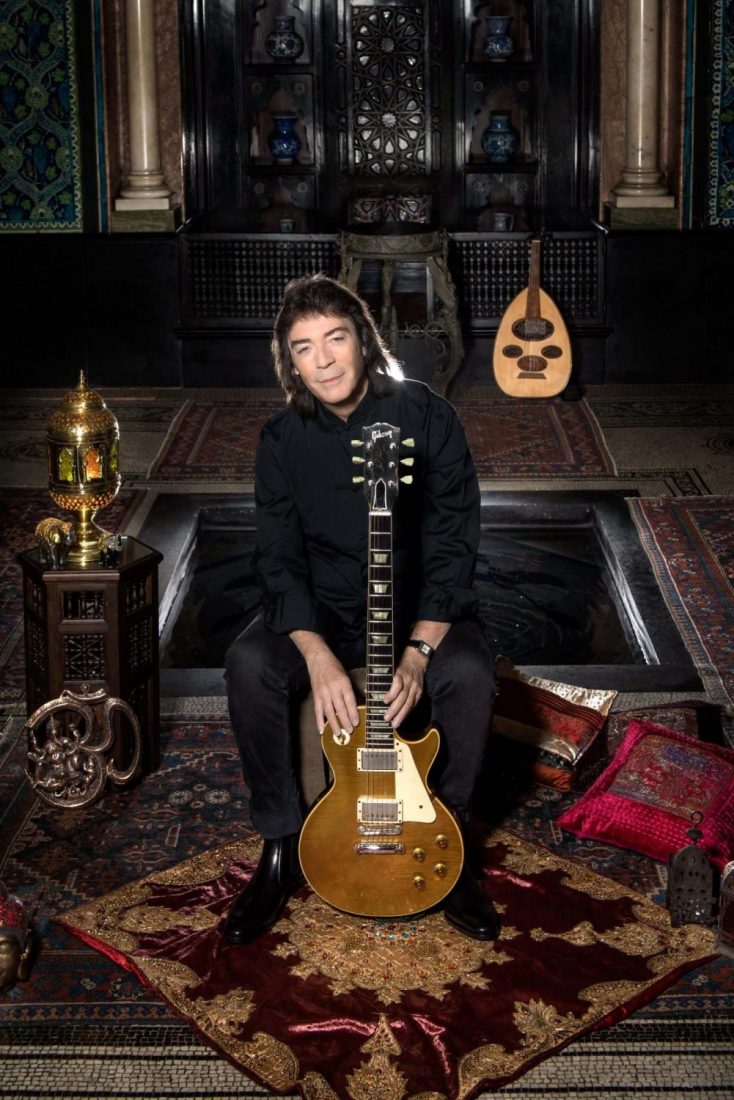
Steve Hackett first came into prominence as the guitarist of the legendary rock band Genesis, whom he played with until 1977. Prior to leaving Genesis, Steve had released his first solo album, Voyage Of The Acolyte, in 1975. His solo career has continued steadily ever since, aside from the mid-1980s, when Steve co-founded the short-lived supergroup GTR. His newest release is The Night Siren, which will hit stores next month via Inside Out Music.
In support of The Night Siren, Steve is embarking on a on a U.S. tour which includes a Feb. 23 stop at Westbury’s NYCB Theater and a Feb. 25 gig at Manhattan’s PlayStation Theater. Downtown caught up with Steve by phone to learn more about The Night Siren, his early days in New York, and what lies ahead for him. More on all things Steve Hackett can be found at www.hackettsongs.com.
I was wondering what you remember about the first time you ever played in New York City.
Steve Hackett: Wow, god, the first time in New York City. I think I remember we played Avery Fisher Hall, and I believe Leonard Bernstein was rehearsing with the New York Philharmonic, I think it was. We were supposed to get in earlier to set up everything and I think rehearsal overran for him. “Great, Leonard Bernstein”…But it did mean things were a bit fraught for us, and one of the other bands that were at the show, Strings & Things, I think they had a problem with an amp, so I lent them mine. Our road manager said, “I don’t wanna worry you, Steve, but your amp’s just blown up.” (laughs) This is the big New York debut and my amp’s just blown up and I already had flu and I was dead nervous about screwing up in New York, so I think I was pretty damn nervous, as was the rest of the band. So I think we didn’t turn in the greatest of performances, but it was to be one of many over time and luckily New York did eventually get what with Genesis was all about. I’ve had wonderful times in New York ever since.
When was the first time on tour or for travel that you actually got to relax in New York and not just play a gig and leave. Do you remember that?
SH: Oh goodness me. Well, I think funny enough the first time through, we couldn’t get that many shows and then we were in New York for a long time. In fact I think to recall that we spent time on both coasts. You’ve got to remember it’s a young struggling band and there aren’t too many things…so I did get to sit quite a bit in New York at that time. Of course one of the early times we were through we heard that John Lennon had said that we were one of the bands he was listening to. I think he was talking to Scott Muni at WNEW, so that was hugely important for us as a young struggling band…But we still couldn’t get a gig anyway, it didn’t make any difference.
For your upcoming show in New York at the PlayStation Theater. What’s to be expected? Are you playing songs from throughout your career and catalog?
SH: Well, what I do these days is I play two sets. It’s a bit like there’s two bands in one. I play a set of solo material and I will pick stuff from the new album, and then we take a break then we come back and we do Genesis stuff…I think I’m doing at least one track from each of the Genesis albums that I made…
So that means nothing from GTR?
SH: Nothing from GTR so far. People have been saying that to me, “Why don’t you do ‘When The Heart Rules The Mind?” So down the line I will probably do that, you know.
So you’ll be playing some material from The Night Siren, which comes out a month or so after your show in New York…
SH: Yeah. Funny enough we just had the first band rehearsal today, and we were rehearsed two of the songs from that album. I have to say, even though we didn’t know every note and it was not perfect, this run for today, even though we’ve all been in individual rehearsal separately, it still sounded extraordinarily-powerful. I’m thrilled that it makes very good live material, that also was the test.
Do you have a favorite song to play live? I ask that because some people had 40 and 50 year careers may say, “You know every song is like my child, I don’t have a favorite.” Other people might go, “Nope, I love my new album…”
SH: Well, I think all of them. Yeah, I think I’m probably in a more…I wouldn’t do these numbers if I did not love them, I think they’ve all got something to say. I think they are all beautiful in one way or another. Some of them are more bombast, some of them more lyrical, but I love them all, you know they’re all my grandchildren. (laughs)
How do you feel about looking at being looked at as one of the forefathers of prog-rock? Is that a tag that you’re comfortable with?
SH: I don’t mind that. I think that whatever we were doing back in the day, mixing genres…practically every style was welcome, including comedy and pantomime, as well as the most serious thing. I’m happy to have been a part of that, we didn’t call it “progressive” at the time…That’s a retrospective catch-all phrase, because we feel that it was okay to do a three-minute single like “I Know What I Like,” and that would be considered to be probably bad form by most progressive bands. But we did the long-form stuff, we did the short stuff, we like to mix it. There were a lot of different include, there was big band, there was classical music, there was aspects of Jazz, there was certainly rock and pop…
Do you listen to any prog-rock in general these days? Are there any bands that you’re interested in?
SH: I think the funny thing is that once a band reaches a certain stature, people no longer say they are progressive. People don’t talk about The Beatles as a progressive band, yet they set the bar for the rest of us. What they were doing was all of a sudden Magical Mystery Tour, you have those aspects of progressive stuff, of course Abbey Road with all those things linked together, vignettes, it’s very progressive. I think there was a progressive aspect that Queen had, and Muse, and Elbow, with their diverse work. You’re doing an excerpt of Chopin and then you’re doing something else that sounds like Prince, like Muse do, that sounds progressive to me.
Is there anything that you haven’t yet accomplished in your career, you’re still hoping to?
SH: Yeah, I haven’t made it as an actor in Hollywood yet. Just kidding. (laughs) I think maybe film work, and I don’t mean acting. I mean music for film, or rather I was hoping that something that I’d done already might be considered by a filmmaker to be dramatic. Something like “El Niño” for instance, off the new Night Siren album…
The film world has been a huge influence for me and many many musicians. I would say Genesis, some of the Disney stuff, the effect on The Beatles…Although I’ve done stuff for film and had a lot of stuff used with documentaries and what have you. Yeah, it’d be lovely to go and score something for sci-fi. That genre, I loved it when I was kid and I still love it now of course, I never outgrow it. I still go and have an imaginary spaceship out the back, and it goes like this… (sings an melody) (laughs) You know that kind of feeling.
Music, I think, has that ability to move you both emotionally and physically, and you feel as if your feet is off the ground. That’s what music does for me. I love slow melodies and fast moving rhythms underneath slow melodies, which I think allow the possibility of iconic melody.
That’s very interesting. So you know if I can put words in your mouth, you revisit Genesis when you perform live, but you are in no way hoping for a reunion. Like that chapter of your life is behind you you’re kind of saying.
SH: I think that it’s extremely unlikely that there will be a Genesis reunion. We’ve tried to put together the band before. There seems to be insufficient common ground or enough, you know, goodwill to be able to do it.
Sure…
SH: I think I have always been up for it, I certainly wouldn’t stand in the way of it, but I suspect the perception is different from fans to the way the band functions. I know that they’re comfortable with the three-piece, or certainly were, you know when you’ve got a five man team, it’s different. But you know it might happen one day, but somehow I doubt it. I think the power play aspect is what runs parallel with it and the thing is I honor the music. I’m free of the politics when I do this stuff. I’m not trying to knock anyone off their perch, I’m not a competitive musician. I’m trying to do music for the people who were disenfranchised and feel that way, feel that Genesis was something precious and personal at first when it was perhaps more experimental, and I do love some of those early albums. I think I think they have some extraordinary material and some great chord sequences as well.
So when you’re not busy with music or sci-fi, what do you like to do for fun?
SH: I like to travel. I’ve just come back from Cambodia and Thailand on a tour of temples and seeing the bridge over the River Kwai and taking a train over it and seeing living history really. Some of the monumental achievements of the ancients…The temple complex in Cambodia was absolutely extraordinary. There were three temples that look like they’re straight out of either the Tomb Raider or Indiana Jones, and it’s glorious stuff in the heart of the jungle. It’s true adventure. So I love doing that, my wife loves to travel. That’s what we do, we do that and we often pick up instruments in these places and make friends everywhere and we get influenced by everywhere that we visit and everyone we speak to.
So finally Steve, any last word for the kids?
SH: For the kids, you say?
Yes.
SH: My god, I think anyone who’s a musician is a kid. There’s only one lesson, which is to love it, because if you love it that will get you over all the difficulties. Don’t let anyone tell you that you cannot make a living at music, you will if you are passionate enough.
Without a doubt, The Beatles are one of the most iconic bands in rock and roll history. Over the years, much has been said and written about them, and the mythology behind their legendary status inspired director Ron Howard to begin work on The Beatles: Eight Days A Week – The Touring Years, a film that focuses on The Beatles’ touring years from 1962 to 1966.
Following them from their time as fledglings performing in The Cavern Club all the way through their final, monumental concert in San Francisco’s Candlestick Park, The Beatles: Eight Days A Week – The Touring Years gives Fab Four fans a peek behind the scenes, as well as a front row seat to their most memorable shows. The film will premiere in theaters on Sept. 15 before being released on the streaming service Hulu on Sept. 17.
Morrison Hotel Gallery will celebrate the film release with Eight Days A Week: The Beatles in Photographs, an exhibit and sale of images Sept. 12 through 19 featuring photographers who worked closely with the Beatles over the touring years. Many of these images are also included in the film.