Categories
Design Uncategorized

Interior Designer Alan Tanksley Reinvisions Luxury, Project by Project


New York-based interior designer Alan Tanksley, a leading practitioner in residential design, has drawn acclaim for his versatility and attention to detail. Tanksley’s architectural approach to interior space planning combined with an organic approach to the comforts of every day living, is renowned. Below, Tanksley shares some of his design inspiration, project loves, and what he considers luxury.

Design by Alan Tanksley. Interior designer, new york based.
Design by Alan Tanksley.

Downtown: How would you describe your design style? 

Alan Tanksley: My interiors reenvision luxury; luxury not as a remote idea, but as a quality and forethought imbued into a space. I believe in creating environments that enhance one’s life experience with an organic approach to how people really live every day. I’m not interested in creating a stage set, but rather places for people to live with comfort, function, and beauty all having equal consideration. I often draw from a transitional design aesthetic.

Downtown: Can you pinpoint the moment or period of time when your first knew you were a designer? What inspired it, brought it on, etc.?

Design by Alan Tanksley. Interior designer, new york based.
Design by Alan Tanksley.

AT: Throughout my youth I thought that architecture was my future. After two years studying the field, I felt disillusioned and adrift. Only when I looked into the interior architecture and design courses did I find my true love and unearth a natural talent. It was a field I had not even considered prior to this.

Downtown: What has been one of your favorite projects to date and why?

AT: A favorite project is a summer house we’ve just completed in Little Compton, Rhode Island. This is our fourth project for the same family. The project is especially wonderful as we’ve become close over the years, enough so that we can collaborate in shorthand the way that partners in any good relationship do.

Downtown: I am obsessed with the foyer in your Urban Manhattan project. Tell us about the mix of materials, accessories, cold and warm designs that made this room so striking!

Design by interior designer Alan Tanksley.
Design by Alan Tanksley.

AT: Given my background in traditional design, it would have been an easy task to follow the given cues of a black-and-white marble floor and the corresponding traditional details by producing a complementary classic room. Instead, the client’s casual lifestyle called for a more eclectic approach where a mixture of furniture styles and periods were both accommodating to the busy family’s comings and goings, and reflective of their desire to express something fresh and modern.

Downtown: What do you most love about commercial work? About residential? If you had to pick one, which would you choose and why!

AT: I have been fortunate to work primarily on the high-end side of residential work for the majority of my career. In fact, my commercial work thus far has mostly been with developers of residential condominiums where I have advised on floorplans, chosen materials, fixtures, etc. and designed all public areas such as lobbies and amenity spaces. My experience in designing for how people live at home informs my work as I design for people in intimate public spaces.

 Design by Alan Tanksley.
Design by Alan Tanksley.

Downtown: Tell us about your approach to the River house Condominium. It is the epitome of chic!

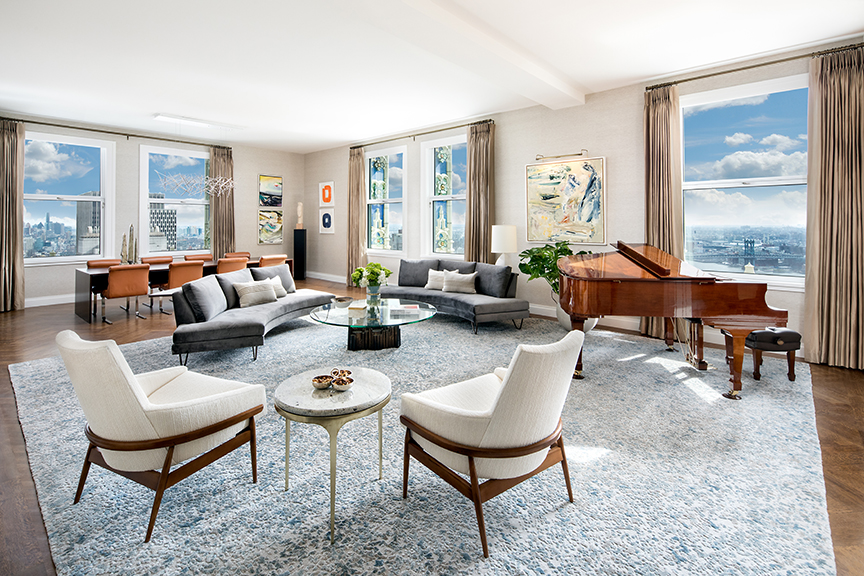
AT: River House was a unique opportunity due to its open skyline views, abundant southern light, and the peaceful movement of the Hudson River. The room that we positioned the work space in sits like the prow of a ship making its way to the distant city with the open living space giving the feeling of a grand state room on a luxury liner.

Downtown: What is a good rule of thumb (it can be your own) that you would offer to fellow designers trying to make their mark in the commercial world. How do you keep the design elegant yet uniquely chic? 

AT: Listen, take notes, research similar projects, ask questions without hesitation (even if you feel you’re expected to already have the answers), and speak with assurance, but not arrogance. As far as elegant and chic, look to other designers past and present. Study how they’ve achieved exceptional results. The goal isn’t to copy, but to find inspiration for the project at hand.

 Design by Alan Tanksley.
Design by Alan Tanksley.

Downtown: Tell us about your furniture designs. When did this come about and why? Where can our readers purchase your pieces? 

AT: Most of the furniture I’ve designed has been specific to projects and has not been offered publicly. However, the development of my “Genesis” line of acrylic tables for Plexi-Craft has been very well received, as have my tables designed for Desiron. Both showrooms are located at 200 Lexington Avenue.

Downtown: What have some of your favorite project designs been and why? 

AT: My favorite projects are those for clients who understand that they play a very important role in the success of their project through open and timely communication, collaborate with and share ideas fluidly, and understand the complex and imperfect processes involved in both design and construction. With those things in place we’re set to create something uniquely suited to their needs and aspirations.

 Design by Alan Tanksley.
Design by Alan Tanksley.

Downtown: If you could design your own dream home, where would it be and what would it look like?

AT: I am a New Yorker for life so my dream home would be located here, preferably (moderately) high up in a south facing central location set back with terraces on three sides. The interior look and feel would be similar to what I’ve designed for many of my clients and the exterior would finally afford the opportunity to have the dog I’ve yet to own in the city.

Downtown: What are some of your go-to furniture sources?

AT: The industry has evolved greatly due to worldwide internet access. We rely on all the various platforms when resourcing projects. That said, there’s nothing like going out and seeing finding things first hand, up close and personally so to speak. Shopping the trade resources at the Design and Decoration Building and 200 Lexington are common resources, as are the wonderful antique shops located around New York City. The hunt for just the right piece, or pieces, remains the great thrill when designing something remarkable

 Design by Alan Tanksley.
Design by Alan Tanksley.


Downtown: What are you working on now?

AT: I have a project in the Woolworth Tower Residences, where I was originally commissioned by the developers, Alchemy Properties and Sotheby’s International Real Estate, to create the premiere model apartment. It’s a sensational apartment with city views that can’t be beat. We’re completing a summer house in Little Compton, Rhode Island, a glamorous classic apartment overlooking the Hudson River, and several others in the region.

Categories
Design Featured

Scott Group Studio Launches Escala, a Six-Piece Collection Inspired by Nature

Jennifer Kirchgessner, Product Director of luxury carpet company Scott Group Studio, sat down with us prior to the launch of Escala—a striking six-piece collection inspired by the colors and forms in nature. Each design is hand-tufted by artisans in the company’s Grand Rapids, Michigan factory.

Agata rug with silk from Scott Group.
Agata.

Downtown: What inspired your new six-piece collection, Escala?

Jennifer Kirchgessner: The Escala collection was inspired by looking at macro and micro views of nature. Designs like Agata, Arveda and Akachi are inspired from patterns created looking at the landscape from an aerial viewpoint. We’ve complemented those fluid patterns with geometric patterns like Claes and Mako. Even the structured patterns in the collection have a softness and asymmetry to them that make them more interesting.

DT: What made you decide to only introduce six patterns in this particular collection?

JK: We typically release six patterns in a collection. When developing a collection, we like to think about how the designs would live together in an interior. What pattern would work as a focal point in a living space, dining room, or stair runner, and how would these patterns and colors complement one another installed in adjacent spaces.

Akachi rug from Scott Group.
Akachi.

DT: How does the color palette emulate nature?

JK: I am always amazed by the vibrancy and variety of color in nature. Especially here in the Midwest when we emerge from winter into spring. What I love about the color palette in the Escala collection are the warm hues of burnt sienna, and goldenrod, along with earthy greens. The palette provides the vibrancy of using color, but because the colors are drawn from nature, they behave as neutrals in an interior environment. They also pair beautifully with more traditional neutrals such as shades of grey and taupe used in a lot of interiors.

Claes rug from Scott Group.
Claes.

Downtown: What are the rugs made of and where are they made?

JK: The rugs are made here at our headquarters and manufacturing facility in Grand Rapids, Michigan. We are celebrating our 50-year anniversary this year and are very proud to be producing a product of this type and quality here in Michigan. The designs are a combination of fiber types, but primarily New Zealand wool, worsted Merino wool, and Mulberry silk. We are adamant about using the highest quality natural materials in our products.

Downtown: What customization options will be available?

JK: Everything we produce is 100% custom. Our collections often serve as inspiration and a starting point for a designer. They may love a pattern that we have developed and want to use it as shown for their project.  They can change any element of the design from scale, color, and construction or start something completely from scratch. We have a team of 14 designers who work hand-in-hand with the salesperson and customer to provide a unique design solution customized specifically for the interior.

Arveda rug from Scott Group.
Arveda.

DT: What is your favorite pattern and why?

JK: Agata is one of my favorite patterns from the collection. I love the combination of pile heights, materials, and colors. There is a pop of turquoise green in the raised loop of the pattern that forms a lovely detail.

DT: When will the collection be available and where can our readers find the rugs?

JK: The collection can be purchased through our showrooms, including one in NYC at the D&D Building. Our customer service reps are also happy to help place orders as well and can be contacted via our website.

DT: What is next for Scott Group Studio?

JK: One of the most exciting projects on the horizon is a collection we are working on with a designer from New York that will be launched at the end of the year. It’s been a really fun collaboration and it took us in a design direction that exceeded our expectations. The results have been outstanding. Stay tuned!

Mako rug from Scott Group.
Mako.
Vidya rug from Scott Group.
Vidya.
Categories
Design Featured

Get a Glimpse into the World of Emily Summers with “Distinctly Modern Interiors”

Emily Summers new book from Rizzoli.
© 2019 Distinctly Modern Interiors by Emily Summers, Rizzoli New York.

Distinctly Modern Interiors by Emily Summers with Marc Kristal is a beautiful body of work that highlights Summers’ interiors over the years. With an engaging foreword by Pamela Fiori, who first fell in love with the designer’s work on a trip to Dallas during her tenure as editor-in-chief of Town & Country, the book is a must read for design lovers of all styles, modernists, of course, included.  

A Dallas home designed by Emily Summers.

From Summers’ renovation of her Dallas home, Touchstone House, designed by MIT-trained architect Robert Johnson Perry in 1965, to her stunning homes in Colorado Springs and Palm Springs, Distinctly Modern Interiors offers Summers’ fans a glimpse into how she lives. And that’s not all, the book is a fascinating read on how Summers arrived where she is now. From an early life growing up in the Midwest with a mother that wielded an astute decorating hand, the designer voraciously studied all things art, architecture, and interiors, and traveled as much as possible. Her early career alone included a co-owned firm specializing in commercial work, an award for a desk she co-designed for Dunbar, three years as the Director of Exhibitions and Funding for the Dallas Museum of Art, and a role on the Washington-based Advisory Council for Historic Preservation—a position for which she was directly recruited to by President George W. Bush.

Today, Emily Summers Design Associates encompasses a team of architects, designers, and art consultants, and consistently works with artists and creatives of all types. The interiors in this book reflect a well-curated eye, a love of color, nature, biophilic design, and above all, a love of collaborating with each and every client.

Categories
Design Featured

Preview Osborne & Little’s 2019 Spring Collections

Textiles from Osborne & Little
Motown by Margo Selby.

Despite the frigid weather, with January comes the anticipation of all the design industry’s coming collection launches. A longtime favorite for homeowners and designers alike, Osborne & Little will launch their Spring 2019 collections on February 18th, with the exciting addition of a special new collection by textile artist, Margo Selby. The designer, who is known for her contemporary woven designs which include fabrics, rugs, and accessories produced by specialist mills and artisan weavers, does not disappoint with Memphis.

Selby’s new launch follows her aptly-named inaugural Ragtime collection for the brand, which abstractly pays tribute to the ragged rhythm of the musical style. Memphis, a bolder, brighter collection that references the musicians of the 50s and 60s, includes six striking patterns in a vibrant color palette (think cherry, teal, jade, and fuchsia), that enhances the luxuriousness of the cut velvet and wool fabrics. From Marvin, a tessellating pattern, to Motown, a geometric jacquard with perfectly contrasting colors, Selby’s collection has a lot of staying power.

Osborne & Little
Glade Wallpaper from Osborne & Little’s Folium Collection.

Osborne & Little textiles
Margo Selby’s Memphis Collection for Osborne & Little.


Not to be outdone, Osborne & Little’s new in-house Spring 2019 collections include Morocco-inspired embroideries, rich velvets, and botanically-themed decorative wallpapers that also incorporate large-scale prints. Albemarle, a collection of tailored woven fabrics inspired by the streets, arcades, and squares of Mayfair, an upmarket area in London’s West End, adds a cozy, winter-inspired touch. Ariadne Velvets, a very different yet surprisingly chic collection of velvet textiles, features digitally-printed crosshatch brushstrokes in varying colors. Meanwhile, Folium, which consists of mostly botanical and tile-inspired wallpapers, lays claim to Tiger Leaf, a pattern that recalls the colors of Palm Springs, and the stunning Faenza Tile. The former references vintage tile-work and is edged with distressed gold leaf on either a stone, blue, or mint colorway. While these are just a few of many eye-catching new designs set to launch next month, the varying aesthetics offer wonderful design flexibility.


Shown: Tiger Leaf wallpaper; Chair and pillows upholstered in the Albermarle collection of textiles.


Categories
Design Featured

Delving into Artistic Tile with Founder Nancy Epstein

Marble mosaics.

Sail Fete, a polished stone mosaic.

Artistic Tile was founded in 1987 by its CEO Nancy Epstein. In the more than 30 years the company has been in business, they have flipped the paradigm of how we view and use tiles. From natural stones, to hard-to-find marbles, and modern classic mosaics, every style of design is within reach at Artistic Tile.

artistic tile
Triangolo.

Below, Nancy Epstein shares behind-the-scenes insight on some of the most beautiful collections past and present and so much more.

DOWNTOWN: We love that color is back! What are some of your favorite new trends with regard to color and tiles?

Nancy Epstein, CEO and Founder of Artistic Tile: Although I don’t advocate following the “trends” in the tile & stone industry, I am happy to see the paradigm shifting, and that designers and homeowners are welcoming colored tile back into their designs. Using colorful stone in interiors is actually nothing new; it’s present throughout some of the world’s most historic and prestigious architecture. When I saw Cipollino marble in my bathroom at the newly renovated Gritti Palace, I was really excited. I hadn’t seen Cipollino used for years. It took a while to us to find it, but it was worth the effort. We have just finished a mosaic blend of Cipollino, Lilac, and Calacatta Rosa, that looks so fresh—it reminds me of gin and tonic on a warm summer day, so delicious and refreshing.

Mosaic marbles.
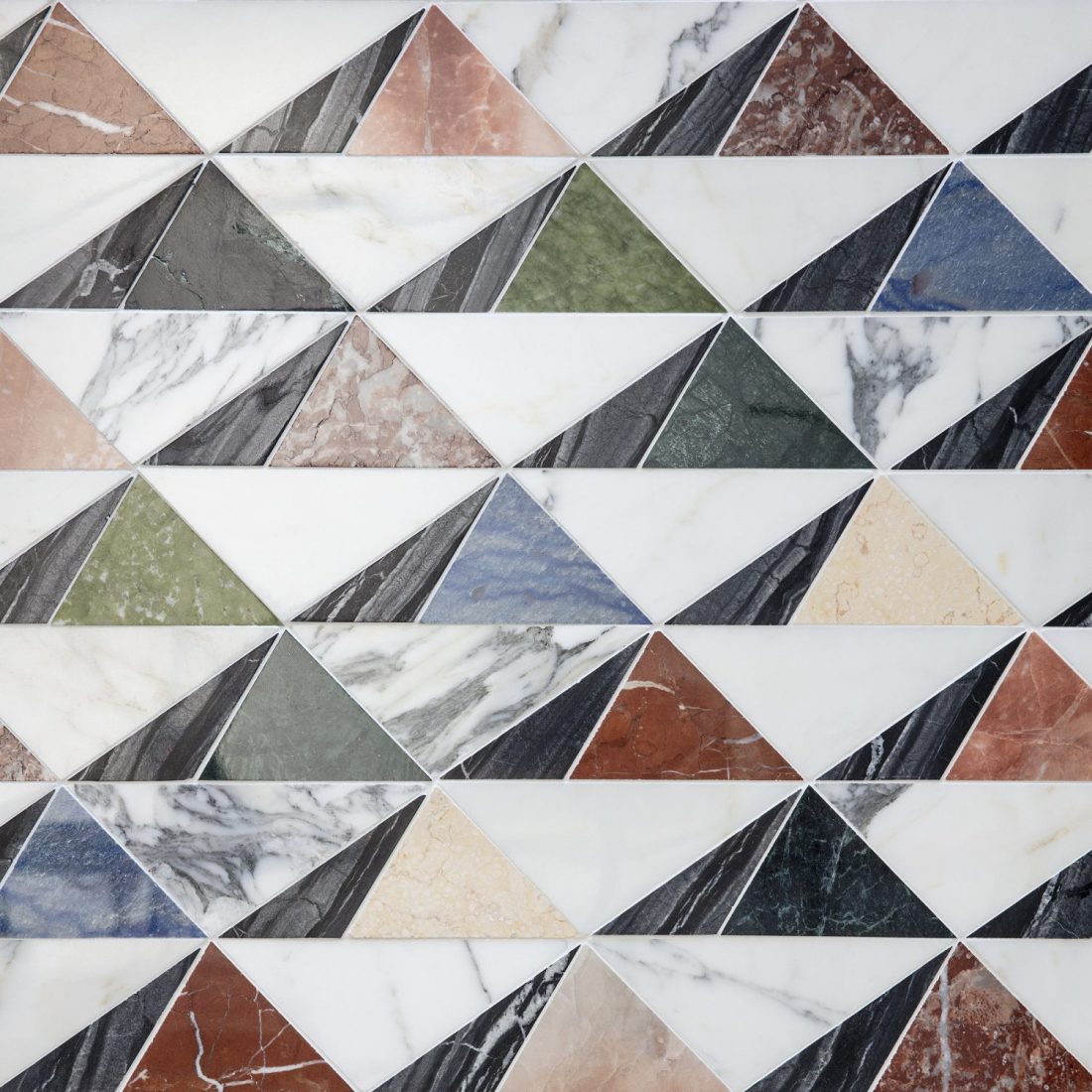
Weston reintroduces the missing color in geometric mosaics: Rosso Francia, Cipollino, and Rosa Portogall marbles.

DOWNTOWN: In terms of patterns, are there certain design periods you are seeing a resurgence of? Which ones if so, and what do you love about them?

Nancy Epstein: I am not seeing an emergence of any periods in particular. We have always been drawn to Art Deco and Nouveau for organic shapes, and the Cosmati style, as seen on the floors in San Marco for Geometrics, along with the patterns of the ancient Romans.

DOWNTOWN: Tell me about Grand Gatsby (below)! We are obsessed with how the completely cool this design concept is—the tiles elevate the space.

Nancy Epstein: Design: Our pattern Grand Gatsby is actually inspired by an Art Nouveau-style pot I saw in a French museum over ten years ago, that I thought would somehow or another work out into a beautiful tile. I took photos of it (I accumulate a lot of pictures during my travels), and every year or so I revisit my collection of photos, each time with a new perspective. The Parisian pot was one reference I kept coming back to.

art deco tiles
The Grand Gatsby mosaic features dramatic geometry and an Art Deco influence.

Color: The reason we’re using multiple colors is because we really like the fact that these colors have come back into our lives, but in this case, the colors are used as accents, rooted in a very traditional Arabescato marble. This way, the pattern has color, but it’s neutral at the same time. And since it has multiple accent colors, you’re not locked into using a single color for the rest of your space.

DOWNTOWN: What is one of your current favorite patterns and why?

Nancy Epstein: Our Sinuous mosaic—it’s classic, it’s forever, it’s stunning, it’s beautiful, it’s decorative, it’s field, it’s all those things wrapped into one. You can never have too much of it. It’s on my bedroom, bathroom and home office floors. I love the way it glimmers in the sunlight. And I love how easy it is to keep clean. I enjoy owning my products, rather than them owning me. My busy schedule and lifestyle of constantly entertaining requires me to have low maintenance products. I never want to tell my grandchildren to be careful in my home; I want them to be able to run around and enjoy themselves.

marble mosaics
Space designed by Christopher Martorana in concert with Artistic Tile architectural rep, Alejandro Mejia.

DOWNTOWN: What would you like homeowners and designers to understand about how to transform a room with tiles?

Nancy Epstein: Tile can do more than just transform a room—it can transform you and your family’s lives and overall well-being. Choosing tile over other surface materials has many benefits that not every homeowner is aware of. First and foremost, natural stone tile endows a space with a timeless aesthetic that can be enjoyed for generations. You won’t have to worry about natural stone fading out of fashion or needing an expensive replacement every 15 to 20 years. Your stone will last forever, in fact, the more it is used, the more beautiful its patina becomes.

lavender marble mosaics
Artistic Tile.

It also promotes a healthier home. Because tile is anti-microbial, it’s more hygienic than other surface materials like carpet, which can trap allergens, smoke, and other pollutants. Tile and well-sealed stone can prevent wet areas from developing mold or mildew, and in dry areas, it can protect floors and counters from life’s inevitable spills. Many don’t consider using tile on their ceilings, but doing so can prevent mold, as well as beautify the space with a look that recalls the elegant styling of castles and cathedrals.

Tile is also low maintenance: Because a sealed tile surface keeps water, soap, and other liquids close to the surface, it facilitates in easy clean-up.

Artistic Tile.
Primal Caiman Palm tiles.

When planning a design or remodel, I’ve always said: design for longevity. Choose tile that you resonate with and that you’re sure you’re going to love for the next twenty years or more, because that’s at least how long it should last you. The installation of tile and stone is expensive. Install what you love. Design for inheritability.

Choose tile that creates the atmosphere you want to come home to, and that your family and guests can enjoy. It should be expressive of your taste and lifestyle, rather than what’s trending at the time. If you buy tile solely based on what’s popular now, you may regret it five years down the road, when the style starts to look dated.

DOWNTOWN: What is one of the most unusual yet stunning application of tiles you have ever encountered?

Nancy Epstein: Aesthetically, the mosaics of Victor Horta sing to my heart. I especially love the Tassels Hotel in Brussels.

Malachite tiles from Artistic Tile.
Triangulam Malachite Tiles. Design by Deborah Walker at SHM architects and Snelling Homes
Photo by Costa Christ Media.

But when it comes to application, although the tiles used by Gustovino are not so “special”, his use of tiles on vaulted ceilings is outrageously gorgeous.

DOWNTOWN: We love how fashion influences design and vice versa. Are there any current collections you can recall that were heavily influenced by the runway. If so, which ones?

Nancy Epstein: I don’t recall any of our collections that were influenced by the runway. But I can recall the runway being influenced by our collections.

Jazz Glass Treble Custom Blend.

DOWNTOWN: How long ago did you found Artistic Tile? How do you manage to keep world of tile so interesting and fresh?

Artistic Tile: Artistic Tile was founded in 1987. It was a business venture that first began in a small cabinetry showroom in Tenafly, N.J., which Founder and CEO, Nancy Epstein, transformed into a larger Kitchen & Bath business by introducing decorative plumbing, and later, tile, and natural stone. Over the course of 30 years, Artistic Tile grew to include 8 branded retail showrooms in major metro areas across the country, a 25,000-square-foot slab gallery just outside of NYC, and a network of over 200 dealers (retail partners) nationwide. Today, Nancy Epstein is still the company’s CEO, and is joined by her sons, Vice President, Zachary Epstein, and VP of Marketing, Michael Epstein; and by her cousins, Joshua Levinson, Wholesale President, and Lauren Cherkas, Retail President.

Sail Fete Artistic Tile.
Artistic Tile.

We’re driven by passion and a purpose, to make the world a more beautiful place, with innovative luxury tile, and to give back to causes we deeply care about. Our company’s core value of generosity is expressed in our philanthropic endeavors and donations to charitable organizations worldwide.

Beyond our drive, I’ve always loved world history, and I relish traveling the world, exploring historic sites and discovering skilled local artisans. Most of our proprietary patterns are born from these travels, where I find inspiration in everything from grandiose palaces to the remaining decorative details of ancient ruins. But we don’t exclusively look for inspiration in architecture —we also look to fabric, jewelry, and emerging motifs. In fact, we look to everything but tile to inspire our tile designs!

DOWNTOWN: What would be your best guess as to how many tile collections Artist Tile carries?

Nancy Epstein: About 50 collections across all materials, however, the majority of our products aren’t marketed as collections. They’re sold as individual patterns available in multiple colorways.

Blue ombre tiles.
Artistic Tile.

DOWNTOWN: If you could convince a client to go big with tile in one spot in their home, where would it be and why?

Nancy Epstein: It really depends on the client’s lifestyle, their values, and where they’ll spend the most time. For most, the most important place to invest in is the master bedroom and bathroom, as they are the most personal, they are spaces that you will use every day, and where you will spend time renewing and getting ready in. The design should be flawlessly efficient, with ample space and storage for products. The surfaces should all be tiled so that they’re durable, safe, and easy to keep clean in a room that will endure moisture, humidity, and hot hair appliances. The master bed and bath are the best rooms in the home to install a decorative mosaic on the floor, which can dramatically beautify and elevate the space.

DOWNTOWN: What can homeowners and designers expect from Artistic Tile?

Artistic Tile
Space designed by Komel Saed of Studio Eagle and Spaces Designed Interior Design Studio
in concert with Artistic Tile architectural rep, Alejandro Mejia. Photo by Mikiko Kikuyama.

Nancy Epstein: High quality. Products of permanence. Innovative designs. Highly customizable products. Timeless elegance rooted in antiquity. Knowledgeable and friendly design- minded sales staff.

DOWNTOWN: If you could outfit any room in your house with one tile, what would it be, which room would it be, and where would you place the tile?

Nancy Epstein: I already have, my master bedroom, bathroom, and home office, but if I were to add more, I would turn my entire living room floor into tile, and I would use our Horta pattern. The ceiling in my living room already has dropped onyx panels, supported by Mahogany beams, and is lit from above. However, removing my husband’s Czech glass  bar to replace our floors is an obstacle that I am not likely to able to surpass.


Field Tile from Artistic Tile.
Capital Denim Blue.


Categories
Events

Trip.com’s TripPicks This Week: Tuesday, Feb. 21 – Monday, Feb. 27

Trip.com is an innovative planning tool that tailors recommendations for places to stay, eat and play to your specific tastes. It also allows you to share your great experiences with people who have the same interests as you; people in your “tribes.”

Trip.com’s TripPicks This Week feature empowers you to discover and take advantage of great events, openings and exhibits throughout the city each week.

Here are some exciting events and sites to check out this week in Downtown New York, courtesy of Trip.com. Visit the Trip.com site or download the app for more upcoming events.

1. Tripped Out Interiors by Toiletpaper
Cadillac House (South Village)
Monday through Friday from 8:00 AM to 7:00 PM; Saturday through Sunday from 10:00 AM through 5:00 PM (through Apr. 12)

Visionaire presents a tripped out immersive exhibition by the magazine Toiletpaper at Cadillac House. Hard to describe the surreal interiors, but we’ll leave you with these highlights — alligator, butt rug, popcorn walls and ceiling, all of which are totally touchable. FREE!

2. New Film Screening Series
Brookfield Place (Battery Park)
Wednesday, Feb. 22 at 7:00 PM

The new indoor screening series, Pictures Under The Palms At Brookfield Place, features “comfy seats, free popcorn and a pre-show DJ set by Tim Martell at 5:30 PM.” The series kicks off with James Gunn’s Guardians Of The Galaxy. FREE!

3. Battle of the Belgians: Trappist Edition
Jimmy’s No. 43 (East Village)
Saturday, Feb. 25 from 12:00 PM to 3:00 PM

For this year’s Battle Of The Belgians, the organizers searched high and low to bring beer lovers a special selection of trappist beer. Sample over 20 beers and feast on a whole roasted hog, vegetarian options are available. $65.

Photo: Ben30/Flickr
Photo: Ben30/Flickr

4. New Spanish Tapas Bar
Lamano (Chelsea)
Monday to Thursday 5:00 PM through 11:00 PM; Friday 5:00 PM through 12:00 AM; Saturday 10:00 AM through 12:00 AM; Sunday 10:00 AM through 11:00 PM

New Spanish tapas bar in Chelsea is the perfect stop after a day of gallery hopping or shopping. Cozy up to a glass of Spanish wine and comfort tapas like the Pulpo Murcia, Tortilja or Pan con Tomate y Queso.

https://www.youtube.com/watch?v=2Qr220iTS90

5. Canadian Nights at Dirt Candy
Dirt Candy (Lower East Side)
Mondays from 5:00 PM through 1:00 AM

Those of us pining for the friendly Canadian shores can head to Dirt Candy where every Monday night the space turns into The Great Canadian Beer Hall. Enjoy Canadian pastimes like watching hockey, drinking Bloody Caesars and eating poutine. CIT0002E applications for Canadian citizenship will be available upon request.

https://www.youtube.com/watch?v=DIeDVaw0mRM

6. Cheers For A Good Cause
Check site for participating restaurants
Through February

If you are running out of good excuses to have a drink, stop by to the Meatpacking District where through the month of February $1 of select drinks will be donated to the ACLU. Now that’s a drink you can feel good about!