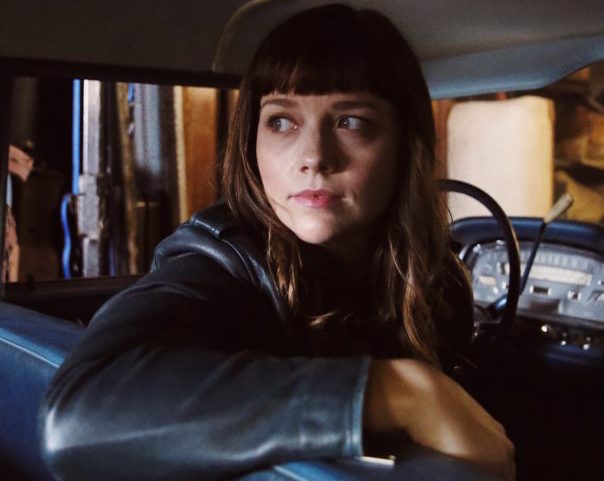
Lesley Barth has often wrestled with a sense of feeling like an outsider in her own life. The questions arising around the key to happiness; a sense of identity that deems outside validation unnecessary; the corporate grind. What is it all for, in the end? Barth’s hunger for a meaningful, mindful existence has resulted in her stellar sophomore album, Big Time Baby, all with a feminine 70s-pop sheen reminiscent of Jenny Lewis. Drawing frequent comparisons to songwriting greats such as Joni Mitchell, Carole King, and Fleetwood Mac, with a commanding and singular voice reminiscent of Natalie Merchant, Barth shapes these influences into a mixture of confessional songwriting, poetry, and wry observations about human nature. Big Time Baby is an album about feeling isolated, wearing masks, failing, rebuilding yourself, questioning societal norms, and the quicksand that is our modern non-stop notifications, performance-driven, social-media-optimized life.
“I learned that you can’t perform your life and live your life at the same time,” says Barth. “There are moments where performing is what’s required. But if we don’t take the mask off from time to time and connect to who we really are, I can tell you from experience that one day you will wake up and not recognize who you are and the life you’ve built for yourself. I hope this album gives people hope that, no matter how uncomfortable or out of place they feel in their life, they can change it by finding the courage to take off the mask and really get to know who they are underneath.”
Photo: Harish Pathak
Barth paired her artistry with Philadelphia producer Joe Michelini (American Trappist, River City Extension). The resulting three singles, all tinged with that 70s songwriter groove, speak to various stages of the process of redefining her life. Woman Looking Back at Me, a disco-flavored tune, seeks to understand negative self-talk and distance Barth from the critical voice in her head. The neon-cowboy-hued Nashville tries to understand better the internal demons that keep us away from the lives we want, and the catchy and empowering You Gotta Hand it to the Man is an indictment of the ubiquity of a patriarchal society and capitalism gone awry, with accompanying video criticizing the precariousness of the American health care system: “Almost all the savings I had for quitting my job got wiped away by healthcare costs, and I had to scramble.”
Lower East Side sees Barth immediately admitting to failure and a sense of unreadiness for the journey ahead.
“Making this album has been a rejection of the concept of ‘big time’ and ‘small time;’ living for other people’s validation is what got me into the whole mess of a life that felt foreign to me, so I wanted this album to be a declaration of who I am,” says Barth. She penned the album as her life became uprooted, and recorded it as she navigated the uncertainty of the structure of the gig economy.
“It’s an album for these uncertain times where many people feel their lives have been stripped to the bone, they’ve woken up from a daydream, and they weren’t sure what tomorrow would bring because that’s where I felt I was when I wrote it,” says Barth.
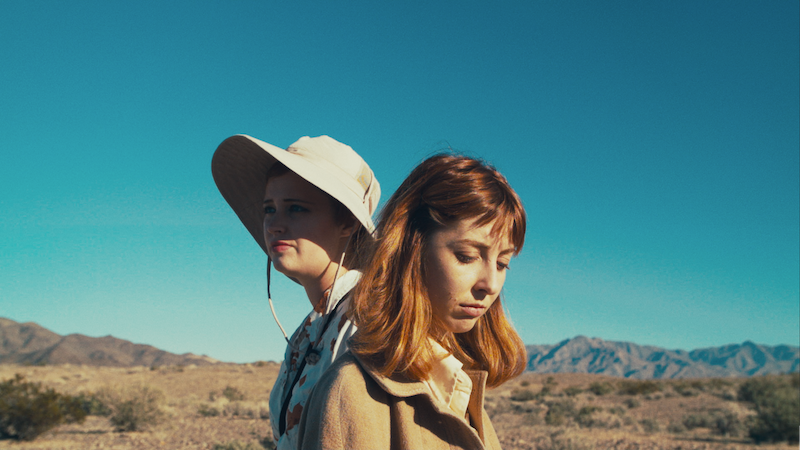
Lenae Day (left) and Wendy McColm (right) in Birds Without Feathers.
Neil gets Jo to pose for her instagram in Birds Without Feathers.
Cinema reflects an idealized world. Films tend to project an ease of existence that ignores the awkward parts of life: the pauses, the tangents, the missed cues and forced repetitions. Cool characters don’t stumble. Even “awkward” characters never mumble unless they’re supposed to. Characters are perfectly crafted to travel from the beginning of the story to the end.
Birds Without Feathers, the directorial debut of actress Wendy McColm, chooses instead to look those awkward moments in the face. In this black comedy, characters wrestle with stilted attempts at conversation to agonizing moments of aborted self-reflection. The realism with which McColm and co-writer Lenae Day pull this off is uncanny, and makes for some good laughs.
The film centers around the mostly-disconnected stories of six isolated individuals searching for meaning. There is Sam (William Gabriel Grier), a wanna-be comedian with stage fright. He briefly dates Janet AKA Neil (Wendy McColm), who dreams of Instagram stardom. Neil meets and befriends Jo (Lenae Day), a desert-dwelling identity thief with more wigs than cigarettes, whose ex, Daniel, (Cooper Oznowicz) is a self-help motivational speaker with no social or communication skills. She also meets Tom (Alexander Stasko), a Russian man trying to become an American cowboy and meet his idol Jeff Goldblum. Sam, on the other hand, runs into Marty (Sara Estefanos) a self-victimizing nurse at a home for the elderly.
Tom meets the wrong Jeff Goldblum in Birds Without Feathers.
If that sounds confusing, it can be. Feathers wanders between these stories, with the “friendship” between Neil and Jo being the most significant crossover. When they do cross over, they rarely share the space. Instead, the story leans into one perspective or the other. There is one scene, between Neil and Tom, which does feel shared, but it is perhaps the strangest in the film. I won’t say which it is, but I think you’ll know it when you see it.
Birds Without Feathers is, for the most part, a fascinating exploration of the awkwardness of searching for identity in isolation. The sometimes-absurd and very personal stories give us the opportunity to laugh at our own most awkward moments and insecurities–if we’re brave enough–without falling into the tired trope of “Black Mirror” social media critique. The meandering plotlines occasionally leave you feeling lost but, for the most part, hold together Feathers’ bizarre yet fun plot. I will be interested to see where McColm goes next.
Birds Without Feathers will be playing at the Roxy Theater for the next week. Get tickets here.
There’s a reason why New York City is dubbed “the greatest city in the world,” and we’re sure there’s more than one reason. But one amongst many is that it inspires people all over the world to flock to it, and never want to leave. A hub of culture and creativity, many musicians and artists have thrived in New York City, here are six of the indie-rock persuasion:
Responsible for the revival of post-punk garage rock, The Strokes released their debut album, Is This It, in 2001. The album was ranked 199 on Rolling Stone ’s 500 Greatest Albums of All Time. The band has released albums from labels such as RCA, Rough Trade, and Cult. Since 2001, the band has released four more albums: Room On Fire, First Impressions Of Earth, Angles, and Comedown Machine.
Formed during their days at Columbia University, Ezra Koenig, Rostam Batmanlij, Chris Tomson, and Chris Baio, got together in 2006 and totally decided that kids liked vampires and weekends. This Grammy-award winning indie rock band mixes Afro-tones and punk rock.
This indie rock band has recorded four studio albums: Fever To Tell, Show Your Bones, It’s Blitz!, and Mosquito. The group’s vocalist and pianist, Karen O was seen singing “The Moon Song” duet with Vampire Weekend’s frontman, Ezra Koenig in 2014’s Oscar Night.
Brooklyn-based MGMT, features Benjamin Goldwasser and Andrew VanWyngarden. The psychedelic rock duo formed back in 2004 when they cultivated their studies at Wesleyan University. The band is best known for their funky hits like, “Electric Feel” and “Kids.”
Carlos Dengler of Interpol, 2008. C/o Nick Thompson
Established in New York City, the rock band Interpol formed in 1997 when bandmates, Daniel Kessler and Greg Drudy met during their studies at New York University. Like The Strokes, Interpol was also one of the bands in responsibility for the 2000’s post-punk revival. The band’s critically acclaimed debut album, Turn on the Bright Lights(2002) made it to tenth position on the NME’s list of top albums in 2002.
Back in the ’90s, no one would have ever thought to put on the ugly Birkenstock. But ever since 2014, it’s on the foot of every fashion icon you can think of, from Alexa Chung to the Olsen twins. Céline‘s fur revival of it sure didn’t help slow down its mass popularity, either! You’ll see Birkenstocks donned by every seasoned Manhattanite, whether it’s in the subway, on the street, or on the line at Mud Coffee.
If you want to spice things up a little, here are some chic alternatives to the wide strapped shoe:
For the fifth consecutive year, downtown Manhattan will be holding its Lower East Side Film Festival, screening handfuls of brilliant films to kick off the summer. The festival will begin on June 11, and will run its course until June 21.
Debut feature film, Desert Cathedral, will be screened at the festival on Sunday, June 14 from 7:30 p.m. to 9:30 p.m.
AMC Loews Village 7 66 3rd Ave New York, NY, 10003
Courtesy of lesfilmfestival.com
Desert Cathedral features a distinguished cast: Lee Tergesen (Oz, Generation Kill, Monster) and Chaske Spencer (The Twilight Saga).
LESFF summates the film:
A broken real estate developer, played by Lee Tergesen, mysteriously disappears into the Southwest in 1992, leaving behind a series of VHS tapes to his employer and family. Without the aid of the police, his desperate wife hires a private investigator, played by Chaske Spencer, to locate his whereabouts and bring him home.
Downtown Magazine got to sit with Desert Cathedral‘s director and writer, Travis Gutiérrez Senger, to gain further insight toward the genesis of the up-and-coming feature.
So this is based on a true story, what about this real-life story inspired you to write your own cinematic version of it? What personal twists did you add, if you did?
I had heard the story and I thought that this idea of this sort of well-to-do suburban father driving around the Southwest, you know, essentially, escaping from all of his responsibilities and his day-to-day life in suburban America, was really fascinating and a sort of interesting image. He seems like a well-to-do normal person, but underneath it, there’s something really dark and terrible lurking. I thought that those were interesting ideas for a film and knowing that he had made these VHS tapes and sent them home, I just thought that was so strange that someone would actually do that. It was like in the early ’90s, he was having financial problems. I certainly felt like it was a story of a personal financial crisis, like in 2008–when I first got into the project was when I first really heard about it–I thought it was interesting just because in the early ’90s, you had the birth of the mcmansion. He was way over extended on his credit, no one was there to bail him out, and he had to deal firsthand with the challenges of being this all-American father. He’s being this proprietor, but at the same time, I feel like he was mixed up in this really interesting way.In terms of what twists I added to it, in the real life story, the guy disappears and he takes off from the Pacific Northwest to the Southwest, and his wife hires the PI. ‘
I really developed the PI character–who’s played by Chaske Spencer–Chaske did a great job. He’s a really talented, up-and-coming actor. He apparently got his break in the Twilight Series, and he’s been doing a lot of cool indie films. He lives in Williamsburg. He’s a really smart guy. I developed his character basically to complement the real story. There was a real PI who did pursue him and all of those things but I sort of developed that part of the story. And in terms of Peter’s character, I tried to be pretty true to what financial problems he was having, the nature of his mental demise. We even incorporated some found audio/video into the film, so those elements are truthful. And I tried to be as truthful as I could with the PI too. Everything the family told me about that, I tried to be truthful. But I didn’t have access to him like I had the family when I was developing the story, so that’s someone I developed more on my own.
It seems like the loneliness of the adult world is kind of a theme. Especially in some suburban neighborhood, so maybe he feels alienated.
Alienation is a big theme in the film. I think both the PI and the real estate developer both have that connection of feeling alienated.
What was the genesis of your film? How was it funded? What are the biggest problems indie filmmakers face these days re: funding their films and, just as importantly, getting them into theaters? These days, are film fest screenings the best that indie filmmakers can hope for? Especially in New York City where living standards and expenses are so high?
Our film was funding through private equity so we had investors. I think for every film, its journey in the world is different and it ranges from films that are now being bought by Netflix at film festivals and going straight to Netflix, to stuff that will have a small release in six to twelve cities, and then stuff that will maybe catch some buzz and get some nominations–and go off to a broader release. And then stuff that was always built to be released on a massive scale. For indie films, I think that there’s more options now in terms of platforms and where your work may be seen. Whether that’s iTunes or Netflix, or theaters like the Angelika in New York. I think that there’s a lot of opportunities. For different films, different things make sense. I think the budget level often determines it, the cast determines it, and then the changing landscape and technology, and how we consume films immediately determines it. But I don’t think there’s any one way. I don’t think film festivals necessarily have to be the only theatrical experience that your audience has. I think the biggest thing television is doing right now is asking the question of, how can you make an indie film? And make it successful financially? Why is it an indie film and not a television series? It’s starting to ask questions about the nature of the story and what its best form is. I think that it’s an opportunity for film–if they want a theatrical release–to really push for an experience that warrants that. My interest personally is still very much people seeing my work on a big screen, whether it’s at a festival or through a release. It’s a great opportunity for me to share my work on that scale. Like Desert Cathedral, is a film full of these big landscapes, a lot of wonderful negative space. The opportunity to see that on a big screen is very rewarding. But I think that it’s always hard, and I don’t think festivals are the best you can hope for.
I’m working on a new film now and I’m really trying to plan it out and design the project in such a way where it would make sense to play in 12+ cities. I think it’s more competitive and challenging to do that now.
I still feel like there are a lot of great indie films that have come out. Like last year, I don’t want to see Birdman on a small screen, I want to see that on a big screen. I feel like that’s a good example of a film that is still in terms of its form and its onset, something that I think needs to exist on a big screen. Some stories don’t. I think if there was something that I did that went to Netflix–because of the nature of it–I would be thrilled to have that audience watch the film. I think it just depends on the project, the filmmaker’s goals, and what the reality is for that project is.
What other filmmakers do you draw your inspiration from?
I’m a big fan of Alejandro González Iñárritu–Birdman, Babel. I love his films. PT Anderson is a big inspiration. Growing up, I really liked Fellini and Truffaut–some of the big European auteurs. I really watched a lot of German New Cinema: Rainer Fassbinder, Werner Herzog. All the sort of European masters have been big influences on me.
Another filmmaker I really like is Pedro Costa. Not a lot of people watch his films, but he’s a phenomenal filmmaker. His film, In Vanda’s Room, is one of my favorite films. I think he’s somebody that has darker material, but it’s great.
How do you want your audience to feel after watching Desert Cathedral? What questions do you intend to raise within the viewer?
It should definitely be a haunting feeling. What happens in the film is something that, no matter how much you understand it, and you learn about it, I don’t feel like you totally understand it. The people I’ve spent time with, that have gone through that, the experiences first hand of having someone close in their life, just leave in such a way that it should leave you with a feeling of wanting to understand and know more about something. The haunting feeling that suicide really leaves you with. I don’t know, especially the nature of this story: what I like about the story, what I like about the film, and what’s drawn me to it is that feeling of lingering questions and lingering remains. Especially with the archives and the very strange nature of the story, there’s a certain mystery and certain sense of haunting that lingers with you in a dark way. And I think thematically when you start to look at the film, that could lead to some interesting questions about the choices we make and our moral value systems, our cultural value systems–the power of ideology. At one point, Peter says, “I could never go back now. I could never go bankrupt. I could never face that.” I felt that, that was very revealing about the power of ideology, the way people internalize certain value systems. This was a person who decided that he was worth more dead than alive. Then you really see when that happens, how sort of meaningless that really is.We made the film right after 2008, when all these big corporations were getting bailed out. You have an individual who’s facing the same problems, and just the nature of financial collapse on an individual looks so radically different than it does with a massive institution. All these things are interesting but I really feel like it’s a film driven by the challenge of the lingering sense of loss. The best way to describe it is haunting.
Being that this is for Downtown Magazine, how do you feel about your film being debuted in the Lower East side?
I think it’s perfect. I really like the culture of downtown. We made this film with a generally young group of filmmakers. A lot of us have done music videos and commercial work. We’ve all lived in either downtown New York or the north of Brooklyn, so I think it’s a perfect fit for the film. I also think the audience of lower Manhattan will appreciate the edgy qualities of a dark film. We do have found audio and video footage, but we also use a pristine, beautiful style of photography. We tried doing something progressive and a little bit different with the film in terms of its form and the way the story is told. I feel downtown is a great place, with an audience that will get that, and appreciate all the aesthetic elements of the film–really just the spirit of the film. It’s designed to be challenging material.
That’s where independent films live: downtown. It’s the home of independent film. There’s more venues here, better screening opportunities, better theaters, in a small area than anywhere.
You can purchase tickets to see Desert Cathedral, here.
The Modern Electric And Old Man Canyon Summer 2014 Tour
Two up-and-coming bands are coming to Lower Manhattan’s Mercury Lounge on June 24.
The Modern Electric will open the show, a four-man cinematic pop band from Cleveland. Critics rave about their captivating melodies, moving acoustic sounds, and catchy hooks. The Modern Electric likes to compare their music to that of The Killers, Delta Spirit, and Spoon.
Old Man Canyon will then take the stage. They have been featured on shows like MTV’s Awkward, Showtime’s Shameless and USA’s series Suits airing on Bravo Canada. Old Man Canyon’s sound can be described as indie folk, with acoustic chords and vocal tones comparable to that of Bon Iver or Mumford and Sons. Front man Jett Pace is hailed for his hearty performances and introspective lyrical themes. The band is certainly not one to miss.
When: Tues., 6/24 Where: Mercury Lounge. 217 E Houston St. New York, NY, 10002 Who: 21 and older only
Visit the event page at Mercury Lounge’s website for more details.