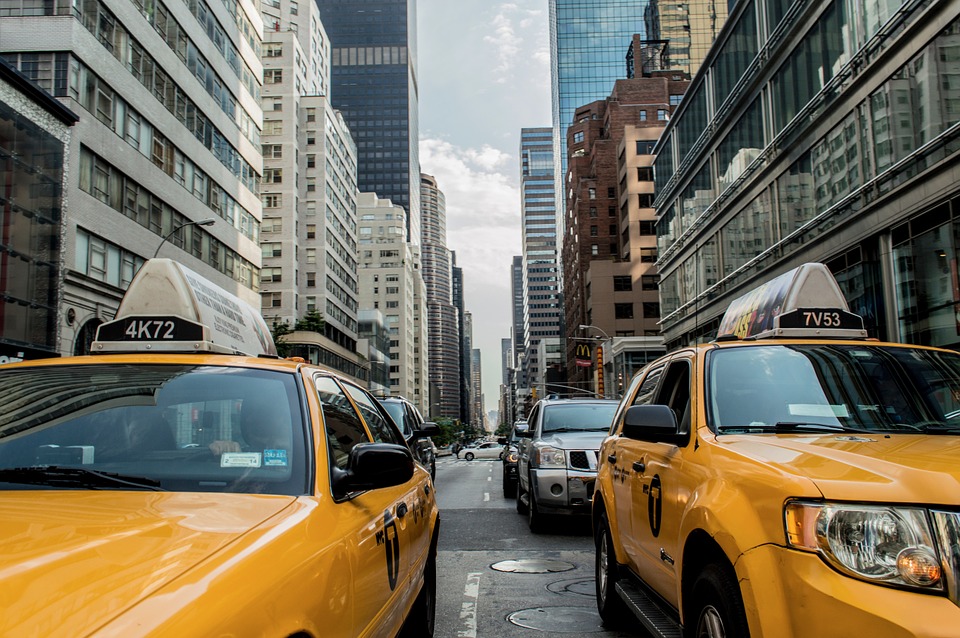
Trip by Skyscanner is an innovative planning tool that tailors recommendations for places to stay, eat and play to your specific tastes. It also allows you to share your great experiences with people who have the same interests as you; people in your “tribes.” Trip by Skyscanner’s TripPicks This Week feature empowers you to discover and take advantage of great events, openings and exhibits throughout the city each week.
Here are some exciting events and sites to check out this week in Downtown New York, courtesy of Trip by Skyscanner. Visit the Trip by Skyscanner site or download the app for more upcoming events.
Starting Monday, January 29th Bar Belly is offering all you can eat mussel for just $15! If that’s not proof that Mondays don’t have to be a drag, we don’t know what is. You can even bring your own board game for a fun night out with friends.
Photographer Edmund Clark, whose work is currently on view at the ICP Museum, and ICP Director of Exhibitions and Collections Erin Barnett sit down to discuss “Edmund Clark: The Day the Music Died.” The exhibition includes photos, videos, and installations in which Clark tackles the issues of “security, secrecy, legality, ethics, and culture” in the global War on Terror. Talk – FREE with RSVP; talk and museum entry – $10.
Inspired by Ai Weiwei’s installation, “Good Fences Make Good Neighbors,” this free public event brings together experts, Anu Joshi (New York Immigration Coalition), Daniel S. Palmer (Public Art Fund) and Kathryn Lloyd, (Tenement Museum) to discuss “the intersection of history, art, and activism.”
Tenement Museum ((Lower East Side)
Wednesday, Jan. 31 from 6-8pm
All three members of the Above & Beyond will be present at the New York premiere of their new concert documentary, Above & Beyond Acoustic: Giving Up the Day Job, which follows the trio spectacular musical journey. $20
Cinépolis Chelsea (Chelsea)
Tuesday, Jan. 30 from 8-10pm
In the early 1600s, with the opening up of the New World, the international chess game for goods and settlements got underway with a fervor that galvanized both Europe and the Americas.
The Spanish were establishing themselves in South and Central America, the French had a small settlement in Quebec, the English were in Virginia and Massachusetts and the Dutch had carved out a vast empire of mostly trackless forest extending from Delaware to Connecticut and up the Hudson (then called the Noort Rivier, or North River)—with the crown jewel being the settlement at New Amsterdam.
From the modest beginnings in 1625, when less than 300 souls resided at the far southern tip of Manhattan island, the newly formed West India Company launched a search for valuable beaver pelts by trading with the Native Americans. The fairly civil relations with the local inhabitants didn’t take long to sour, however, and lack of understanding on both sides produced a series of military actions and massacres that set the template for the conquest of the continent.
Getting Settled
The first Dutch explorers looked at Manhattan harbor very carefully and determined that the southern tip could be best fortified while still providing an ice-free and deep harbor. The earliest maps and plans show a diminutive but growing little village, dominated by a large star-shaped fort on the site of the current Custom House and about ten streets crisscrossing around the fort.
They were protected to landward by the famous wall, which was a palisade of logs that ran across the island along the line of our current Wall Street. There is evidence that a windmill and sawmill were early arrivals. This made good sense for anyone who has stood in the powerful gusts that come off the Hudson, and the fact that a great deal of wood was needed to be processed to construct not only houses and fortifications, but also to build new ships and repair the vessels arriving in the harbor from Europe.
The initial slaves to shore were eleven black men who came with the first waves of settlers, establishing a precedent that would not be sorted out until two hundred and forty years later. There was also a curious mix of settlers, not just Dutch, but some English, Belgian, French and others, leading to a reputation for pluralism that came to be an essential American motif.
William Kieft was the man chosen to be Director of New Amsterdam, and he was in office from 1638 to 1647. Unfortunately, he lacked organizational skills as well as an understanding of the Native Americans. He launched a series of attacks on Indian villages that served to unite and in flame the formerly peaceful population.
Because war is bad for commerce, and partly as a result of his ham-fisted rule, Kieft was replaced by Peter Stuyvesant, a one-legged military man who proved to have the right touch to get the new colony back on its feet and in the black.
But when a large English fleet sailed into the harbor in 1664, Stuyvesant found himself alone in wanting to fight it out to the last Dutchman. He was overruled, and New Amsterdam fell to the English. Although it was captured back a few years later, the “Golden Age” of the Netherlands had come and gone and the Dutch would never again be a force in North America.
Dutch Imprint
Since they built mostly with wood, and considering the devastating fires of 1776 and 1835 (among others), we have no remains of New Amsterdam today beyond the Dutch Revival architecture along South Sullivan Street. But we have no lack of Dutch influence on New York and America, both in their words and the people bequeathed to us. The nautical terms “bow,” “stern” and “avast” are all of Dutch origin, as is the term boss (from “baas”) and cookie (from “koekje”). The expression “Yankee” is said to have come from the name Jan Kees, but linguists have cast doubt on this explanation. The term Knickerbocker was originally a surname meaning “toy marble maker,” and is now the name for any old New Yorker.
Humphrey Bogart
Among the many illustrious Dutch who settled in New Amsterdam we can include the ancestors of prototypical tough guylm actor, Humphrey Bogart, as well as the illustrious Roosevelt family. A man named Claes Maartenszen Rosenvelt arrived from Holland in the 1640s, and in 1649 bought a farm that encompassed what is today the area between 29th and 35th Streets, and from a bit west of Fifth Avenue east to Lexington. His son, Nicholas Roosevelt, changed his named and his two sons established the two major branches of the family. Between both we have gotten two presidents, a general who won the Medal of Honor on D-Day and a legendary CIA officer who helped to overthrow Iran in the 1950s—not bad, for immigrants.
A lifelong New Yorker, Cristina Alesci is an award-winning television and digital correspondent. Even before joining the CNN team in 2014, she had interviewed countless business leaders and tastemakers as a correspondent for Bloomberg. Facebook’s IPO, Dell’s takeover battle, and Gwyneth Paltrow’s “common woman” interview are among the stories that have helped make Cristina one of the go-to New York journalists for breaking stories.
As hosted by Cristina, The American Dream: New York will be premiering on CNN’s digital platforms on Monday, Feb. 13. The American Dream is a multi-part documentary series exploring how living in New York during the first half of the 20th century inspired some of New York’s most successful residents. Interviewees include J. Crew CEO Mickey Drexler, Xerox CEO Ursula Burns, former Federal Reserve Chairman Alan Greenspan, hip-hop legend Russell Simmons, and Starbucks CEO Howard Schultz. The series will also be showing on CNN International shortly after its Feb. 13 premiere.
Downtown spoke with Cristina about The American Dream, daily living as a journalist, and what keeps her based in New York all these years later. She can be followed on both Twitter and Instagram.
Cristina Alesci: Now more than ever, I believe the American Dream is hope. At its core, the American Dream is having the freedom to achieve success as you define it, regardless of where you’re born and who your parents are. While government programs and policies can nurture an environment of possibility, the individual needs ambition, resilience and a decent amount of luck. It’s a struggle and it’s not easy. The American Dream is an ideal we should all aspire to achieve and preserve for future generations.
CA: My family and New York, two of my favorite things. My parents and grandparents inspired it in large part. Like many others in this country, they emigrated to the U.S., in their case from Italy. To me, they embody the spirit of the American Dream, unrelenting hard work and hope. My mother arrived when she was 12 years old and had to learn a new language, a different culture and how to take care of herself in some very tough neighborhoods. The same with my father, who eventually started a successful small business. I’m in awe of what they’ve been able to achieve. Also, New York was a breeding ground for their dreams and so many others who found success in this country. I wanted to understand it, document it and share it so it can inspire others.
CA: I have many, actually, but as a woman covering corporate America eight years was struck by Xerox CEO Ursula Burns‘ observation that despite all the advances women have made in business over the last few decades, men still seem to have the advantage. She made a point about how women sometimes may overlook picking a kind of partner who will help them share the burdens of their personal and family lives.
CA: My younger sister Laura, I was eight. My parents had just bought a video camera and my first thought was, “I want to do an interview for the news.” I actually watched the video over Christmas for the first time in years, and it was a lot different than I remembered. It was more like an interrogation.
You’ve interviewed a lot of big names, but are there people that you’re still hoping to talk with?
CA: The bold-faced names often don’t lead to the most riveting stories. Jimmy Breslin likes to say that the more compelling stories are found in the losing team’s locker room. One of the biggest stories of Breslin’s career, which is still taught in journalism school, was a column he wrote following President Kennedy’s assassination, where he interviewed the gravediggers who would be burying the President. I firmly believe the best way to report on something is by looking in the less obvious places.
Rumor has it that you wanted to pursue a career with the FBI before getting into journalism. What was it that drew you to the FBI?
CA: The rumor mill was right! I was always drawn to the idea of public service. At the time, it seemed like the best way for me to make a difference in the world. Also, Agent Alesci seemed to have a nice ring to it…but I had no poker face, so I wouldn’t have been very good at undercover work.
Have you been able to interview anyone from the FBI?
CA: I do get a lot of late-night calls but breaking a story is rarely that easy. It’s always the product of shoe leather. That, and not taking “no” for an answer—even if you’ve heard it a dozen times. But it can be a lot of fun.
I had a two-year rivalry with another reporter at a major financial newspaper. We were always trying to one up each other on breaking financial news. One time, after a week-long vacation, I scooped him on three stories my first day back. He e-mailed that night and begged me to go back to the beach.
What is a typical day like for you as a reporter? How much of the day is actually spent reporting or writing?
CA: A typical day is five hours of sleep, one hour of eating, one hour in the gym and the rest spent reporting and writing. How much is reporting versus writing changes from one day to the next, but I do both every day.
CA: I’m focused on the nexus of money and politics, and its impact throughout the country. I believe it’s more important than ever to ensure the public understands that relationship.
You’re a CUNY graduate. What is it that keeps you based in New York?
CA: That seems like a trick question! I was born in Brooklyn, raised in Queens and now that I live downtown, I can’t imagine myself living in too many other places.
When not busy with your career, how do you like to spend your free time?
CA: With my family. I have four younger siblings; three sisters and a brother. My husband and I love cooking big meals and having everyone over for dinner — I’m Italian, after all.
Do you have a favorite restaurant in New York?
CA: It’s hard to have one favorite restaurant in New York. I have my top ten, but it’s always changing. Right now I really like Café Altro Paradiso, Via Carota and Le Coucou. I don’t have time for brunch, but for a simple breakfast on a Sunday, I love hitting the Greek bakery Pi in Soho.
Do you have tickets to any upcoming concerts or events?