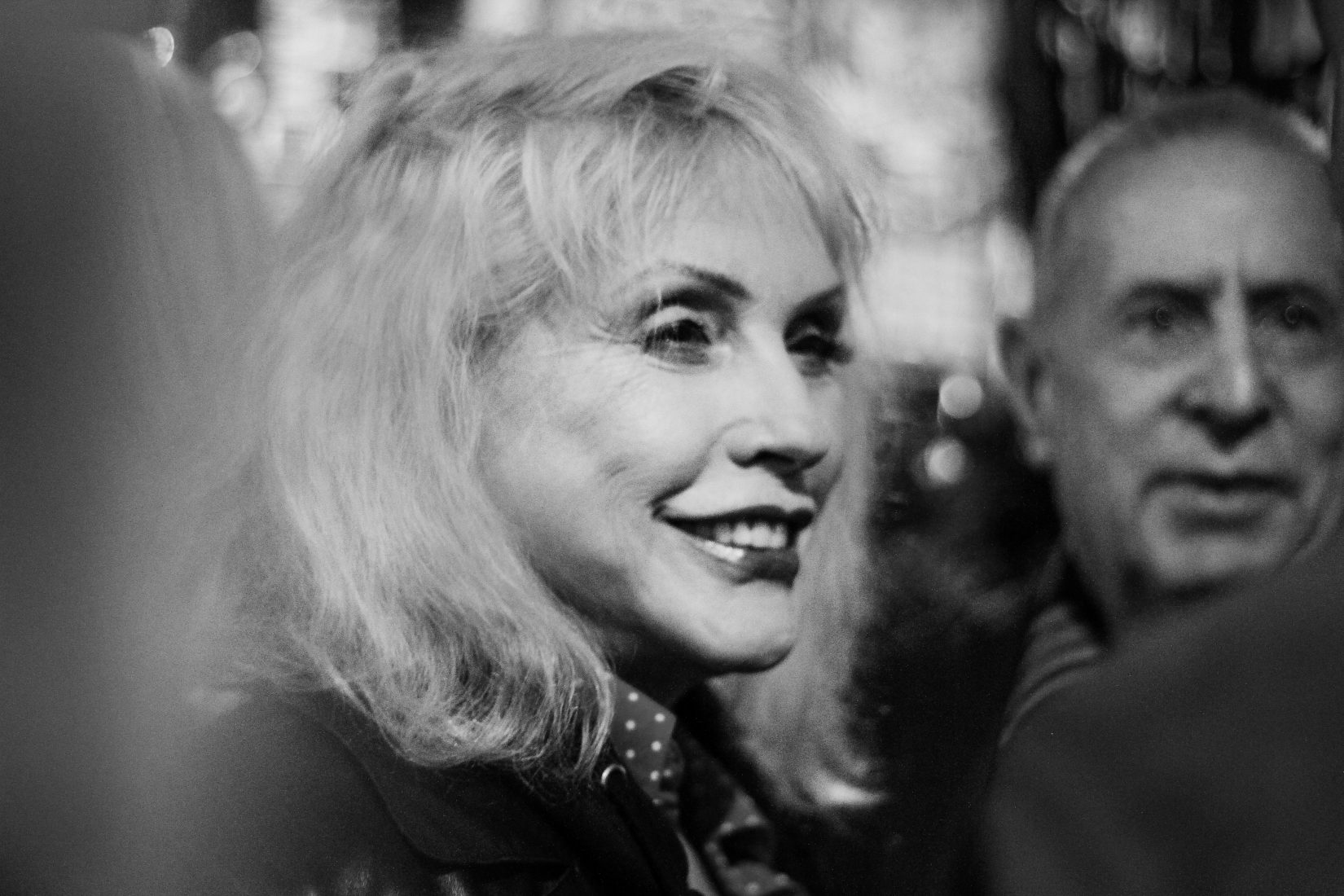
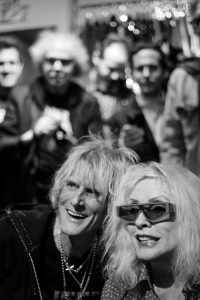
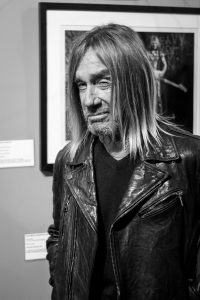
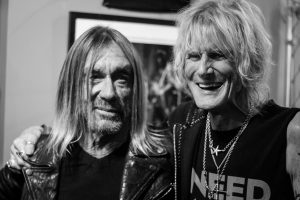
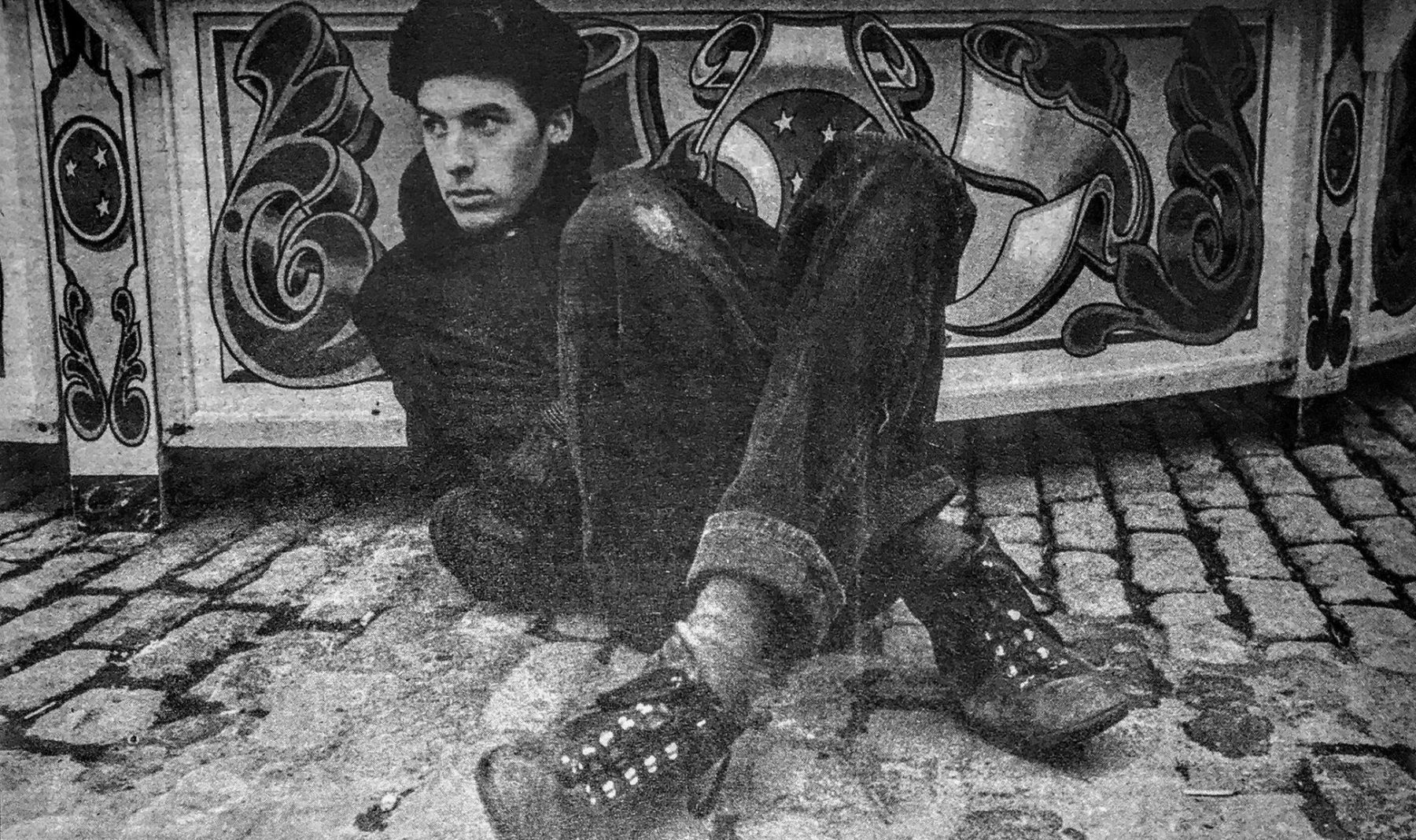
Just ask Jimmy Webb, owner of rock boutique I NEED MORE, tucked on the quieter side of Orchard Street in the LES. Webb, immediately recognizable by his punker coiffure, tattoo sleeves and bright smile, had the wonderful idea to immortalize the footprints of his friends Iggy Pop and Debbie Harry in concrete.
On 24 February, he made it happen. With Iggy Pop in town for the Tibet House Benefit, Webb and his army of PR, managers, and the fantastic I NEED MORE staff welcomed Iggy Pop and Debbie Harry to the hot pink emporium with unbridled enthusiasm. As each person filed in one by one, they were greeted with cheers and big hugs from Webb.
Iggy and Debbie are immortalized on either side of the counter. Iggy was reluctantly persuaded to not cannonball into the concrete, although one could understand the temptation. Debbie gingerly stepped in wearing a pair of gorgeous red heels, and embellished her autograph with her signature X’s. Both pairs of shoes were given to Jimmy Webb as gifts, and will be on display at I NEED MORE, along with other amazing music memorabilia, unique pieces of art fashion, rock photography, and merch from your favorite bands.
Amongst the fans in the crowded shop were Henry Rollins, Duff McKagan of Guns N’ Roses, Chris Stein, David Johansen and Mara Hennessey, famed photographers Bob Gruen, Godlis, Bobby Grossman, Roberta Bayley and Mick Rock; Danny Fields, Jim Jarmusch, Amos Poe, Sara Driver, and Nina Alu.
In John Varvatos’s world, music and fashion combine to create a lifestyle brand for those about to rock.
by Deborah L. Martin photography by Andrew Matusik
JOHN VARVATOS IS A ROCK AND ROLL guy, and he arrives at his Bowery flagship store
for our 8 am call time looking the part: skinny jeans, leather jacket, stone-cold stare. It’s clear that he hasn’t been in the store in a while and he busies himself with his team, doing some merchandising. “I don’t want these shirts like this. People don’t shop this way.” He’s walking around the store doing something that people who know retail understand. He is shaking things up. When we sit down to talk, I nd that this is a phrase he uses often, and it’s something he is proud of. “In my company, we hire a lot of young people, in the design studio, in sales, in the stores. It’s inspiring to be around. I’m someone who loves change and I’m so in there with them. I just want to shake shit up. I say it all the time, it’s in my DNA.”
John Varvatos by Andrew Matusik
As it turns out, the stone-cold stare is the public face, and behind that is a warm, funny guy who is a bit verklempt, and grateful, for the way his life has turned out.
John Varvatos the brand, and John Varvatos the man are both known for their rock and roll edge—from the musicians who have appeared in his ad campaigns to the New York flagship location in the former home of CBGBs, Varvatos has managed to weave his passions together in a way that eschews the normal ebb and ow of “fashion.” He says, “Music was my energy force as a young kid growing up in Detroit, in a 900-square-foot home with seven people. My escape was to put my headphones on—it transported me someplace else.” That love of music is the baseline for everything he does.
“I don’t really use the word fashion,” he says. “I talk about style. Our designs are inspired by my sense of rebelliousness and toughness, which is what rock and roll stands for.” He knows his customer. “Our guys range from Wall Street and business people to music artists, but they all have that creative bone.” He continues, “We don’t think about fashion of the moment. For me, style is more timeless. Our customer doesn’t need something obvious. They are the anti-obvious.”
And what about those musicians?
“They are probably the smallest part of our business, but thank goodness we have them, because they add a cool vibe.” Varvatos has called on some of those rockers to star in his ad campaigns. “All those people have become friends. They do it because they want to be associated with the brand. There’s no real money of any consequence attached to it, but they like the association, they like me, and we have a relationship. Like anything else, it has to be good for everyone. and it is good for them, as well.”
John Varvatos by Andrew Matusik
The list of names who have appeared reads like a list of inductees at the Rock and Roll Hall of Fame. Ziggy Marley, Ringo Starr, Kiss, Iggy Pop, Chris Cornell, Alice Cooper, Dave Matthews, Questlove, ZZ Top, Jimmy Page—the star-studded roster goes on and on. Varvatos says, “The guys from Kiss invited me to their farewell tour, and it’s the friendship that’s important. The thing I’m proudest and most humble about is that they consider me one of their own, and not just some fashion guy that’s trying to get rock stars to be in his ads.”Varvatos isn’t just “some fashion guy.” He started in Midwest sales for Ralph Lauren in 1983, and moved his way up the ladder, eventually taking a design post in New York. In 1990, he joined Calvin Klein, where he launched the menswear collection, the cK brand, and the hugely successful underwear line, in the process gifting the world with Mark Wahlberg in boxer briefs (which he invented by cutting the legs o long johns). After a short stint at London Fog, he rejoined Ralph Lauren as vice president in charge of men’s design for all Polo Ralph Lauren brands. In 1998 he joined Nautica Enterprises, who agreed to back his own brand, which launched in 1999
“These were great learning places for me.
I’m still close with Ralph and Calvin, and they respect what I do. When your mentors give you cred, it’s a humbling thing.” He chokes up a little when he says, “My wife ran into Ralph in the park and he told her, ‘I’m so proud of John, he really did what he said he was going to do.’”
He views the brand as a culture, and the Bowery store—once the site of one of the most infamous clubs in music history, CBGB & OMFUG—is a big part of that culture. “We are really thrilled with the people who come to visit the store because of its history. They want to come in and hang out and it’s all about the culture. That’s why we do concerts in the space. We clear out all of the clothes and turn it into a club again.”
John Varvatos by Andrew Matusik location WTC 3
In addition to the clothing, there is also the punk documentary produced with Iggy Pop, a music label, the annual Love Rocks concert for Gods Love We Deliver, relationships with AMFAR and Stuart House in LA, and a brand new tequila launch with friend, Nick Jonas. “I started the music label about four years ago, with Universal and Republic records. We signed the Zac Brown Band, and we had a multi-platinum album right out of the gate.” After leaving Universal, Varvatos teamed up with Scott Borchetta and created Big Machine John Varvatos Records. The label’s first band is a young group called Bad ower. Varvatos says, “They are one of the most incredible bands I’ve heard over the last 10 years. I was in LA in the spring and the kids were lining up for four hours before the show because they wanted to get the best place in the theater. When I saw that I had goosebumps. For me, it’s about helping young artists and their voice.” The label has just added another band out of Wales called Pretty vicious.
Varvatos friendship with Nick Jonas goes back to a dinner party where they were seated together.
“We realized we had a lot in common, including a love of tequila. The next day he called me and said ‘I’m in the recording studio and I’d like to play you some of the new music.’ When I got to the studio, there was a bottle of tequila sitting on the soundboard. For the next few hours, we drank tequila and talked about life.” The friendship developed into a fashion and fragrance collaboration and just this summer, villa One tequila was born. Varvatos says, “I’m proud of it, and of my friendship with Nick. He’s half my age but he has the heart and soul of someone who is much older.”
John Varvatos
The success of the brand, and his passion for music have taken him on a wild ride. “To quote the Grateful Dead, it’s been a long strange trip. It was never a plan.
I wanted to be a musician but I wasn’t a good musician, I didn’t have a great voice. But I lived through the music and organically this happened.” He continues, “We didn’t even talk about rock and roll when we started the brand. And then suddenly Jimmy Page is calling and telling me he’s coming to New York and says he loves my stuff and wants to meet up. These people become friends because we have a similar core ethos.”
Varvatos is at the top of his game, enjoying the adventure, challenging himself and his brand. “Success isn’t just about the product. It’s about what you do that’s different from the rest. If you don’t do something different, there’s no reason for being. I am so blessed. I get to do all of these cool things that I never could have dreamed of as a kid. I’m so blessed.”
2019 has been all so overwhelming, hasn’t it? Being trapped in this infinity loop of crisis and pundits, all at our fingertips? We mindlessly scroll through the drone of Facebook, greedily lapping up salacious headlines and fretting over our future. Is anything changing for the better? Has the ennui always existed? Humanity loves believing in a simpler past. The deluge of programming and movies rebooting old material and old scripts is played out so heavily now one wonders if innovation is allowed anymore, or if we’re just going to keep pacifying ourselves with cozy familiarity. The 1980s seem as much of a utopia now as the 1960s did when The Wonder Years premiered in 1988.
Frank Tovey saw right through the excess, saccharine and glamour of the Reagan/Thatcher era, and, much like the soothsayer of Julius Caesar, went ignored by the masses. There was no room for nostalgia here.
Fad Gadget, photo by Florence Doorgeest
Frank Tovey’s proto-industrial band Fad Gadget, the first signed to Mute Records, boldly steered electronic music into the realm of industrial sound. Eschewing the stationary, robotic playing of his early synthwave contemporaries, Tovey shocked audiences with intense art performances: ripping out body hair, crowd surfing, being tarred and feathered, climbing rafters with a microphone stuffed in his mouth, often seriously harming himself with head gashes, black eyes and snapped tendons.
Fad Gadget albums were an eclectic mix of electric drills, drumming, Orff-inspired vocal arrangements, musique concrete, and shrieks. Tovey’s message and notorious reputation clearly threatened the suits; his lyric material found more sympathetic bedfellows with The Pogues, the Kinks, and Billy Bragg, by way of Einstürzende Neubauten and Iggy Pop. Tovey’s message was highly confrontational, bitterly anti-commercial, and deeply vulnerable. As most pop stars crooned about romantic love spats, Tovey operated on a different plane: warning humanity of the dangers of late capitalism.
Photo by Anton Corbijn
Despite never making Top of the Pops, Frank Tovey still wielded tremendous influence in the UK and West Germany. A fledgling Depeche Mode were entranced by his early performances, and signed to Mute soon after. The entire industrial genre owes him a tip of the hat, with artists like Skinny Puppy, NIN, and Marilyn Manson snatching the relay baton.
By the late 80s, however, Tovey pulled an about-face with his sound. He tucked the chaotic Fad Gadget in bed for a long nap, picked up an acoustic guitar, and penned brand new protest folk as Frank Tovey. After 1986’s Snakes and Ladders, which retained many sonic elements of Fad Gadget, and a side project called MKultra, he released the extraordinary Civilian in 1988.
The sonic switch confused his fans, the press and even his own label, but his fundamental message remained. The irony was, Tovey had always been a folk musician, albeit one with a synthesizer. His lyrics delved into humanity, the human experience, and the Everyman existing in a technologically-fueled fascism. Much like Bowie, Tovey found inspiration from various collaborators.
“It was never about transitioning from electro to folk with Frank,” says John Cutliffe of The Pyros, with whom Tovey would collaborate on his final albums. “It was about songs and sound and the musicians he surrounded himself with. His influences had always been eclectic, and his love of manipulating sounds electronically inspired so many, but that is also what we were doing with the more traditional folk and rock instruments. We would push the limits of what they could do and play…Frank didn’t care if it was a banjo or a synth. The song mattered, and the layers of sound we could use to draw out the emotion of the song was the only thing that was relevant.”
Over thirty years later, Civilian remains as prescient as ever as it slips into 42-minute slow motion tumble of Western civilization’s house of cards. This was not a world Tovey wanted for his beloved children.
Civilian is a hypnotic channeling of rage at corporate greed and corruption. The album opens with New Jerusalem, a screeching cacophony of crowd chants and a droning, nightmarish recounting of a fascist police state and street violence. It is a bleak, paranoid scene of innocents falling victim to the militaristic whims of “big enterprise.”
Ultramarine bitterly attacks the Hollywood glorification of the American military complex:
Liberation comes
In jeans and Coca-Cola
Liberty this bullet’s
Got your name on it
You make the films
And you’re making history
Napalm burger bars
Popcorn victory
Tovey darkly closes Ultramarine with his own Wonder Years-style monologue, recounting a childhood memory of watching a Buddhist monk die by self-immolation on live television. So much for the veil of nostalgia.
From The City To The Isle of Dogs examines the gentrification of London neighborhoods already present by 1988, the continuing erasure of local culture, and the demise of the middle class. The jaunty banjo number Bridge Street Shuffle wryly predicts the horrific spectacle of human suffering via reality television.
I’ve got two tickets, front row seats For the riverside We can take a picnic And watch the suicides
The Brotherhood lambasts the corrupt patriarchal power of fraternal societies. Diana echoes the wrenching pleas of infidelity forgiveness. Unknown Civilian explores the post-war home front, and the silent suffering of shell-shocked veterans.
Civilian as a whole is a horrifying, clairvoyant glimpse at Western society on the precipice of complete breakdown.
In 2002, Frank Tovey’s earnest heart suddenly gave out, and he shuffled off this mortal coil. By then, however, he had already tilled the parched earth for the greedy saplings of a post-9/11 dystopia. Too bad no one heeded his warnings when Civilian was first released, but it deserves a fresh listen. You won’t find a more perfect soundtrack to close out these chaotic 2010s.
Mute Records would be wise to re-release this treasure. It’s time. Fad loves you.
Tomoyasu Hotei — also known as HOTEI — is one of the most famous guitarists to hail from Japan. He has sold over 40 million albums in his 30-plus year career, and you undoubtedly know his song “Battle Without Honor Or Humanity.” But HOTEI continually challenges himself as an artist, and his 2015 album Strangers was only his second-ever English-language release; the album features contributions from Iggy Pop, Shea Seger and members of Rammstein, Bullet For My Valentine, and Apollo 440. He is also known to challenge himself off-stage, having uprooted his life in recent years with a permanent move to England.
Downtown had the pleasure of conducting Q&A with HOTEI about many facets of his life and career. HOTEI can be visited online at www.hotei.com, and can also be followed via Twitter and Facebook.
Strangersis your first international release, after being a very successful artist in Japan for decades. Where did the decision come from to break into the United States market?
HOTEI: One word: “adventure.” When I first held an electric guitar in my hand, I dreamt myself touring all over the world on a private jet, just like those rock stars you find in rock magazines! (laughs) That ambition does not fade just because I was successful in Japan. Time flies and this year marked 35th anniversary as professional musician. I questioned myself, “Am I still that same boy at over the age of 50?” I would be a con artist if I gave up my ambition from that moment when my messages to audience is always, “Life is short, be yourself and don’t regret.”
I thought it is not too late to follow my dream. I sold my property in Tokyo — I had a nice swimming pool with that property — and Bentley five years ago to relocate to London to reset my life. I wanted to challenge myself from ground zero. It took two years to complete Strangers with various U.K. producers. Have done some gigs in Europe, then I felt I am ready to check out U.S. market. I know it is not easy, but I’m all excited. I have confidence in my music.
On Strangers, you collaborated with Iggy Pop, Shea Seger, and members of Apollo 440, Bullet For My Valentine, and Rammstein. Are these all people that you had known? Or did you have a list of ideal collaborators that you approached?
H: As for Iggy, I met him in Berlin Airport when he came back from his show in Tokyo, and I was there for my recording in 1985. When I realized Iggy was there, needless to say I was all excited! He was one of my heroes, next to David Bowie. I was debating whether to walk up to him or not to ask for his autograph, when he approached me and asked me, “You are a famous guitarist from Japan, aren’t you? My girlfriend is a huge fan, would you mind giving me your autograph?” When I finished with demos of “Walking Through the Night” and “How The Cookie Crumbles,” I really wanted vocals with strong personality. Through my friend, I sent those demos to Iggy via Don Was to see if he would be interested. Fortunately, he totally loved them.
When I went to Miami for his vocal recording, I mentioned about the story from Berlin Airport, then he said “Oh! that was you!” Thrilled to know he remembered that moment! And Noko from Apollo 440 is my old friend for over 20 years. We share the exact same birthdate. He is my musical partner, feels like part of myself. Matt Tuck and Richard Z Kruspe — I met them through the producer. Shea is my friend in London. They are all amazing artists. We collaborated not just on music but shared more in the depth. I truly appreciated them all for their friendship.
Do you have plans to tour the United States again in support of Strangers?
H: Of course! I had an amazing experience in New York and Los Angeles this year. I’m dying to return in 2017! Also, I want to try other cities as well. I thought the audiences in the U.S. were amazing! I think they know how to enjoy music really well.
In 2013 you played at the Highline Ballroom, and you played there again a few months ago. Was your first time playing live in New York in 2013?
H: Yes. When I first played there, I had this prejudice that I had to sing in English. However, after that first show in New York, I learned it is not the language…with music I’m communicating with audience. I was truly appreciative of so many Japanese fans came to see me there. It was a huge relief moment.
Besides touring, have you spent time in New York City? Do you have a favorite restaurant over here?
H: I have a long-time friend in New York who is managing my schedule while I’m there. Where is the best steak restaurant, newest ramen shop, etc., so I don’t need to open a guidebook. I no longer have energy to go “clubbing” all night, and the size of steak in the U.S. is too big for me, so mainly I enjoy jogging in New York! (laughs)
So you and your family live in London. What inspired you to move to England?
H: I got bored with my life in Tokyo. I think Tokyo is the safest city in the world, everything is well-organized, very comfortable. But now I feel it is too much sometimes. I am quite tall for a Japanese, so everybody recognizes me in Japan. I can’t casually go to a ramen shop. I have not been on [Japanese] public transportation for over 30 years!
I think it was a good thing to relocate, especially to go with new challenges. I rarely had an opportunity to speak English when I am in Japan. London is a huge city, but there are lots of greens. I’m sure Lurie, our doberman dog is all pleased with change of scenery. My 14-year old daughter speaks perfect Queen’s English. I commute to studio by tube and bus. Sometime I feel lonely for not been recognized. (laughs)
Is there a career accomplishment of yours that you’re most proud of?
H: When I see the audience’s faces all lit up by listening to my music, I can reconfirm my message has been delivered through my music. I learned that if I can’t attract one person, I can’t attract 10,000 audience through my long career.
H: Of course! The Rolling Stones! I got great influences from David Bowie and Roxy Music, glam rock from 70’s in general, followed by the new wave movement, and punk killed me. Love all the music which has hint of avant garde. Recently St. Vincent is becoming part of my heavy rotation. I am convinced I may be the only guitarist on the Earth who played with David Bowie, The Rolling Stones, Roxy Music, Gang Of Four, Zucchero, Joni Mitchell, Brian Setzer, Chicago — you name it! If I may greedy, I’d really love to play live with Iggy some day.
Do you have a favorite song to perform live?
H: It has to be “Battle Without Honor Or Humanity.” Everybody has heard this tune somewhere, even if they don’t know my name. When I played festivals, people always cold shoulder at the beginning, but as soon as I start this tune, people turn around, and change their attitude toward my performance. It is so obvious. I don’t have enough words to appreciate Quentin Tarantino. I’m totally up for placing it in Kill Bill 3. (laughs)
Aside from releasing Strangers, what else is going on in your career?
H: I can sell out 10,000 tickets, no problem, but still struggling to sell 200. I am really frustrated with this situation, but it reminded me how it was back in 35 years ago when I first started in Japan. If I can reach to audience’s heart with music, I know that they will come back for next time around. Also they will bring their friends to share the excitement. If I repeat that, a 100-person audience will turn into 500, then 1,000, then to 3,000. Nobody told me to do this. I made my choice. I have to find a way to enjoy this frustration.
When you’re not busy with your career, how do you like to spend your free time?
H: Sadly, I don’t have any hobbies. No fishing, gold, triathlons. (laughs) If I have time, I would love to spend it with my family. My daughter is a teenager, soon she will never care about her parents, being busy spending time with her boyfriend! I’m very busy to please my daughter, hope to prolong time together. (laughs)
Finally, HOTEI, any last words for your fans?
H: I sincerely appreciate all of your support, regardless of where you are! And those who are not my fan “yet,” please listen to my music and come see me play live! I hope to deliver “positive” vibes into your life!
Nick Valensi first came into prominence as one-fifth of the downtown New York band The Strokes. Formed in 1998, The Strokes became one of the world’s top rock bands in 2002, going on to sell millions of records. While more music is in the works from The Strokes, lead guitarist Nick Valensi is staying further active with the band CRX.
CRX released its debut album, New Skin on Oct. 28 via Columbia Records. Produced by Queens Of The Stone Age leader Josh Homme, lead-off track “Ways To Take It” was the first single released from New Skin. CRX — which also includes drummer Ralph Alexander, guitarists Darian Zahedi and Richie Follin, and bassist Jon Safley — will be playing at The Bowery Ballroom alongside Streets Of Laredo on Nov. 18. Fans of Elvis Costello, The Cars and Cheap Trick ought to appreciate the poppier fare of CRX.
Downtown caught up with Nick for some Q&A who has also notably collaborated with Devendra Banhart, Regina Spektor, Kate Pierson and Sia over the years. CRX can be visited online at www.crxmusic.com.
How would you describe CRX to someone familiar with The Strokes but hasn’t seen your band live before?
Nick Valensi: There are some similarities between CRX and The Strokes, mainly in the guitar arrangements. Since I play guitar in both bands, I guess that’s kind of inevitable. Someone who likes The Strokes will find a lot to enjoy in CRX. There are differences too, though. CRX has some songs that are heavier and more aggressive than The Strokes. And obviously, I’m not the singer in the strokes, so that’s the gonna be the most apparent difference.
Having played some of the world’s largest venues and been part of so many iconic musical moments with The Strokes, is it ever difficult to play more intimates venues like the Bowery Ballroom?
NV: On the contrary, I love it. Bowery Ballroom is one of my favorite venues in the country. And part of the reason I started CRX was to have some balance from the bigger gigs I get to do. The Strokes don’t perform that much anymore and, when we do, it’s generally at one of those huge music festivals, which I love, but I wanna be able to do both. It’s more about balance. Likewise, if I only ever got to play the Bowery Ballrooms of the world, I’d probably get sick of that, and I’d be thinking, “shit, I’d love to get on one of those festival stages.” So it’s cool for me to get to do both.
What is coming up for you professionally after this CRX show in New York?
NV: Once we wrap up the North American tour, we’ll head to the UK and Europe. I want CRX to be a band that tours a lot and puts on a really good show, so we’ll be doing a lot of that, and working on getting better at what we do. In between all the CRX stuff, I’m also finding time to work on material for The Strokes. We’re writing together and slowly stockpiling material for our next album, so it’s been a pretty busy time for me lately.
CRX / Photo: Magdalena Wosinska
Do you have any goals for CRX? Or is it just about playing out and staying active as a musician?
NV: I wanna be able to make different sounding music and not be confined by anything. I wanna keep learning about music, and work on become a better singer, frontman, and songwriter. And above all, I want CRX to be something fun and simple that I can do whenever I feel like it.
I heard rumors of you soundchecking with “Hot For Teacher” by Van Halen years ago on a tour with Longwave. Do you have a secret hard rock past?
NV: It’s no secret. I have a “hard rock” past, present, and future.