The Warsaw Ghetto Uprising, where 13,000 Jews died fighting Nazi oppression –
in April and May 1943, it was the largest single act of resistance during the Holocaust. The Uprising was the inspiration for “Zog nit keyn mol” (Yiddish: “Never Say”), known as the “Partisan Song.”
WeAreHere-IG-Timezones
The song, which exemplifies Jewish resistance to Nazi persecution, is inspiring a special virtual event this Sunday, June 14 –
“We Are Here: A Celebration of Resilience, Resistance, and Hope.” The concert – which will be live-streamed at www.wearehere.live – commemorates the 75th anniversary of the end of World War II and the 77th anniversary of the Warsaw Ghetto Uprising, even as it speaks to the challenges of the current moment.
“We are all inspired by the example set in the Warsaw Ghetto Uprising. The Partisan Song, which begins and ends this program, speaks to the fight for social justice and fundamental human rights,” said Bruce Ratner, Chairman of the Board at the Museum of Jewish Heritage – A Living Memorial to the Holocaust.
And they’ve enlisted a robust array of renowned actors, musicians, and civic leaders to participate. Among them is a four-time Grammy Award and National Medal of Arts-winner, star soprano Renée Fleming, who will perform the world premiere of a new work by Pulitzer Prize-winning composer John Corigliano based on a text by Kitty O’Meara.
Among the others participating are EGOT-winner Whoopi Goldberg –
Grammy Hall of Famer and Tony-winner Billy Joel, world-renowned pianist Lang Lang; the iconic Dr. Ruth Westheimer, Emmy- and Tony-nominated actress Lauren Ambrose, multi-platinum, Tony-winning Broadway star Lea Salonga, multi-Grammy-winning opera star Joyce DiDonato, and award-winning actress Mayim Bialik.
“Both the recent COVID-19 pandemic and the centuries-old pandemics of racism and antisemitism highlight the need for resistance and resilience,” Sing for Hope Co-Founder Camille Zamora said. Added Sing for Hope Co-Founder Monica Yunus, “As we seek to listen, learn from, and serve our communities in the days ahead, thoughtful organizational partnerships will be key. It is an honor to unite artists and stand together as allies with a global network that fosters resilience, resistance, and hope.”
National Yiddish Theatre Artistic Director Zalmen Mlotek –
and Executive Director Dominick Balletta noted that “In this time of rising antisemitism and global crisis, the themes of resistance, resilience, and hope are more important than ever, and the Partisan Song takes on even more resonance. The song begins with the words ‘Never say this is the final road for you,’ and ends with the words ‘We Are Here.’ It is the song that binds together those who fight for justice.”
The program also will feature an interview by The Forward Editor-in-Chief Jodi Rudoren with Nancy Spielberg, Roberta Grossman, and Sam Kassow about their film Who Will Write Our History, which chronicles the story of Oneg Shabbat, the group that daringly preserved the history of the Warsaw Ghetto.
You can view the list of all participants here. Local viewing times include 11 AM Pacific Time, 2 PM Eastern Time, 7 PM London, and 9 PM Israel.
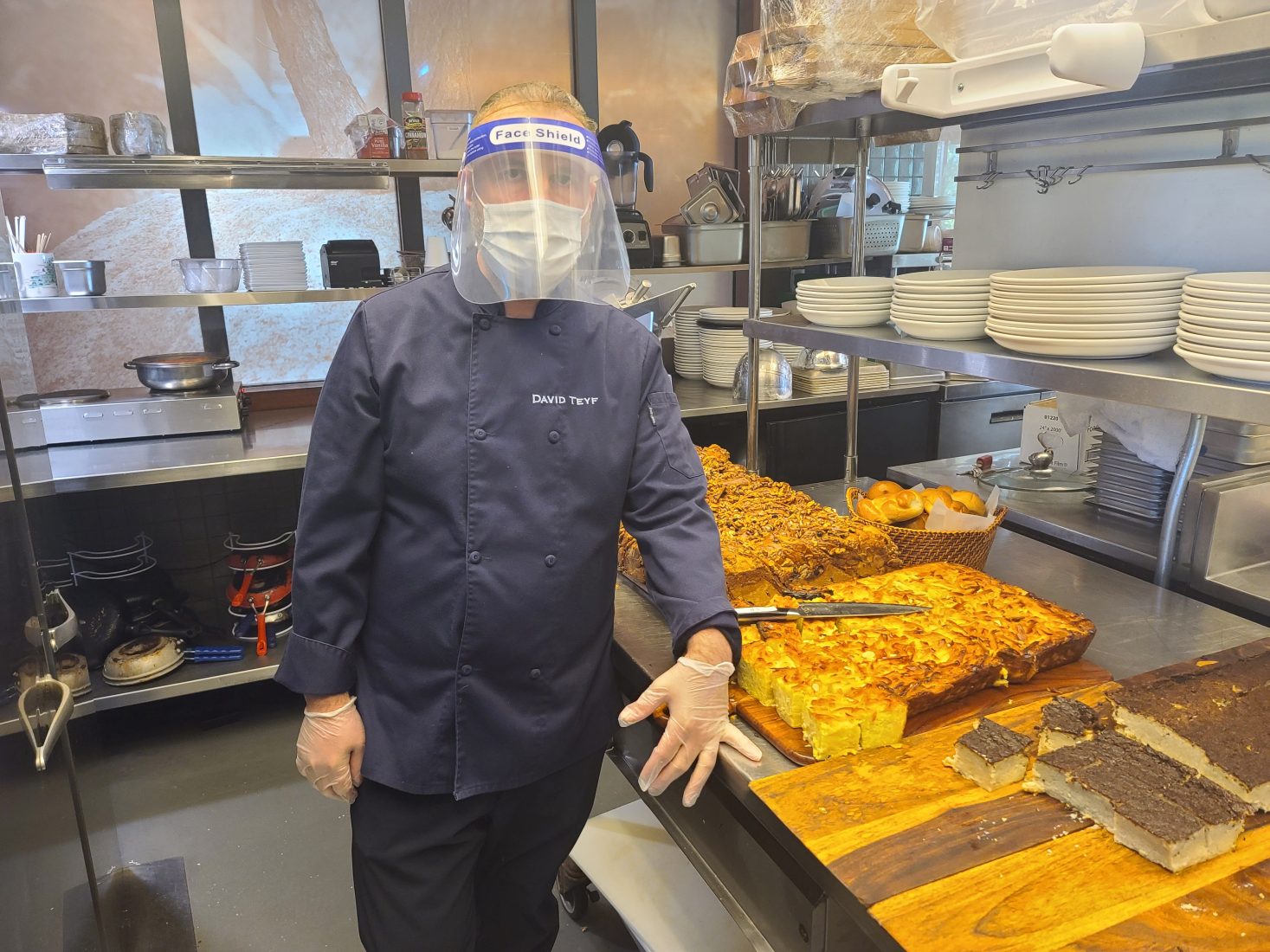
With a small team, Teyf then bring the meals directly to these seniors across New York City.
“I am personally cooking and delivering these meals. I know that my grandparents, who were Holocaust survivors, are smiling down on me. This is something I want to do to honor them and because it’s the right thing to do,” Teyf says. “It’s in my soul to give back.”
An estimated 38,000 Holocaust survivors live in the greater New York City metropolitan area, according to Selfhelp Community Services. More than 50% of them live in poverty.
The pandemic is particularly traumatizing, echoing their lives more than 75 years ago during the Holocaust when food and resources were scarce. Because of coronavirus restrictions, they struggle with a lack of resources and community as they isolate at home.
Teyf has partnered with the Museum and the Met Council to identify 50 Holocaust survivors who need assistance. Additionally, the Museum is reaching out to other survivors to assess their needs so Teyf can provide more support.
He also is setting up an arrangement to deliver more kosher meals to essential healthcare workers at hospitals throughout New York City. The meals include salads, entrees, and desserts.
Jewish dish from Teyf’s restaurant
Teyf’s family has more than a century of epicurean experience.
“My great-grandfather started baking matzah for the Jewish community in Minsk in 1920,” he says. Each of his grandparents was the sole family survivor of the Holocaust. “After the Holocaust, my grandfather continued his father’s tradition of baking matzah for the Jewish community, which he had ultimately risked his life during Communist times until 1979. In 1979, my grandfather decided to pick the whole family up and leave Minsk for the United States for our Jewish freedom.”
Museum President and CEO Jack Kliger praised Teyf’s philanthropy.
“David is doing a real mitzvah,” Kliger says. “The Met Council and David are being generous with their hearts and minds: stepping up to serve others when there is a great need in our city.”
Next week, the Museum of Jewish Heritage – A Living Memorial to the Holocaust will open the most comprehensive Holocaust exhibition about Auschwitz ever exhibited in North America. Auschwitz. Not long ago. Not far away. is produced in partnership with the international exhibition firm Musealia and the Auschwitz-Birkenau State Museum in Poland. The groundbreaking exhibition has been curated by an international team of experts led by historian Dr. Robert Jan van Pelt. It runs through January 3, 2020 in New York City.
For the first time, 74 years after the liberation of Auschwitz, a traveling exhibition dedicated to the historical significance of the camp is being presented to a U.S. audience. The exhibition’s May 8 opening marks the anniversary of VE Day or Victory in Europe Day, 1945, when the Allies celebrated Nazi Germany’s surrender of its armed forces and the end of World War II in Europe.
Auschwitz. Not long ago. Not far away.arrives in New York City after the exhibition completed a successful run at Madrid’s Arte Canal Exhibition Centre, where it was extended two times, drew more than 600,000 visitors, and was one of the most visited exhibitions in Europe last year. The exhibition explores the dual identity of the camp as a physical location—the largest documented mass murder site in human history—and as a symbol of the borderless manifestation of hatred and human barbarity.
AUSCHWITZ EXPOSICIÓN DE MADRID
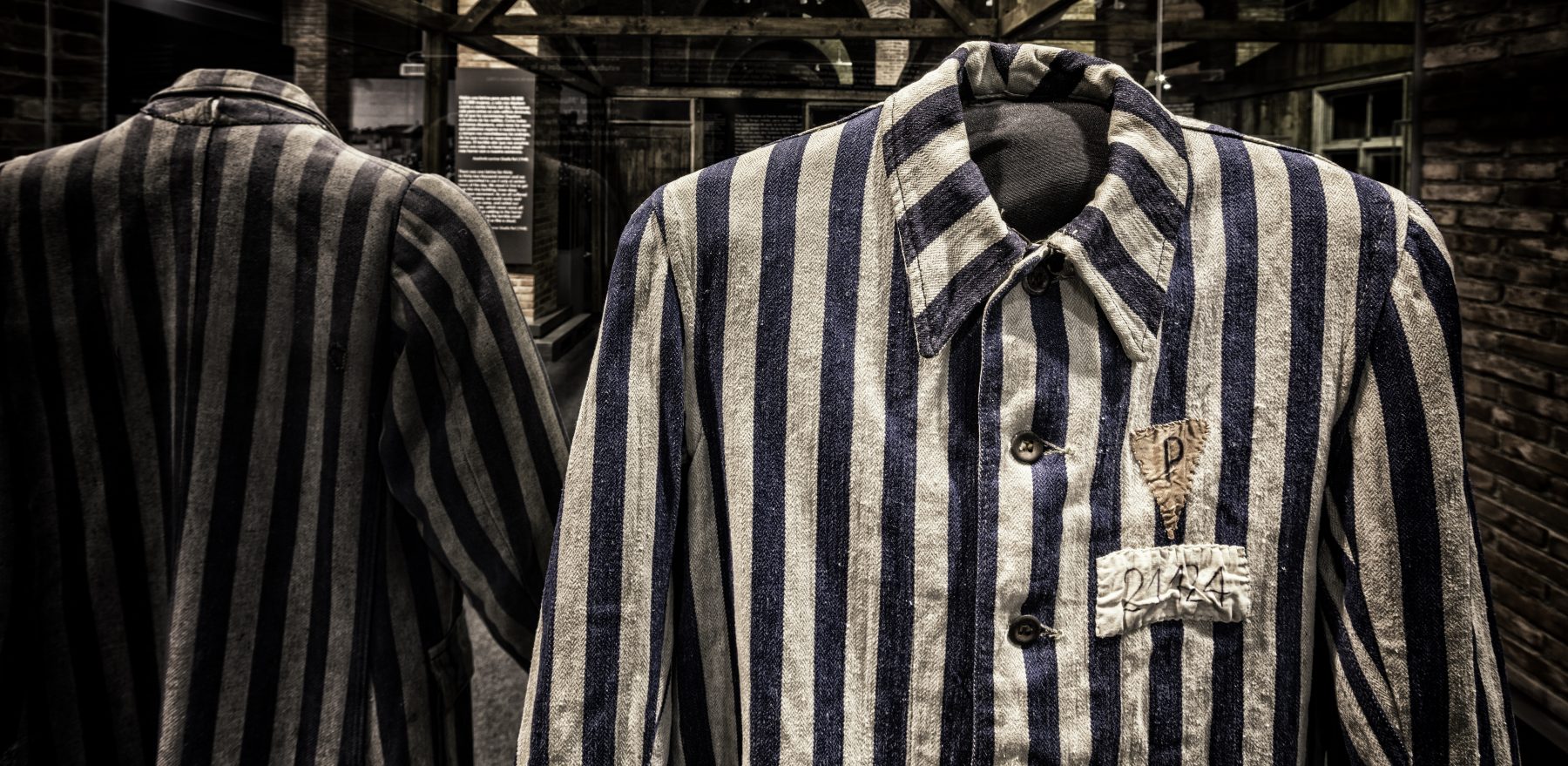
Featuring more than 700 original objects and 400 photographs, mainly from the Auschwitz-Birkenau State Museum, the New York presentation of the exhibition allows visitors to experience artifacts from more than 20 international museums and institutions on view for the first time in the North America, including hundreds of personal items—such as suitcases, eyeglasses, and shoes—that belonged to survivors and victims of Auschwitz. Other artifacts include: concrete posts that were part of the fence of the Auschwitz camp; part of an original barrack for prisoners from the Auschwitz III-Monowitz camp; a desk and other possessions of the first and the longest serving Auschwitz commandant Rudolf Höss; a gas mask used by the SS; Picasso’sLithograph of Prisoner; and an original German-made Model 2 freight wagon used for the deportation of Jews to the ghettos and extermination camps in occupied Poland.
Museum of Jewish Heritage Board Vice Chairman George Klein visited the exhibition in Spain and recommended to his Board that they bring it to Lower Manhattan. The exhibition features artifacts and materials—never before seen in North America—on loan from more than 20 institutions and private collections around the world. In addition to the Auschwitz-Birkenau State Museum and the Museum of Jewish Heritage – A Living Memorial to the Holocaust, participating institutions include Yad Vashem in Jerusalem, Anne Frank House in Amsterdam, United States Holocaust Memorial Museum in Washington, Auschwitz Jewish Center in Oświęcim, the Memorial and Museum Sachsenhausen in Oranienburg, and the Wiener Library for the Study of the Holocaust and Genocide in London.
Auschwitz. Not long ago. Not far away. traces the development of Nazi ideology and tells the transformation of Auschwitz from an ordinary Polish town known as Oświęcim to the most significant Nazi site of the Holocaust—at which around 1 million Jews, and tens of thousands of others, were murdered. Victims included Polish political prisoners, Sinti and Roma, Soviet prisoners of war, Jehovah’s Witnesses, and those the Nazis deemed “homosexual,” “disabled,” “criminal,” “inferior,” or adversarial in countless other ways. In addition, the exhibition contains artifacts that depict the world of the perpetrators—SS men who created and operated the largest of the German Nazi concentration and extermination camps.
The Museum of Jewish Heritage has incorporated into the exhibition more than 100 rare artifacts from its collection that relay the experience of survivors and liberators who found refuge in the greater New York area. These artifacts include: Alfred Kantor’s sketchbook and portfolio that contain over 150 original paintings and drawings from Theresienstadt, Auschwitz, and Schwarzheide; the trumpet that musician Louis Bannet (acclaimed as “the Dutch Louis Armstrong”) credits for saving his life while he was imprisoned in Auschwitz; visas issued by Chiune Sugihara, a Japanese diplomat in Lithuania often referred to as “Japan’s Oskar Schindler”; prisoner registration forms and identification cards; personal correspondence; tickets for passage on the St. Louis; and a rescued Torah scroll from the Bornplatz Synagogue in Hamburg.
Also on display from the Museum of Jewish Heritage collection will be Heinrich Himmler’s SS dagger and helmet and his annotated copy of Hitler’s Mein Kampf, as well as ananti-Jewish proclamation issued in 1551 by Ferdinand I that was given to Hermann Göring by German security chief Reinhard Heydrich on the occasion of Göring’s birthday. The proclamation required Jews to identify themselves with a “yellow ring” on their clothes. Heydrich noted that, 400 years later, the Nazis were completing Ferdinand’s work. These artifacts stand as evidence of a chapter of history that must never be forgotten.
“As the title of the exhibit suggests, Auschwitz is not ancient history but living memory, warning us to be vigilant, haunting us with the admonition ‘Never Again.’ It is a prod to look around the world and mark the ongoing atrocities against vulnerable people,” said Bruce C. Ratner, Chairman of the Museum’s Board of Trustees. “While we had all hoped after the Holocaust that the international community would come together to stop genocide, mass murder, and ethnic cleansing, these crimes continue. And there are more refugees today than at any time since the Second World War. So my hope for this exhibit is that it motivates all of us to make the connections between the world of the past and the world of the present, and to take a firm stand against hate, bigotry, ethnic violence, religious intolerance, and nationalist brutality of all kinds.”
Auschwitz. Not long ago. Not far away.was conceived of by Musealia and the Auschwitz-Birkenau State Museum and curated by an international panel of experts, including world-renowned scholars Dr. Robert Jan van Pelt, Dr. Michael Berenbaum, and Paul Salmons, in an unprecedented collaboration with historians and curators at the Research Center at the Auschwitz-Birkenau State Museum, led by Dr. Piotr Setkiewicz.
“Auschwitz and the Shoah are not just another single, dramatic event in the linear history of humanity. It is a critical point in the history of Europe, and perhaps the world,” said Dr. Piotr M. A. Cywiński, Director of the Auschwitz-Birkenau State Museum. “While commemorating the victims of Auschwitz we should also feel moral discomfort. Antisemitic, hateful, xenophobic ideologies that in the past led to the human catastrophe of Auschwitz, seem not to be erased from our lives today. They still poison people’s minds and influence our contemporary attitudes. That is why studying the Holocaust shouldn’t be limited to history classes. It must become part of curricula of political and civic education, ethics, media, and religious studies. This exhibition is one of the tools we can use,” he explained.
“Seventy-three years ago, after the world saw the haunting pictures from Auschwitz, no one in their right mind wanted to be associated with Nazis. But today, 73 years and three generations later, people have forgotten, or they never knew,” said Ron Lauder, Founder and Chairman of the The Auschwitz-Birkenau Foundation Committee and President of the World Jewish Congress. “This exhibit reminds them, in the starkest ways, where anti-Semitism can ultimately lead and the world should never go there again. The title of this exhibit is so appropriate because this was not so long ago, and not so far away.”
“Auschwitz did not start with the gas chambers. Hatred does not happen overnight: it builds up slowly among people. It does so with words and thoughts, with small everyday acts, with prejudices,” said Luis Ferreiro, Director of Musealia and the exhibition project.“When we had the vision to create the exhibition, we conceived its narrative as an opportunity to better understand how such a place could come to exist, and as warning of where hatred can take us to.”
AUSCHWITZ EXPOSICIÓN DE MADRID
Auschwitz. Not long ago. Not far away.is presented in the symbolic, hexagonally-shaped building at the Museum of Jewish Heritage. This 18,000-square-foot exhibition introduces artifacts and Holocaust survivor testimony through 20 thematic galleries. At the conclusion of this presentation, the Museum will debut its new permanent core exhibition.
Throughout its presentation of Auschwitz. Not long ago. Not far away., the Museum will host a series of related public, educational, and scholarly programming, featuring world-renowned experts on the Holocaust. The Museum also will expand its work with students in the tri-state area and introduce complementary educational tools for in-class and onsite use.
“All through the exhibition there are stories—stories about individuals and families, stories about communities and organizations, stories about ideologies that teach people to hate, and responses that reveal compassion and love. There are stories of victims, perpetrators, and bystanders, stories with heroes and villains—stories that all merge into an epic story of a continent marked by war and genocide,” said Dr. Robert Jan van Pelt, Chief Curator, who has published several books on the camp—including the award-winning Auschwitz, 1270 to the Present (1996) and The Case for Auschwitz (2002)—and participated as an expert witness in Deborah Lipstadt’s case against Holocaust denier David Irving.
Following the New York presentation, the exhibition is intended to tour other cities around the world. This destinations will be announced by Musealia and the Auschwitz-Birkenau State Museum in the upcoming months and years.
· It Wasn’t Only Sandy Koufax explores the history of Jews in American sports and how being Jewish affected careers.
· Ink Bleeds History: The Art of Jewish Comics with leading graphic storytellers discussing how they subvert centuries of anti-Semitic depictions.
· The film Olympic Pride, American Prejudice, marking the 80th anniversary of the 1936 Berlin Summer Olympic, tells the story of 18 African Americans who boarded a ship to Germany to represent the U.S., defying Jim Crow laws and Adolf Hitler.
Born in the backyard of a matzo factory in Minsk, Russia, Chef David Teyf has been strongly practicing his roots in Russian and Jewish culture throughout the entirety of his life. His new restaurant, Lox — as located in the Museum of Jewish Heritage — is 100 percent kosher and brings his background to life.
While growing up in Minsk, now Belarus, Teyf was exposed to the culinary world early on.
“My grandparents provided the Jewish community in Minsk with matzo,” Teyf said. “My great-grandfather started in 1920 under Communist times, which was illegal. They were burned down many times, but they prevailed and kept making matzo for the Jewish community.”
During this time, Teyf’s family faced the Holocaust. His grandmother was part of the Jewish partisans, a group of Jewish individuals who escaped from ghettos or concentration camps and fought against Nazi Germany. Some of his family members are Holocaust survivors.
To be located in a museum with a strong connection to his upbringing means to provide a place where kosher individuals have the opportunity to experience Jewish and Russian culture while eating well. Teyf realized there are not many places in New York City to enjoy such authentic cuisines.
Caviar by Lox / Photo: Rayna Greenberg
“Jewish food in the states got lost in translation,” Teyf began. “We took it back to the original way it’s been done, by hand, no equipment.”
As a chef whose training is very focused around the Japanese world of fish, incorporating Jewish and Russian culinary influences was not hard for Teyf. Lox serves various smoked salmon dishes, a Jewish-inspired bento box, baked goods and other traditional favorites. Everything made at Lox is promised to be handmade and homemade while offering the freshest of ingredients.
To ensure the highest quality, daily trips to the produce and fish market are made, fresh breads and hand-rolled, kettle-boiled bagels are brought in from a commissary Teyf has in Brooklyn, and curing the salmon for lox is an intricate process that leaves smoky and delicious sushi-grade fish. Last month, the menu offered lox flavors including pastrami, sake and wasabi, and double-smoked. But the menu will change four times a year based on the seasons, Teyf added.
Lox 5 Ways / Photo: Rayna Greenberg
Each recipe is part of Teyf’s very own personal creations, a unique quality at Lox that raises the standard of kosher Jewish and Russian cuisine. The Old-Fashioned cocktail inspired Teyf’s flavors of salmon, a rarity when it comes to lox and kosher food in general. The next menu will feature a lox with bourbon, orange zest and angostura bitters, a taste that only Chef Teyf knows before he tries it.
To combat the label of Jewish and Russian cuisine, Teyf has a specific vision for Lox. “We want this concept worldwide. We want Lox in other museums around the world, we want to show our pride and show that Jewish Russian food can be great,” Teyf declared.
As noted by Downtown publisher Grace A. Capobianco: “When I was younger I loved a good Kosher meal. However, over time when discovering a new kosher deli or restaurant, I often left disappointed. But a few weeks ago at Lox, I experienced the best everything. This is what kosher food is supposed to be: refreshing, authentic, delicious and fresh.” Capobianco continued: “My favorite was everything, but for now lets focus on the homemade bagels and the cream cheese sushi-grade salmon, infused with grapefruit gin and juniper berries…I’ll be back more than I probably should.”
Chef David Teyf is dedicated to changing the perspective of kosher food in New York City. As a customer, you’ll never know what unique dishes the menu will offer when walking into Lox.
But one thing is guaranteed while visiting: one taste, and you won’t believe that it’s kosher.