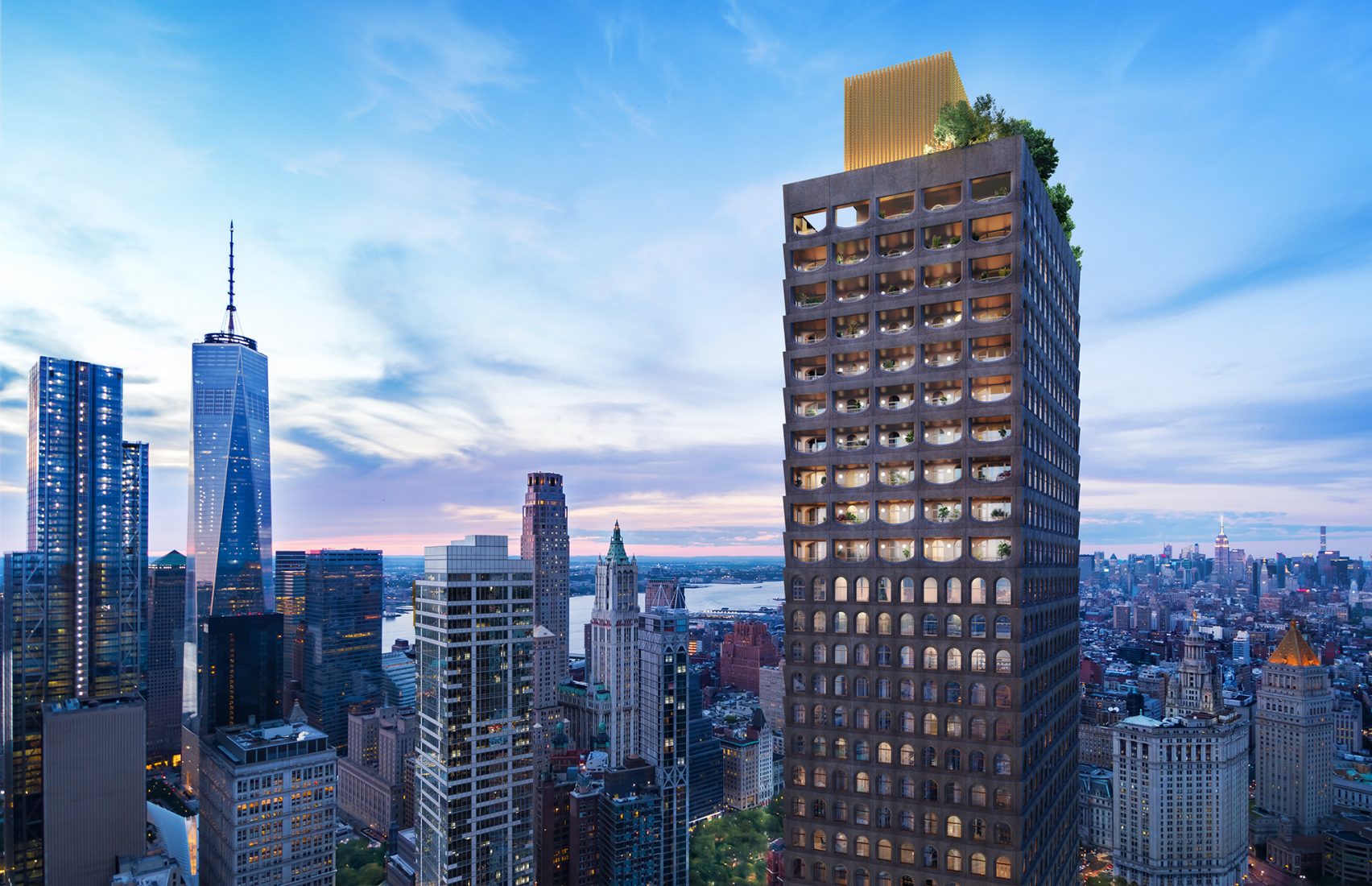
Woolworth Tower Residences unveils their 40th-floor masterpiece in the building where beauty and commerce meet.
In the pantheon of iconic buildings, the Woolworth Tower Residences stand tall. As Stan Ponte, Global Real Estate Advisor of Sotheby’s International says, “We are standing at the highest point the world could reach in 1913. It’s impressive, and it reminds New Yorkers how great man and architecture can be when they work together.” He continues, “You experience New York in a very different way, through the lens of history.” The 33 apartments that make up the Woolworth Tower Residences occupy floors 29 through 58. On the 40th floor, in what was formerly Frank Woolworth’s office, a spectacular, full-floor luxury home awaits.
Framing the best views of New York City are three-storey arched windows dressed in the tower’s distinctive, hand-carved, polychromatic, and fully restored terra cotta tiles, making the 40th floor apartment the ultimate New York City home. Alchemy Properties, the building’s developer, has taken great care to preserve the landmark’s irreplaceable historic features, while updating it for a modern client.
Interior architect Thierry Despont, whose designs pay homage to the building’s original architect, Cass Gilbert, created the residences and public spaces, and the firm has added contemporary luxuries such as app-connected lighting and blinds. Cheryl Eisen, the founder of Interior Marketing Group, walked the line between honoring the building’s past while looking to the floor’s future as a luxury escape. “All of our spaces are high drama,” Eisen says, “because we want visitors to have a jawdropping moment. The interior architecture is high drama and we accentuated Despont’s vision with floor to ceiling drapes. Enormous area rugs, light fixtures, a wall of mirrors and the floor to ceiling curtains all create drama.”
Eisen used the color and details of the restored windows as her main inspiration for decorating the space. Spanning the entire floor, the apartment measures 6,095 square feet with four bedrooms, four bathrooms, and two powder rooms. Eisen decorated each room with a different mood in mind while simultaneously preserving Frank Woolworth’s and Cass Gilbert’s original vision. As Eisen describes the space, “The delicate interior is not the star of the show—it’s the view.”
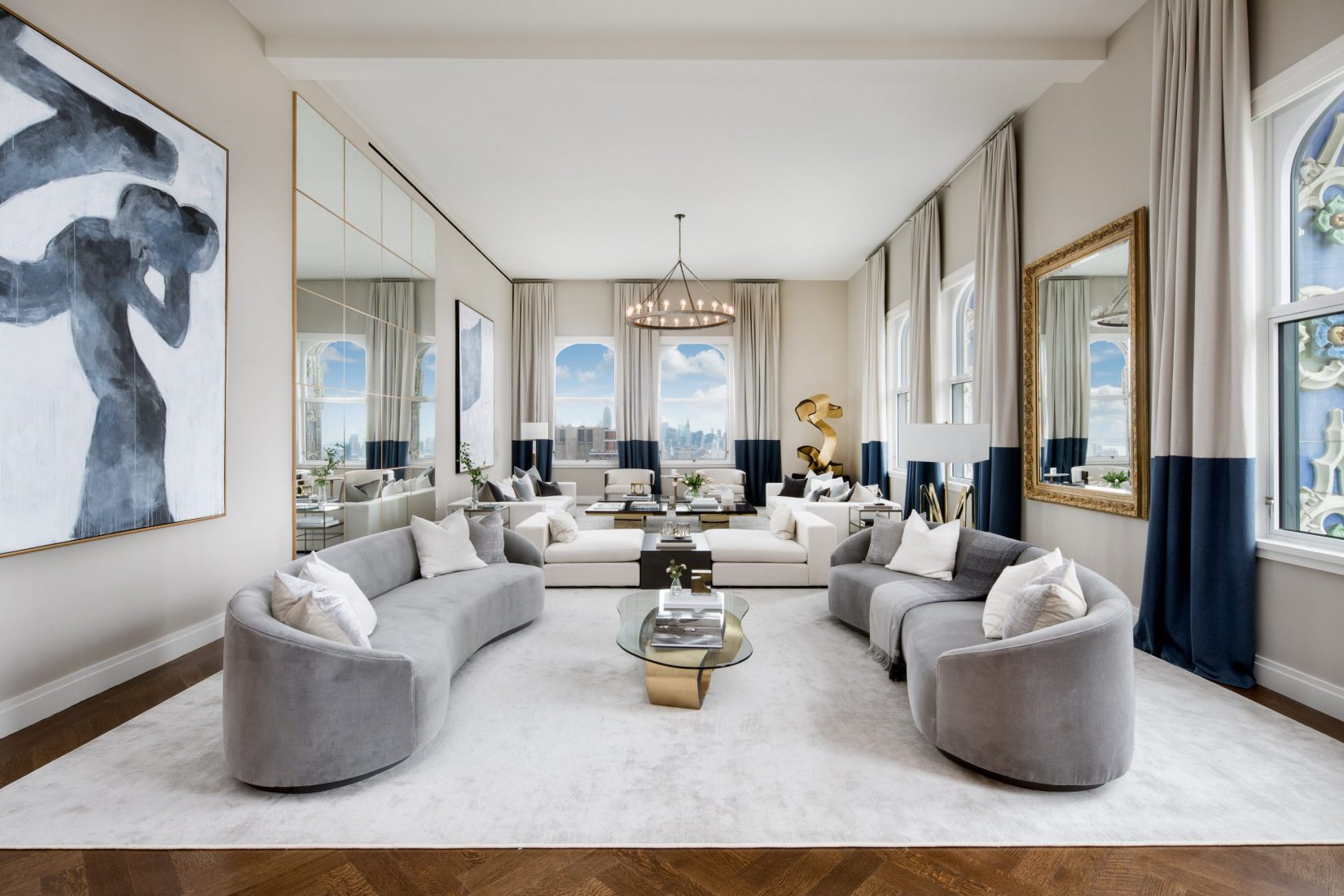
The dashing great room features custom artworks by the visionaries at IMG, the room’s hues complement the apartment’s terra cotta windows, and the furnishing are low profile to accentuate the 14-foot ceilings. A sculptural chandelier completes the room. “Gray and gray-ishare IMG’s signature colors. It’s such a subtle difference between a cool grey, a warm grey and a cool neutral, it makes everything beautiful and lush,” Eisen says. “You can do any piece of art with grayish and it works.”
The furniture featured in the great room emphasizes the classic traits of the building’s aesthetic. Eisen paid close attention to scale in the vast space. The blue palette exhibited throughout the apartment, hiding in small details such as pillows and the deep border on the floor length window treatments, was inspired by the building’s exterior. “The blues are interesting because they bring out the blues in the terra cotta.” She continues. “It’s one of the original artifacts from the building and we wanted to speak to that.”
In the dining room, IMG’s signature grass-cloth wallpaper adds texture and shine. Eisen juxtaposes low furnishings with the dining room’s high ceilings to maintain the grandeur found in the great room. The custom glass dining table complements the large host chairs which were originally made to serve as sofas. “Regular dining chairs would have been too small,” she says.
Eisen used the city views as decor in the dining room, but added a stunning custom mirror at the rear of the room to reflect the window and the cityscape throughout the space.
In the guestroom on the southwest corner of the floor, Eisen chose a masculine style to honor the room’s original use as Frank Woolworth’s office, and which, at the time, showcased a panoramic view of the Statue of Liberty. Says Stan Ponte, “At the time this building was built, there was no real view looking north. There was nothing beyond the Village except low buildings. So he chose the Southwest corner where he could view the only thing to see at the time, the Statue of Liberty.”
Eisen continued with the masculine atmosphere in her decoration of the master bedroom. Much like all the other rooms, the furniture for the master bedroom maintains a low profile, contrasted with decorative pieces incorporated to emphasize the high ceilings. For this room, IMG created a custom headboard that plays with the space between the floor and the ceiling. Eisen further created a leisurely sitting area in the corner of the master bedroom.
Eisen meticulously and expertly selected pieces to reflect the delicate detailing that is already incorporated into the architecture of the building. The design is a representation of the timeless style and elegance of Downtown New York, and serves as a pedestal for the story that Frank Woolworth told with his “Cathedral of Commerce.”