Eschew the production line and choose a one-of-a-kind piece to tie your room together.
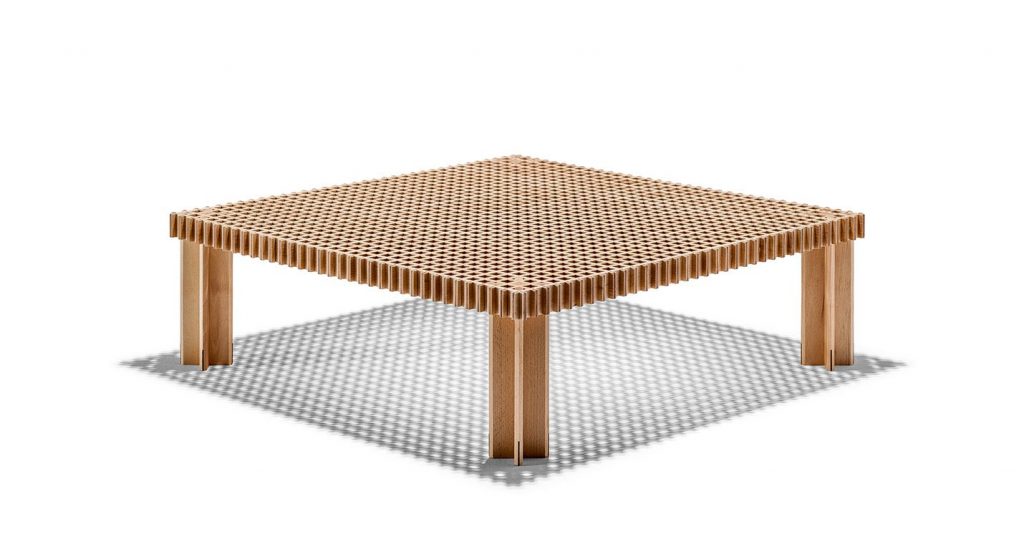
KYOTO TABLE
Poltrona Frau revisits the iconic Kyoto table designed by Gianfranco Frattini in 1974. The elegance of Japanese design blends with the rich and tactile qualities of solid wood. The table is crafted with precision dovetail joints, making the craft part of the decorative appeal.
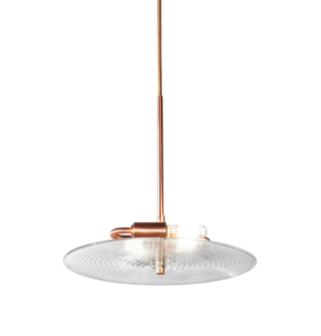
A simple, yet elegant glass rondel hovers beneath an LED light and copper hardware. This pendant light is also available as a flush mount light or sconce.
Bec Brittain’s Taxonomy collaboration with Edward Fields continues with designs based on the structures and functions of the natural world. Hyaline I mimics the patterns of insect wings writ large. Brittain continues to re-contextualize the science of taxonomy, not as limiting or separating force, but as a means of revelation.
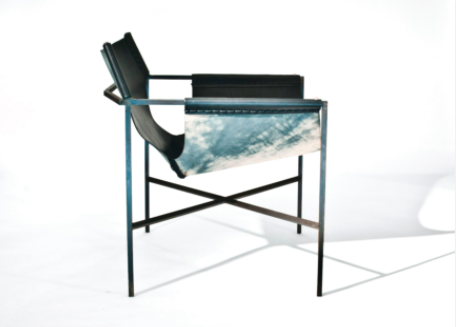
Taylor Forrest designs and produces his furniture in New York. The Club Chair is crafted with vegetable-tanned saddle leather. The sling is fixed to a solid metal frame with an oversized saddle stitch. Hammered brass rivets on the armrests add contrast while keeping the leather in place.
Lodes introduces a crystal suspension lamp designed by Venetian designer Luca Nichetto in honor of the brand’s 70th anniversary. Jefferson uses a reinterpretation of the vortex pattern of Bohemian glass, which casts a swirling play of light.
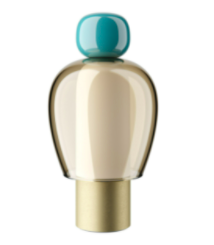
Adds quirky portable style to any room. The rechargeable table lamps from Lodes have a metal base that houses an LED light, and a methacrylate diffuser wrapped by a glass bell. A solid knob functions as a dimmer, and also allows users to control the intensity and warmth of the light.
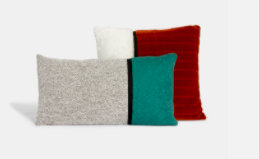
From Marimor Objects are ultra-soft and feature contrasting colors and textures, adding a punch of personality and playfulness. Toss is available in five color combinations and two shapes, lending itself to a range of aesthetics and color schemes.
RALPH PUCCI INTERNATIONAL introduced a new concept in their Chelsea flagship location, last year. The (factory) collection includes work by Patrick Naggar, Paul Mathieu, Vladimir Kagan, John Koga, and Olivier Gagnere, as well as new exhibits. Many of the works are produced entirely in Pucci’s 18th Street workshop, using techniques and materials born out of the company’s history and experience producing mannequins.
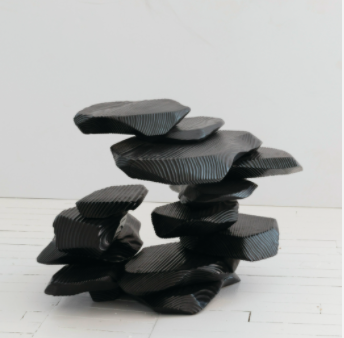
Currently, the floor also houses the large-scale, sculptural wood designs of Stefan Bishop (Orka side table, above) and light sculptures created by Ana Meier and Hervé Descottes for Richard Meier Light (below).
Bishop creates organic forms inspired by the iconic redwoods of his home in Oregon. He works in wood, bronze, and steel, and his pieces beg you to touch them and appreciate the tactile textures that evoke tree bark smoothed and shaped by the elements.
Currently, the floor also houses the large-scale, sculptural wood designs of Stefan Bishop (Orka side table, above) and light sculptures created by Ana Meier and Hervé Descottes for Richard Meier Light (below).
Bishop creates organic forms inspired by the iconic redwoods of his home in Oregon. He works in wood, bronze, and steel, and his pieces beg you to touch them and appreciate the tactile textures that evoke tree bark smoothed and shaped by the elements.
In a limited-edition collection that explores light, color, shape, and shadow, the light sculptures of Meier and Descottes are inspired by the architectural shape of a construction I-beam. ralphpucci.com
Designer Noha Hassan has a gift for zeroing in on the unexpected, perhaps influenced by her globe-trotting past. Hassan’s life has taken her around the world: born in Egypt, she lived in both Cairo and Brussels during her studies, and then Jeddah, Luxembourg, and finally London, before she settled in New York City. Despite her now decade-long calling in the interiors world, Hassan also spent more than eight years working in finance at firms including Goldman Sachs and JP Morgan in London among other business ventures. She regularly calls on her life experience to bring a personal element to her design, making her work unique, and uniquely hers.
Photography by Matthew ScrivensLIGHT AND AIRY: Hassan brought in furnishings designed to enhance the expansive feeling rendered by the high ceilings, letting the linear wall slats and handsome columns draw the eye upwards.
Photography by Matthew Scrivens“Lighting should serve as functional art: architectural and industrial.”
Her worldly past is fascinating and unusual to say the least, and helps give context to her intuitive approach to interiors. Hassan’s seeming effortless touch yields a global aesthetic, and feels natural and layered. Case in point: When Hassan was tapped to renovate a 1,450 square-foot pied-a-terre in SoHo, she brought a new perspective to the project.
In a stroke of luck, the one-bedroom, plus den and open-plan living and dining area already contained distinctive cast-iron support posts original to space. “Fortunately, the developer did not cover them in sheetrock as he did the other units in the building,” says Hassan. “They add the industrial drama typical of original SoHo lofts.” Working around them to create a cohesive unit that enhanced their presence, Hassan and the client’s husband took charge of the space. Since the wife was working on the renovation of their primary residence, Hassan was given full permission to bring a masculine, bachelor pad-flair to the project.
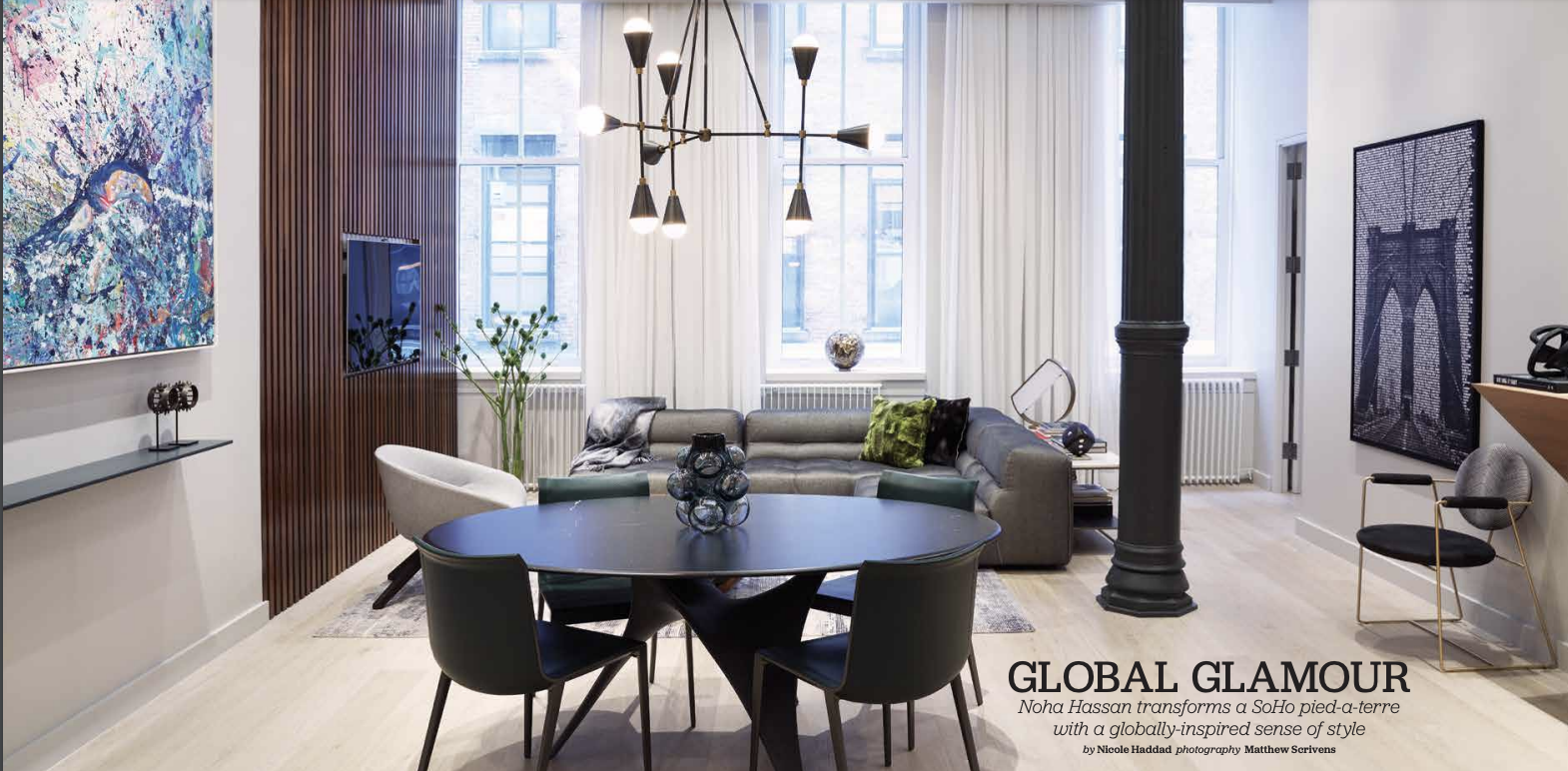
In the open-plan living and dining area, a minimalist yet warm aesthetic pervades the space. Every item is perfectly placed to add both interest and function. In the dining area, the sculptural base of the Foster & Partner’s Arc table for Molteni enhances the simple beauty of the matte Marquina marble top, while the Triad 9 pendant from Apparatus adds an element of surprise. “The New York-based lighting studio is inspired by vintage pieces but gives them a new twist—I love the industrial look it lends to space as the theme of the apartment is masculine, industrial,” says Hassan. “Lighting should serve as functional art: architectural and industrial.”
Light leather Charlotte chairs by Antonio Citterio for B&B Italia bring comfort and counteract the dense nature of the table. To the left, a painting from the clients’ art collection adds a pop of color and sits across from a monochromatic work by Ralph Ueltzhoefer that depicts the Brooklyn Bridge. The piece not only reflects the clients’ love of iconic New York but showcases the artist’s process—Ueltzhoefer layered the work in words describing his concept.
Photography by Matthew ScrivensGEOMETRY IN MOTION: In the living room, various geometric accessories, as well as the linear wall slants, provide a sense of movement.
Photography by Matthew ScrivensNATURAL APPEAL: Hassan anchored the living room seating area with a handcrafted coffee table created by Dan Pollack—an artist she has had her eye on for years. His work is available through Suite NY.
To the right of the Brooklyn Bridge artwork, Hassan satisfied the husband’s request to have additional desk space. The designer added a Segreto floating desk by Ron Gilad, calling it “the most concealed way to add a working area to the living room.” The contemporary Italian desk adds an architectural element that is enhanced by well-placed accessories. The Gemma chair adds the perfect touch, with a black-and-white upholstered back juxtaposed with a black fabric seat and brass body. Overhead, a round mirror reflects the various elements in the space and adds a feeling of expansiveness.
In the living room, Hassan elaborated on the notion of creating an artful and livable home. Gone is the cookie-cutter TV wall, or the expected built-in bookcase meant to hide the television. Instead, Hassan created an intriguing custom wood wall made of various walnut slats that also serves to create a clear separation between the living and dining areas. “I am always inspired by the restaurants and boutique hotels that use 3D wall effects that add depth and dimension,” says Hassan. “I didn’t want all the wall character to come from wallpaper,” she explains, referencing the den’s gorgeous vinyl Phillip Jeffries wallpaper.
Forming the focal point between the sofa and the striking wall, a one-of-a-kind, handcrafted Spotted Sugar Pine coffee table made by artist Dan Pollack sits over a striated textural rug from Stark Carpet. A modular sofa by Patricia Urquiola for B&B Italia is upholstered in an eye-catching fabric that exhibits a beautiful sheen. A complimentary cashmere throw and a green fur pillow from Barneys add comfort and draw attention to the hardware and resin sculpture sitting in the window. Behind the sofa, a narrow bronze table holds a Dice sculpture from Mantiques Modern and a geometric table lamp from Arteriors. For added seating, Hassan included an attractive white swivel lounge chair.
“I wanted to design a contemporary-meets-industrial space: clean-lined, monochromatic, but with a strong use of metals and woods,” says Hassan. The space, and everything in it emphasizes versatility, and singularity, and reflects the lifestyle of her clients. DT
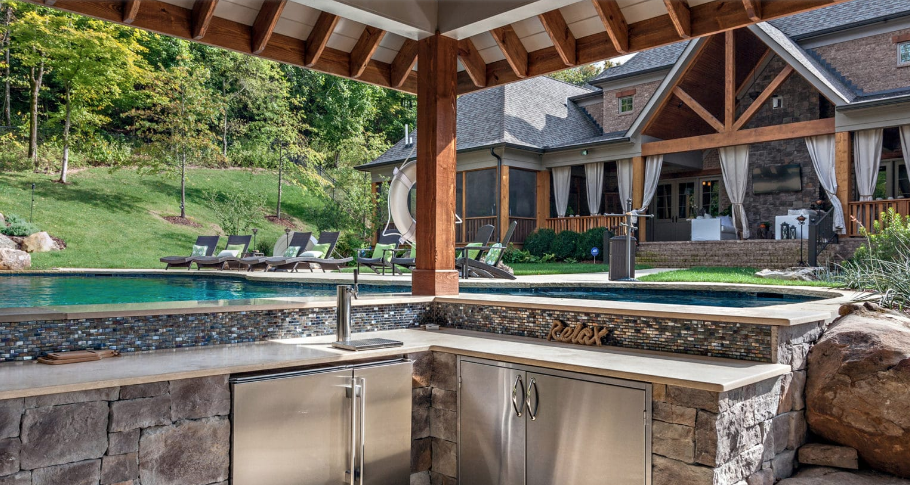
As we all ready ourselves for the fun festivities and fireworks that accompany the Fourth of July, socially-distanced outdoor barbecues, pool parties, and backyard soirées rank high on everyone’s mind. In celebration of one of America’s most red, white, and blue holiday, we thought we’d spotlight some of our favorite products from two American-made brands: True Residential and Room & Board! Replete with designs made for creating the ideal outdoor retreat, we’ve included everything from stools, to ottomans, to beer beverage dispensers, and wine cabinets to boot. Happy Fourth of July!
Room & Board’s Emmet Tall Sofa in Red; True Residential’s Clear Ice machine in Matte White and Pewter; Room & Board’s Oasis Outdoor Sectional in Sunbrella Canvas Navy.
Luxury home refrigeration brand True Residential, which launched in 2008 as an offshoot to its American-born, family-owned parent company, True Manufacturing (1945), has stayed on its American-made path. Room & Board, named as one of the “Most Innovative Companies in Retail” by Fast Company in 2019, also adheres to True Residential’s focus on handcrafted and quality materials, the American-made model, and on good design with some serious functionality. With a vast selection of indoor and outdoor furniture for modern—and most important—summer living, it remains that more than 90% of the company’s products are manufactured in America. Likewise, everything at True Residential is done in-house—from the coiled rolls of steel to the final powder-coated finish. Each with a large repertoire of products that are perfect for creating the ideal outdoor retreat!
Montego Sofa from Room & Board; Undercounter Refrigerator Drawers from True Residential.
From benches and sofas to under-counter refrigerator and freezer drawers, True Residential and Room & Board combined can cater to all of America’s favorite summer pastimes. Whether the focus is on barbecuing, summer poolside parties, and/or backyard soirées and more, all of their made-for-outdoors products will ensure one sublime Plein-air experience.
Entertaining preferences run aplenty, but from adults-only affairs to watching kids run wild, Room & Board’s versatile Brook Counter and Bar Stools, which come in a range of eye-catching colors and are made from recycled milk jugs, sit at the perfect height to pour the perfect draft pour from True Residential’s single or dual tap Beverage Dispenser—also available in a beautiful assortment of color combinations.
For those that lean towards a more relaxed outdoor ambiance yet with a more sophisticated palette, going with a black and metal theme might just be the ticket. Room & Board’s Aria Outdoor Table—shown in a graphite base topped with a marbled black ceramic composite—melds perfectly with True Residential’s easy-access Undercounter Refrigerator, which is shown in a striking matte black finish paired with gold hardware.
Then again, pure relaxation isn’t for everyone. For a more laidback vibe with a touch of fun, opt for Room & Board’s Boyd Round Ottoman in Phipps Spa Mist and True Residential’s Clear Ice Machine—the most efficient ice machine on the market—in the brand’s cheerful new saffron finish. Boost that sense of liveliness with some visual cues!
We all know the matching game can run strong so if that’s the inclination, run with it! Shades of blue are always beautiful, especially in the summer, and when one of the designs actually provides some shade. Room & Board’s Pacifica Square Patio Umbrella in Sunbrella Awning features a 60 mph wind-rating that will keep it in place to sunburns while True Residential’s Dual Zone Indoor/Outdoor Undercounter Wine Cabinet in Cobalt does the highly important job of keeping guests sated and bottles cool and protected.
retail and residential neighborhoods in New York, the large, cast-iron buildings housed factories on the top floors that were used for light manufacturing of household items, lighting, textiles, and fashion accessories. Those goods were then sold in the ground floor retail spaces.
In the 1960’s manufacturing started to give way to artists, who moved into the gigantic lofts because of the tremendous light, and the minimal rents. Though much of SoHo is now more reminiscent of a large, open-air mall, there are still pockets on the outer edges that recall those early days. It is in one of those pockets that Michele Varian has her eponymous design shop.
“I started my business from my loft in SoHo,” says Varian. “I worked as a fashion designer so I wanted to do something that I could self-finance.” Since Varian had fashion experience she had an understanding of textiles and she started with a business that was primarily wholesale. “I started doing these installation-type pieces. I was helping a friend who was getting married in their loft so I made massive cutout scrims that looked like trees and enormous mobiles with transparent and frosted plexiglass discs that reflected the light. I sold those in my first store, but I was mainly doing wholesale business.” Then after September 11, she decided to buck the current trend and open a retail store on “sleepy Crosby Street.”
Image by Ryan Liu
“I was one of the first retailers on Crosby Street.
I made all of the pillows in the back of the shop, and I hired all of the seamstresses I had worked with in fashion.” Though she had a shop, Varian was mostly still selling her merchandise wholesale to stores like Barney’s, Nieman Marcus, and ABC Carpet & Home. Then the 2008 recession happened and things changed. “My showroom reps in Texas were doing tremendous business for me, and in the beginning of 2008 they abruptly shuttered. They had started to feel the pain from the recession before it happened here.”
In the meantime, ABC asked her to do a pop-up shop, and they placed her in a great location on the ground floor. “Up until 2008, wholesale carried the business, and I was a neighborhood store with regulars, a place where people stopped in to take a break. After 2008, my retail business took off, primarily because I have always had accessible as well as aspirational design. I never wanted to be one of those snobby SoHo shops where the staff glares at customers who don’t have enough money. We always had a neighborhood kind of vibe here.”
Curated Collection –
Michele Varian in her Howard Street shop (Above). Below, leather-clad mirrors and tableware by DBO Home, in front of wallpaper designed by Varian and printed by Chambord in Hoboken New Jersey.
Image by Ryan Liu
Today, Varian’s Howard Street shop features an extensive, and colorful pillow library in the basement. She also manufactures her own lighting line in the shop and has a line of wallpaper that she designs, which is manufactured in Hoboken, New Jersey. She just started working with Two Trees in Brooklyn to create a furniture line, and designs jewelry and objets d’art, as well.
The shop also holds a beautifully curated selection of items from other artisanal makers like Bloomist, and DBO Home, which is arranged through Guesst, a system of “pop shares” that she created with fellow Detroit native Jay Norris. The system allows existing retailers and small, artisanal brands to connect. “Even doing a pop-up can be wildly expensive for a small brand.
Image by Ryan Liu
We are hoping that Guesst will help brick-and-mortar stores to survive and still evolve with the changing times.” DT
Editor’s Note: Michele Varian has moved to 400 Atlantic Avenue, Brooklyn, NY 11217. At the present time, the physical store is closed due to COVID-19, however online ordering is available.
In just a few weeks, the world’s leading brands and top talent will come together in a curated presentation of design, offering inspired vignettes by respected brands, design seminars, culinary demonstrations, and special appearances.
Imagine walking around to see the latest designs from furniture, accessories, lighting, and art to kitchen, bath, and building projects, the show offers thousands of products for you to source and shop, from independent makers and well-established manufacturers.
ADD Show is now in its 19th year and draws around 40,000 design aficionados to interact with incredible design displays from more than 400 brands.
“There are a lot of big brands that you’d expect here, but it’s kind of amazing how many smaller brands you can discover. It’s a free look as an architect at what’s going on in the world of design and what’s emerging right now.” —David Rockwell, Founder & President of Rockwell Group
“There’s nothing that surpasses the Architectural Digest Design Show in our industry. It is a meeting of great minds, and where our industry comes to exchange good ideas and take-home information that will improve their business. There’s really nothing that tops it. As seasoned as I am a professional, one would think I’ve seen it all, but more than half of what I see [here] I’ve never seen before.” —Jeffrey Bilhuber, AD100 Designer
PAUL-ÉMILE RIOUX
Mark your calendars, get some comfortable shoes, get tickets and come to meet Downtown Magazine’s team as this will be our first year as a media sponsor.
MARCH 19-22, 2020
Thursday, March 19: 10:00 A.M.-6:00 P.M. Open to design trade & VIP consumer ticket holders.
Friday-Saturday, March 20-21: 10:00 A.M.-6:00 P.M. Open to all ticket holders. Sunday, March 22: 10:00 A.M.-5:00 P.M. Open to all ticket holders.
LOCATION PIER 94 55th Street at 12th Avenue
New York City 10019
This purchase includes a 2-month complimentary trial membership to AD’s new digital design community AD PRO which includes the current issue of AD Magazine, a $50 value.
Your ticket allows you complimentary access to DIFFA by DESIGN! A three-day confluence of design, art, shopping, and festivities located in a new venue Center 414, 415 5th Avenue. From the opening night DBD Gala to the one-of-a-kind industry chats, DBD will showcase the latest in the design world, all while raising money in the fight against HIV/AIDS. DIFFA by Design takes place on March 26-28, 2020. For more information go to diffa.org.
MIELE, INC.
Valid FRIDAY-SUNDAY
Includes re-admission all 3 days
$32.00+tax
Onsite ticket price is $45.00+tax.
Ticket purchase includes a 2-month complimentary trial membership to AD’s new digital design community AD PRO which includes the current issue of AD Magazine, a $50 value.
Your ticket allows you complimentary access to DIFFA by DESIGN! A three-day confluence of design, art, shopping, and festivities located in a new venue Center 414, 415 5th Avenue. From the opening night DBD Gala to the one-of-a-kind industry chats, DBD will showcase the latest in the design world, all while raising money in the fight against HIV/AIDS. DIFFA by Design takes place on March 26-28, 2020. For more information go to diffa.org.
Screen Shot 2020-02-05 at 2.24.08 PM
Valid FRIDAY-SUNDAY
Includes re-admission all 3 days
$32.00+tax
Onsite ticket price is $45.00+tax.
Ticket purchase includes a 2-month complimentary trial membership to AD’s new digital design community AD PRO which includes the current issue of AD Magazine, a $50 value.
Admission to the show is complimentary for Design Trade with proper credentials who pre-register prior to March 19, 2020. Design Trade are registered Interior Designers, licensed Architects, Landscape Designers, Set Designers, Developers, Contractors, and other design professionals. Students can register for complimentary admission. Valid credentials are required and include business cards, company credit cards, profession -membership cards, Tax ID. Along with a Government-issued Photo ID.
Your ticket allows you complimentary access to DIFFA by DESIGN! A three-day confluence of design, art, shopping, and festivities located in a new venue Center 414, 415 5th Avenue. From the opening night DBD Gala to the one-of-a-kind industry chats, DBD will showcase the latest in the design world, all while raising money in the fight against HIV/AIDS. DIFFA by Design takes place on March 26-28, 2020. For more information go to diffa.org.
Valid THURSDAY-SUNDAY
Includes re-admission all 4 days
Onsite ticket price is $45.00+tax.
Earlier this year, two similarly minded companies decided to combine forces and open a joint 7,000-square-foot showroom on the 26th floor of the New York Design Center. Merida, a textile design house and rug maker, now shares an incredibly gorgeous space with FAIR by Brad Ford. We sat down with Merida’s CEO, Catherine Connolly, to discuss all aspects of the design decision, the space, and what’s new at Merida. We left with some serious decor envy and a new appreciation for the craftsmanship and attention to details espoused by both companies.
Merida + Fair Showroom; Photograph by William Geddes.
Downtown:FAIR is one of our favorite showrooms! We are so excited to hear Merida is sharing a space. How did that collaboration come about?
Catherine Connolly: I totally agree with you about FAIR—we love it too. Brad and I met through a mutual friend several years ago and we connected over our love of makers and the idea of re-imagining craftsmanship in America. We also share Southern roots which is a connector. When Jim Druckman approached Brad about taking on a larger space, he talked to me about combining our companies in a joint showroom. Our idea is to create a different experience for designers by letting the space showcase the craftsmanship and invite designers to slow down and discover the amazing but often subtle details inherent in our products.
Downtown: What
has the process been like? Can you describe the showroom to our readers?
CC: I have remarked to so many people about how simple the process of combining our teams and the space has been. So often in life things seem harder than they have to be, but in this case it has been much simpler than I could have imagine. We had a tight deadline and Brad really had a vision for clearing out the old space and creating a minimalist shell for the new space that would allow the magnificent natural light to fill the showroom and our products to tell their story.
Merida + Fair Showroom; Photograph by William Geddes.
Downtown: What do you think your rugs add to the space?
CC: I think textiles are the heart and soul of spaces. They add texture, color, and sometimes pattern, they absorb noise, invite conversation, and add warmth. In our space, they add dimension and depth to the incredible furniture that Brad has so brilliantly curated. We actually had our rugs in the former FAIR Showroom, but now we are also able to showcase our rugs in a way that enables the designer to appreciate the artistry, design, and integrity as much as the depth, quality, and feel of the rugs.
Downtown: In
terms of designers enjoying the space, do you find it gives them more context
to see what various designs can bring out of each rug?
CC: Our hope is that designers will come and linger in the space. We hope that designers and their clients will come and enjoy the space by sitting down, seeing how the light interacts with the rugs and the furniture, and more importantly, to experience how they feel in the space. We have already received a tremendous amount of feedback about how great it is for designers to see our rugs in the showroom in combination with the furniture. We are also seeing more and more designers bringing their clients in to the showroom which is fantastic.
Merida + Fair Showroom; Photograph by William Geddes.
Downtown: Where
are all your rugs sourced or made?
CC: There are three main aspects of Merida’s design point of view: the first is a relentless commitment to natural ingredients. All our rugs are made from rapidly replenishable materials such as plant fibers (like sisal and jute) and animal fibers (wool, alpaca merino) The second is that we care deeply about the makers—the integrity and the spirit of the rug depends greatly on the talented people weaving the rugs, so we invest in them deeply. The third is that our products are innovative—we are creating things that are original, whether it is the way in which the sisal is blended before it is woven, or an entirely new way of weaving and tufting rugs.
We have a 30-year-long relationship with our partner in Belgium where we get all of our woven sisal products. We have a similar relationship with our partner in India where develop all of our jute products, and a third partnership is in the Philippines for all of our abaca rugs. The vast majority of these rugs are made to order in our Fall River workshop where our craftsmen cut and finish the rugs to the designers’ specifications.
Merida + Fair Showroom; Photograph by William Geddes.
The other component of our business are the rugs that we make from scratch in Fall River, MA. All of our wool, alpaca merino, mohair, and linen rugs are designed, woven or tufted and finished in Fall River with our team of designers and craftsmen.
Downtown: Do FAIR and Merida share similar ideas of how things should be made?
CC: In the first conversation Brad and
I had, we realized that we had very similar views about makers and how
important craftsmanship is to our industry. We both love the idea of things
that are well made from concept through to fruition. Craftsmanship takes time, it is not cheap, it
is not fast, and it is absolutely not disposable. This philosophy is nothing short of counter
cultural right now, but I think people are increasingly yearning for something
different from their products, taking the time to understand how things are
made, and are appreciating the details that distinguish amazing work from
mediocre work. That is rewarding in and of itself. The discovery and the knowledge are as
satisfying as the purchase ultimately.
Downtown: What
are some of the rugs you currently have on display in the showroom and what
drew you to carrying them?
Merida + Fair Showroom; Photograph by William Geddes.
CC: Right. Now we are really showcasing
two different collections in the showroom. The first are products that we
developed over three years with our partner in Belgium. They are part of our
Wander collection and they are incredibly innovative and showcase a modern take
on sisal and wool rugs. We had to develop special yarns, and we had to retrofit
the loom in Belgium to create these rugs. Our team had to develop an entirely
new way to finish the rugs, and they are spectacular.
CC: The second collection we are showcasing both on the floor and hanging on the walls are from our Atelier 18 collection. Sylvie Johnson joined Merida as our Artistic director in late 2017 and traveled back and forth from Paris (where she resides) to Fall River to develop this first collection. Sylvie is one of the most talented weavers in the world, and she brought her vision and talent to our team in Fall River. Together they created an extraordinary collection that started in Fall River with the use of entirely new yarns that were blends of mohair, wool, alpaca and even leather and sisal in some of the collections. These yarns are then woven or tufted in combined looms and machines with intricate handwork.
Downtown: We love
that they are displayed as large art pieces in some cases. What inspired this?
CC: For our new Atelier 18 collection, Sylvie set out to create textiles that were totally unique starting with the yarns, and carried through to the weaving and finishing. As with so many things, the beauty is really in all the details and the extensive development process that refined the rugs tremendously from start to finish. When we finalized the Atelier collection we thought of them as works of art and we felt one of the best ways to showcase these details was to hang them as art. We had an exhibition in January in Paris during Deco Off at Galerie Alain Le Gaillard. It made us realize how impactful it was for everyone to really see the intricacy and sophistication of the weaving for this collection and we decided that we should do that in New York as well.
Downtown: What do you most love about sharing the space with FAIR? What kind of collaborations do you foresee occurring?
CC: We love sharing the space with Brad and his super talented team because we are able to combine ideas and collaborate at a much more in-depth level. The two teams merged almost seamlessly which is still incredible to me, and we love the diversity we both bring to the table. We recently had our opening party for the showroom and the overlap on our invite lists was less than 20%! Downtown: What has the reaction to the space been like?
CC: We have been overwhelmed by the
positive reaction our new showroom has received. The comment we heard over and over again at
our opening event was this “marriage” makes sense.
Downtown: If you
could pick any FAIR piece and any one of Merida’s rug designs to take home,
which would they be and why?
CC: Quite frankly, I think I would take any piece in that showroom with any one of our rugs but there are two that I love in particular. Right now, the Sylva Daybed by Coil + Drift of Brooklyn is sitting on our Saga Midnight Flax rug from our Atelier collection which I adore. The second is a stunning circular couch, the Dandy Sofa by MassProductions of Stockholm Sweden that is on a Dash rug from our Wander collection—I would love to have both of those.