Categories
Doctors Featured Miami

When Disaster Struck, This Celebrity Doctor Was Ready

By Bennett Marcus

Hurricane Dorian

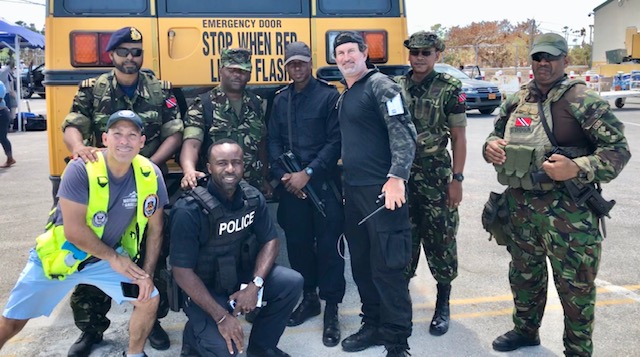
Hurricane Dorian was the most intense cyclone recorded to strike the Bahamas and the worst natural disaster in the country’s history. Dr. Michael Hall, who was in D.C. riding out a category five storm during its genesis, saw the news about the destruction in the Bahamas and felt motivated to help. He joined the Third Wave Volunteers to help run their medical component during the initial recovery a few days after the Bahamian aftermath. Dr. Hall said, “What was endearing was the stoicism of the people who had lost so much and showed great dignity during Mother Nature’s fury.”

Celebrity Clients

At the Hall Longevity Clinic in Miami Beach, Dr. Michael Hall, MD provides regenerative aesthetic, and anti-aging medical treatments, as well as general medicine, travel vaccinations and basic women’s health. Over the years, he has treated members of the Saudi Arabian Royal family, the King, and Queen of Swaziland, Simon Cowell and Blaine Trump. Drake, the rapper, gave Dr. Hall a shout-out on Instagram after a visit last year.

Social Justice Warrior

Dr. Hall is trained as a family physician and eye surgeon, a healthcare policy expert, and provided humanitarian services around the world, including to the survivors the 2004 Indian Ocean tsunami, 2010 Haitian earthquake, and the recent Bahamian hurricane.  He is a published author and is certified in traditional Chinese medicine. As a social justice warrior, he has made it his cause to make health care affordable and more efficient with his medical software company, Wellskor.  A helicopter pilot, Dr. Hall is a designated Aviation Medical Examiner offering FAA-required exams for commercial airline pilots. His life has been a journey of curiosity, learning and fighting for social justice.

Dr. Hall

NY Presbyterian & Weill Cornell Medical Center

As a young ophthalmology resident at New York-Presbyterian -Weill Cornell Medical Center, Dr. Hall observed cases in which African American patients were treated unfairly, and sometimes became victims of malpractice due to racial profiling by doctors. He registered an official complaint with the hospital staff and was dismissed from his duties. “I was eight months away from finishing my residency, and I was literally just thrown out,” he says. He went to the US Southern District federal court and the New York State Department of Health which found the hospital was in the wrong, but his federal judge sat on the case for three years, forcing Dr. Hall to sue his judge for relief. He took it to the New York Times, which exposed the cover-up.

Dr. Hall
Dr. Michael Hall

Lower East Side Service Center

Dr. Hall next took a job as medical director at the Lower East Side Service Center, a substance abuse clinic, found that he loved it, and obtained a master’s degree in healthcare policy from NYU, transforming his career. “I wanted to look at the 30,000-foot view and really see what we’re doing; I had felt that medicine for me really was more at the global level because of Cornell. I was kind of forced into thinking differently about how to look at the patient.”

Volunteerism & Indian Ocean tsunami

He became a community and family physician, board-certified after a two-year residency and then moved to New Zealand to study their healthcare system. While working with the indigenous Maori, the 2004 Indian Ocean tsunami hit. He took two bags with gear donated from the community and flew on his own to Sri Lanka to join another doctor there. To help survivors, he worked with a church, visiting their multiple outreach centers and orphanages. Five of his Maori nurses from New Zealand also came at their own expense. “It was a beautiful experience,” he says.

Traditional Chinese & Maori medicine

While working with the Maori, Hall learned about natural and plant-based medicine, and then went on to work with indigenous peoples in Hawaii, Montana, and Maine. “I found that to be a pivotal point to understand our real human connection to one another, these tribes of people all over the world use local plants, sustainable diets and ancient implements to heal themselves. “That led him to a fellowship in traditional Chinese medicine at the University of Miami, combining a holistic component with Western medicine. “Then anti-aging just made sense because obviously it’s conscious awareness and real preventative medicine.” He attends conferences with top scientists who are “trying to crack the code on what goes on in the body as we age.” 

Downtown Favorites

When Dr. Hall is in New York he likes to stop by Raoul’s for their Steak au poivre and Balthazar for their soft-boiled eggs and fresh bread and coffee. On a Sunday, you might find Dr. Hall at Lupes East LA Kitchen enjoying Margaritas and burritos with friends. hallongevity.com

Categories
Dining Living

Chinatown’s Hot New Restaurant, Chinese Tuxedo

Prepare yourself for a whole new take on Chinese food. The new restaurant, Chinese Tuxedo, has taken Chinese cuisine to the next level and it is the hot place to be.

Rooted in the traditions of Chinatown, Chinese Tuxedo is a contemporary Chinese restaurant set in a former opera house on the historic Doyers Street. Their mission is to modernize Chinatown dining, and they are doing it in a fashionable manner with Executive Chef Paul Donnelly directing the kitchen. Their menu is flavorful and eclectic, enticing reimagined traditional and classic Chinese banquet dishes.

Downtown talked to co-owner Eddy Buckingham about his recent addition to Chinatown. Jeff Lam, the other co-owner, and Eddy have been friends for a long time coming. While Eddy is Australian, Jeff is Chinese/American and together they have created a truly unique restaurant.

Co-founder Eddy Buckingham

It all began one day when Buckingham asked Lam for him to take him to his favorite places for Asian food, which led them to Chinatown. Compared to the Australian Asian food Buckingham was used to, he found American Asian food to be rather “old school” and felt Australia was progressing more. From that moment on, Buckingham was determined to bring this unique twist on Asian food to the heart of Chinatown, which they proceeded to do with the opening seven months ago.

The atmosphere of Chinese Tuxedo makes the restaurant hip and different. A big space and full of history while giving off a contemporary feeling.

Overall, the Pan-Chinese dishes are organic and superb quality of high-end Chinese food. Their menu is more broad but they tend to stick to the classic Chinese principles while cooking, but in their own, new way. All is served family-style, allowing you to try a little bit of everything.

Downtown had the pleasure of visiting the restaurant to find out what all the hype is about, and let’s just say we understand. Upon entering the restaurant, you’re met with greenery and candles lighting up the room, creating a very informal, yet trendy feel, all in the heart of Chinatown.

Among everything on the table, the crispy eggplant was exquisite. After the tasteful dinner, dessert was brought out and was the perfect ending to a flavorful dinner. Although many Chinese restaurants aren’t known for their dessert, Chinese Tuxedo are getting everything right, from dinner to dessert. The Chinese strawberries and cream was out of this world. It was a memorable experience to say the least.

Downtown’s CEO and Publisher, Grace A. Capobianco has become a frequent visitor and has nothing but positive things to say about the restaurant. During her last visit, she found the restaurant to be chic, trending and the hot new place to be seen for celebrities as well..

“It’s a celebrity hotspot, even Usher was there enjoying a meal with friends last time I visited,” Capobianco noted.

“You’re in a historical area, the space alone has more history that one can imagine. Oh yes, and the food is delicious with a fresh spin on old favorite Asian fare,” said Capobianco and added, “Dishes like the eggplant makes your mouth water.”

Chinese Tuxedo aims to give you a premium experience with their new twist on traditional Chinese food. Buckingham stated that the goal is to be the most exceptional Chinese food in the country, and we’d say they are well on their way to reaching that goal.

Photos courtesy of Chinese Tuxedo

Categories
Culture Living

The Birth Of Chinatown

chinatown

Racism And Opportunity Give Rise To A New Nation In A Small Neighborhood.

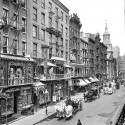
There is no more amazing area to behold than New York City’s Chinatown. The veritable nation-within-a-nation features the largest Chinese population on the planet, outside of the Asian continent, and has been a New York City fixture since its birth in the 1880s.

Established on the notorious geography that was Five Points, and the home of the tenement slums that produced The Gangs of New York, Chinatown is roughly bounded by Broome Street on the north, Chambers Street to the south, East Broadway to the east, and Broadway to the west, depending on the era you’re talking about or the people you’re talking to.

With a current population approaching 100,000, the area had its beginning in the tail end of the gold rush and the completion of the railroads in the Old West. When jobs in both industries began to dry up, the floods of Chinese immigrants who came to the United States to seek their fortunes needed a new alternative.

Because the Chinese were so desperate to work, they were more than willing to take on undesirable jobs at lower wages and as a result, faced anger, discrimination and violence from whites around the country. The intensity of this racism peaked with the onerous Chinese Exclusion Act of 1882, which was intended to stop the immigration of these people altogether.

As a result, many Chinese people came to New York seeking asylum and opportunity, along with the support of their own people. An early settler named Ah Ken, who lived on Mott Street and ran a cigar roll- ing business, is often credited with providing some of the first jobs and accommodations to other Chinese immigrants around this time.

When they arrived, new Chinese immigrants were provided contacts with whom they could board until they were on their feet. This sometimes placed 5-15 people into two-bedroom apartments, and the population boomed. Soon, new Chinese businesses began sprouting up all over the former Five Points area, and people flooded here by the thousands to escape oppression and find work. Uniquely, and to protect themselves from further violent attacks and discrimination, the Chinese people established internal associations of government, community, business and recreation to make the area self-sustaining, minimizing the need for contact with the outside world.

Sometimes this development took a dark turn when some of these associations turned out to be criminal and violent. They were known as “Tongs” and preyed upon local businesses and people. Because they were often from different backgrounds and regions of China, they would stage bloody, raging battles in the streets of the expanding neighborhood, further isolating it from other people who were afraid to venture inside

 By Samuel A. Southworth

The Rebirth of Chinatown is the Rewing feature of DOWNTOWN’s Summer 2014 editionIf you would like to continue reading the entire article, you can find our latest issue on newsstands now! Or you can subscribe to DOWNTOWN Magazine for home delivery by clicking here.