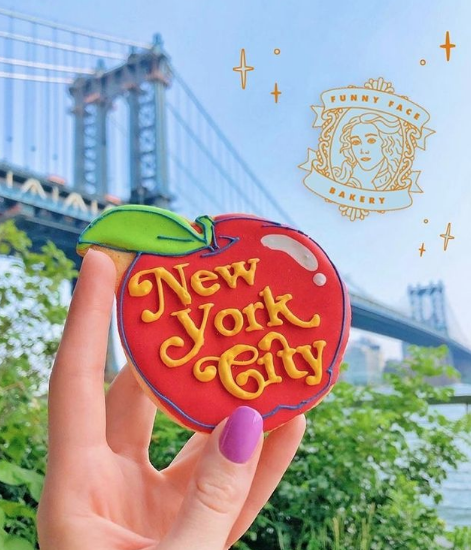
In this episode of Downtown Highlights, we visited Funny Face Bakery, where they make a variety of very detailed, hand-piped cookies.
About Funny Face Bakery
Funny Face Bakery They are located in the Seaport District at 6 Fulton St, New York, NY 10038
Funny Face Bakery was founded in 2016, Sarah Silverman opened her first bakery in East Village. She gained attention for her cupcakes, made with Swiss meringue buttercream. Silverman debuted her face cookies in August 2016 for the first time with the faces of the 2016 Presidential Candidates. These cookies quickly gained a lot of attention. As a result, Silverman hired a cookie decorating team to keep up with the demand.
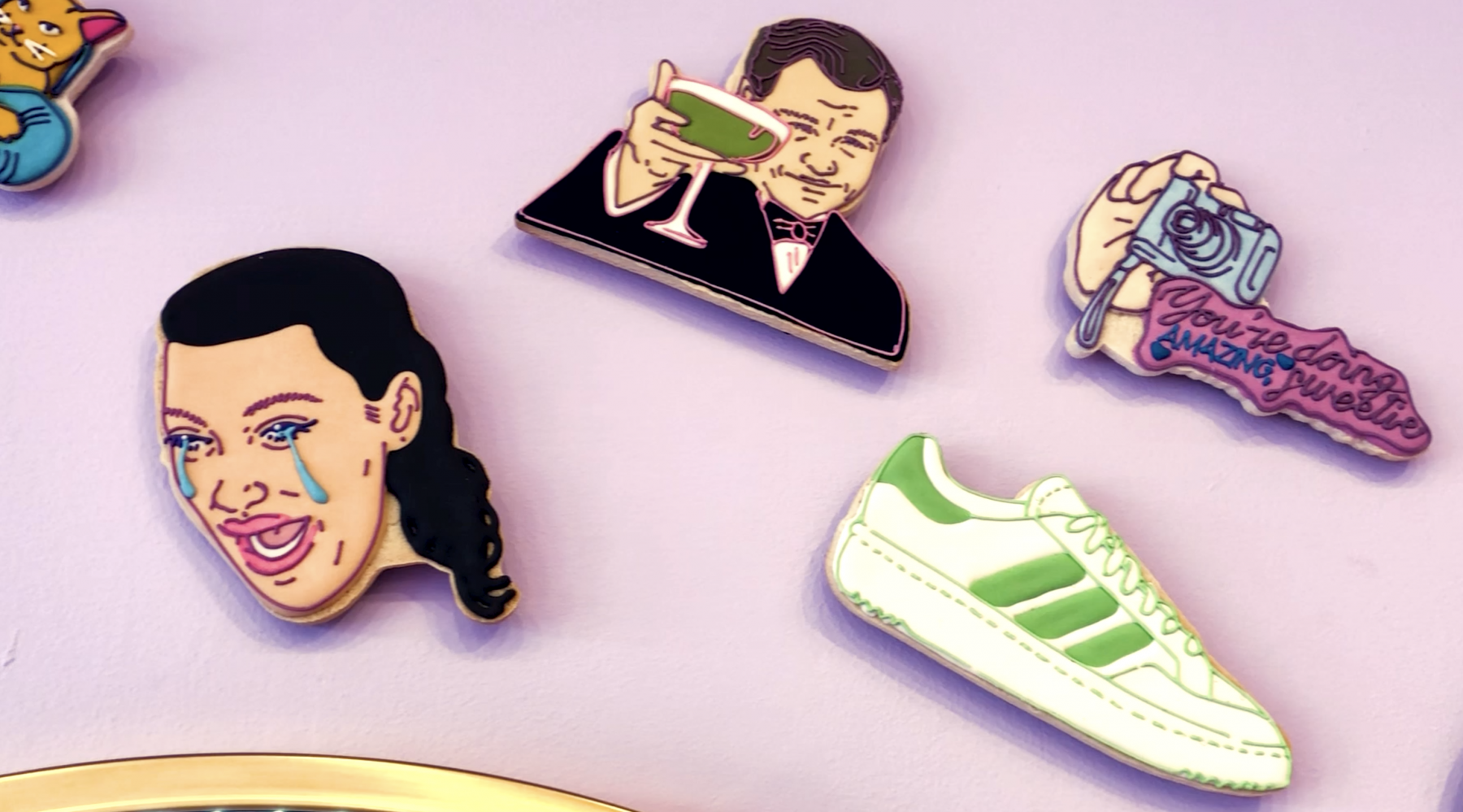
Some classic cookies at Funny Face Bakery: Kim Kardashian Crying, Leonardo DiCaprio as the Great Gatsby, You’re Doing Amazing Sweetie Meme, and an Adidas Sneaker.
Each cookie is made with a laser printer cookie cutter to ensure each cookie is the exact shape needed. Cookies go through two rounds of icing, first a base coat of icing and then the detailed hand piping. The making of one cookie can take 20 to 30 minutes to make depending on how involved the design is.
Five deluxe cookies at Funny Face Bakery: Chocolate Chip, Rainbow Crumbfetti, Double Chocolate, S’mores, and Oatmeal Raisin
They also have freshly baked, 6-ounce deluxe cookies that come in flavors including double chocolate, chocolate chip, oatmeal raisin, and more.
Some of Funny Face’s best-selling cookies are the Kardashian cookies, the Harry Style Cookies, the Birthday-themed Cookies, and the Mean Girl’s themed cookies. Funny Face Bakery’s animal cookies, such as the horses and dinosaurs, are very popular among kids. They will also make personalized cookies of your face or your pet, the perfect gift for someone who loves sweets.
Tasting the Cookies at Funny Face Bakery
These cookies taste as beautiful as they look! Since Funny Face Bakery has not yet developed gluten-free options, Sam did the tasting in this episode. First, she tries a birthday-themed decorated cookie. This cookie was absolutely beautiful and sweet. She almost felt bad for eating such a detailed piece of art. The second cookie Sam tries is the deluxe double chocolate cookie. This cookie was so gooey and soft, and of course, very chocolatey.
Funny Face Bakery is Something Really Special
This bakery is one of a kind. There are no other bakeries nearby that create as detailed and beautiful cookies as Funny Face Bakery. Also, Funny Face is in on internet culture, allowing them to relate well with people, especially younger generations, with their celebrity and meme cookies. Funny Face Bakery is definitely worth the visit!
For more Downtown Highlights episodes, click here.
Jessica Camacho has always had an inclination towards justice. She even considered a career in law before becoming an actress. She enjoyed the idea of fighting for what is just, something larger than herself. That makes her new roles, as LA County Public Defender Emily Lopez in CBS‘s All Rise and Police Officer ‘Pirate Jenny’ in HBO‘s Watchmen, particularly compelling.
Both shows ask compelling questions about the criminal justice system, and about the responsibility each person has to do what is right–whether or not that thing is backed up by the law. Camacho herself holds strong convictions, though she doesn’t see those convictions as political. “There are things that I just know are right,” she tells me, “that is like the pursuit of freedom, the pursuit of fairness. We all want to be treated with respect. To have a shot at a life and providing for ourselves, for our family. We all want to be free from violence. That, to me, is the hard line.”
Downtown: What excited you about All Rise?
Jessica Camacho: I get to play this incredible human being who is committed to justice in a very clear and true way. I got to really understand and explore what it is to be a public defender. That particular line of work is so heavy and burdened by the knowledge that so many lives are reliant upon the public defender as their last line of defense. The clients often have nothing and are in situations that are so dire. They are trusting in this human being to help them have a shot at the rest of their lives. I get to play somebody who is committed to something so much greater than themselves. I was very honored.
DT: Did you have an interest in the legal system before this role?
JC: Before I became an actor, before I even knew that acting would be a part of my life, I thought about going into law. It’s something that always interested me. It fascinated me: fighting on the right side of things, fighting for something bigger than yourself. I was always moved by that.
The problem was that I could never decide if I wanted to be a prosecutor or a defense attorney. I was not very good at making decisions, so I’m like, I might not be the best lawyer. I see the gray a lot of times. I’m not a person that is more apt to see things in black and white. So it was just like, “I don’t know if this is the right pursuit for me.” And then pretty soon after that, I discovered acting.
Jessica Camacho
DT: Were there any issues in All Rise that were particularly close to you?
JC: I think the thing that’s closest to me in my personal life is Emily’s struggle with relationships. But also I know that the topics that we explore in All Rise–as a human being, as an American–a lot of those really resonate with me, hit home with me. So I often find myself being really, really stirred emotionally by the things that we’re exploring on the show.
DT: Did you read Watchmen or seen the movie before you, uh, audition to be part of Watchman?
JC: I had seen the movie. As I was auditioning, I started to read through the original graphic novel and I was blown away. It was dark and it was stirring and it was uncomfortable. It was talking about real fears and real anxieties, and the paranoia and the darkness within us.
So that’s when I kinda realized like, “Oh, this is special, this is really special. This is like a different kind of look at life through the lens of the comic filter. This is something different.” So, yeah, it was very exciting.
DT: In addition to Watchmen, you were also on The Flash. Why do you think superhero shows are so popular right now?
JC: (Superheroes) speak to the possibility, the potential within us. I think as human beings, we feel limited in our lives. We feel the separation between how we want to see ourselves and how we actually see ourselves. I think the fascination with superheroes, it kind of picks up where our limitations leave us and there’s something beautiful and there’s something freeing about that.
But I think in terms of Watchman, I think this is the perfect time for Watchman because, with the constant stream of news and updates that technology brings us, we’re blown away by how much war, darkness, fighting, racism, and fear there is in the world. I think we want even our fantasies, even our heroes, to reflect what we’re experiencing as human beings.
I think people now want to see real. Yes, (Watchmen is) dealing with fantasy and yes, it’s dealing with heroes. Yes, it’s dealing with masks, but why the masks? What are the masks hiding? What are they disguising? I just think we’re just ready to delve in, even in our fantasy, to the darker nature of what is behind all of this.
When you see Watchman it’s like, Oh shit, this is not shying away from ugliness. This is not shying away from the horrible parts of American history. This is actually digging straight into that. Like, let’s address it so we can stop hating. Let’s address this. Then we can stop pretending that this is not at the core of us right now because we need to heal from it. And wounds need air to heal. I think it’s actually a really positive and beautiful thing that we’re starting to present things that are of the darker nature of us because I think it means that we want to heal.
Jessica Camacho
DM: What’s next?
JC: Right now, we just found out that uh, all rise is getting a full season, so we’ll be shooting until about March. I think we’re just all kind of like, “Cool, all right, let’s buckle down. Let’s make this, let’s combine our efforts and make a really beautiful piece of work.” So that’s what’s on my agenda. I’m excited to see what comes next. I’m bubbling over with passion and energy. I love what I do. I am so, so excited to show up for it, to show up for every project that I get to do, and I’m just excited to see what comes next.
Artist Domingo Zapata was honored at the Brooklyn Borough President’s Latino Heritage Celebration where he received the Most Influential Artist of The Year Award. The theme of the event is Young Artists/Old School and Domingo gave the keynote speech. Zapata has also created the illustrations for The Lonely Princess by Marie Ferraro from Lightswitch Learning, which comes out in time for the holidays in November. The book is about the power of friendship, generosity, and respect for the differences between people.
“Life is a Dream”
Domingo’s 15-story mural that wraps around the One Times Square. Features his mantra, “Life is a Dream” amidst flowers, flamingos and polo ponies. The artist said, “For me, it is an honor to be part of the story by creating Life Is a Dream, the largest mural in New York. I want to convey this message to people from all over the world who visit Times Square and who can enjoy and get to know my art.” The mural will be on view through January 1st.
‘Life is A Dream’ in Times Square
Success, Contrast & the Future of Patronage
Zapata’s early impressions as an artist, coupled with several high-profile clients, first cultivated a reputation as an artist du jour. But after 15 years and creating a portfolio of art worth over $40 million, the Spaniard’s ever-increasing success – and the artistic vision underlying it – continues to paint a decidedly different picture.
For years, Domingo Zapata has been, in a word, busy.
It’s not just the paintings, which for the last decade have required perpetual work to keep any amount of inventory. It’s not the increasing number of sculpture and mural commissions that he fulfills or the expanding social media input. Nor is it his many exhibitions or the myriad number of collectors and clients, including Johnny Depp, Leonardo DiCaprio, Diana Picasso, the Missoni Family, and investment bank Goldman Sachs.
Instead, it’s what Zapata has been doing with his own time. Whether it be collaborations with global figures such as Alejandro Sanz, designing clothes for his fashion shows, donating artwork to innumerable charity events, writing a novel, painting with Pope Francis, or serving as a guest speaker at the United Nations to advocate for art education, Zapata has done it all.
Pope Picture
The resulting image is in stark contrast to the one that Zapata’s earliest critics predicted – that of an “artist to the stars.” But Zapata’s outlook and ascent have been remarkably consistent for the past fifteen years – the duration of his career as an artist – and the predilections of the past have been unraveled year by year, painting by painting, achievement by achievement.
As the artist himself notes, his works “contrast between the past and present, and try to make the work say something about the future.” It’s fitting, then, that Zapata himself is one such contrast, in art as in life; and with a past not steeped in fine art, but rather, in humble beginnings on the Spanish island of Mallorca.
Zapata’s Early Years
Had Zapata ambled up to a younger version of himself on Mallorca in the early 1980s, he would have likely found himself back in the garage his father worked in. And even then, it would not have been surprising to see him with paintbrush in hand. “I always loved to paint,” Zapata notes. “It’s something I was obsessed with since I was a kid. We had a car shop, and my dad fixed and painted cars, and my mom was a painter. We lived on top of the shop, so every day I lived with the paint and the fumes. The environment I grew up in was one with a creative family.”
But when it came to painting full-time, Zapata – who graduated from American University with a degree in political science – was at first more pragmatic, especially after his move to New York City in 1999, where the art scene was particularly intimidating. “Moving to New York, I never thought I had a chance. I came from this humble background, and I didn’t even know where to start. I took the first job that was available, to survive, and in those days, the jobs were in finance.”
For the next ten years, he worked in corporate, painting in his home when he could. That is, until one day in 2005, when a friend, contractor Michael Borrico, took an interest in a picture of a polo horse that Zapata had painted and placed in his office.
Blue Polo Horse
“This friend of mine came by our office and he said, ‘Oh, I love that painting, I’d love to show it to a friend of mine,’ Zapata recollects. “It was a painting of a polo horse. And I said to him ‘I did it.’ And he’s like, ‘I can’t believe you did that!’ And I said, ‘Look, I have a studio in my house; it’s a hobby. I do this.’”
Convinced he had found talent, Borrico organized a dinner and exhibition at his house, where Zapata’s work gained its first critical recognition. Various gallery representatives bought paintings, and the friend that Borrico had mentioned so casually in the office turned out to be none other than billionaire George Soros, who made a purchase of a polo painting titled “Blue Horse.”
The feedback was overwhelmingly positive. “They all motivated me to dedicate myself to art,” Zapata said. “I quit my job and started painting. I was working in the corporate world for more than ten years, leaving a job where you were making some money. But I thought, if I don’t do it now, in my early thirties, when am I going to do it? So I went and I said, ‘fuck it, I’m going to go ahead and do it.’ And thank God it worked!”
Asked if this strange road to the beginning of his artistic career had an impact on his eventual style, Zapata answered in the affirmative. “That’s where my unconventional way of doing things came from. When I wanted to go to college, everybody said no, when I was in college, everybody said no, when I wanted to get a job, everybody said no, and when I wanted to be an artist everybody said no. So I said, you know what, I’m just going to do things my way, and nobody’s going to say no to me.”
Superman by Domingo Zapata
2011 : Artist to Watch
He never looked back. Zapata began painting incessantly, creating works for events, commissions, and “pop-up shows:” sponsored, transitory exhibitions. In 2011, he was named Whitewall Magazine’s “Artist to Watch,” slowly cultivating a clientele ranging from typical collectors to celebrity purchasers. Small events eventually transitioned into larger gatherings, and over the years the guests at such shows ballooned into the thousands.
As Zapata’s clientele grew, so did his opportunities. He began holding exhibits throughout the world, including appearances in Paris, Miami, Los Angeles, New York, Venice, Rome, Singapore, and Monte Carlo. From these gatherings, he generated continued interest in his work and began receiving regular commissions. Celebrity clients whom he had met along the way also continued to buy, including Johnny Depp and Leonardo DiCaprio. Such efforts bore fruit: in 2005, his paintings sold for $5,000; in 2011, $30,000; in 2015, $40,000 to $50,000. Now, in 2019, Zapata’s smaller work sells for $60,000 to $70,000, with his larger gallery pieces and sculptures regularly selling for well over $100,000 a piece. And perhaps more impressively, he has no inventory of artwork, as his works and commissions have sold out completely for the last ten years.
Artistry: Style and Substance
Given the excitement surrounding Zapata’s artistry, one would expect the works themselves to be similarly exciting; and by no means do they disappoint. Falling roughly within the confines of neo-expressionism and pop art, Zapata’s works utilize bold use of color and exploration of themes such as sexuality, power, and opulence. But more than anything, his work is defined by contrast. Within a single showing, one might see the Mona Lisa bedecked somehow magnificently with graffiti, mixed media, and a platoon of primary colors; a pop art panda sporting backgrounds with neon geometry or sinister scenes emulating crucifixion; a garden with beautifully ornate flowers and growth breaking free of rigid outlines; bullfighter jackets, or chaquetillas, generously marked with color and text; or something as commonplace as an airplane vividly portrayed from the front, a cruel line and three blurred propellers screaming against the hues and text they appear to be suspended in.
“I like to work in different themes,” Zapata muses, “for things that I am passionate about. And then I like to use different techniques on those themes, according to the theme. However, the strokes are always the same…so when you see my work, you will see and recognize it’s mine, it’s Domingo Zapata, because of my colors, the strokes, and messages, and the type of combination and conversation of colors.”
Zapata’s attention to such contrast is the cornerstone of many of his themes, both in how he views art and how he views reality. It can be seen in virtually every series he creates, whether it be the juxtaposition of Polaroid and acrylic in his ‘Ten’ series, for which Sofia Vergara and others have sat, or the larger-than life figures in his superhero paintings as they sit among graffiti. This, he states, is no different than how we might see it in real life. “The world we live in is about contrast,” he says emphatically. “In New York City, you can live in a twenty-million-dollar penthouse, you go downstairs, and there’s somebody sleeping in your door. These contrasts have an influence on me, because I am a contrast. I was born in a very humble family that was making an average of $800 per month for their entire lives, and I can make a painting worth more than $100,000.”
It is for such reasons, Zapata notes, that he cares so much about emulating contrast in his own style, although his background and later immigration to the United States have also heavily affected his creative process. “As a Spaniard loving art, I was brought up understanding – or,” he corrects himself, “learning, better than understanding – about Velasquez and Goya and Picasso and Dali…and then I moved to New York and had a huge influence from the pop culture of the 80s that was just kind of turning into the beginning of the 90s. So I had the end of that movement with Warhol and Basquiat. It created this passion for contrast, where I would try to take the master’s work and make it contemporary using contemporary techniques.”
When asked about how he wants his artistic style to impact others, Zapata was quick to answer:
“Everything’s possible, that dreams are possible, that if you go and work very hard you can achieve whatever you want in this life, no matter who you are or where you come from. That’s what I portray in my work. And it’s always positive and it’s always trying to make you feel good. I always say I don’t know anything, really, about business or about politics, you know, but I do know how to make this world more beautiful. Other people can make it better; I’m just going to make it beautiful if I can.
“I try to use my work to influence those people in a positive way, to make them feel good. And if they have it in their house and they wake up in the morning and they’re going through any struggles, or whatever – if they look at my painting and it makes them feel better to go to work, and to make the world better – then I’m doing my job. And that’s what I do, that’s my motif, that’s my style.”
Letters to Panda, Acrylic on Canvas by Domingo Zapata
Patronage, the Gallery Model, & Social Media
Zapata’s unorthodox style also extends to social media. While many artists remain firmly in the gallery model, Zapata has decided to create inroads into social media sites such as Instagram, where he currently has close to 40,000 followers – and through which he has occasionally sold paintings to collectors. “I don’t have anything against galleries or the gallery model,” he said, laughing. “It’s a misinterpretation; if you Google it, you could find a Zapata at maybe sixty shows.”
But the artist is adamant that the future lies in the past; or in the case of the art world, patronage. Pointing at the large overhead that many galleries and their artists have to deal with – whether it be from rent, staff size, shipping costs, and the like – Zapata notes that social media is providing a conduit between artists and collectors that simply didn’t exist a decade ago. “In today’s world, with social media being such a big influence, bigger than regular media, everybody looks at Instagram, Twitter, Facebook,” he says. “Now, you have all these sites which bring the collector and painter together, so they can start their own relationship. And that’s where we’re going. I don’t think these platforms are a condition-based model; they’re a service model, where they’re introducing you to the variety; they put you right in front of the source. That’s how it was done a hundred years ago, and that’s how it’s going to be for the next hundred years.”
This, he agues, is a return to patronage; social media and website users can browse through the work of a number of artists, find an artist that suits them, and meet them in person. Instead of going through a gallery, where paintings are normally viewed, the role is being taken by social media sites and more polished, art-specific services. And this, in turn, helps to bring exposure to artists who otherwise might have trouble wending their way trough the gallery model. “I think it’s amazing,” he says. “It gives an opportunity to those thousands of artists to have a chance, even if they are totally unknown. Talent prevails.”
To that end, Zapata expects that artists large and small will eventually shift to a form of digitally enhanced patronage, and he has every intention of being on the cutting edge. Pointing to artists like Picasso and Michelangelo, who both benefited immensely from traditional patronage, he also discusses how art, a much older institution than art galleries, thrived under that system. “The art world is forty thousand years of history, since the cavemen dipped their hands in blood and printed them on the cave to state ‘I exist, I am here.’ That’s the beginning of art, the beginning of the international language that everyone can understand.” While a far cry from that age, social media, he says, is once again making the language of art accessible, both for collectors and artists alike.
Sky Polo by Domingo Zapato
Philanthropy
Zapata’s desire for accessibility in art is the focal point, as it turns out, when it comes to philanthropy. In the name of practical application, he supports innumerable charitable organizations, including routinely creating or auctioning off his own works for charitable foundations for hurricane relief, funding art programs for children with impoverished backgrounds, participating in New York Fashion week for charity, and raising awareness for art education.
Even in New York, where the art scene is alive and well, Zapata notes that 80% of public schools do not have an art program anymore, despite higher rates in previous years. “I believe that if we forget art in education, then we will be raising children without sensitivity, and those will not be children; they will be soldiers,” he says.
To counter this issue, Zapata has been heavily involved with Pope Francis, whom he has visited, painted with, and more recently, been appointed an ambassador to the Scholas Occurentes program. As an ambassador, Zapata will meet with the pope twice a year and discusses how to further benefit the program, which unites low-income schools together to improve resource generation and increase the quality of education for its students. As an ambassador, Zapata was also able to attend a panel at the United Nations and speak about the importance of art and education at the recent Latin American summit.
Zapata’s motivations, however numerous, come down to a simple goal, however. “To me, right now, I just want to be able to express to as many people as possible everything that speaks to my heart; to be able to use my position, and that place of influence, to do murals and sculptures which are public, for people to enjoy; and to use it to raise funds for charities and causes that I believe are important; and also grow as an artist. I’m already in the system, where I can pretty much say I’ll be doing this for the rest of my life; God forbid that something fucked up happens; but I am one of those who have that opportunity, which have been given so much. It’s my time to also give back, and at the same time, grow as an artist, and keep expressing myself. I don’t know how or what is next, but I know that I will fight like the first day to keep delivering feelings and a positive energy to anyone that is aiming to take them from me.”
Looking Forward
But fifteen years is, Zapata hopes, just scratching the surface; and though forever occupied by exhibits, painting, and his own activities, he never wants to be complacent. Indicating a distaste for being labeled, he takes inspiration from artists like Pablo Picasso, whose style changed dramatically throughout his life. “I don’t want to be stuck with description,” Zapata says decidedly. “I just want to be able to do. You have artists like Picasso who have proven themselves extraordinary through different styles and different themes throughout their entire life and career. So if you look at Picasso when he was twenty, it has nothing to do with him when he was fifty, or when he was seventy. And I think that is an example to follow. I cannot be doing the same thing…I want to work in different themes and different styles my entire career, so that I’m influenced by every moment I’m alive.”
Part of accomplishing that, Zapata says, is continuing to do what he does best. “I’m not an artist to the stars, I’m a painter,” he says simply. “I have the opportunity to paint people who are extraordinary; obviously, with some, I am going to develop synergy or friendships with them. One of the most beautiful things about this work is that I get to know people, and I’m happy to have that opportunity.”
Spring Red Flowers Acrylic on Canvas by Domingo Zapata
And that opportunity, it seems, has enabled him to use his artistry to positively impact all that he meets – whether it’s a client personally visiting his studio, an aspiring artist who sees his work on social media, or a beneficiary of his philanthropy. Such interaction, he says, is what keeps him truly inspired.
“I believe in this world,” Zapata finally says, taking in the last breath of the interview. “My clients are celebrities, and billionaires, and collectors; but they are also children in need, and charities, and everybody who walks through Brooklyn and sees my mural. This is my collector base. This is my job.”
Nick Jonas, Joe Jonas, Kevin Jonas, Ryan Tedder, Lindsey Underwood
October 9th, 2013 brought heartbreak for millions of teenage girls when it was officially announced that the wildly popular, Grammy-nominated Jonas Brothers were breaking up. The three brothers went their separate ways, citing “a deep rift within the band” and “a big disagreement over their music direction” as the reasons for the split.
Following the band’s split, Kevin, Nick and Joe continued to exist in the public eye, Kevin for the reality television show about his life with wife Danielle Jonas, Nick for his successful solo music career, and Joe for his funk-pop band DNCE.
However, on February 28, 2019, six years after the break-up, the Jonas Brothers announced their reunion as a band. They debuted their first single since the band’s absence, ‘Sucker,’ the next day. Their new fourteen-track album, Happiness Begins, and the Amazon Original documentary following their journey as brothers, Chasing Happiness, were released on June 7, 2019.
Despite the overwhelmingly positive reaction to the reunion of the beloved group, fans still had a lot of questions about why the band decided to get back together, why they broke up in the first place, and what this new era will bring for the band.
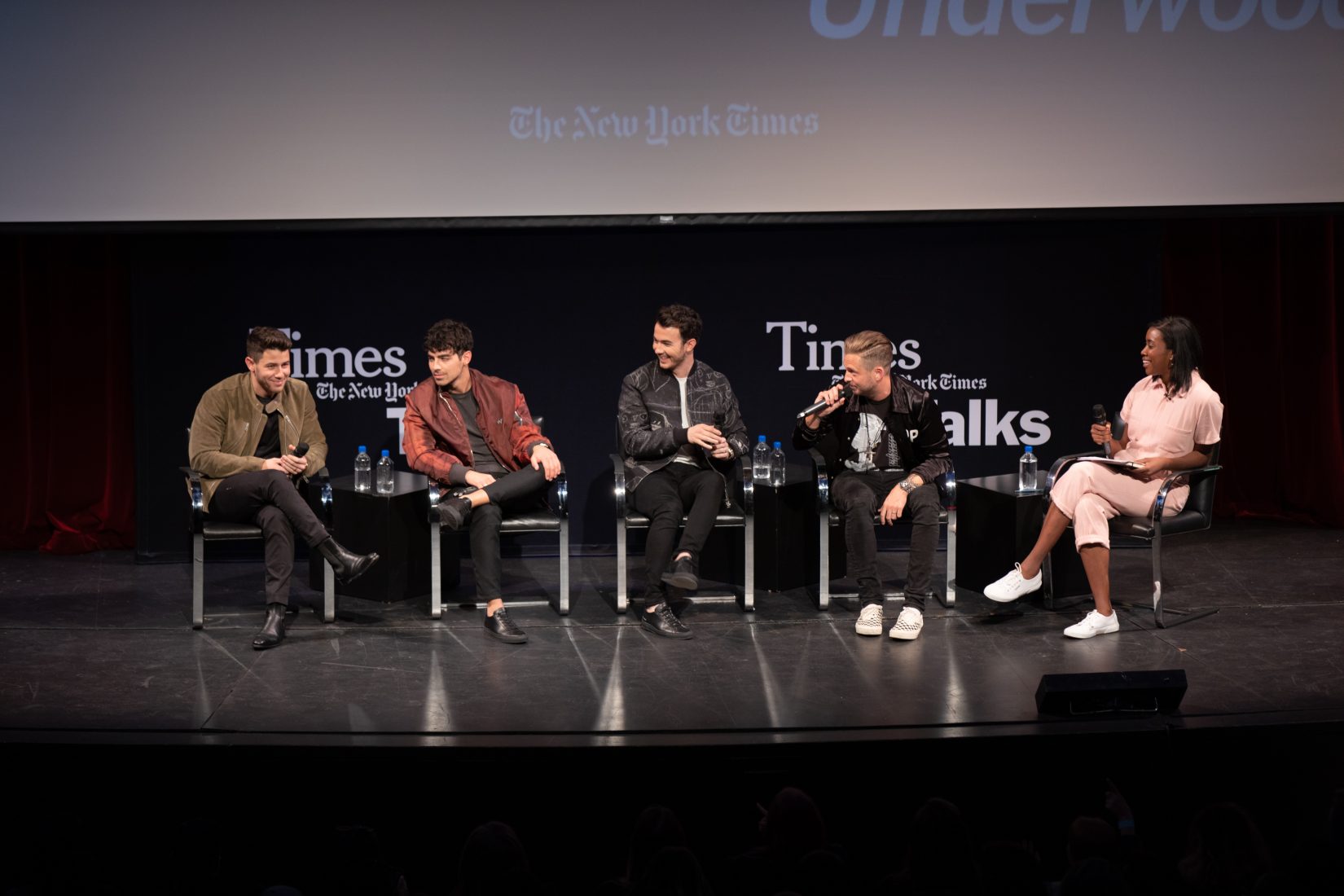
Kevin, Nick and Joe, joined by OneRepublic frontman and Happiness Begins’ executive producer Ryan Tedder, tried to answer some of these questions to a live audience of press and fans at a TimesTalk in Tribeca on June 13, 2019. The event was a part of The New York Times’ live conversation and performance series.
Nick Jonas, Kevin Jonas, Ryan Tedder, Joe Jonas, The Jonas Brothers
Tedder
and the three Jonas’ covered topics like their collaboration, the new album and
its influences, and most importantly, the growth of the Jonas Brothers as a
band and as a family during their break.
The new era for them began with the intention to just do a documentary, they explained, to share more about their lives and growth with fans and the world, and it evolved organically into the official reunion of the band.
A recurring theme during the hour-long session was healing. The brothers discussed the personal rifts and the factors that caused them, which developed between them before Nick’s decision to pursue a solo career- the ultimate catalyst in the band’s break-up. It was a difficult decision, but one they all felt necessary, as Nick said. He carefully articulated the importance of the break and how it allowed each of the band members to discover who they were as individuals, rather than basing their identity solely on the band.
Nick Jonas
“I never felt like I gave up on our friendship, our brotherhood or any of those moments, but I needed to take a step away from it. And it took a lot of time, it took a lot of healing for me personally. And I will say it was hard. There were times where it was tough to watch them succeed. But I started to realize that I was succeeding so much and growing so much as a person,” Kevin said of the growth the hiatus forced them to undergo.
Part of that growth meant distancing themselves from Disney. Nick assured that they were thankful for the platform that Disney had given them but said that “The flip side of that too was that it was limiting, at a certain point. When we wanted to grow and evolve as artists, it started to insulate because we felt like people that we wanted to work with, like the Ryan Tedders of the world, maybe they wouldn’t want to work with us because they didn’t take us seriously.”
Tedder laughed at the comment and went on to say the Jonas Brothers are one of his favorite bands to work and write with for several reasons, one being their priorities. All three brothers are now married, and Tedder, who also has a family of his own, described his respect for their dedication to getting home for dinner with their families and keeping themselves grounded. The reason that their return to the group and making music together works, they said, is that the band is no longer the most important thing in their lives and no longer ranks above their relationship as a family.
Nick Jonas, Joe Jonas, Kevin Jonas, The Jonas Brothers
Tedder collaborated with the band to write several songs on the new album, including ‘Sucker’. “What they brought to ‘Sucker,’ what they added to it, is something that I never could’ve done, and no act on earth would’ve done it better than them. And it changed the temperature on the record. You have to acknowledge the right artist and the right song,” he said.
As far as questions about the new album, they described their new music as a balance between all of the brothers’ styles and cited Stevie Wonder, The 1975, Post Malone, and Prince as some of the influences on their new sound.
The Jonas Brothers are a rare example in the media of growth and an authentic familial bond, on top of being one of the millennial generation’s most beloved bands, and I, for one, am excited to continue to watch them grow. Be sure to check out Chasing Happiness on Amazon Prime, and blast Happiness Beginsall summer long!
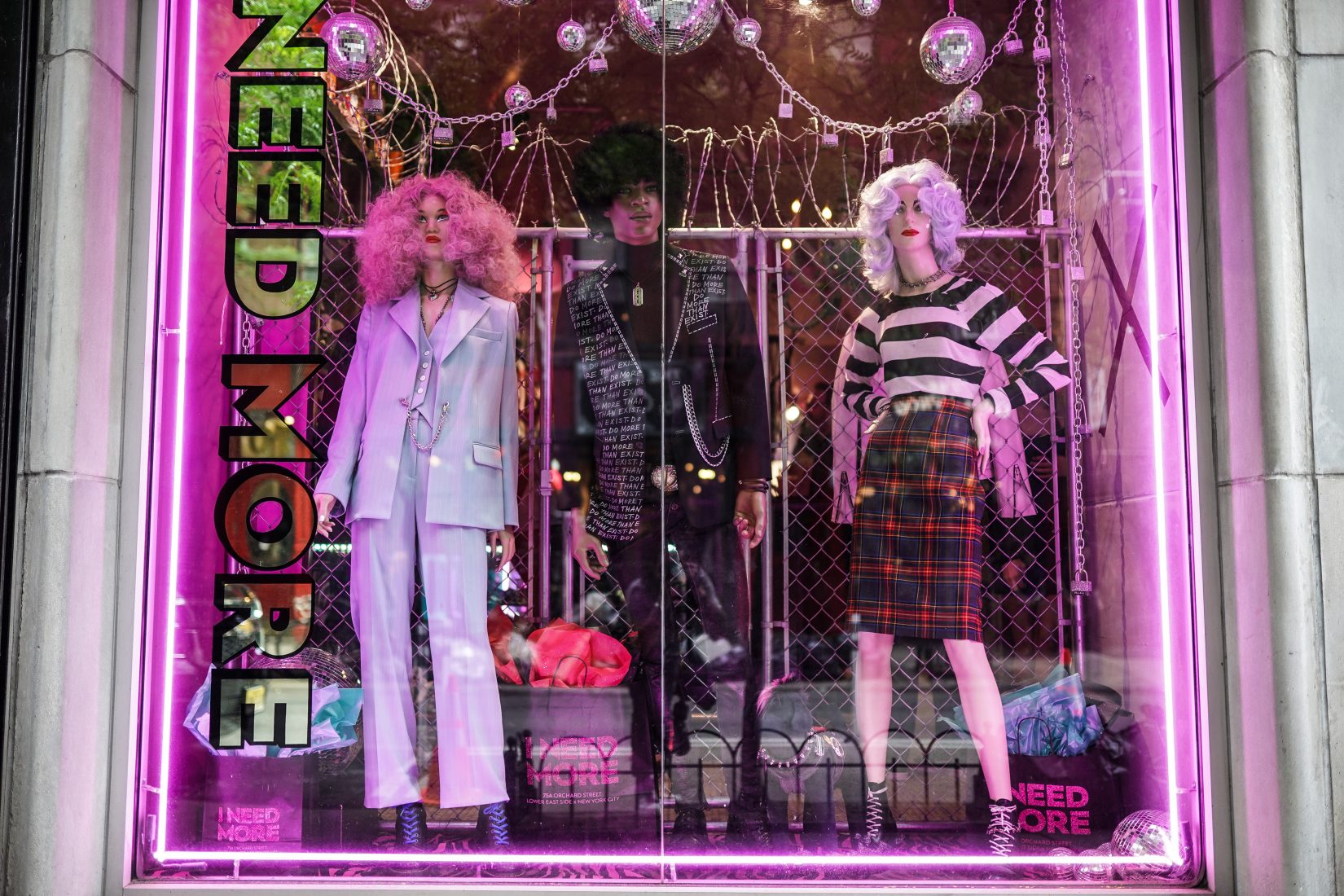
NEW YORK, NEW YORK - JUNE 05: Atmosphere during the Mae McKagan Capsule Collection Launch At I NEED MORE the Mae McKagan Fall/Winter 2019 Capsule Collection Launch at I NEED MORE on June 05, 2019 in New York City. (Photo by Gonzalo Marroquin/Getty Images for Mae McKagan Fall/Winter 2019 Capsule Collection)
Eighteen-year-old designer Mae McKagan debuted her new Capsule Collection last night at an exclusive event hosted by Downtown and I NEED MORE, Jimmy Webb’s punk rock boutique in the Lower East Side.
NEW YORK, NEW YORK – JUNE 05: Atmosphere during the Mae McKagan Capsule Collection Launch At I NEED MORE the Mae McKagan Fall/Winter 2019 Capsule Collection Launch at I NEED MORE on June 05, 2019 in New York City. (Photo by Gonzalo Marroquin/Getty Images for Mae McKagan Fall/Winter 2019 Capsule Collection)
Downtown’s editor-in-chief Deb Martin said of the event, “Downtown Magazine is so proud to support young talent like Mae, who has designed a capsule collection that is cool, elegant, and edgy all at the same time.”
NEW YORK, NEW YORK – JUNE 05: Deb Martin, Mae McKagan during the Mae McKagan Capsule Collection Launch at I NEED MORE on June 05, 2019 in New York City. (Photo by Gonzalo Marroquin/Getty Images for Mae McKagan Fall/Winter 2019 Capsule Collection)Grace A. Capobianco, Susan Holmes-McKagan, Deb Martin
In attendance at the boutique party were many big names in music and fashion, including McKagan’s parents, Duff McKagan of Guns N’ Roses, and Susan Holmes-McKagan, the American model and now author, as well as her sister Grace McKagan, the frontwoman and lead singer of The Pink Slips. Debbie Harry and Ewan McGregor also attended, among many others who came to show their support of her collection.
The event was lively and packed with guests, with rosé provided by Bosman Family Vineyards and Wines for the World, and hors d’euvres provided by Emmy-winning chef Erwin Schröttner and his Lower East Side mainstay, Cafe Katja.
Duff McKagan expressed awe for his
daughter’s talent, and her passion for her creations, sharing that she’d had a
passion for fashion from a very young age.
NEW YORK, NEW YORK – JUNE 05: Susan Holmes – McKagan, Mae McKagan, Grace McKagan and Duff McKagan during the Mae McKagan Capsule Collection Launch At I NEED MORE the Mae McKagan Fall/Winter 2019 Capsule Collection Launch at I NEED MORE on June 05, 2019 in New York City. (Photo by Gonzalo Marroquin/Getty Images for Mae McKagan Fall/Winter 2019 Capsule Collection)
Jimmy Webb, owner of I NEED MORE, also spent the evening gushing about McKagan’s talent. Webb helped to make McKagan’s dream of being a fashion designer into a reality by partnering with her for this collection. “I love the whole McKagan family, they are in my heart forever, and I’m so proud that Mae chose my baby, I NEED MORE, to launch her line,” Webb said.
NEW YORK, NEW YORK – JUNE 05: Mae McKagan and Jimmy Webb during the Mae McKagan Capsule Collection Launch at I NEED MORE on June 05, 2019 in New York City. (Photo by Gonzalo Marroquin/Getty Images for Mae McKagan Fall/Winter 2019 Capsule Collection)
Despite the excitement of her debut in the fashion world, McKagan was the picture of focus and humility as she received a stream of well-deserved praise throughout the evening, on top of looking effortlessly elegant in a pale pink corset top of her own creation in collaboration with designer Veritée Hill.
NEW YORK, NEW YORK – JUNE 05: Susan Holmes – McKagan, Deborah Harry and Mae McKagan during the Mae McKagan Capsule Collection Launch At I NEED MORE the Mae McKagan Fall/Winter 2019 Capsule Collection Launch at I NEED MORE on June 05, 2019 in New York City. (Photo by Gonzalo Marroquin/Getty Images for Mae McKagan Fall/Winter 2019 Capsule Collection)
“Pouring my heart and soul into this line has changed my mindset and life!” She wrote in an Instagram caption today, between sentiments of gratitude towards her family and supporters.
The line itself is sophisticated,
and perfect for ambitious young women of her generation, featuring pieces like
a powder blue power suit, a modern-punk plaid pencil skirt, and several other
items, including the corset she wore to the event.
NEW YORK, NEW YORK – JUNE 05: Atmosphere during the Mae McKagan Capsule Collection Launch At I NEED MORE the Mae McKagan Fall/Winter 2019 Capsule Collection Launch at I NEED MORE on June 05, 2019 in New York City. (Photo by Gonzalo Marroquin/Getty Images for Mae McKagan Fall/Winter 2019 Capsule Collection)
The capsule collection is available exclusively in-store at I NEED MORE, 75A Orchard Street in the Lower East Side.
Celebrities, actors, musicians and chefs have teamed up with Williams Sonoma cookware and national non-profit organization No Kid Hungry to design a selection of limited-edition spatulas, in a bid to fight childhood hunger.
“Everyone has a role to play in ending childhood hunger in America,” said Bridges, who is also a national spokesperson for No Kid Hungry. “Whether you volunteer your time, advocate on behalf of kids in your community, or even buy a spatula, you join millions in the belief that America’s kids deserve to grow up healthy and strong.”
“Sluggish and hungry is not the recipe for a child’s success,” added Bell. “That’s why I’m working with No Kid Hungry to connect kids to the food they need to reach their full potential.”The spatulas, sold at $12.95, are available online and in selected Williams Sonoma stores. The company is aiming to raise $2 million, an equivalent of 20 million meals for children across America, with 30% of the price for each spatula donated to No Kid Hungry. An additional $5,000 will also be donated by the designer whose spatula sells out first.










 “Sluggish and hungry is not the recipe for a child’s success,” added Bell. “That’s why I’m working with No Kid Hungry to connect kids to the food they need to reach their full potential.”