Categories
Featured Fitness Health Wellness

Squat Thruster: A Building Block

By: Adam Que and Aida M. Toro

Adam: We all know squat thrusters are tough. Some people love them, and well, I think most despise them. Imagine your sweat dripping, your arms aching, your body wobbling — that’s the first time I saw one client do a squat thruster…

Aida: “Hey, hey, hey–I was trying my best!”

But all jokes aside, squat thrusters should be everyone’s buddy when it comes to functional fitness. I haven’t encountered the most pleasant experiences with a squat thruster, as it can be tough for one’s physique to process. But once I started incorporating fitness into my wellness, I saw the progress. At first, I struggled with getting up efficiently from a push-up position. As I learned more about the movement, developed more mobility, and strengthened my midline, I suddenly realized that I was able to rep them out at a faster pace than usual.

Adam: Squat thrusters are still not Aida’s cup of tea, however, these are some movements that have helped her develop that good relationship with squat thrusters.

Squat Thruster: A Building Block
Photo Credit: Aida M. Toro

Inchworms:

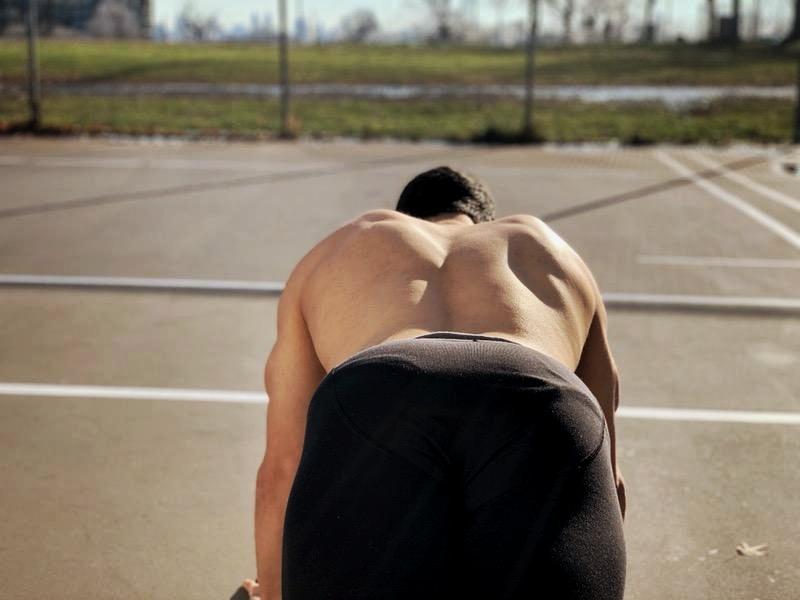
To do an inchworm, option 1). start off in a push-up position (as all of these movements will be) and walk your hands towards your toes until you reach full flexion in your hamstrings without bending your knees, then walk your hands back out into push-up position and repeat. This option is great if you have limited space. Option 2). Start off in a push-up position and walk your feet towards your hands without bending your knees until you reach that full flexion, then walk your hands out back into a push-up position, continuing your momentum forward. This is obviously great with more space.

Squat Thruster: A Building Block
Photo credit: pushing Donuts

Shoulder taps:

Start off in a push-up position and bring your hand to the opposite shoulder and touch it, then the other hand and repeat continuously. Try to keep your chest down and shoulders aligned, don’t raise your shoulder when tapping your hand. Also, keep your midline engaged in the process. Simple though it is, it can be a very effective movement when slowed down.

Squat Thruster: A Building Block
Photo Credit: Skimble

Lateral Walk-in Push-up Position:

Probably the simplest of movements but also effective. Start off in that push-up position and shift your hands and feet sideways to the desired distance, then the other way till your start point or another point of reference. Again, keep your midline engaged and TRY NOT TO RAISE THOSE HIPS. You, of course, can amplify the movement with a push-up, another calisthenic, or plyometric movement.

Squat Thruster: A Building Block
Photo credit: Pop Sugar

Everest Mount Climbers:

You know what position we’re in. When there, you can either jump or step your foot to the outside of your hand. Try to make sure your foot is flat as possible at that point and your back leg is in a prone position but still slightly hovering off the ground. Of course, mobility and morphology come to play, but try to keep your hips down and chest high. Then keep flowing or stepping your feet up and back.

Squat Thruster: A Building Block
Photo credit: Style With Glamour

Two-foot hops middle and side to side:

This final movement is the most dynamic out of all of them and is cardiovascular-ly involved. In our push-up position, as explosive as you can, hop your feet roughly towards your hands and chest then back again. Of course, in this movement, your hips will rise a bit. Then when hopping your feet to the sides of you, make sure you don’t compromise your positioning. Try to keep your feet together and try not to wobble and be strong throughout the movement.

Squat Thrusters: A Building Block
Photo credit: Badunkafit’s Blog

Remember, all these movements can be done in your apartment. Furthermore, I hope you can take this notion into the new year because this is one of the most utilized movements in the fitness and wellness world. As well as, this is where that burpee starts…but we’ll leave that for another day.

Here is a little circuit you can practice to improve that squat thruster:

4-6 sets of:

5 low impact squat thrusters (slowly stepping or motioning through the movement and taking pauses throughout the movement to evaluate your posture/body and breathing.)


10 full squat thrusters

Squat Thruster: A Building Block
Photo Credit: Fit Girl’s Diary
Categories
Featured Fitness Health

Strength Training – Most Effective Exercise You’re Not Doing

From resistance bands a great option which will give you plenty of variety and special grips to Bulgarian bags and the newest four-movement exercise to target your rear delts, working out can often contain a few complexities here and there – sometimes too many. With all of the newest technology and year-long fads crowding our minds, we can often leave the simplest movements by the wayside. To make your entire body stronger, bring up imbalances and get some conditioning in while you’re at it, there is one old-school, simple strength training movement to add to your repertoire: the farmer’s walk. 


Photo by Binyamin Mellish from Pexels

The farmer’s walk is as easy to understand as carrying your groceries inside – only much, much more physically taxing. To perform this exercise, simply grab two heavy (for seasoned gym-goers, half your body weight in each hand should be a good starting point) weights – dumbbells, kettlebells, trap bars, plates, etc. – let them hang down at your side with your palms facing your body and start walking. Make sure to focus on keeping a good posture and tall spine, keep your grip tight and take short steps – the weight will handle the rest. For more strength and hypertrophy (muscle growth) benefits, focus on heavier weight and shorter walks – longer walks will help you improve cardiovascular performance and have an effect on the nervous system similar to a set of sprints.

Benefits of Strength Training with the Farmer’s Walk


Photo by Victor Freitas from Pexels


“It’s just walking, right?” If that thought crossed your mind, you’re not wrong, but that is the beauty of this exercise. Walking in a controlled manner with extremely heavy weight comes with a ton of benefits, even being cited as a safer alternative to the deadlift.  Your arms will take a beating keeping the weight inside your hands and at your sides, your shoulders and back will be taxed from maintaining proper posture, your core will struggle to keep everything together and your legs and glutes are pumping with each step. If you’ve heard the term “functional strength training” thrown around in the gym, this is it. A single, heavy exercise that will improve your musculature and translate to increased athletic performance in every aspect and generally better fitness.
 
Training will also naturally help with HGH levels, which includes the ability to build and repair muscle, keeping the body fit and energetic, and its anti-aging abilities. Building this naturally takes some time though, so here are different types of HGH injections that may speed up this process.

For more fitness and strength training tips, head over to our Downtown Fitness section.

Categories
Fitness Health

Body Weight Squats

squat

Picture by Tribesports

The ability to do a full bodyweight squat is probably the most fundamental movement humans can do, yet many adults can’t do them, due to either strength or flexibility issues. A movement that babies and children can do so easily, we lose as adults. Squatting, done properly, improves the health of the knees.

Foot Position. To improve your ability to squat, you first need to be properly set up bio-mechanically; this means setting up the foot position correctly. The feet should be slightly wider than the hips with the feet pointed outwards about 30 to 45 degrees. This placement creates a straight path for the butt to go down, without the knees and feet getting in the way of the movement, and loads the front portion and rear portion of the legs evenly. The stance also allows the knees to be slightly pushed out, tracking over the feet and not buckling inward.

The Arms and Head. Once the feet are positioned properly, bring your arms up and extend them in front of you parallel to the floor. Fixate your eyes slightly upward and forward. Keeping the arms in front will counterbalance the possibility of falling backwards while in the bottom position. By fixating the eyes up and forward, the head, neck and spine are forced to become straighter, with the torso remaining more vertical.

Breathing. For bodyweight and sub maximal squatting, it is better to “reverse breathe”, meaning, exhale, or breathe out, going down and inhale, or breathe in, coming up. Inhaling on the way down pushes the internal organs forward, throwing the center of gravity forward in the bottom position, causing you to potentially lose balance. Exhaling during the downward movement pushes the organs backwards towards the spine, better stabilizing the lower back and better placing the center or gravity right under the hips. In addition, exhaling on the way down increases the range of motion and allows the butt to go further down in a much more comfortable manner.

The Movement. Starting from a standing position, with the feet properly placed, the arms extended forward, and the head straight with the eyes fixated slightly upward, take an inhale and exhale going down. As you move downward push the knees slightly outward, so they are tracking directly over the feet. As you go down, you will feel the stress go from the front of the legs (quadriceps) to the rear (Glutal and hamstrings). The weight on the feet will go from being evenly distributed on the foot’s ball and heel to being distributed more on the heal. Once in the most bottom position, as you begin going upward, inhale and the muscle stress and weight shift will reverse until you wind up in the starting position again.

-Bill Garelick, DOWNTOWN’s Fitness Editor