Categories
Culture Entertainment Music News Theater

Launch Event At The Museum of Jewish Heritage Announces Immigrant Arts Coalition

This week, the Immigrant Arts Coalition, an activism support group comprised of New York City-based cultural organizations, unveiled an agenda aiming to recognize the important and ongoing contribution of immigrant artists and arts organizations representing America’s diverse cultural mosaic.

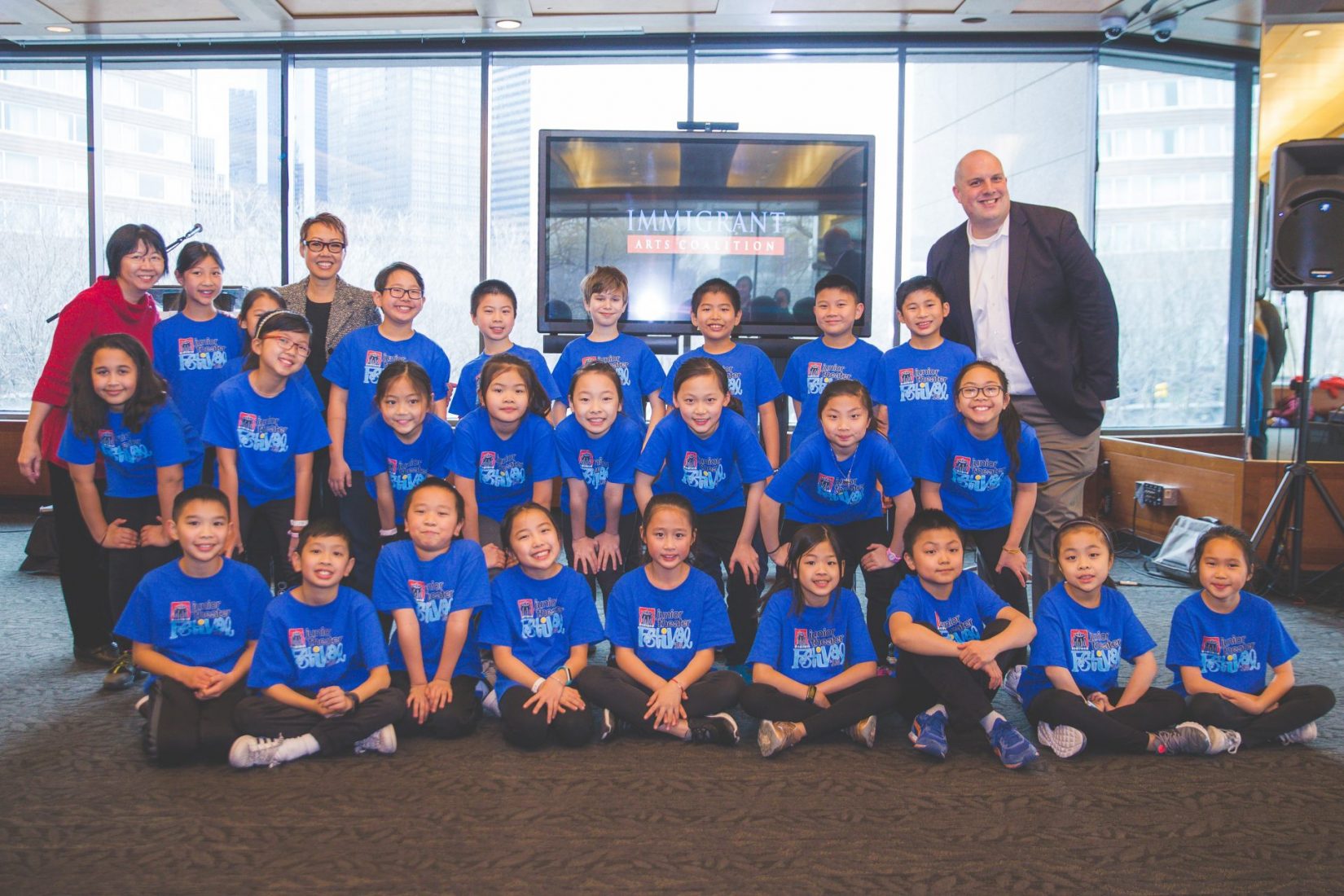
Held at the Museum of Jewish Heritage, home to Coalition founding member National Yiddish Theatre Folksbiene, the launch event drew about 75 attendees, as members presented plans to serve as a united front for advocacy and audience development, and work to collaborate with continuous shared programs, including the second annual, multi-day Immigrant Arts Summit this summer.

Members of the new Immigrant Arts Coalition (from left to right): Member-at-Large Laura Caparrotti; President Marlena Fitzpatrick; Treasurer Giacinta Pace; Vice Chair Ayse Eldek; Chair Christopher Massimine; and, Secretary Carrie Beehan, Artist at GOH Productions (Photo credit: Victor Nechay/Properpix.com)

“Artists are the cornerstone of our society,” said Marlena Fitzpatrick, President of the Immigrant Arts Coalition. “Art heals. Art unites. Artists are doers. We work shoulder to shoulder to build this nation and our native homelands alongside union workers, domestic workers, farm workers, doctors, nurses, teachers, lawyers, public policy makers, executives and entrepreneurs, cooks, tech and inventors, activists, veterans, and emergency responders who risk their lives to save ours.”

“This is why we’re here today; we must tear down those invisible walls and coexist in solidarity with all cultures, all communities and all forms of art. We’re doing this through advocacy as we’re working with various facets of the community to help undocumented and documented immigrants. We’re also collaborating by cross-pollinating our audiences and programs amongst our coalition members. In doing this, we’re fostering diversity and unity,” she said.

Michael S. Glickman, President & CEO of the Museum of Jewish Heritage, noted that the Museum’s guiding principles stand against fascism, restrictions on free speech, and limits to the humanities.

“We are dedicated to supporting free expression and convening diverse thinkers for important conversations,” he said. Across the water, Lady Liberty lifts her lamp and Ellis Island marks the gateway through which millions flowed into this country seeking refuge. New York Harbor is a fitting backdrop for conversations that touch on the challenges and urgencies of art about immigration.”

The Coalition began forming in July 2017, when a group of arts and cultural organizations held their first arts summit at the Museum of Jewish Heritage. Leaders of the Coalition announced an agenda focusing on key areas of the arts: Advocacy, Diversity Support, Collaboration, Empowerment Through the Arts, and Artistic Engagement.

“Your being here this morning, your interest in the ongoings of the Coalition, and most importantly, your support of arts and culture, are paramount to the future of a cultural mosaic without borders,” said Chair of the Immigrant Arts Coalition and Chief Executive Officer of the National Yiddish Theatre Folksbiene (NYTF) Christopher Massimine. “Your engagement helps to deliver an important, and timely message: diversity is our strength, and illustrates why we must unite together to support the immigrants who for generations have contributed to the advances, collaboration, and innovations that have helped enrich our country through the arts. This reflects our mandate to advance immigration rights through artist advocacy, foster multicultural collaborations, encourage diversity initiatives, promote empowerment, and be the foundation of support for those who raise their voice.”

In celebration of the artistic diversity of programming in New York City, the event featured moving performances by Yiddish Theatre star Daniel Greenwood; acclaimed Latin jazz pianist Carolina Calvache of Colombia; and, 25 students from PS 124’s Theatre Club, which is an educational outreach program of the National Asian Artists Project.

Founding organizations with representation in the Coalition include: Actors Equity, Asian American Arts Alliance, Cultural Department Consulate of Spain in New York, Cumbe Center for African and Diaspora Dance, El Museo del Barrio , Emotions Physical Theatre, Irish Arts Center, Irish Repertory Theatre, Israel’s Office of Cultural Affairs in the USA, Italy Theater, Kairos Lower East Side Tenement, Local 802 of the American Federation of Musicians, Museum at Eldridge Street, Museum of Chinese in America, Museum of Jewish Heritage, NAAP, National Asian Artists Project, National Yiddish Theatre Folksbiene, New York Foundation for the Arts, NYC Mayor’s Office on Immigrant Affairs, Pan Asian Repertory, Repertorio Español, SAG-AFTRA, Turkish American Repertory Theatre, and United Scenic Artists.

Sita Chay, violinist from the Grammy-winning all-female mariachi band Flor de Toloache, said: “What people don’t always recognize is that we are all benefiting from the rich cultural diversity. Behind every culture is the influence of our neighboring cultures and on a broader spectrum every culture commonly carries the most humanistic side of us. As a musician, it is my duty to invite all musicians to come together and create art that’s ground-building and celebrates culture. Because, when all else collides, music unites. Instruments, for example, reflect that. String and percussion instruments show that human side of us: our common thread and our heartbeat.”

Added Shawn Rawls, Director of Emotions Physical Theatre, “Art for me saved my life… Without diversity, you won’t get the wonderful things outside of your own bubble. One head is not as smart as many heads and many perspectives.”

In addition to Mr. Massimine and Ms. Fitzpatrick, the Coalition’s Board includes: Vice Chair Ayse Eldek, stage and screen actor and director; Secretary Carrie Beehan, Artist at GOH Productions; Treasurer Giacinta Pace, actor, producer and journalist; and, Member-at-Large Laura Caparrotti, actor and Founding Artistic Director of the Kairos Italy Theater in New York and of In Scena! Italian Theater Festival in New York.

The event concluded as Coalition members announced that a second annual Immigrant Arts Summit will be held August 6 to 8. “The Summit promises to be a memorable event that will continue to engage the community, create a vital dialogue, and further the success of our artists and our Coalition,” Mr. Massimine said. “We will bring together not only some of our city’s finest immigrant performers, but distinguished and renowned experts on the arts and culture to examine the challenges and opportunities that exist for immigrant artists in our country today.”

You can learn more about the Coalition and its principles on its website and view the Coalition launch event, including performances, here.

Categories
Dining Events

It’s Time for the Annual Taste of TriBeCa

Get ready, because this Saturday – once again! – it’s time for the annual Taste of TriBeCa. Back for the 23rd time, this year’s Culinary Festival will take place on Saturday, May 20th and feature dishes from 60 plus neighborhood restaurants.

The best part of it though, is the great taste attending this event leaves you with. Not only from the flavorful food concoctions, but the beneficial component of the event. Taste of TriBeCa is the oldest fundraiser that benefits the arts and enrichment programs at two neighborhood public schools, PS 150 and PS 234.

“We have a couple of new things going on this year, including a raffle for a Vespa, which is very exciting and fun. We also have a demo for kids that is being done by Eataly on pasta making and that’s a new event for us,” said Keith Klein, co-chair of Taste of TriBeCa about this year’s new additions.

It really is worth noting that this is a true neighborhood event, for both adults and the children of this area. Each year, they make great effort to ensure children are entertained too.

“In addition to the Eataly demo, we have the Kid’s and Sports Zones, each of which has a wide range of activities and performances,” said Klein.

There will be face painting, a custom balloon, Minecraft with Pixel Academy, and a photo booth hosted by Tribeca Journal.

“The Sports Zone, produced by our friends at Manhattan Youth, features clay-making and sports-themed carnival games for young athletes,” explained Klein.

But – let’s be honest, we’re going there for the food. And with more than 60 participating restaurants, food wise this year is shaping up to be a great one. The lineup includes newer additions such as BâtardTwo Hands and Hank’s Juicy Beef as well as restaurants that have been part of the event for the last 23 years including Bubby’s, Duane Park Patisserie and Walker’s.

Back for its second year is Two Hands, a restaurant and bar taking inspiration from Australia’s culinary scene, located on Church Street in TriBeCa.

“When I moved to New York a little over 5 years ago, one of my very good friends took me to Taste of TriBeCa and I had such a great time. It reminded a lot of the market days back in Australia with delicious food and great vibes,” said Giles Russell, co-founder of Two Hands.

Participating in the culinary festival was a chance for the restaurant to really connect with the neighborhood and get ingrained in the community in a deeper way.

“Two Hands is all about supporting the community we are in. We wanted to open a restaurant in TriBeCa for the people who live in the neighborhood. We felt like they deserved a great day to night café that could be also be a hub for locals. Being a part of Taste of TriBeCa was a natural extension of that goal as well as an opportunity to raise money for an important cause,” explained Russell.

And what do they wish guests take away from visiting Two Hands’ booth at the festival?

“A smile! We want people feel good when they eat our food. We also want to meet our neighbors and make new friendships,” stated Russell.

Also back this year, for the third consecutive time, is The Beer and Cider Tour of TriBeCa. The tour boasts beer and ciders sourced from New York breweries, including newcomer SingleCut Beersmiths from Astoria, Queens and will be hosted by establishments around the neighborhood such as Church Publick and Woodrow’s.

To ensure diversity in the food and beverage lineup, so there’s something for everyone, Taste of TriBeCa has a hardworking restaurant committee.

“We have a great roster of volunteers, truly exceptional people across the board. Our restaurant committee manages that, working with the restaurants, making suggestions to ensure that there is a balance and that each restaurant stand out,” explained Klein.

Klein’s best advice for guests? Come hungry!

“I think that all the restaurants do such a great job and really put effort into their tastes, I am excited to try all of them! Seriously, you never know who’s going to have something that’s just going to blow you away, so I find it best to come in with an open mind and hungry stomach,” he said.

Photography by Gary Petersen/Taste of Tribeca

Categories
Culture Movies

Eliza Taylor in Thumper: A Portrait of an Actress

Dispatches from the Tribeca Film Festival: A look through the lens of films to see ourselves in the other, and the other in ourselves.

“It’s a little bit painful to watch at times, in the best way possible. It’s very gritty and raw”, Eliza Taylor tells me of her new movie that just premiered at Tribeca Film Festival, Thumper, a very real portrait of lower class America by Jordan Ross in which she plays an outsider who gets involved in a high school meth ring.

Cozily sitting in front of me, wearing all black, she is tired; her face is flawless but her eyes are sleepy. As she talks about the film and her acting, sentences encompass extremes–hard to watch/best way possible, rough/wonderful–but not for a second is she scattered. She seems to know her place in the world, ingrained in a path in which every challenge to her craft is as rough as it is a wonderful opportunity.
Camila Gibran: Thumper is “hard to watch sometimes”. Why did you decide to take this role?

Eliza Taylor: Because the way the script is written you get a real glimpse into these people lives. The lives of people who in a lot of ways feel like they’ve been forgotten about and left behind by society. And as an actress, for the first time in my life, I got to play a character like Kat/Meredith, a character playing a character and it was a wonderful challenge to separate the two.

CG: You do a lot of television. Can you tell what film means to you as a visual art form?

ET: Film has been a life long love affair. For me personally, it’s about taking people away. I remember being at the cinema and watching really powerful movies and forgetting I was sitting in the theater.

It’s about being able to have a glimpse into different people’s lives around the world that we wouldn’t necessarily have a glimpse into.

If we get to pull that off successfully for an hour and a half, you take people out of their daily lives into a completely different world.

CG: No commercial breaks …

ET: Yes, No commercial breaks (laughs)


CG: Can you tell me about the world of Thumper?

ET: The movie is about kids who get caught up in the world of making and selling methamphetamines. But one thing about it is that you can really empathize with every single character, none of them are black and white, you can see that they are doing the best they can in a situation they are in.

CG: It feels very real. How was the shooting process?

ET: It was fascinating. We filmed in people’s homes that are in these areas that aren’t necessarily the wealthiest and their quality of life isn’t perfect. They were all really good people and very welcoming. But the sad thing was, we would wrap and finish shooting in their houses for the day and they went back to their lives. It was humbling and quite touching.

CG: What city was it set in?

ET: We didn’t want the movie to be specific to an area in America. We wanted it to be very American but we didn’t want everyone to automatically assume that it was in one certain area, one place. We shot it in San Pedro in Los Angeles, but yah… we kinda wanted it to have a hot sticky industrial vibe.

CG: You said that if a movie pulls it off, it can take us away and give us a glimpse into a different world. How do you feel after immersing yourself in this particular world? 

ET: I didn’t know myself by the end of this movie… I was like “ Who am I
again?”

It was rough; it was a really intense shoot. I did a lot of research and learned a lot about methamphetamines and the effect it’s having on modern society, it’s quite incredible, even in Australia it’s an epidemic. I came out of it feeling quite overwhelmed by that.

It was a real experience and it wasn’t easy, which was great.

And just like that she gives me yet another glimpse into her world, the path she is on and the kind of actress she is.

Photography by Leslie Hassler

Categories
Culture Events Movies

Russell Peters Shines in The Clapper

Dispatches from the Tribeca Film Festival: A look through the lens of films to see ourselves in the other, and the other in ourselves with Russell Peters.


Russell Peters generously breaks the ice by mimicking farting sounds as he settles into an armchair, simultaneously setting the joke bar within an easy reach for me. It’s a comfortable place to begin when interviewing one of the world’s top comics whose career spans decades. He also designed his wife’s engagement ring to feature four lobster claws–or so the internet tells me.


Svetlana Chirkova: What is the world of The Clapper, in your own words?

Russell Peters: The film is about a guy, Eddie Krumble, who moves to Los Angeles and makes his money as a professional audience member. All he’s trying to do is make a living, he’s not trying to become “Hollywood”, he’s not trying to become a celebrity, he just wants to live a very simple life, and do a very simple job, then along comes this late-night talk show host, Jayme Stillerman, played by myself…

SC: You look great in a pink suit, by the way.

RP: Thank you, it may have been my own suit, actually… Anyway, my character, while doing his monologue and trying to make people laugh, unwittingly exposes Eddie as he thinks it’ll be a really funny ‘bit’ to try to find him, which in turn destroys Eddie’s life. So it’s a situation where one guy is trying to do the right thing, and the other guy, while thinking he’s doing something funny, wrecks it all.

SC: So there’s real gap in perspectives between these two as to what’s of value in life?

RP: Yeah, Stillerman is a TV cornball host, it’s his whole existence, so he really just can’t imagine how TV exposure could be bad for anybody. Eddie, on the other hand, is just trying to make his $100 dollars and the fact that his job ends up on TV is irrelevant to him. So there’s a failure to understand a very blue collar business by someone coming from the shiny, “glitzy lights” business, thinking that exposure is only going to lead to bigger and better things.

SC: This lack of mutual understanding between the so called ‘blue collar’ and the ‘glitzy lights’ classes has become a much debated topic following the election and the events since.

RP: There is no finger pointing, we are all the problem. Ultimately we all have to take credit for the problem.

SC: The world has become such a different place compared to a year ago, when this film was being made. Does the story of these characters take on a different meaning against the current backdrop?

RP: Isn’t it weird that a year ago seems like a much different time? Even 10 months ago was. We had a different president, we had a different mood, and now here we are with all this uncertainty about the future. There are so many threatening things in the world now, so many different things coming at us we don’t know what to dodge. It’s such a bizarre time. So I guess the thing that this film can offer is a glimpse back to a time when things were simpler – you know, 10 months ago.


SC: Ha. So apart from this time capsule property, what else can film offer above other forms of story telling?

RP: Film takes you into that world of escapism that we all desperately need, especially in these times. I think fewer people are going to movies nowadays, because the thought process is ‘Well, I can rent it on iTunes’, or wait to get it on Netflix, or just get a bootleg somewhere. We are detaching ourselves from tangible things which is a very bizarre thing to me. Going to the movies gives you something: to sit in a seat, to hold a ticket, to eat your popcorn and have a soda, to look at the person beside you and cheer, to be in the room full of strangers. Now we curate everything from the TV shows we watch to the music we listen to, we create a tailor made bubble. It’s hard to get that collective feeling anymore, because when you do find yourself in a group of people they too have been curated and are all in fact the same person. We are homogenizing ourselves individually. But what we forget is, back in the day, when these bubbles didn’t exit; we all talked, we had common ground, we had common things to talk about. We all just co-existed quite well with each other.

To further demonstrate his fondness for embracing the necessary discomfort of the true collective experience, the farting sounds got an encore as Russell distributed his goodbye hugs on the way out.

Photography by Leslie Hassler

Categories
Culture Entertainment Movies

Pablo Schreiber Cooks Meth in Thumper

Dispatches from the Tribeca Film Festival: A look through the lens of films to see ourselves in the other, and the other in ourselves with Pablo Schreiber.

I am sitting on a stoop having a coffee and a croissant when a very tall Pablo Schreiber crosses the street in my direction. I’m here to interview him about his role in the new movie Thumper. When I say I’m waiting for the lights to be set up in the studio upstairs, without missing a beat he sits down beside me.

We start talking about LA weather–his new home–being immigrants–he is Canadian–him being a father and how through films we may be able to see the “other”. For a while we are two New Yorkers, coffee in hand having the easiest of conversations on a stoop in Chelsea.

On the way up the easiness takes a pause when the elevator door closes but it doesn’t move. Panic crosses his face. “Is something wrong?”

“It’s really hard being this tall in a very small space” he says.

Seconds later we start to move and we are back at ease again. Upstairs, coffee still in hand but now on comfortable chairs.


Camila Gibran: I saw Thumper last night it’s raw and heartbreaking. In your own words how would you define it?

Pablo Schreiber: It’s the journey of a young woman who gets involved in a meth ring, but swirling in all of it is this idea of an America that has been left behind; people who have to do things that they didn’t originally want to do, making choices that they didn’t necessarily need to. How do you make a life when you don’t have many opportunities? This is the lot that enveloped all of these young kids, and that’s the real tragedy of this movie.

CG: What compelled you to take this role?

PS: It was interesting to hear you say the ‘other’ downstairs, because that’s definitely something that I look for in my work. I’m really interested in the extremes, not just the extremes of society but also the extremes of human behavior. So Wyatt, to me, was a guy who was operating in the extremes of human behavior, in the sense of, you know, cooking meth and giving it to children to sell, not really behavior that I would condone or practice, and so whenever I see someone who’s doing something that’s so far from my experience, I want to know why they do it. There is a scene where he goes into some of the reasons why he does what he does and where this country is, in his opinion, and how immigrants and the workforce shrinking have made things so difficult for him. I was compelled by that really different voice.

CG: We are in a time in this country, and in the world in general, that’s very different to where we were a year ago. How do you feel Thumper to be relevant today?

PS: We shot it last year in March and April, long before the election, and long before this country, as some people say, s**t the bed, but now we’re sleeping in it. We’re rolling around in it, and it’s taken on a whole other weight, since the election, of that voice of the angry white man.

When we were making this movie, none of that was really around, there was some of it blowing in the air, but you couldn’t tell that this was coming. Living in New York, or living in LA, you couldn’t see that blowing in the wind, and the election was such a huge slap in the face for costal livers, and for anyone who was living in a major metropolitan area… So this movie has taken on a whole new significance in the after-math of the election, and only gone further to kind of humanizing in a way a lot of the sentiments that are in the air… that’s not to judge it as good or bad, it’s just trying to understand a little more about where a lot of these feelings are coming from.

How do you see the role of film, and visual storytelling in people’s lives?

PS: As an actor I deal with film and TV. I see it on all fronts. There’s just so much content, as consumers we are so lucky, especially in the market of television right now, but we are bombarded by choices. We are so spoiled, which brings up another problem: When do you watch it all?

I’m a bit embarrassed to say, but as a dad, I mostly watch movies on airplanes because I travel so much. The other day I was taking a flight and I finally just watched Moonlight, after however long it’s been.

So, once you find a little time to watch a story being told either in the form of television or film, what would you choose and why?

PS: You really have to choose something that’s going to make an impact on you. Art is here to influence us in some way or another, to make us re-evaluate or look at our life in new and interesting ways. So if you’re going to commit that amount of time to something you have to be sure that it’s something that’s going to affect you profoundly in some way.

So last question, as an artist and as a consumer of those art forms, do you think they can bridge the gap in understanding what creates ‘the other’?

PS: That’s the next thing, and I never want to take that leap, because to me, how to bridge the gap, I don’t know. The only thing we can do is start conversations. And we can also look into what makes other people tick and try to empathize with them. Through understanding, and looking deeply into circumstances and trying to understand how somebody feels about something is the only way to then … behave in a way that’s more empathetic towards them. So I guess that’s a form of bridging the gap – knowledge and information.

As we are hugging goodbye I am reminded of how tall he is. When the elevator door opens I smile as to assure him that it will go down just fine. The door closes and the easiness is still there.

Photography by Leslie Hassler

Categories
Entertainment Events

Rosamund Pike, Taylor Shilling & Ryan Eggold dazzle for IWC Schaffhausen

This past Thursday, April 20th, the luxury watch brand IWC Schaffhausen hosted their fifth annual star-studded event at Spring Studios in support of the Tribeca Film Festival.

The event had notable attendees on the guest list such as actor and Tribeca Film Festival (TFF) co-founder Robert DeNiro , IWC Brand Ambassadors and actresses Rosamund Pike and Taylor Schilling, actresses Zosia MametUma Thurman and Alice Eve, actor Ryan Eggold, TFF juror and actress Christina Ricci, TFF Juror and actor Anthony Mackie, along with models Adriana Lima and Karolina Kurkova and TFF co-founders Craig Hatkoff and Jane Rosenthal.

The well-heeled crowd was kept in stitches all night as host, Samantha Bee — from the hit show Full Frontal on TBS — poked fun at everything, from our current political leaders to some famous faces in the room. The stylish guests were also treated to an intimate performance by Tony and Grammy Award Winner, Cynthia Erivo, who dazzled the crowd with her stunning vocals.

IWC showcased their support of the festival by making a donation to the Tribeca Film Institute, a nonprofit arts organization that supports filmmakers. The award was presented to filmmaker, Chloe Zhao at the dinner and consists of a cash prize of $50,000, providing production or post-production funds to one feature-length narrative film, which demonstrates innovation and technical mastery, inventiveness through direction, cinematography and/or editing or forward-thinking storytelling.

Photos courtesy of Getty Images for IWC