Categories
Architecture Art Culture Living News NYC Outdoor Uncategorized

Sky Light

Twenty years later, Tribute in Light helps New York City heal. Photo by Joe Woolhead.

IN NEW YORK, art isn’t limited to the galleries and theaters; it overflows into the streets, draping itself across the city’s skyline. Architects, artists, social organizations, and New York’s many public agencies each play a hand in building the immersive installations that speak towards some of today’s most pressing topics. New York-born architect and artist Gustavo Bonevardi is recognized for his many public projects exploring the impact local and global crises have on our population, and in New York today he is perhaps best known, along with creative partner John Bennett and lighting designer Paul Marantz, as among the artists behind Tribute in Light, an annual light projection commemorating the anniversary of 9/11. Today managed by the 9/11 Memorial & Museum, Tribute in Light was conceived with the support of the Municipal Art Society as two beacons echoing the Twin Towers as they defined New York City’s skyline. Though the two light beams don’t represent the actual size of the towers, which were each an acre in size, the gap between the beams and the net acreage the installation occupies is approximate to the size of the towers. “What we’ve settled on is to create not the buildings themselves, but the void between those,” Bonevardi notes, emphasizing “this tension between these two vibrating pillars.” With the beacons of light reminiscing what the Twin Towers represented, Bonevardi adds that, “to my mind, it always seemed like the World Trade Center towers were sort of like a gateway, like a door to the city,” symbolizing open arms to the millions passing through each year. In the 20 years that Tribute in Light has taken place, it has acquired a steadfast following that looks to those lights each year, recalling that same message the towers once represented.

Tribute in LIght
Tribute in Light. Photo by Joe Woolhead.

Yet, Bonevardi hopes that the installation looks less at what was, and more at what could be. The Freedom Tower now erected serves as a new vision for the city’s reception of travelers and immigrants alike. Lower Manhattan on its broader spectrum has transformed from a once “beautiful and haunting” evening ghost town, as Bonevardi describes it, to a thriving neighborhood accommodating both residential and commercial tenants collaborating together to build a culture of arts, activism, shopping, and dining.

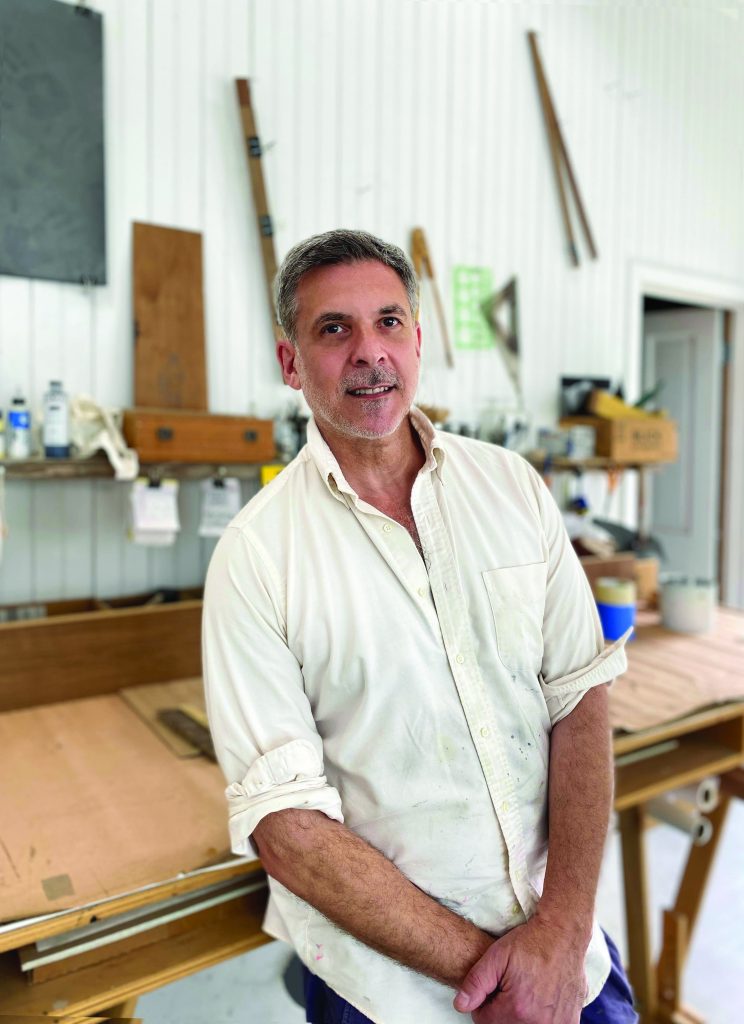
Gustavo Bonevardi
Gustavo Bonevardi. Photo by Ann Foker.

“I think that’s what New York is, it’s always fresh and new and vibrant,” Bonevardi notes, adding that when it comes to downtown’s future, “I expect it to be something unexpected. I expect to be surprised somehow. I mean, the city is constantly reinventing itself.” His most recent proposal, Missing, explores what traces the COVID-19 pandemic left on cities through footsteps echoing the many who passed away these nearly two years. Whether through such unexpected displays of resilience or delicate works of art, Bonevardi and the many other artists across New York show that this city champions perseverance and adaptability above all, underscoring what it takes to be a New Yorker.

Learn more and view a selection of Bonevardi’s works at gustavobonevardi.com.

Categories
Culture Living News NYC

Art on the Ave NYC Displays Downtown’s Resilient Spirit

Strength by Deb Fong

In recent weeks, you may have seen vacant downtown storefronts be transformed into public art galleries. The Downtown Alliance has tapped the inspiring power of art to convey the city’s resilient spirit. They have joined with Art on the Ave NYC, to create Resiliency-A Gallery Walk.

“Public art in Lower Manhattan will help us mark our return in a thoughtful and joyous way,” Downtown Alliance President Jessica Lappin said. “Whether it’s storefront galleries, permanent outdoor sculptures or performances taking place across the neighborhood, the arts are flourishing downtown. We welcome New Yorkers to come rediscover and explore our neighborhood with fresh eyes.”

Thought Form I: Resiliency Joan Aglaia Choremi
Thought Form I: Resiliency by Joan Aglaia Choremi


Home + Coming by Kevin Byrd
Home + Coming by Kevin Byrd.


Art on the Ave NYC-Broadway
Art on the Ave NYC Gallery Walk

The public-art nonprofit Art on the Ave NYC launched the initiative in partnership with the Downtown Alliance in September . More than two dozen artists currently have pieces for sale, on display. They will remain up through Nov. 28.

For more information about the exhibits, or participating artists, or inquiries to purchase, visit artontheavenyc.com

Categories
Art Culture Design Featured

Donald Christiansen, Founder of Chelsea Art Group, Shares his Views on the Evolving World of Art

The sheltering at home (when possible) effect the virus has had on the world over, has made many of us appreciate the arts more than ever. With galleries, art fairs, and installations closed, canceled, or postponed for the time being, supporting artists is more important than ever. See below for Christiansen’s take on the ever-evolving world of art.

Donald Christiansen of Chelsea Art Group.

Downtown: Tell us about the services your firm, Chelsea Art Group, provides?

Donald Christiansen, Founder of Chelsea Art Group: Basically, we are an Art Advisory firm. We provide detailed information to our clients about the work that we offer to them. Whether it is to incorporate art in order to decorate a new home or office, or if it is to purchase art to diversify an investment portfolio, we make sure that our clients have all the important information about the artwork they are interested in purchasing. We also manage entire collections—this includes loans to Museums and Gallery Exhibitions. In addition, we have the capability of providing ancillary services such as framing and shipping.

Downtown: How would you describe the state of the art industry today?

DC: Unknown! I think the future of the entire world is in a state of unknowing. However, because several clients are still buying and there are a few major purchases happening, I feel encouraged. Many people are looking for bargains now and are interested in putting their money into physical assets such as art, but they are also looking for big discounts. I have several good works that are being greatly discounted because the owners are now in need of cash.

Downtown: With so many huge galleries such as Pace furloughing workers, how do you see the art world adjusting in the next year?

Artwork by Jaume Plensa.

DC: Time will tell! I do not think anything will ever be the same, and unfortunately, some of those jobs will probably never come back. Certainly, some of the mid-to-small galleries will have a difficult time returning to their pre-COVID-19 days, but I think the larger and more prestigious galleries will return to their former state, and possibly even expand. With the current individual isolation requirements, galleries and art fairs are creating digital platforms with accessible virtual viewing rooms. I think the big surprise is that there are so many sales taking place on these platforms.

Downtown: How do you think COVID-19 will impact the art market differently to the financial crash of 2008?

DC: People have a lot more money to spend now as compared to the days of the financial crash. Many are looking to diversify their portfolios to include tangible assets. With many more people flooding the market, art has become its own financial class. As was back then, a lot of money is flowing out of Asia for tangible luxury goods and art can be a lucrative investment with the right strategy.

Downtown: What measures would you like to see undertaken in the art world in support of galleries and artists?

DC: Collectors at any level should make purchases to help out both the galleries and the artists.

Downtown: What was the last art fair you went to and what was the general feeling then?

Sculptures by Lynn Chadwick.

DC: We took a group of clients to the Zona Maco Art Fair in Mexico City this past February. Things were very upbeat, and we sold quite a lot from the galleries participating in the fair. During the course of the week we visited the Mexico City galleries and some artist’s studios

Downtown: How valid is “fatigue” to you? How many art shows would you attend over the course of a year?

DC: Last year, by the end of April, I had traveled to seven fairs. I was away more than I was home. I made a conscious decision to stay home this year and I am glad I did because there were definite issues with people contracting the Coronavirus all over the world. I am pretty tired of the fair circuit and since many galleries already know me, I can work with them from my home. So I don’t feel it is necessary for me to visit as many fairs anymore. However, I say this, but I will probably back soon.

Downtown: While many of us bemoaned the sheer number of fairs in both the design and art worlds, what fair would you most love to explore again right now?

DC: I think Art Basel Switzerland in June will be missed this year. This was one of the first fairs and remains one of the best art fairs I visit each year. Galleries save and place their best pieces in Basel each year. I look forward to the rescheduled fair in the fall.

Work by Mona Hatoum.

Downtown: Why would you argue that investing and supporting art and artists is more important now than ever?

DC: As I mentioned earlier, for galleries and artists to survive it is imperative for people to purchase art. I am afraid that for a while there may be a lull as people will take time to adjust to the new norm. Galleries need to retain and pay their employees, and artists need to eat and pay rent. When the crisis hit, people cut back their discretionary spending and saved it for a rainy day. Unfortunately, art purchases are one of the first purchases to be put on hold.

Downtown: Who are some of the emerging artists you have your eye on now and why?

DC: I am always looking and buying artwork where I can find it. The artists I collect are usually established and already quite famous. I have been very interested lately in Spanish artists from the late 1950s. I recently bought an Esteban Vicente. Two of the most recent acquisitions are women artists who have had amazing mid-career success and have been included in many museum shows. Camille Henrot creates a primitive mythology featuring half-human and half-animal beings, and Jorinde Voigt, who is an artist from Berlin, incorporates physics and geometry with poetry. Both artists have great stories behind the work and styles that are totally new and different.

Downtown: What do you think this period in our lives—where many of us are confined to our homes—has taught people about the importance of art and the arts in our lives?

Living with art: Donald Baechler print.

DC: When this period is over, I think there will be a thirst to see things in real life and up close. Hopefully as quickly as possible. I think people will start seeing beyond the canvas, from sculpture to performance art, and search for the meaning behind these artistic expressions. Isolation and confinement can create a feeling of appreciation for the artwork they have acquired. This can encourage people to find more art for their homes that can bring them comfort in distressing times.

Downtown: Are you still advising and consulting with clients? If so, where can our readers reach you?

DC: I consult daily. I receive 50–100 emails with people buying or selling artworks—some with deep discounts. Some calls are from people designing their new homes and wanting me to find some special works for their space. We have a website, which show some of the works we have placed over the years, as well as artwork we have sold showcased in clients’ homes. Some of the larger ticket items I have sold need to be treated more discreetly and I can’t show them.

Downtown: Have you gone on any of the virtual museum tours? If so, which would you recommend to our readers and why?

DC: I have checked out a few Galleries Virtual sites to see what they would have brought to different art fairs. I think most of the museums will have some extra content at this time. MOMA and LACMA are two of the good ones.

Categories
Art Culture Featured

Mysterious Faux Food Cart Appears In Astoria

There’s a new food pop-up in Astoria, and it’s looking downright appetizing!

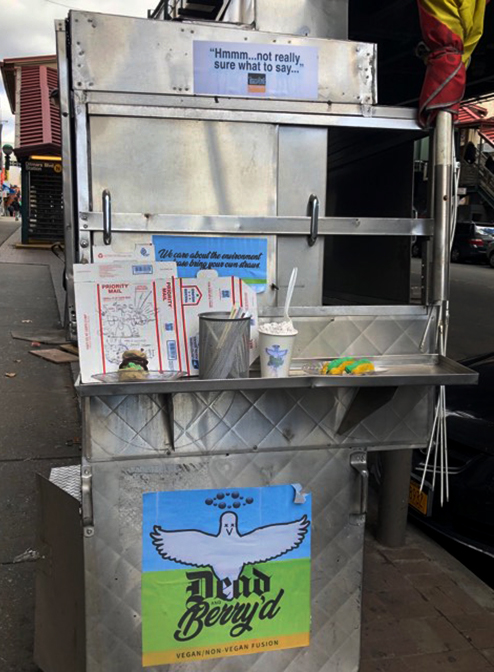
Dead and Berry’d appeared on 31st Street at an abandoned hot dog cart under the Ditmars stop this week. Its tasty “vegan/non-vegan fusion” offerings have certainly been tantalizing the block!

Photo by Hayley Bing

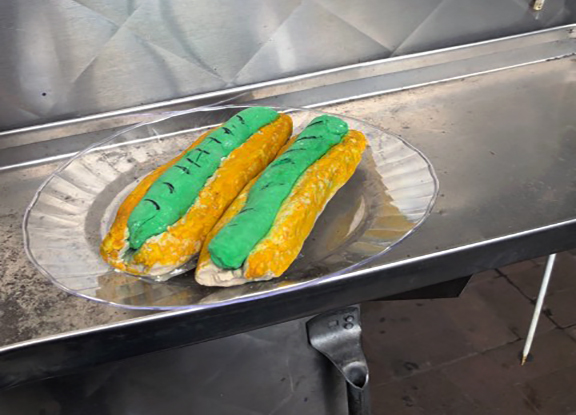
Green frankfurters, double-decker neon hamburgers, and frozen delights await the hungry masses at this formerly unloved street cart chained to a “No Parking” sign. The authentic artisan cuisine is skillfully handmade with indigestible Sculpey polymer, plated on eco-friendly thrift store china, and blends the finest in conceptual slaughter and foraging.

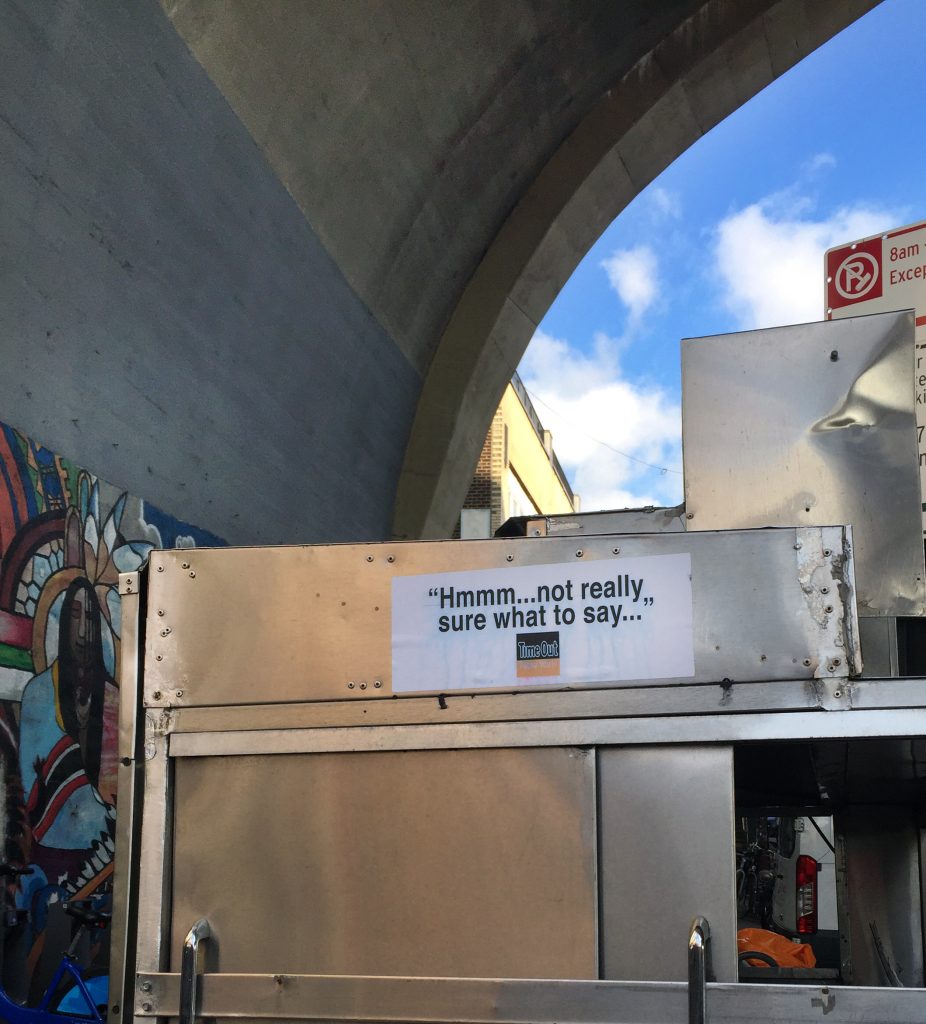
This forward-thinking chow wagon is committed to saving the environment and politely demands customers bring their own straws, on a sign plastered to the side of the cart. With all the roly-poly pigeons roaming the immediate area, and a farmer’s market across the street, Dead and Berry’d is committed to providing fresh farm-to-table squab for busy commuters.

Photo by Hayley Bing

The Dead and Berry’d logo alone is a masterpiece in graphic design: a KO’d pigeon with berries spinning over its head, invoking the spirit of the classic Rainbow Peace Dove poster of the great Milton Glaser, but with a tragic twist.

Their rustic menu, supplied by the neighboring Astoria post office Priority Mail rack, is artfully hand-drawn and calligraphed by a talented Anonymous…such a feast for each sense.

Astoria resident Hayley Bing, who spotted the new joint on her way to work, sent in these photos. She was one of the lucky few who got to sample the rare goods firsthand:

“The menu item they called ‘hotdog’ was reminiscent of the modeling clay I used to eat in art school on special occasions,” she says.

We aren’t sure what’s in those offerings or even the head chef’s true identity, but perhaps it’s best to keep this a beautiful mystery. Ditmars certainly needed a little zip in its step with all the new construction and changes happening to the beloved 31st Street promenade. And what a gamble! Food is flying off the shelves. By Thursday they’d sold out of their signature hot dogs, hamburgers and shakes, but we’re anxiously waiting for the next installation.

Perhaps Time Out had no idea what to say, but Downtown is ready to chow down.


See More

Raising The Bar With Hank Fontaine

Album of the Year: Civilian by Frank Tovey

Clan of Xymox Materializes At Le Poisson Rouge

Blake Charleton Keeps It Fresh

Christine Smith Waits On The Far Side Of A Star

Adrian Sexton Draws The Death Card

Categories
Culture Entertainment Events Featured

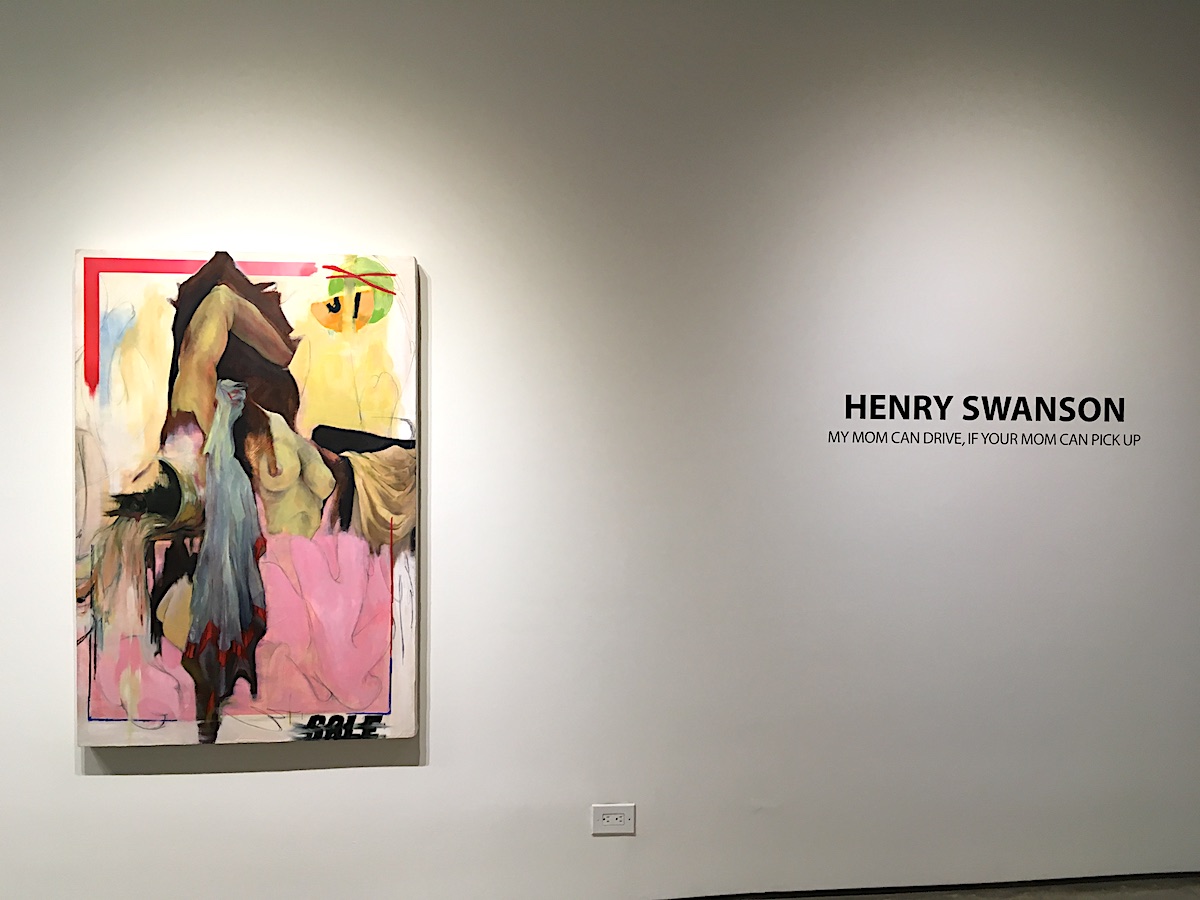
From Dallas to Downtown: Meet Artist Henry Swanson

Dallas-based artist Henry Swanson is currently in the middle of his first New York City solo show, My Mom Can Drive, If Your Mom Can Pick Up, which runs through Feb. 10th at the Anna Zorina Gallery at 533 W. 23rd St., next to the Highline.

The 23-year-old Swanson, a graduate of the prestigious Rhode Island School of Design, recently spent 6 weeks as the Artist in Residence at The Goss-Michael Foundation, a major player in the Dallas art scene (run by Kenny Goss, former partner of the late musician and philanthropist George Michael, and Goss’ sister-in-law Joyce). The residency and its resulting exhibition, Mad Festive, gave Swanson his first real taste of life as a working artist.

He describes his new show as “discussing themes of Southern childhood insanity and Dallas’ culture of constant change and revision — politically and physically.” Here he takes Downtown through some pieces from the exhibition, talks about his ever-changing relationship with an ever-changing NYC, remembers his “big break,” and tries to explain just what it is about Dallas that makes its hidden-in-plain-sight dysfunction such a fascinating and bottomless source of artistic inspiration.

From Dallas, To NYC, To New England And Back: Changing Perspectives

“There’s always been gaps in the times I’ve been here. The first time I was here, I was maybe 15 or 16, so coming from Dallas, I was like ‘This is the greatest place ever!’ And I didn’t know anybody, so it was just awesome. Everything was visually the coolest thing I’d ever seen.

Then I didn’t come back for a while, and my second experience [with New Yorkers] was during college. There was this huge swarm of people who grew up in New Jersey and around New York City, all showing up at this New England art school. It reshapes your view of a city, what you think of it. That was the first time I’d ever met real New York people, and it totally remolded what I thought of the city… I was thinking, ‘I don’t like anyone from this city, and I don’t understand the cultural interaction dynamic.’ Just socially, I thought it was not appealing at all.

Last time I was here, it was about 5 Pointz and street art, and now it’s more like construction site stuff that I find more exciting. Everything in New York is still exciting, but it’s always a whole different culture that I’m being baptized into every day.”


We’re Not So Different After All, Are We?

“Everyone at school who was from New York City thought everything sucked. You’d meet someone from Manhattan and say you went to Brooklyn, and they’d say ‘Brooklyn sucks!’ You’d meet someone from Brooklyn and they’d say Queens sucked… the negative atmosphere made trying to work really frustrating. I had a lot of trouble wrapping my head around it.

Yet everything that makes its way into my work comes from negativity, sarcasm, or deflective attitudes. It’s all there. In Dallas, everyone is really nice, all the time. So after being in New England and then returning to Dallas to work for a while, I found I was really annoyed with how nice people were. All of a sudden, people being nice became this really spacey experience of ‘Y’know, I don’t really believe you!’ Spending time with nice people was now really antagonizing. I’m thinking “What are you getting from being so nice right now? This is really frustrating!’

It reached equilibrium at a certain point. There are some things that Dallas and New York have in common, but neither would have admitted that. There are some mutual insecurities and maybe some immature things that might be universal here, but spending time in New York made Dallas a lot campier, and a lot funnier, to me.”


Everybody In The Pool! Um, Except You

“Each piece in the show is a collage/vignette about a couple of different things that represent what my experience of where I’m from is like. Some of it spans way, way back to a memory, while some of it might be something I saw the other day. The compositions are not pre-planned. Sometimes I just see something or someone, and wonder why. The alchemy of Southern pride as a push forward of the stuff that’s already socially strange is like throwing gasoline on a fire.

Dallas isn’t like New York City, where different types of people tend to live in different areas. Right next to my house is a country club. And the area around it is this really poor neighborhood. When I was young, the private school kids swam in the pool. The public school kids couldn’t swim in the pool. The whole idea of doing a show about Dallas came to me when I thought about how it’s spliced up in a way where it doesn’t remember any of the crappy things it does to people socially. It just kind of smiles on the front end and puts on a new façade. It’s a beautiful place, but it never owns up to all the negativity of how it treats people.”


Negativity Can Be An Inspiration, So Make It Your Friend

“Some of the pieces are about embracing that negativity, I suppose. It’s like playing tic-tac-toe with yourself. You will beat yourself, but you’ll also see what you should have done. You’re totally in control of how you view that game.

People read some of my work as street art, but the initial intention was to use a construction worker color palette, like the bright orange and blue were intended to be industrial colors. I like pop culture a lot, but I try really hard to make my work not about pop culture. A lot of the art I make is art about art.”


The Call That Changed It All

“I worked in Dallas [after graduating RISD] for a year before I met anyone else who was a painter. I called tons of people, tried to arrange for studio visits, and had no luck because I didn’t know anyone in the Dallas art community. So I didn’t meet any other painters… until my Goss-Michael residency happened.

It happened in less than a day. A friend of a friend saw my work, passed my number on, and the next thing I knew, I got a phone call. It was the first time I’d been asked to make a body of work about one thing. I get a little distracted sometimes and want to do paintings about more than one aesthetic, so I think that show taught me a lot about working through the crisis. It’s a big space, and I had 6 weeks to create the entire show.

That’s what I wore to my residency every day. That cap, that t-shirt, those shoes. I was doing a lot of paintings on stretched U-Haul tarps at the time. And I was wondering, is it art? Ideally, the spray paint would be on the floor and wall of the space. I’d been looking at a lot of Northern European sculptors who do stuff with lockers and metals and jumper cables … and they’d affix them to become part of the space. That was very exciting to me. It would be a dream to install this piece in that way. In January, I did a whole show of pieces like this. And people still ask me if I do fashion work. I don’t.”


“I Should Totally Do A Texas Thing”

“This is one of the first pieces I did when I was trying to decide what to make the show about. I got it on a road trip to a friend’s college graduation. And I came home and looked it, and thought, ‘I should totally do a Texas thing.’ It fit with a lot of what I wanted to talk about, like family dysfunction in the South being kind of a ‘kicked under the rug’ thing. There’s not a lot to do there, so it’s so out of control. Irresponsible adults running rampant at every level of the socio-economic scale.

I never for a second want anyone to think I don’t like Dallas or New York. There are things about both that I find hilarious. Like the way rich people can conduct themselves a thousand times worse than poor people. Even if it’s the saddest or most negative thing about Dallas, it should be worth laughing about, saying ‘Isn’t that ridiculous?’”


Why So Serious?

“My work is about things that make me happy, which is stuff I find funny. Some of it’s dark, but all of it’s funny. I try very hard not to make judgmental paintings. Even if the work is about negativity, I’m never trying to be negative or dark.

Art is for fun. I find it really hard to spend time with artists who make really critical work. A lot of them think it’s not good work unless it’s hard-hitting and you have some giant thesis about the statement you’re making. What if you just really love to paint? What if you have funny or happy thoughts that maybe address it, but there’s something genuine about it, like ‘We can work with this!’?”


Just Henry Being Henry…

“I bought an I NY sweatshirt four years ago and wear it everywhere I go. It’s the dirtiest piece of clothing I own. I’ve been to this city a thousand times, but I somehow got lost in Times Square the other day. While, ironically, wearing that touristy shirt. My friend just said ‘Now you have a free pass to act horribly, because everyone expects it from you.’”


Henry Swanson, My Mom Can Drive, If Your Mom Can Pick Up is on view through Feb. 10th. at
Anna Zorina Gallery, 533 W. 23rd St.
(212) 243-2100
Tuesday – Saturday, 10am – 6pm
Sunday, Monday by appointment
Categories
Events Music

Dan Fishman Talks This Weekend’s Emerging Music Festival

In preparation for this weekend’s Emerging Music Festival, Downtown sat down with Dan Fishman, the producer and booker for the festival.

Find out who you should see, check the program for Friday and Saturday, and learn more about Fishman’s musical background as well at the festival.

Dan Fishman

Where are you from, if outside NY why did you choose NY?

Dan Fishman: I grew up in Connecticut – in New York’s long shadow. As a kid, I used to visit NYC with my family and it always seemed like a place where extraordinary things happen. Plus, I love arts and parks and this city has some of the best of both.

How long have you been producing and why this particular festival?

DF: I’ve been at Bryant Park helping to produce cultural events for over three years now. Emerging Music Festival is just one of the over 40 free performing arts events we put on at the park every summer as part of Bryant Park Presents. Our sister company 34th Street Partnership also puts on dozens of concerts every year – and I help with those, too. In total, it’s around 100 free public cultural events every summer.

You are so young, how did you get into music and then producing? 

DF: I became interested in music relatively late actually: I didn’t listen to music regularly until college. Somehow early my sophomore year something clicked and I started listening to at least one new album of music every day. Then it became two or three. At some point, I realized that I should do something more than just listen, so I started writing about music for the school paper. Then I became music editor of the paper – and I was hooked.

I produced events while I was in school – poetry readings, a film festival, some larger literary events. It was fun: I never thought I could do it for a living. At some point, I realized that it could be more than just fun, too.

How did the festival come about and why?

DF: Our events team at the park wanted to showcase local bands and to do something larger and more informal than we usually do. We decided that it should be celebration of music and culture from New York City, so we brought in local food vendors and beer and limited ourselves to only booking young NYC-based acts. Then we added dozens of picnic blankets and giant lawn games and hula hoops. It became something completely unexpected for the middle of Midtown. People loved it.


How did you go about choosing the artists for this festival?

DF: I look at a dozen or so small venues in NYC and see who they’ve booked in the past year and listen to recordings of as many of those artists as I can. Then, I look at blogs – and ask musicians for recommendations. From all of that, I try to make a list of 25 or so favorites and to see those artists perform live if I can: or at least to see video recordings of their live performances. From there, I try to make as diverse a lineup of artists as possible.

What do you look for in emerging artists? Anyone in particular you’re excited to see this year?

DF: I look for one specific thing that makes their sound unlike what I’ve heard before: even if it’s just a voice or a way of using an instrument. I like the element of surprise.

I’m excited about all of them, but make sure to come early enough on Friday to dance to Landlady – and early enough on Saturday to see Breanna Barbara.

How many artists for this festival are NY centric and does this matter since it’s a NY festival?

DF: They’re all in or around NY. I like the idea of celebrating some of the great young musicians that are here: there’s so much talent. It gives New Yorkers a chance to hear musicians who might live in their neighborhood. Plus, I think the bands like the opportunity to play a big free concert outdoors in the middle of their city – and to bring their friends and fans.

There seems to be many music festivals in NYC for the summer months, how did this trend start and how does one decide which one to go to?

DF: I’m not sure I know how it started. I do know, though, that there is something special about outdoor music in green spaces s urrounded by skyscrapers. I’m a big fan of many of the free music series in parks, including SummerStage and Lincoln Center Out of Doors. My recommendation is to pick a day that works for you, a venue you trust, and a kind of music you’ve never heard before.

NYC, as much as we complain, the weather is usually good with the exception of three hard months, will there be other seasons where we will see outside music festivals?

DF: At Bryant Park we program large outdoor cultural events starting in late April and go until the end of September. There’s so much going on in NYC during the peak summer months, it only makes sense to expand the calendar. People still want to be outside listening to music.

What makes this festival stand out?

DF: The audience experience. It’s as accessible and as permeable as a festival can be. It’s completely free. There are no lines or tickets at all: you just walk right in. Any mode of public transportation can get you here. We hand out picnic blankets if you didn’t bring one. There’s food and beer if you want it. You can stand close to the stage and have that experience. You can learn how to juggle or play giant Jenga or just relax on the Lawn.

Our hope is to create a venue where people feel comfortable. And once they’ve arrived, we hope they experience something new.

Who chooses the food and beverage supplier?

DF: Hester Street Fair selects the food vendors – they’ve been a great partner. Beers are chosen by the folks who run the Southwest Porch, a bar in the park.

There you have it, ladies and gents. According to Fishman, the audience experience is what makes this festival stand out. And why deny yourself this experience? Grab a jacket, an umbrella, and head on out. All performances are free.

Photos courtesy of Bryant Park