Categories
Business Finance News NYC Real Estate

A New York Story

Larry Silverstein has spent a lifetime shaping the New York City skyline. He isn’t done yet.

Photography by Andrew Matusik

“BUY CORNERS,” Larry Silverstein replies without hesitation when asked what the most important lesson is that his father Harry taught him about the real-estate business. “If you buy a corner, you have frontages on at least two streets, right? And if you get lucky enough to be able to buy a block front, that gives you even more possibility.” Trained as a classical pianist, Harry had struggled to provide for the family during the Great Depression, eventually becoming a commercial real-estate broker to make ends meet.

Curious about the business, Larry went to work for his dad after graduating from N.Y.U. in 1952. “Something that hit me very early on,” he recalls, “is that I wanted to own something. I wanted to be an owner.” Lacking cash for a down payment, the Silverstein father-son duo took a page from Harry Helmsley and Lawrence Wien’s playbook, scraping together a syndicate of investors to buy their first property, a shabby industrial loft building on East 23rd Street, in 1957. It may not have been a corner property, but they made it work by converting it to office space and leasing it out to white-collar firms. “It was sink or swim,” Larry says of their first venture. “Failure was not an option.”

Silverstein, who turned 90 in May, still reports to the office almost every day, invariably dressed to the nines in a double-breasted suit with a colorful tie and matching pocket square, dispensing friendly salutations to everyone he passes along the way. But behind the elegance and old-school charm, the Brooklyn grit and street smarts remain. “It was not a very luxurious existence,” he recalls of his upbringing on the top floor of a six-story walkup in Bed-Stuy, “which wasn’t nearly as trendy of a place as it is today.”

THE REBUILDING

That Brooklyn grit would come in handy when it came to rebuilding the World Trade Center. When Silverstein acquired the Twin Towers in July 2001, he could never have imagined that within months they’d be gone—and he’d be stuck with a 99-year lease that obligated him to continue paying the Port Authority, which owns the site, $10 million a month in ground rent. The lease also stipulated that he rebuild all the office and retail space that had been destroyed on 9/11.

To make matters worse, quite a few of the two dozen companies that had insured the towers—to the tune of $3.5 billion—were refusing to pay Silverstein’s claims. It took five years of litigation and the intervention of New York governor Eliot Spitzer to finally move the needle. “I called him, and I said I can’t collect,” recalls Silverstein. “So, he brought them all to New York and told them, ‘The courts have found that these are your obligations, so if you don’t pay, you’re never gonna do business again in the state of New York.’” In May 2007, they finally agreed to pay Silverstein the $2 billion he was still owed, marking the single biggest insurance settlement in history. A tidy sum indeed, but still not nearly enough to fully rebuild the Trade Center.
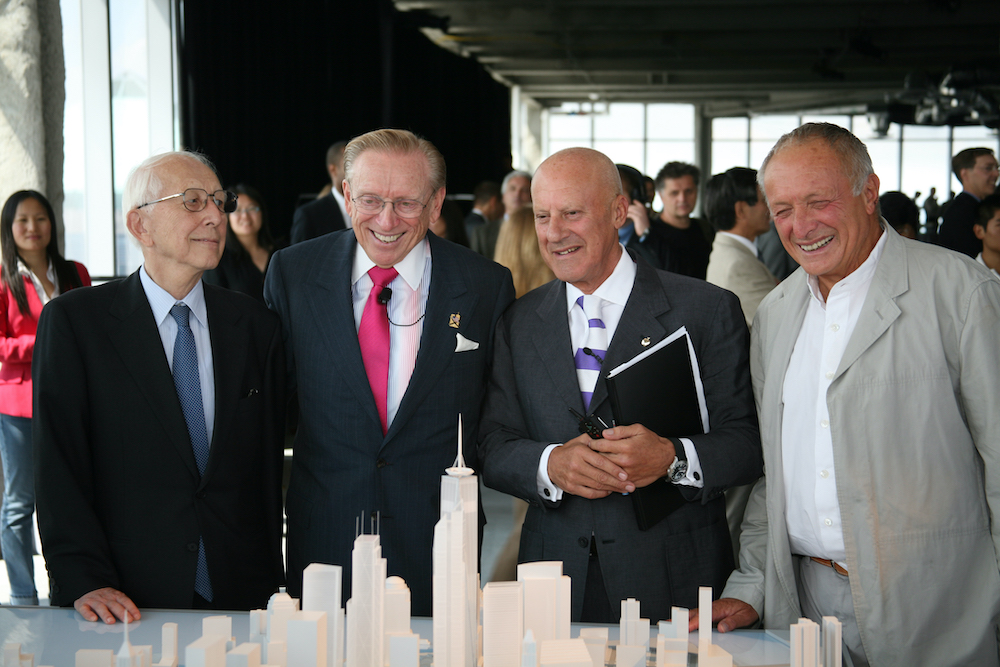
Fumihiko Maki Larry Silverstein Norman Foster and Richard Rogers photo by Joe Woolhead
STARCHITECT LIFE: Prtizker-prize winning architects Fumihiko Maki, Lord Norman Foster, and Lord Richard Rogers, with Silverstein, in front of an architectural model of the World Trade Center campus. Maki designed 4 WTC, Foster’s 2 WTC is expected to begin soon, and Rogers designed 3 WTC. (Photo credit Joe Woolhead)

Despite the many professional battles, Silverstein says it was the “naysayers” who personally affected him the most. “The negative voices kept telling me I would never succeed,” he says. “No one will ever come down here. No one will ever rent space. Why are you wasting your time?” Yet he remained determined to rebuild. Not for personal gain—he stood to make little money from the effort and was already well beyond retirement age—but because otherwise would signal defeat. “If you don’t rebuild it, then the terrorists have won, right? I absolutely couldn’t let that happen.” When pressed if there was ever a point at which he doubted that rebuilding office towers adjacent hallowed ground was the right thing to do, his answer is immediate and unequivocal: “Never.”

“[Downtown is] young, it’s vibrant, it’s enormously exciting. Should add ten years to our lives.”
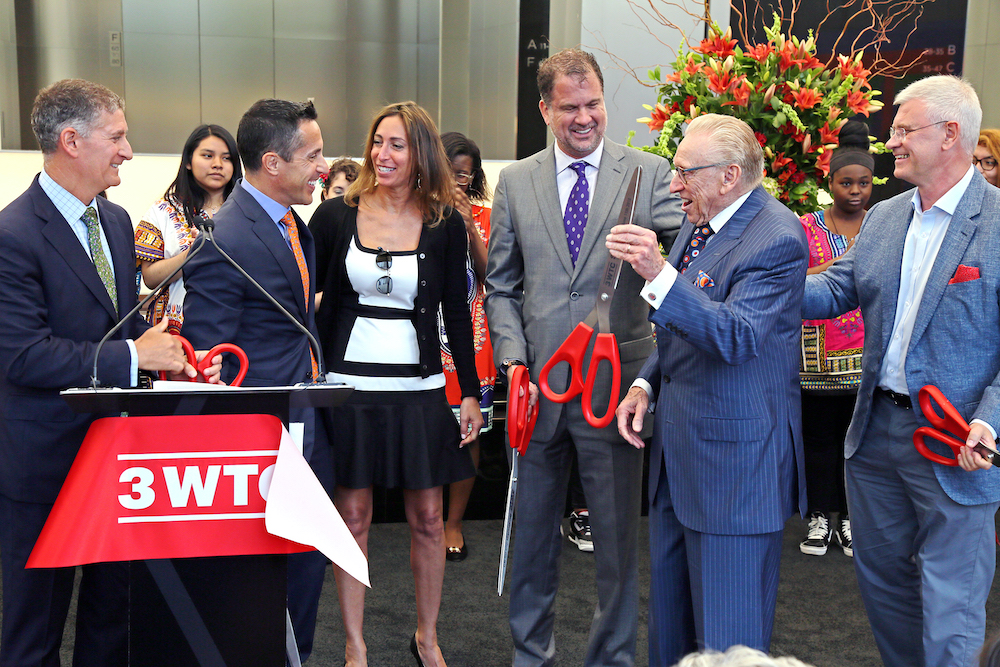
Larry Silverstein at opening of 3 WTC.
OPEN FOR BUSINESS: Silverstein at the opening of 3 World Trade Center in 2018, with CEO Marty Burger, President Tal Kerret, daughter Lisa, son Roger, and architect Richard Paul. Photograph by Joe Woolhead.


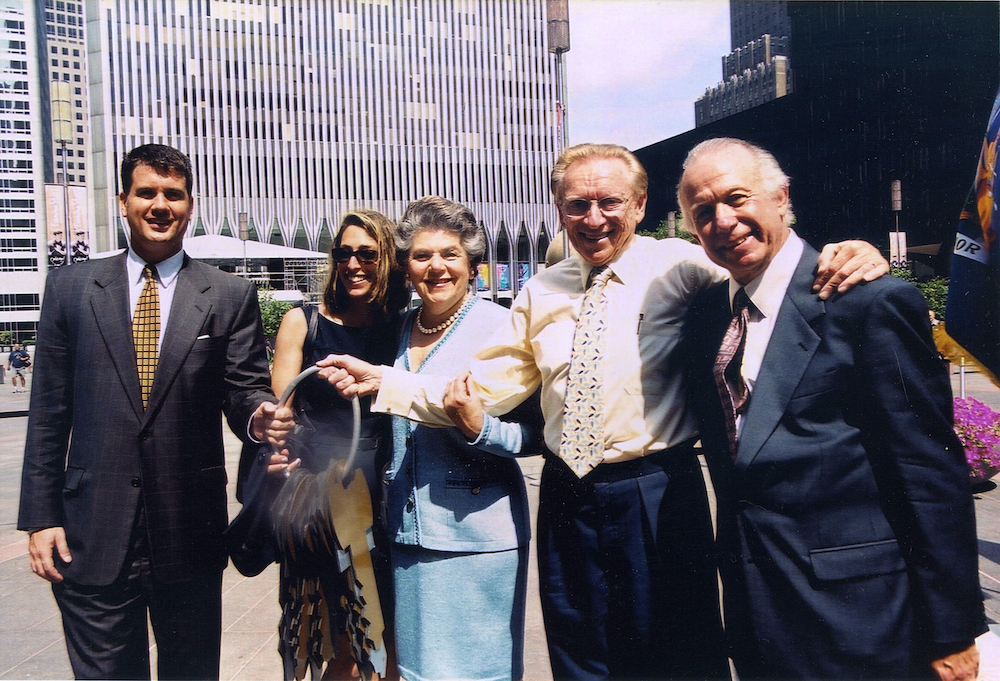
Roger, Lisa, Klara, Larry, and Lenny Boxer pose with the ceremonial keys to the World Trade Center on July 24, 2001.


NEW KID ON THE BLOCK

“When we bought the Twin Towers, this place was a ghost town,” Silverstein recalls. “After six o’clock, you could roll a bowling ball down Wall Street or any place you wanted.” But after watching the neighborhood evolve after 9/11—and after more than 30 years in the same Park Avenue apartment—Larry and his wife of 65 years, Klara, decided it was time for a change.

“Something that hit me very early on is that I wanted to own something. I wanted to be an owner.”

Larry Silvestein
Larry Silverstein poses with the children of some of Silverstein Properties’ employees during “Take our daughters and sons to work day ” in 2013.

So, in 2018 they moved into a penthouse at 30 Park Place, one of his developments. The 82-story tower, designed by Robert A. M. Stern to look as if it could have been built a century ago, opened in 2016 and includes residences atop a Four Seasons hotel. “If you look far enough,” Silverstein jokes about the view from his 80th-floor terrace, “you can see the curvature of the earth.”

“Two things really tipped the scale in favor of moving down here,” he explains. “Number one: my grandson said, ‘Poppy, if you move down here, I’ll show you how to go to work by skateboard every morning. It’s two blocks, downhill, piece of cake.’” Number two was
the rejuvenated neighborhood. “It’s young, it’s vibrant, it’s enormously exciting. Should add ten years to our lives.” Downtown’s residential population has more than tripled since 9/11, and according to Silverstein, the area now has the highest work-live ratio in the country: 27 percent.

That ratio will soon tilt even more residential. Last February, the Port Authority awarded Silverstein—in partnership with Brookfield Properties and two other firms—the rights to build 5 World Trade Center on the site where the plagued Deutsche Bank building once stood. The sleek 900-foot-tall tower, designed by Kohn Pedersen Fox, will feature more than 1,300 residential units, a quarter of which will be set aside for households earning less than 50 percent of the neighborhood’s median income.

While significant obstacles to groundbreaking remain, so does Silverstein’s trademark eternal optimism. Not only will the new tower be a model of energy efficiency and sustainability, he says, but “the firms that take office space at the new World Trade Center will be able to house their employees in the same campus if they want to, which is pretty damn unique, right?”

PRESERVING HISTORY
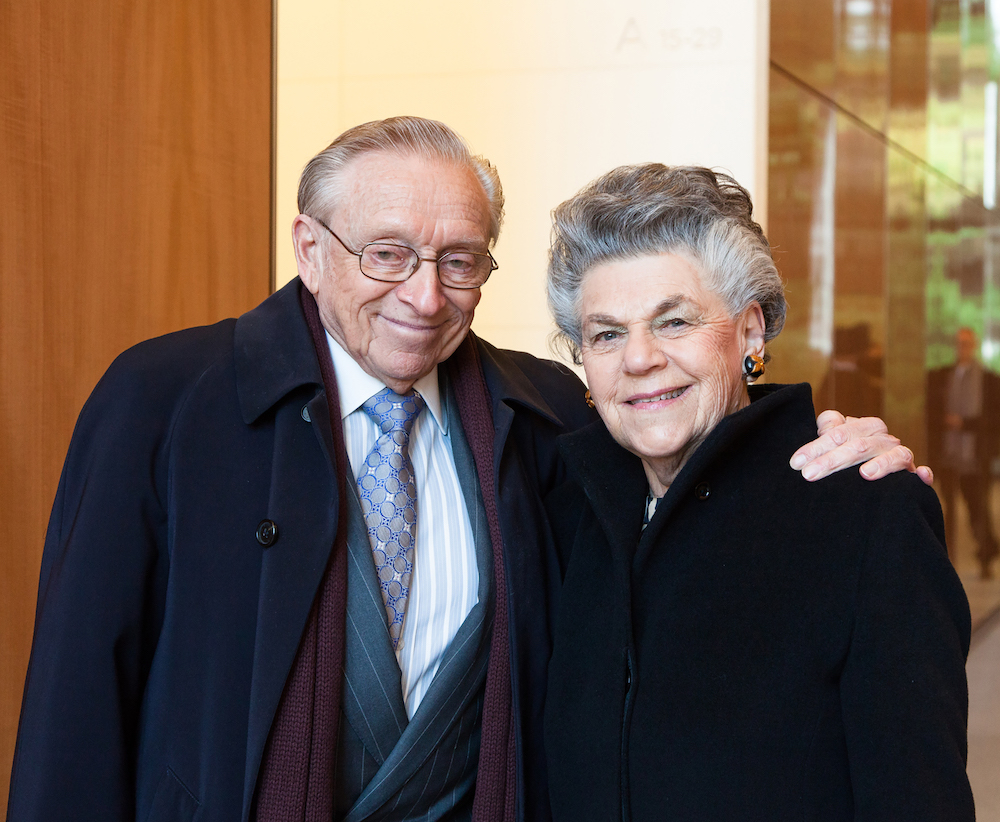
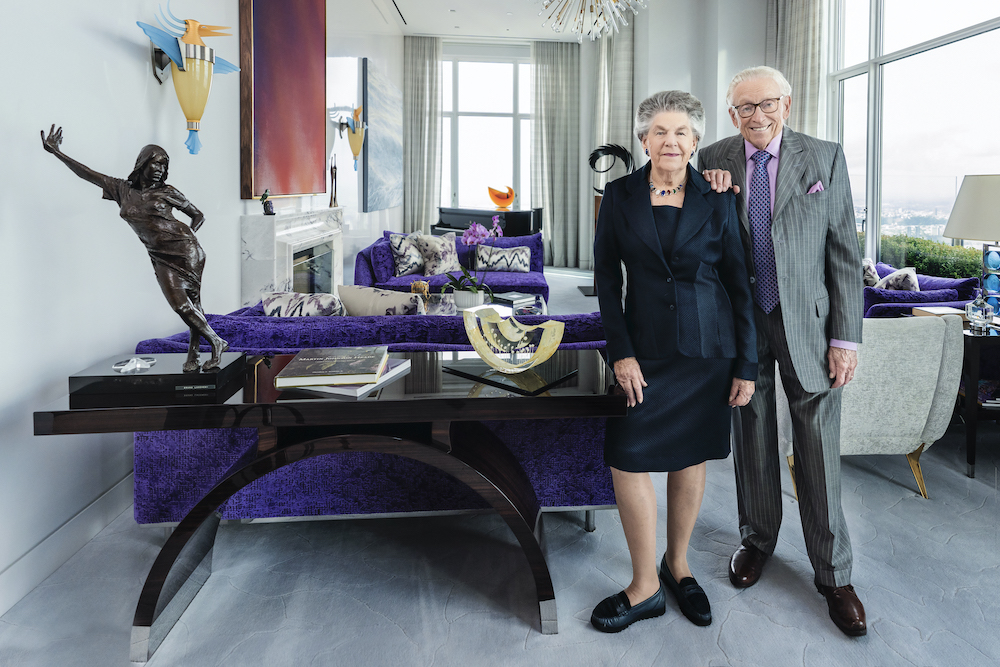
LOVE STORY: Larry and Klara Silverstein in the lobby of 4 World Trade Center.

Silverstein’s earliest memory of downtown is of the “extremely tall, very impressive buildings.” Little did he know he’d one day own one of them, 120 Broadway. Known as the Equitable Building, it became the biggest—if not the tallest— skyscraper in the world when it opened in 1915, occupying an entire city block between Cedar and Pine streets. It was so big that it spawned the city’s 1916 Zoning Resolution, which limited new construction to a percentage of lot size to ensure at least a modicum of sunlight could reach the surrounding canyons.

When Silverstein bought the landmarked building in 1980, many of its historic details had been neglected, if not concealed outright. “The previous owner had no feeling, no sensitivity to the importance of historic landmarks,” he recalls. “They hung acoustical drop ceilings without any kind of architectural detail at all. Added fluorescent lights and so forth. It was dreadful.” So, Silverstein immediately set about renovating it, carefully restoring such original details as the terra-cotta window frames and the lobby’s Tennessee-pink-marble floor, and vaulted, coffered ceiling with carved rosettes. “It makes such a difference,” he says. “Tenants appreciate what a detailed restoration can produce.”

ART & COMMERCE

Something tenants also appreciate, Silverstein says, is art. When he opened the original Seven World Trade Center, in 1987, he immediately realized he had a big problem on his hands. “I looked at the lobby, and I said to myself, I’ve gone crazy.” He explains that he had “fallen in love with” a particular carmen-red granite he’d personally selected from a Finnish quarry for the building’s façade.

But he didn’t stop there. “The entrance to the building? Carmen-red granite. The toilets? Carmen-red granite. The elevators? Carmen-red granite. Everything! Carmen-red granite. The place looked like a mausoleum.” He called Klara in a panic and asked her to come down and have a look for herself, hoping maybe she wouldn’t think it was all that bad. “One look around and she said, ‘You know what? Looks like a mausoleum.’”

They agreed the lobby could use some art to spruce it up, so they set about scouring the city for contemporary works large enough to adequately cover all that carmen-red granite. One of their first purchases was a fourteen-by- six-foot Roy Lichtenstein entablature. Works
by Frank Stella, Ross Bleckner, and Alexander Calder soon followed. “We ended up collecting a whole realm of first-class contemporary art,” he says. “That taught me something, that is art has a huge impact on people’s attitude towards buildings, a very positive attitude. It made an enormous difference.”

“We ended up collecting a whole realm of first-class contemporary art. Art has a huge impact on people’s attitudes towards buildings.”
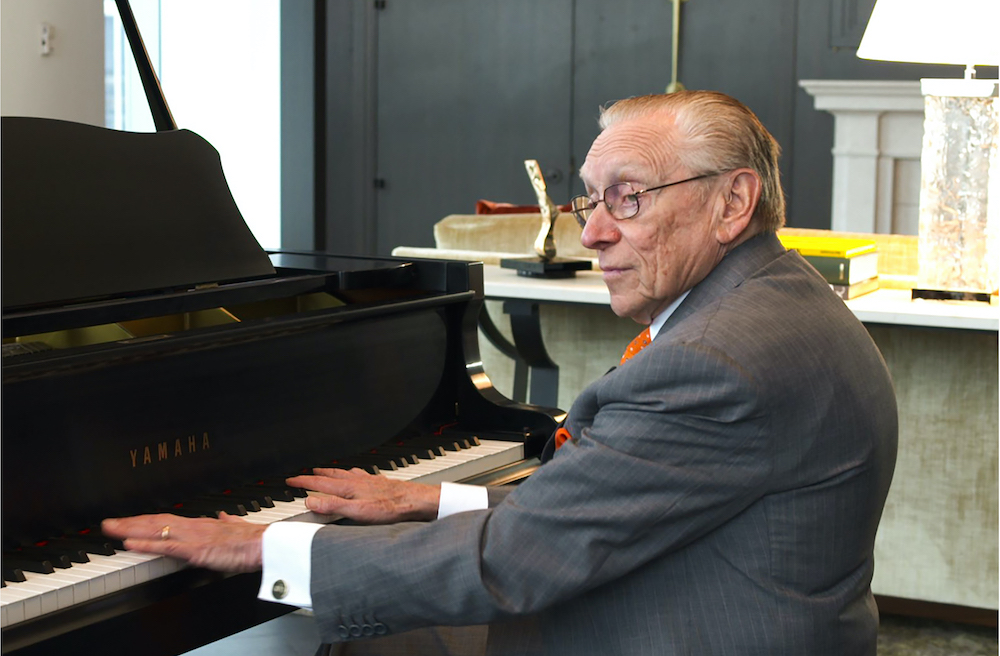
Larry Silverstein at the piano.
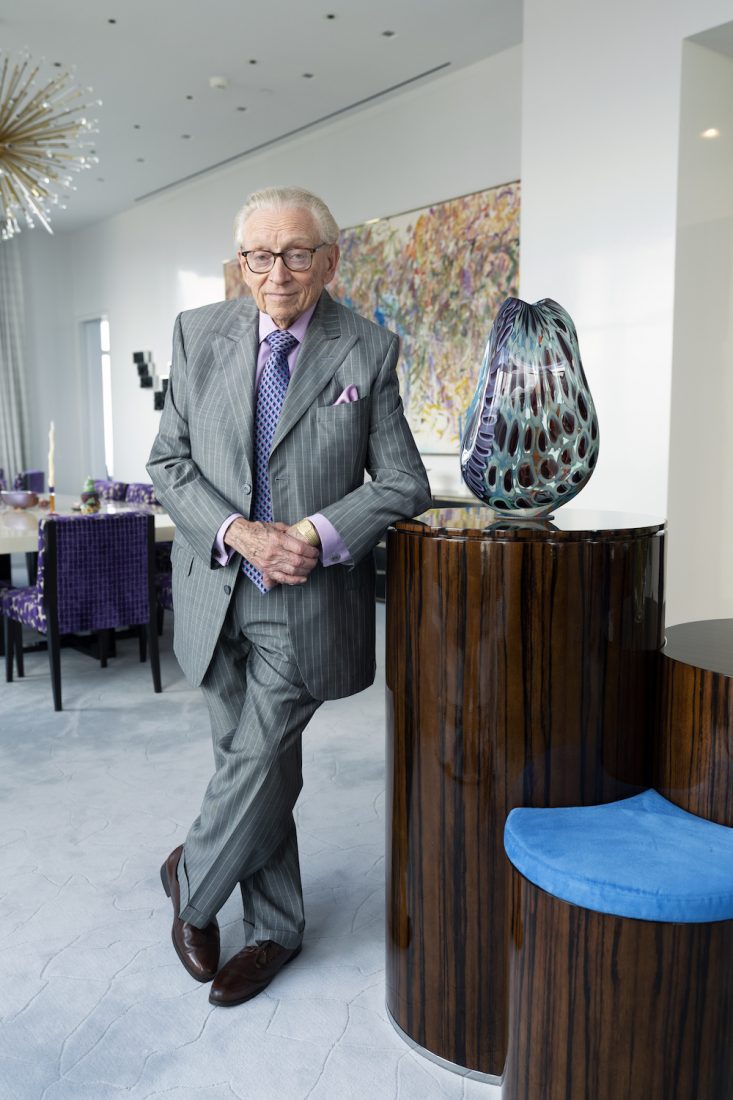
AT HOME: Larry Silverstein at the piano.

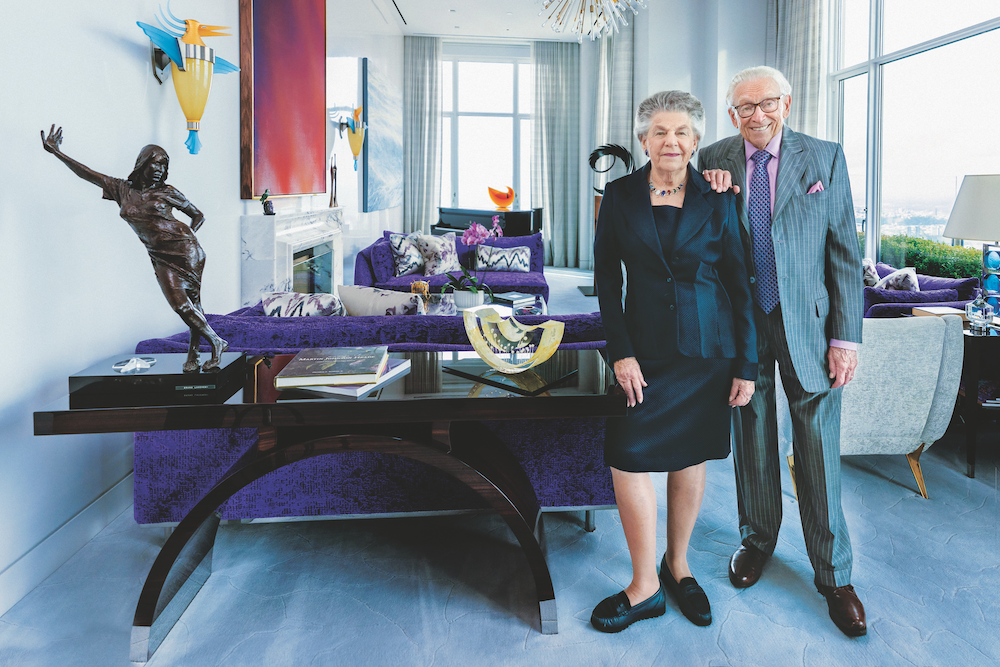
Larry with his wife Klara, in their apartment atop the Robert A.M. Stern designed 30 Park Place.

“Whether I’m still around or not, the Trade Center will be done. And what we will have put back is vastly superior, not just in terms of quality or architectural design. The parks, the neighborhood-totally transformed.”

Art plays a bigger role than ever in and around the new World Trade Center campus. Not only are there remarkable lobby installations, like Jenny Holzer’s “For 7 World Trade” and Kozo Nishino’s “Sky Memory,” Silverstein even hired street artists Stickymonger, Ben Angotti, and BoogieRez to paint the corrugated metal walls that sheathe the base of what will eventually become 2 World Trade Center, now an entrance to the transit hub.

BACK TO WORK

“There’s been no shortage of naysayers all over again,” Silverstein replies when asked if he sees parallels between post-9/11 and post-pandemic downtown. “New York is done, finished. No one’s ever coming back. The office buildings are gonna be vacant. Fold up the tent and steal away into the night.” Not surprisingly, he’s as sanguine as he was after 9/11 about the potential for recovery after covid. “Will it be 100% back to the way it was? No, I don’t think so. But people will come back. Of course. It’s gonna happen. So much comes out of talking together around the water cooler.”

And what does he think downtown will look like in another 10 years? “Well, whether I’m still around or not, the Trade Center will
be done,” he says. “And what we will have put back is vastly superior, not just in terms of quality or architectural design. The parks, the neighborhood—totally transformed.”

“Buy corners” may have been the best professional lesson Harry Silverstein imparted to his son, but it’s this bit of wisdom that endures: “Whatever you do in your life, be truthful with people,” Harry told him. “And never equivocate.” Impeccable advice for an age where truth has become all too relative. DT

Categories
Art Fitness Health Nutrition NYC Wellness

Performing Artists

I sit here with sun rays beaming through my window, and I look out over the vast new luxury high-rises and newly present nooks and crannies that weren’t visible as recently as this time last year.

With every change of a season, as cliché as it may be, I’m always struck by how quickly time flies.

Then again, living in New York City, I’m also impressed with how much we can accomplish in such a short amount of time when we put our minds to it whether it’s calling for action from our political leaders, adding new architecture to our iconic skyline, or transforming an entire floor from a raw space into an artistic wonderland.


Performing Artists
Cover Fall 2017 By Nigel Barker


And then there’s the change you can make in yourself with hard work, dedication, and passion.


Read about our cover talent, shot by the incredible Nigel Barker, and learn how this man from a small American town was able to do what he loves with talent, a strong mind, and an even stronger physique.


The 2017 Art issue cover came about because of my long term relationship with the founder of DogPound Kirk Myers. First, he was my personal trainer, then he became Downtown’s first fitness editor and quickly turned into a dear friend, who had dreams of his own.

Preforming Artists
DogPound New York IG

We discussed how we could showcase artists, but artists and art come in many different shapes, sizes and forms, not just ones with a brush or camera but athletes.


Performing Artists
By Nigel Barker


Looking at him now, you wouldn’t think that Kirk Myers used to be overweight.


Performing Artists
Kirk Myers then and now


“I was uneducated about healthy eating,” he begins.

“I drank ‘skim’ chocolate milk and thought it was healthy,” he adds with a smile.

Now, knowing much better, he’s come a long way. He credits much of it to education and preparation. And that’s exactly why he’s taken on a more educational approach to fitness.

As the owner of the popular NYC and LA gym the Dogpound, Kirk Myers’ body is one of his most important tools. To work the hours he does training his clients and running a business in NYC endurance and strength are key.

“I think most people who have their own business understand that it doesn’t come overnight. It takes years and years of grinding and learning from your mistakes,” he says.

Performing Artists
DogPound IG Victoria Models


“You must also be open to change, open to feedback, and eager to improve your craft at all times, in every aspect. If your business is not growing, you are dying.”

And even though his business is growing, he keeps a focus on the individual.

For Kirk, it all comes down to training and making a difference for other people.


Performing Artists
DogPound LA IG

“You can really change people’s lives and the way they feel day to day,” he says. “That’s something that I can’t get enough of, it really is priceless.” Kirk Myers DogPound 

This article ran Art Issue Downtown 2017

Special thanks to for this shoot location to The Silverstein Organization; our incredible Board Chairman Dara McQuillan, Chief Marketing Officer at Silverstein, his guidance and belief in what we do here at Downtown each and every day is so vitally important to who we are as a brand.


Categories
Business Design Featured

Coming Home

By Michael Hammer, with photography by Eric Laignel

GROUP M —THE INNOVATIVE and diverse public relations and advertising giant—has moved into 3 World Center, making it the latest in a long line of multi-faceted and cutting-edge businesses that reflect the growth and diversity of the community around it. “It’s a great fit,” says the global media investment management group’s Chief Financial Officer, Mark Sanders. “Downtown is the new media hub. It’s a place of revitalization and rebirth. It’s the best place for us to be.”

COLLAB: Communal spaces, conference rooms, and workstations allow staff to work together, appreciate the views, or to have a few moments of downtime in a busy day.

The company’s unique new office space houses multiple brands including Essence, Mediacom, and Mindshare in its multi-adaptable 14 floors and 700,000 square feet. The space—which includes a modular town hall theater, a coffee bar complete with baristas, a health care and physical therapy unit, and an open terrace—is home to the company’s over 4,000 employees.

The 80-storey 3 World Trade Center—now the fifth-tallest skyscraper in New York—has been described by Architectural Digest as the “next step in Lower Manhattan’s renaissance.” The building’s “ability to attract hip, creative tenants like GroupM,” according to the magazine, “should accelerate the youth movement already reshaping downtown.” GroupM’s new headquarters is the latest example of cutting edge, collaborative office space for a new demographic.

Sanders says that being an integral part of Silverstein’s vision for a reborn Downtown is an honor. “Downtown is incredibly beautiful and revitalized today. But when we began our search for a new base of operations, it was still in the recovery stage. We took a leap of faith in [developer] Larry Silverstein’s inspiring vision for the area—but we always believed it would become a reality.”

And that goes a long way to explain why the group committed to being 3 World Trade Center’s anchor tenant, occupying about 40 percent of the newest World Trade Center tower. “This is a moment of enormous pride for me and for everyone in the Silverstein organization,” said the renowned developer at the building’s ribbon cutting. “We sought to create modern, environmentally-conscious, and technologically-advanced offices. Places that foster creativity where young people would want to work and collaborate.”

The building’s open environment was originally intended to serve the financial industry, but has been repurposed to provide unparalleled utility and inspiration for one of the most creative media groups in the world. “Many of the same features that are conducive to a trading floor are conducive to the kinds of environments companies are trying to make in general,” observed Jeremy Moss, director of leasing for Silverstein Properties.

And that was one of the main selling points for GroupM. “One of the best things about the space is our ability to be flexible,” Sanders says. “It allows for an enormous amount of creativity. We offer our facilities to all of our clients to utilize—whether it’s one of the many huge conference rooms or the smaller offices. “The unique environment inspires collaboration with our clients and allows talented people to be inventive.”

Sanders describes GroupM’s philosophy as creating an innovative workspace that emphasizes group-wide collaboration while enabling individual agency brands to flourish by taking advantage of the most current trends in agile working. “We needed a lot of space,” Sanders admits. “We have 4,000 people—and that’s not an easy task in itself. But we also wanted to be part of an area that provided for the needs of our employees—and would create a productive, inspiring and fulfilling environment.”

Technology, advertising, media, and information, or TAMI businesses made up 37 percent of the square footage that relocated Downtown in 2016. Media mammoths like Condé Nast and Time Inc. blazed the trail when they moved Downtown. At the end of 2018, TAMI companies made up more than 30 percent of the Downtown office market, up from 17 percent a decade earlier.

And that has helped the company attract, stimulate, nurture, and retain the brightest young talent seeking to work with some of the world’s largest brands. “Having companies like Condé Nast come down here made the decision that much easier,” Sanders says. “People seeking cutting-edge opportunities are flocking here and we want to be there to help them accomplish their goals. The area is a media hub and it made sense for us to contribute to and drive that environment,” Sanders says. “But we also wanted a place where our people would feel connected to the community. We wanted a place that had a real vitality—in business and beyond. We wanted to be among that vanguard to set up shop here and use our voice to drive that dynamic.”

GroupM’s chief executive officer, Kelly Clark, agrees. “Lower Manhattan is quickly becoming a world capital for advertising, media, technology and information. We’re excited about our inspiring new space and everything this neighborhood has to offer.” DT

Categories
Business Featured News Real Estate

Banner Year in Lower Manhattan Leasing

Lower Manhattan captured over 5.5 million square feet of new commercial leasing activity in 2018 with a surge of activity in the fourth quarter that made it the best year for leasing since 2014, according to the Alliance for Downtown New York’s Lower Manhattan Real Estate Year In Review.  

J. Crew inked the largest relocation deal of 2018 with its commitment to Brookfield Place and, along with McKinsey & Company, led the pack of 26 new Lower Manhattan tenants relocating to Lower Manhattan and taking  25,000+ sq. ft. of space. These tenants represented eight industries and showed a dramatic diversification over the previous year where large relocations were dominated by three industries (see illustration). The diversification of Lower Manhattan’s largest tenants has been a growing trend and closely mirrors the overall market transformation. 

“It was an incredible year in Lower Manhattan,” said Downtown Alliance President Jessica Lappin. “We saw a number of new high profile companies like McKinsey, Casper, and Nike choosing to relocate to Lower Manhattan and many more current tenants like Omnicom and BMI choosing to stay. It’s clear that this neighborhood has arrived as a place where companies across all industries want to be located.”

While the opening of 3 World Trade Center introduced significant availability to the Lower Manhattan market in 2018, the neighborhood continued to see high demand – resulting in the largest quarterly drop in the vacancy rate since the second quarter of 2014 as the market tightened to 10.8 percent at year’s end.

Retail in Lower Manhattan also continued to grow in 2018 with a total of 95 new stores and restaurants.  Nearly 60 full-service dining restaurants, casual eateries and nightlife spots across a variety of cuisines and price points opened this year, including Sola Lab, Brooklyn Chop House, and Don Wagyu.  Lower Manhattan also welcomed new and unique hotel brands to the market, including two concepts that are entirely new to New York City. The neighborhood’s inventory is now home to 7,700 rooms, representing an incredible breadth of options for both the business and leisure traveler.

Categories
Business Real Estate

Exciting Downtown Real Estate Developments


2514453078_97e036e49e_o
The building at 3 World Trade Center is just one of many attracting a wide array of businesses to Lower Manhattan.

Downtown real estate has become extremely popular for tenants looking for premium office space in Manhattan at affordable prices. Several of the biggest real estate transactions of 2013 took place in Lower Manhattan, including Citigroup’s continued lease of 2.6 million square feet in Tribeca.

The media company Group M will occupy 515,000 square feet, at 3 World Trade Center, a lease that made it possible for building to fill its 80 stories to capacity. The negotiator for Group M’s lease, Mary Ann Tighe, told the New York Post, “Interestingly, Group M did not start out looking for new construction. They tried very hard to find an existing building they could retrofit for their needs. But at the end of the day, they discovered nothing could support their operations as well as the high-ceilinged, column-free environment.” As Group M and Jones Day move Downtown, Citigroup is also moving its headquarters Downtown to Greenwich Street.

Ken McCarthy, economist and leasing-market analyst at Cushman & Wakefield, told Crain’s New York, “The deals show that downtown is getting interest from several sectors. There are also lots of tenants heading to lower Manhattan from midtown south because the rents are cheaper downtown and it is actually closer to the workforce in Brooklyn.”

Crain’s New York reports that the Downtown lease increase is the highest since 1999 and 2000 during the dot-com boom. Real estate companies SL Green and Vornado Realty Trust lead the way with the Citigroup, Metro North, and Macy’s deals.

–Louise McKnight