Categories
Education

Learning a Language as a Piece of Theatre

As Shakespeare once put it, “All the world’s a stage, And all the men and women merely players.” And if that’s the case, why should learning a language be any different than learning a script? 

One Crazy Narrative After Another

Early conversation practice at ABC Languages can take many forms. Practice ranges from a class to a conversation group, to even a bit of narrative theatre. I worked with co-founder Elizabeth Zackheim, and together we ran through a short French conversation diagnostic. This included the help of Carmen, Betty, Yukio, and a few other fictional characters to help us test out speaking lines in French.

The class took place in a classroom in Paris. The characters we acted out included students from America to Italy to Japan. Each gave their own perspective on visiting Paris and naming their favorite monuments — as any tourist would! Before long, the scene took a mysterious turn when a publication in the local newspaper announced the disappearance of three students from a rival language school. Sadly, our story was cut short due to the fact that we only read individual chapters. I guess it’ll be a while before we uncover what happened. “It’s a bit of Scooby-Doo,” Zackheim joked.

Running Lines Makes for Perfect Practice

So how does running through a short plot like this help with learning a language? Speaking lines out loud with a partner helps with both comprehension and pronunciation. Particularly if you’re working with a teacher who can guide you on both levels. Our chapters were pretty elementary, both in vocabulary and pace. This allowed for ample space to break down each portion to its most accessible core.

French can be quite the challenge to speak through correctly the first time around. Therefore, we paused to sound out words syllable by syllable.  As the teacher, Zackheim also took moments throughout the narrative to check in with my comprehension, asking certain “feeler” questions to gauge my understanding. Her doing so allowed me not only to stay focused on the story itself, but also gave me a chance to practice my speaking skills as I strove to elaborate on my answers. 

A Place for Well-Informed Feedback

After running through the narrative, Zackheim was also able to give a well-informed diagnostic towards my comprehension and oral skills in French and recommended shortly after which of the conversation groups at ABC Languages I should attend. For any student looking to test out their skill levels in a foreign language, running through a script like this can be a fast and fun way to receive feedback from a teacher towards what you might need to focus on moving forward. Afterwards, attending a conversation group like those at ABC Languages can provide an environment to work out oral and listening skills in a comfortable, well-paced environment.

To learn more about the conversation classes available at ABC Languages, visit ABC Language School. 

For more on language and culture from Downtown, click here.

Categories
Education Featured

Pronounce a Language — With Or Without an Accent

All of those myths we once faced towards speaking a language with the right accent and pronunciation are just that — myths. It turns out, being able to pronounce the words of a language correctly has nothing to do with a speaker’s native accent. Rather, it is a learned skill that can be taught, and quickly too. 

Pronunciation Bootcamp

The French Pronunciation Bootcamp at ABC Languages takes an actor’s approach to pronouncing French words properly. This can be quite a challenge for any native English speaker. However, Bootcamp uses simple repetition strategies and breaks down beginner words syllable by syllable. The program makes for a fast, fun, and easy way to dismantle a lot of the barriers that come with taking on a new language. Elizabeth Zackheim, the co-founder of ABC Languages, also guides new students. She dismisses misconceptions about adapting to a foreign accent. “It’s your French,” she declares, adding that speaking French with an American accent means you’re nothing other than an American speaking French. “And so what?” she posed to students, laughingly.

Tackling New Muscles

The key to adapting to foreign pronunciations comes first with being aware of how the facial muscles shift patterns with different languages or dialects. In English, we tend to rely heavily on our jaw, with sounds moving up and down from the tips of our tongues. French pronunciation stems from the throat and the back of the mouth. This elicits less need for jaw movement and more pursing of the lips. Women especially might find themselves dropping the pitch of their voice much lower than usual, and sensing more activity in their nasal region. All of this comes with moving past the subjective understanding of how letters and words might be pronounced. As Zackheim puts it, “meeting the native speaker in their territory.”

Attending the Bootcamp at ABC Languages can be a great first step towards achieving speaking fluency. Furthermore, it is a great step toward speaking confidence. Zackheim recommends attending pronunciation workshops like these two or three times and following up with a private coach if needed. Most of all, she recommends, “make a lot of mistakes — that’s how you learn!” Where learning a language can come with a lot of hurdles and a bit of self-consciousness, programs like Zackheim’s go the extra mile towards providing a safe, educative space for students to explore new languages at their comfort level. To learn more about ABC Languages and browse their programs, visit ABC Language Classes.

For more on language and culture from Downtown Magazine, click here.

Categories
Education Entertainment Featured News NYC

A WHALE OF A TALE

by Catherine McVay Hughes, photography by Artie Raslich/Gotham Whale

New York a feeding ground for whales, seabirds, seals, sharks, and dolphins.


THE EFFORTS OF REGULATORS, environmental groups, and New York scientists and citizens have greatly improved the conditions of the Hudson River and the waters in and around New York Harbor. With these improvements, the food chain has rebounded, the water is cleaner, and supports a diverse ecology, from oysters to whales.

This has only been documented since 2011 and each year the numbers of humpback whales have increased dramatically, according to Gotham Whale.

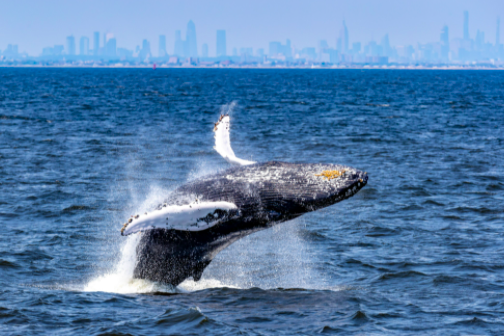
The waters of New York are now a feeding ground for seabirds, seals, sharks, dolphins, and whales. 2020 brought into focus our immediate surroundings as we became outdoor vacationers in New York City. A highlight has been increased sightings of whales, most recently in December in New York Harbor, and throughout last summer in the shallows of the Atlantic Ocean.

Menhaden, a feeder-fish species also known as bunker

A humpback whale stole the show as it frolicked up the Hudson River by the Statue of Liberty and points north. It grabbed our hearts and gave us hope that we can build a better world together. These visits owe a lot to the resurgence of a cornerstone species called Menhaden, a feeder-fish species also known as bunker.

Many different groups worked to protect these fish from overfishing because they are also critical to the survival of the Atlantic striped bass, bluefish, tarpon, and other sport and commercial fisheries.

THE FOOD CHAIN & OMEGA 3

Americans spend more than $1 billion a year on over-the-counter fish oil. A 2018 New England Journal of Medicine study found that Omega-3 fatty acid supplements “did not result in a lower incidence of major cardiovascular events or cancer than placebo.” A downtown resident and dad, Paul Greenberg, explains in his book,

The Omega Principle: Seafood and the Quest for a Long Life and a Healthier Planet, that most Omega-3 supplements come from the little fish such as the Menhaden that big fish (and whales) eat.

Consequently, when the reduction fishery targets smaller wild fish to make them into fish oil for vitamins or meals, a key portion of the food chain is significantly reduced.

A WHALE OF A TALE
photography by Artie Raslich/Gotham Whale
SAVE THE WHALES, PROTECT THE FOOD – ADVOCACY TO SAVE ATLANTIC MENHADEN

At the New York State level, local fishermen and women, the Theodore Roosevelt Conservation Partnership (TRCP), The Nature Conservancy, Gotham Whale, Menhaden Defenders, marine scientists, and others came together to educate others on the importance of sustainable management of a keystone species, the little known Menhaden.

Many worked at the state level with elected officials to pass legislation to stop the unregulated fishing of the species. In 2019, legislation was signed into law by Governor Cuomo that prevents the use of large purse seine nets to take menhaden from New York’s waters.

Built on the measures of the Atlantic States Marine Fisheries Commission in 2012, this important action is critical to restoring the Menhaden population which had been overfished to just a small percentage of their former abundance.

As a result, they have been returning to New York’s coastal waters in historic numbers, which is good news to the striped bass fisheries on Long Island.

The replenished food source is bringing whales and dolphins back to New York’s coast, a boon to tourism.


A Whale of a Tale
photography by Artie Raslich/Gotham Whale


A Whale of a Tale
photography by Artie Raslich/Gotham Whale


DOWNTOWN PLACES TO ENJOY AND LEARN ABOUT NY’S HARBOR

Water surrounds Downtown on three sides and there has been investment in its waterfront over the past several decades. Along NYC’s west side of the Hudson River is the Hudson River Park, which has several downtown highlights including:

• Pier 40 Wetlab:
  • A native aquarium and marine biology field station that also serves as a learning laboratory for those interested in learning more about the Hudson River Estuary.
Tribeca’s Pier 26
  • A 2.5-acre, ecologically-themed pier opened in September 2020 and incorporates indigenous plants as well as a short habitat walk through five native ecological zones: woodland forest, coastal grassland, maritime scrub, rocky tidal zone, and the Hudson River. At the tip of the Pier is the Tide Deck that is an engineered rocky salt marsh.
  • Downtown Boathouse is an all-volunteer nonprofit organization with the mission of providing safe, free public access to the water through kayaking programs.

Just south, Battery Park City has an esplanade that takes you to views of the Statue of Liberty and Ellis Island. BPCA’s Marine Education programs include joining experienced anglers for catch and release fishing and learning about life in the nearby waters.

The Hudson River is home to over 150 species of fish, and BPCA welcomes the public to keep a “life list” of each species of fish and bird.


A Whale of a Tale
photography by Artie Raslich/Gotham Whale


On the east side starting at the Brooklyn Bridge along the East River Esplanade, there is Manhattan’s only beach, called the Brooklyn Bridge Beach, where visitors can watch the tide go in and out. If you are lucky, there may be an event such as the City of Water Day. There are also plans to restore that area just north of Pier 17 while keeping the waterfront accessible.

At the tip of Manhattan is The Battery. Across the path from the SeaGlass Carousel will be the Playscape: a new 1.5-acre sustainable playground with elements inspired by climate, sea, and wind. Rain gardens will filter urban runoff. It is expected to open in Summer 2021.

In a city of islands surrounded by 520 miles of coastline, Governors Island is located at its core, just a 10-minute ferry ride away. Governors Island is a 172-acre island that serves as a hub of learning about how the harbor is changing through its existing community of tenants and partners like the Billion Oyster Project, the Harbor School, and the Climate Museum.

The island is poised to play an even greater role as a research and education hub, anchoring its continued growth by attracting a center for climate solutions.


A Whale of a Tale
photography by Artie Raslich/Gotham Whale


WHALE WATCHING, CITIZEN SCIENCE, AND THE FOOD CHAIN

If you are up for a special several-hour boat ride out of the NY Harbor into the Atlantic Ocean for close-up views of the bunker fish, Atlantic Bottlenose dolphins, or humpback whales (if you’re lucky!), then Gotham Whale, in conjunction with American Princess Cruises, is your next stop.

They had a fantastic 2020 whale watching season. Gotham Whale is a not-for-profit corporation that is the only research group currently monitoring marine mammals around NYC.

Under the leadership of Paul Sieswerda, it combines citizen activism with science by collecting marine research data throughout the area. Their Citizen Science project records sightings of seals, dolphins, and whales in our area, and catalogs individual photographs of whales.

Gotham Whale’s observations have shown that the New York region is becoming a feeding ground. Menhaden, the prey species, have increased over past years.

Whales, as a top predator, are a dramatic indicator of the health of the underlying food chain, and the health of the waters in general. Their work shows evidence of improving conditions in the waters around New York City.

CONCLUSION

As we approach the 50-year anniversary of the Clean Water Act and Endangered Species Act, the humpback whale populations decimated by whaling are still listed as endangered, even after decades of protection. However, we have seen that steps are taken, even at the state level, to give them a better chance.

The World Economic Forum says that although the economic and political consequences of COVID will be with us for years to come, they warn that the biggest global risks over the next 10 years are extreme weather, climate action failure, and human environmental damage.

We welcome the whales for their beauty and intelligence, and they are also unusually good at taking carbon dioxide out of the atmosphere, which is important in tackling climate change. New York rose to greatness on its harbor, becoming a nexus of trade, industry, and finance.

We look again to the ocean and see hope confronting new challenges.

Categories
Education Health Lifestyle Wellness

My experience going to college during a pandemic

The pandemic has been a difficult time for everyone. From the loss of jobs, lack of opportunities to safely socialize, and more, people around the world felt the impact of the pandemic. As I finish up my junior year, I realize that I learned quite a bit from taking in-person classes at college during a pandemic.

Photo by Charlotte May from Pexels

1. Teamwork is extremely important

As expected, there were a few outbreaks on campus throughout the semester. However, COVID-19 cases almost always spiked as a result of students failing to follow safety guidelines. Even when a majority of students follow the safety guidelines, the failure of a few students to do so will still lead to outbreaks on campus. It was essential for students to work together to prevent others from getting sick. We were able to effectively work together as a school to stop the spread, finishing the school year with two successful semesters in-person.

Photo by Charlotte May from Pexels

2. Planning your days helps you get a lot done

Being on campus always helped me focus more, but when the pandemic was factored in, I sometimes found it difficult to focus on my studies. In addition, since many of my classes were still virtual, the amount of work I had to do out of class was overwhelming. I realized that if I made deadlines for myself, I got work done in a more efficient manner. Planning your day really makes a difference in productivity.

Photo by Nicole Michalou from Pexels

3. It’s okay to give yourself a break

It’s frustrating when you’ve been working for a long time and get nothing done. This was something that I experienced often while at school. Due to the pandemic, there were a lot fewer activities to participate in. In addition, interaction with friends in other housing areas was occasionally not allowed depending on the number of cases on campus. As someone who relies on social interaction with friends as a refreshing break, this was very difficult for me. I found new ways to effectively give myself breaks such as cooking or baking, watching TV, and going on walks around campus.


Photo by Samantha Doria

4. Be thankful for what you have

Before the pandemic, I found myself living in the future instead of enjoying the present. Being at college during the pandemic taught me to enjoy every fun moment I had like it was my last. When I was able to safely spend time with my friends, I cherished these opportunities. Even if my junior year was not what I had hoped for, I am thankful for the experience I had.

Categories
Education Featured NYC

A LINE IN THE SAND


Sam Waterston is taking a stand in support of the world’s oceans.

by Mike Hammer photography by Andrew Matusik

AS A CHILD, SAM WATERSTON FELL IN LOVE with the New England coastline where he was reared. “I was a child in the days just after World War II,” he recalls. “Because of the war, fishing had been cut back significantly, and the oceans were plentiful. Growing up in Rhode Island, seafood was plentiful, full of variety, and inexpensive. Everyone believed the sea was inexhaustible until suddenly it wasn’t — and I knew I had to do something about it.”

The 80-year-old Law & Order icon has now resolved to use his enormous equity as one of America’s most respected actors to help restore the world’s waterways to the pristine and plentiful status he remembers from his youth.

He dove into the business of researching how much damage had been done — and even more importantly — what he could do to help stem the tide, and he was deeply shaken by what he discovered. On the advice of a good friend and fellow actor, Ted Danson, Sam looked into Oceana, a nonprofit organization dedicated to restoring the world’s oceans and waterways, that also boasted a long resume of environmental victories.


A Line in the Sand
Sam Waterston by Andrew Matusik


Recent triumphs have included helping to secure the banning of industrial activity in protected Canadian waters, ramping up digital monitoring of previously unregulated salmon fishing in Chile, and creating the world’s second-largest marine national park off Spain’s Mediterranean coast. “I saw that Oceana is an organization that gets things done and I wanted to be a part of that,” Waterston says. “Because of public pressure organized by Oceana, the Obama administration closed the North Atlantic for oil drilling for the next decade. Because of Oceana’s efforts, people up and down the coast lobbied for this destructive activity to end, and they swayed the governors of states on the Atlantic coast to join in.” He continues, “That gave me all the motivation I needed to get on board.”


He warns that in order to save species in the ocean — and secure our own survival


Sam joined Oceana’s Board of Directors in 2008 and within two years was testifying before Congress about the urgency of reversing ocean acidification. According to Oceana’s statistics, the world’s oceans absorb about 30 million metric tons of carbon dioxide every day. “It’s changing the chemistry of seawater and killing sea life,” Waterston says with palpable sadness in his voice. “To reverse ocean acidification, the United States must reduce its carbon dioxide emissions and transition to clean, renewable forms of energy before it’s too late.”

He warns that in order to save species in the ocean — and secure our own survival — we all need to change the way we live dramatically. Recognizing his commitment, Oceana elected Waterston Chairman of the Board last year, providing him with more opportunities to turn passion into action. “I feel so fortunate to have been placed in this position,” he says. “It’s a tremendous place with incredibly committed people and a history of important victories I would be proud to add to.”


A Line in the Sand
Sam Waterston by Andrew Matusik

Waterston’s family history includes some relatives that came from England on the Mayflower


One victory he’d love to add to Oceana’s record is replenishing the once-plentiful codfish population off the shores of New England and Canada. “I’ve seen first-hand the damage fisheries have done without serious regulation,” he says with passion. “Codfish drew Europeans to the Northeast Atlantic going all the way back to when the Vikings first got to Greenland.” Waterston’s family history includes some relatives that came from England on the Mayflower, so the history of the Northeast Atlantic runs in his veins. He says, “Alexandre Dumas wrote in the 19th century that if every cod egg reached maturity, you could walk across the Atlantic on their backs.”


To further the cause, he wrote an impassioned op-ed piece to try and compel the Canadian government to fall in line with American fishing restrictions to help save the species.

In it, he wrote, “In 2019, we stood — literally and figuratively — with the federal government to celebrate the new [Fisheries] Act, which for the first time included obligations to rebuild depleted fisheries and manage them sustainably.” Unfortunately, it seems the celebration was premature. He explains, “Rather than requiring clear, measurable actions to rebuild depleted populations to healthy levels, they went out of their way to avoid setting any enforceable standards.”

“Since the U.S. introduced a strong law in 1996 to stop overfishing and require rebuilding, 47 stocks have been rebuilt, generating about 54 percent more revenue than when they were overfished. The new Fisheries Act promised a brighter future for Canada’s fisheries. It’s time now to deliver on that promise.”

“And, if people make whales extinct, we’ll have exposed something awful about ourselves.”

Waterston’s focus is also riveted on the redemption of the imperiled North Atlantic right whales—he calls them the “Leviathans of the Bible”—which are rapidly disappearing from the planet. Oceana estimates there may be just 360 individuals left.

“Whales haven’t been diminished; they are what they were, magnificent creatures, but our capacity for wonder has been shrinking,” he warns. “And, if people make whales extinct, we’ll have exposed something awful about ourselves.”

He points to collisions with ships and entanglements with fishing gear as key factors
in the depletion of the species, with new threats emerging every year: key among them the deadly non-biodegradable plastics that are dumped into the oceans by the ton, that whales often consume or get caught in with deadly results.

But Waterston believes there is hope. “We have to produce less plastic because once it’s made, it’s here for good,” he says. “The equivalent of a garbage truck full of plastic goes into the ocean every minute. It’s an issue Oceana is rightly addressing with real urgency.”

He points out that Oceana is pressuring companies to take action to reduce plastic production and offer alternatives. It is also pushing for new legislation that will reduce the use of the deadly material in coastal countries worldwide, where a staggering 35 percent of plastic waste is generated each year.

“But the oceans are being killed by throwaway plastics,”

“Our oceans sustain life that could feed a billion people a healthy seafood meal every
day, forever. But the oceans are being killed by throwaway plastics,” Waterston says. “We should not be forced to pollute the ocean every time we eat, drink, or go to the store. We need a choice —a plastic-free choice.”

Luckily Waterston and Oceana are not alone in their battle to bring back our waterways.
In New York, the food chain has rebounded because of more stringent fishing regulations, the establishment of oyster farms in New York Harbor, and the resulting cleaner water that has welcomed the returning whales.

A significant factor was legislation to protect against over-fishing of Menhaden,
a small feeder fish, which is a key source of food for the returning whales. “It’s incredibly encouraging and a key proof of concept,” Waterston says. “This is the kind of thing that we’ve been fighting for at Oceana. It shows that the right actions produce results that prove our oceans can be fully restored if the proper actions are taken.”

And while Waterston remains highly focused on these noble efforts to save our oceans, he hasn’t given up on his storied acting career, which includes star turns on screens big and small, as well as the stage. The 80-year-old actor has played presidents (Lincoln, twice!); Shakespearian princes (Prince Hal in Henry IV and Hamlet); literary figures (Nick Carraway

“I can’t wait to be acting again,”

in The Great Gatsby); and journalists (Sydney Schanberg in The Killing Fields); not to mention his longtime role as District Attorney Jack McCoy in Law & Order, the series’ second-longest-running actor. He is looking forward to shooting another season of the hit Netflix comedy Grace and Frankie, with his equally accomplished castmates, Jane Fonda, Lily Tomlin, and Martin Sheen, as soon as the pandemic allows.

“I can’t wait to be acting again,” he says. “If it weren’t for the pandemic, I would be in a production of Measure for Measure at the Public Theatre in New York right now.

Working with Fonda and company is anything but work, Waterston says, and has led the former television D.A. to one of his more unusual experiences — getting arrested on the steps of the Capitol in 2019 when the issue-oriented cast assembled to protest climate change.

“It was a new one for me,” he laughs. “But getting arrested [during a peaceful protest] is
a wonderful way to get the message through to yourself about how deep your own convictions are.” And like the oceans for which he is a staunch advocate, Sam Waterston’s convictions are so deep they appear to be bottomless.

Categories
Education

Studying While You Work – Is It Worth It?

Education is an essential tool that helps society function and grows.


Not everyone chooses to continue with their education after high school, and instead decide to start their career journey as soon as possible. While this path is right for many people, others might not have been able to go to college for various reasons, even though they wanted to. Alternatively, some people might find themselves stuck in jobs they don’t like, and wonder if they made the right choice. 

So, what do you do in those circumstances? You can stay put and feel dissatisfied, or you can dedicate some of your spare time to gaining a college education. Whether you enroll in a part-time or night class with your local community college or opt for an online degree program, it is possible to return to education. The big question is – is studying while you work worth it? Yes, and here’s why.

Career Progression

If you are stuck in a job you don’t like but aren’t sure how to make a change in career, an education can help you make this jump easier. Many employers like to see candidates with a college degree on their resume, as well as some work experience. If you know what you want to do for your career, but aren’t currently in the right role for that dream, you should look into studying a relevant subject that will help you get an entry-level job in the industry of your choice. 

You might already be in a job you like, but your lack of education has limited your progression to higher roles in the company. Even if you already have a degree, studying to gets a master’s or Ph.D. would certainly make you stand out from other candidates. If you’re worried about having to take time off work to study, consider enrolling in an online degree program like this MBA UK, for example. This will mean you can fit your studies around your work schedule easier. 

Self-Discovery and a Sense of Achievement

While future career prospects might be the main reason people choose to continue with their studies, there are many more personal benefits to consider. It’s an opportunity for self-discovery, and realize some of your hidden talents or find interests in new things that before you might never have given a second thought. A chance to test yourself and see how far you can be pushed to achieve your goals and to be proud of your efforts. Not only will you feel this way about yourself, but your friends and relatives will also be proud to see you work hard to achieve your goals, and you could become a role model for your kids or other members of your family, inspiring them to follow their dreams.


Studying While You Work – Is It Worth It?
Julia M Cameron Pexels


Exploring Your Interests

Yes, education can give you the chance to learn a lot about yourself, including what your interests are. You don’t have to return to study simply for the sake of your career, but perhaps you have discovered a new passion for learning and want to explore a subject in more depth, like economics or literature. Learning can be fun if approached in the right way, so this is another reason to think about studying while you work. It could help you feel more confident talking to your other colleagues and share your knowledge, or inspire you to start a new initiative at work based on what you have learned.

Maintain Your Lifestyle

A lot of people are worried that returning to education while they work will disrupt their lifestyle, but that doesn’t have to be the case. Yes, you might not have as much free time to socialize or watch your favorite TV shows because you’ll have to study, but at least you won’t have to worry about losing out on money each month. This is what is great about online learning, in particular, as you can fit it around your schedule and study at a time that suits you. This is why many people choose to study in this way rather than attend college full-time, as they can save on additional expenses such as accommodation and transport when studying from home. 

Networking Opportunities

Another perk of studying while you work is the potential for networking opportunities. You might find this easier if you’re attending physical classes, but that doesn’t mean you still can’t make connections from online learning programs as well. This is a big benefit to studying, as it’s a chance to make new friends, but you can also get a good reference from your tutors and discover work experience/job opportunities through them, too. 

It will require you to dedicate time to your studies, and it might be a challenging experience, but studying while you work has so many benefits that it will be worth your efforts in the end.