The Lower East Side is in danger of losing a very important piece of history. The Tenement Museum has called for some financial assistance during the COVID-19 crisis.
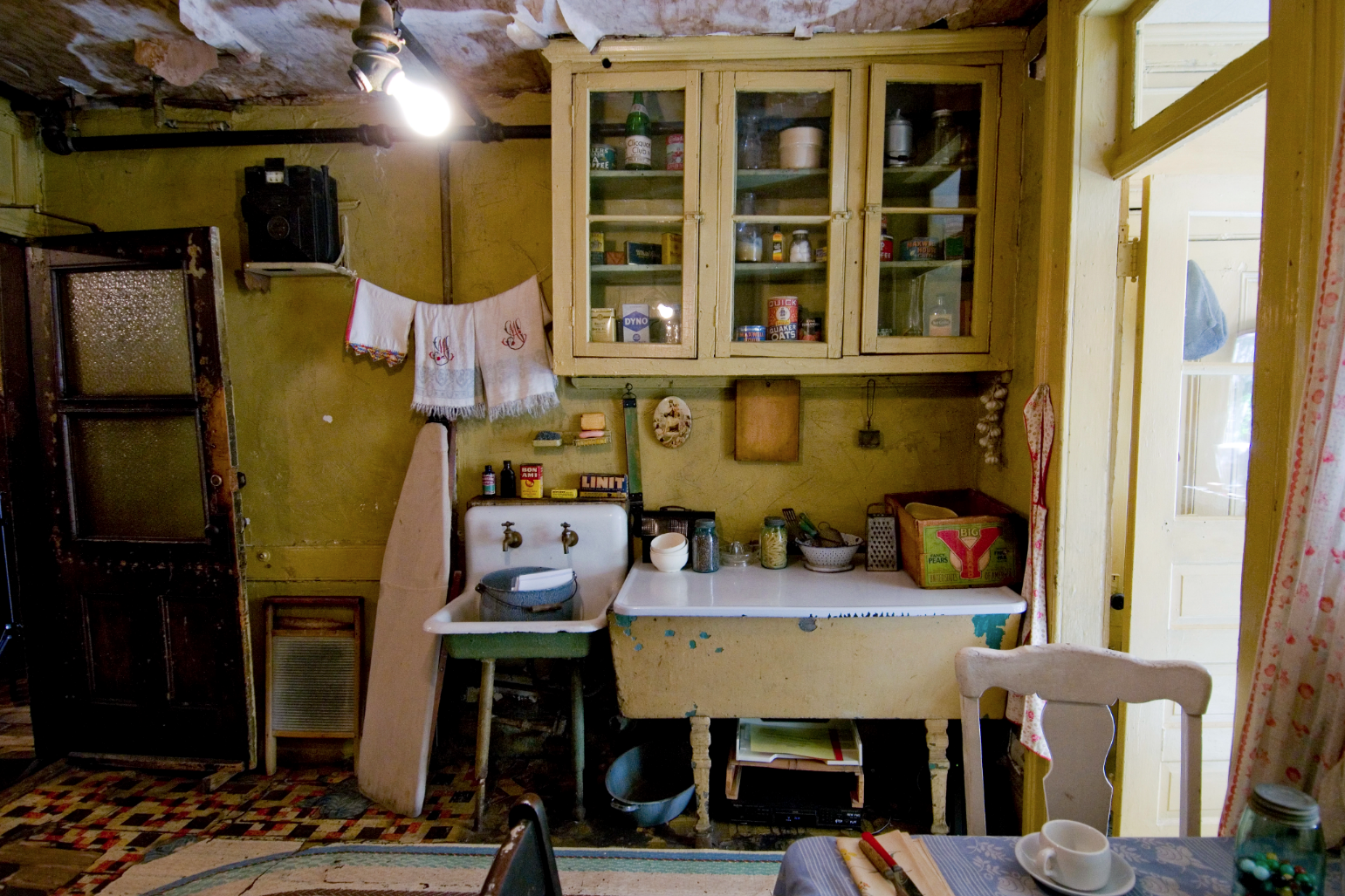
The Tenement Museum tells the true stories of American immigrant families through recreated apartments in a historic tenement building. The museum offers neighborhood walking tours, evening programs, free English language classes, and programs for school groups.
The Tenement Museum’s mission is to “foster a society that embraces and values the role of immigration in the evolving American identity.” They accomplish this through guided tours; curriculum and programs for secondary and post-secondary educators; stories, primary sources and media shared on our website; and interactive online experiences such as Your Story, Our Story, podcasts and more.
Due to the crisis, the museum has had to close; forgoing their normal earned revenue, as well having to cancel its fundraising gala. The museum’s dedication to keeping the experience and the story of the LES immigrants’ experiences alive is unparalleled. Just like the immigrants who made their homes at 97 and 103 Orchard Street, New Yorkers are experiencing a pandemic and financial crisis of our own time, and it is important to remember how our ancestors prevailed.
“We are living through the stuff of history. It’s all the more important, therefore, that our response fits this moment,” says President Morris J. Vogel in a statement.
Please consider making a gift that will allow the Tenement Museum to survive these unprecedented times, remain strong, and reopen when circumstances allow.
Corporate sponsorships are also welcomed. Corporate Members are entitled to free admission for employees and their guests, merchandise discounts, early access to Museum events, and recognition on the Museum’s website and in its Visitor Center. The Museum can also tailor packages to meet other corporate philanthropic and marketing goals.
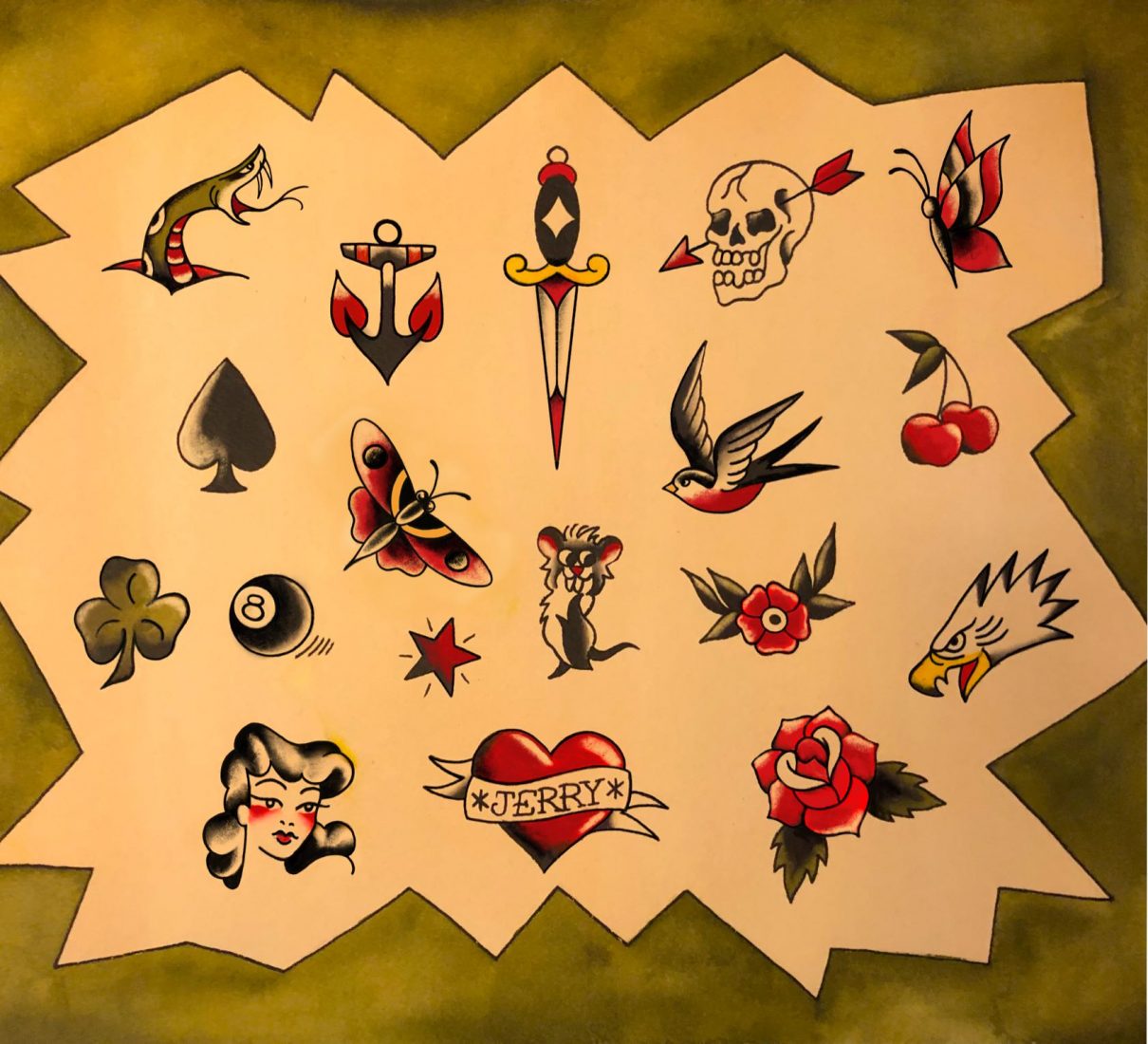
On January 14, Daredevil Tattoo Museum (141 Division Street) and Sailor Jerry Spiced Rum will be paying homage to the godfather of modern tattooing, Norman “Sailor Jerry” Collins, on what would have been his 109th birthday. From 12pm to 10pm, Daredevil Tattoo Museum will ink classic Sailor Jerry designs for $20 each. After getting inked, patrons can learn about the history of tattooing and Sailor Jerry’s work at the Museum. They can also continue to celebrate next door at Forgtmenot (138 Division Street), who will be serving Sailor Jerry Spiced rum and Ginger cocktails.
Sailor Jerry + Ginger Cocktails
Norman Collins joined the U.S. Navy in the 1930’s when he was 19 years old. He served in China and Japan, where he began to appreciate Asian-style art. But he learned how to tattoo before that, in Chicago. In 1942, after his tour of duty ended, he settled in Honolulu where he began to build his reputation as a talented tattoo artist in his now famous tattoo parlor on Hotel Street. He also played in a band, became a licensed skipper of a large three-mastered schooner, and hosted a radio show.
Collins pioneered innovations in tattooing such as inventing the color purple for ink, and promoting the use of sterile needles. He inspired future generations of tattoo artists, like Ed Hardy, Mike Malone, and Kazuo Oguri, with his distinctive artwork. When he passed away in 1973, he left his infamous shop to Ed Hardy and Mike Malone, with instructions that if they did not take over, everything was to be burned to the ground.
Sailor Jerry Rum
Daredevil Tattoo opened in 1997, when tattooing became legal in New York City. They feature artists working in different styles, and they are famous for their Friday the 13th tattoo days, where ink-aficionados line up for hours to get special designs for $13 and a “lucky $7 tip.” The museum attached to the shop features antiques and tattoo memorabilia that co-owner Brad Fink has collected over 27 years. The collection features items from the earliest days of tattooing history, like early tattoo machines, artwork, newspaper clippings, photos, and printed matter. The museum is now a 501(c)(3), NYC Tattoo History Inc, dedicated to the preservation of tattoo history, and to educating the public on this storied art form.
Next week, the Museum of Jewish Heritage – A Living Memorial to the Holocaust will open the most comprehensive Holocaust exhibition about Auschwitz ever exhibited in North America. Auschwitz. Not long ago. Not far away. is produced in partnership with the international exhibition firm Musealia and the Auschwitz-Birkenau State Museum in Poland. The groundbreaking exhibition has been curated by an international team of experts led by historian Dr. Robert Jan van Pelt. It runs through January 3, 2020 in New York City.
For the first time, 74 years after the liberation of Auschwitz, a traveling exhibition dedicated to the historical significance of the camp is being presented to a U.S. audience. The exhibition’s May 8 opening marks the anniversary of VE Day or Victory in Europe Day, 1945, when the Allies celebrated Nazi Germany’s surrender of its armed forces and the end of World War II in Europe.
Auschwitz. Not long ago. Not far away.arrives in New York City after the exhibition completed a successful run at Madrid’s Arte Canal Exhibition Centre, where it was extended two times, drew more than 600,000 visitors, and was one of the most visited exhibitions in Europe last year. The exhibition explores the dual identity of the camp as a physical location—the largest documented mass murder site in human history—and as a symbol of the borderless manifestation of hatred and human barbarity.
AUSCHWITZ EXPOSICIÓN DE MADRID
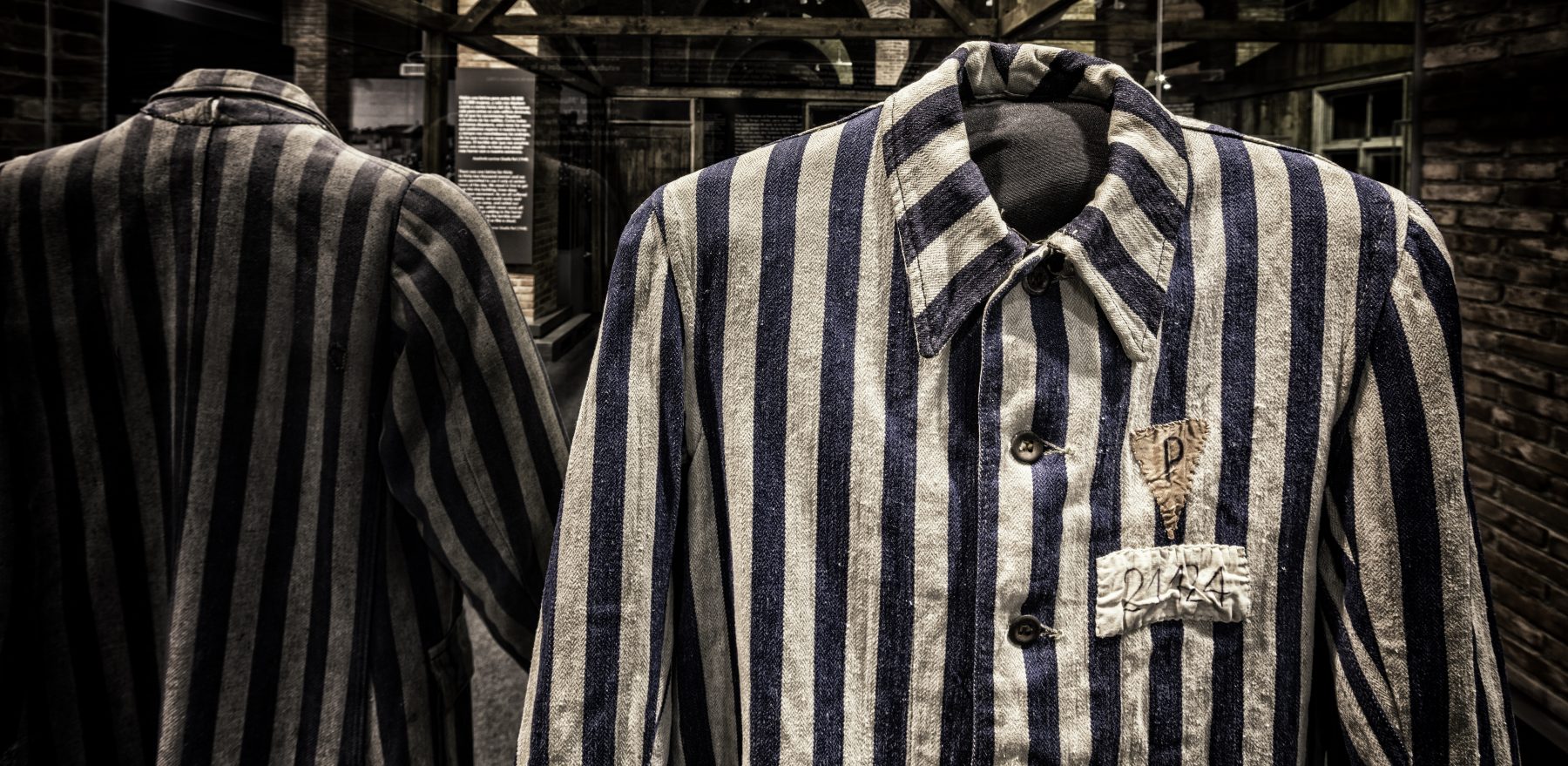
Featuring more than 700 original objects and 400 photographs, mainly from the Auschwitz-Birkenau State Museum, the New York presentation of the exhibition allows visitors to experience artifacts from more than 20 international museums and institutions on view for the first time in the North America, including hundreds of personal items—such as suitcases, eyeglasses, and shoes—that belonged to survivors and victims of Auschwitz. Other artifacts include: concrete posts that were part of the fence of the Auschwitz camp; part of an original barrack for prisoners from the Auschwitz III-Monowitz camp; a desk and other possessions of the first and the longest serving Auschwitz commandant Rudolf Höss; a gas mask used by the SS; Picasso’sLithograph of Prisoner; and an original German-made Model 2 freight wagon used for the deportation of Jews to the ghettos and extermination camps in occupied Poland.
Museum of Jewish Heritage Board Vice Chairman George Klein visited the exhibition in Spain and recommended to his Board that they bring it to Lower Manhattan. The exhibition features artifacts and materials—never before seen in North America—on loan from more than 20 institutions and private collections around the world. In addition to the Auschwitz-Birkenau State Museum and the Museum of Jewish Heritage – A Living Memorial to the Holocaust, participating institutions include Yad Vashem in Jerusalem, Anne Frank House in Amsterdam, United States Holocaust Memorial Museum in Washington, Auschwitz Jewish Center in Oświęcim, the Memorial and Museum Sachsenhausen in Oranienburg, and the Wiener Library for the Study of the Holocaust and Genocide in London.
Auschwitz. Not long ago. Not far away. traces the development of Nazi ideology and tells the transformation of Auschwitz from an ordinary Polish town known as Oświęcim to the most significant Nazi site of the Holocaust—at which around 1 million Jews, and tens of thousands of others, were murdered. Victims included Polish political prisoners, Sinti and Roma, Soviet prisoners of war, Jehovah’s Witnesses, and those the Nazis deemed “homosexual,” “disabled,” “criminal,” “inferior,” or adversarial in countless other ways. In addition, the exhibition contains artifacts that depict the world of the perpetrators—SS men who created and operated the largest of the German Nazi concentration and extermination camps.
The Museum of Jewish Heritage has incorporated into the exhibition more than 100 rare artifacts from its collection that relay the experience of survivors and liberators who found refuge in the greater New York area. These artifacts include: Alfred Kantor’s sketchbook and portfolio that contain over 150 original paintings and drawings from Theresienstadt, Auschwitz, and Schwarzheide; the trumpet that musician Louis Bannet (acclaimed as “the Dutch Louis Armstrong”) credits for saving his life while he was imprisoned in Auschwitz; visas issued by Chiune Sugihara, a Japanese diplomat in Lithuania often referred to as “Japan’s Oskar Schindler”; prisoner registration forms and identification cards; personal correspondence; tickets for passage on the St. Louis; and a rescued Torah scroll from the Bornplatz Synagogue in Hamburg.
Also on display from the Museum of Jewish Heritage collection will be Heinrich Himmler’s SS dagger and helmet and his annotated copy of Hitler’s Mein Kampf, as well as ananti-Jewish proclamation issued in 1551 by Ferdinand I that was given to Hermann Göring by German security chief Reinhard Heydrich on the occasion of Göring’s birthday. The proclamation required Jews to identify themselves with a “yellow ring” on their clothes. Heydrich noted that, 400 years later, the Nazis were completing Ferdinand’s work. These artifacts stand as evidence of a chapter of history that must never be forgotten.
“As the title of the exhibit suggests, Auschwitz is not ancient history but living memory, warning us to be vigilant, haunting us with the admonition ‘Never Again.’ It is a prod to look around the world and mark the ongoing atrocities against vulnerable people,” said Bruce C. Ratner, Chairman of the Museum’s Board of Trustees. “While we had all hoped after the Holocaust that the international community would come together to stop genocide, mass murder, and ethnic cleansing, these crimes continue. And there are more refugees today than at any time since the Second World War. So my hope for this exhibit is that it motivates all of us to make the connections between the world of the past and the world of the present, and to take a firm stand against hate, bigotry, ethnic violence, religious intolerance, and nationalist brutality of all kinds.”
Auschwitz. Not long ago. Not far away.was conceived of by Musealia and the Auschwitz-Birkenau State Museum and curated by an international panel of experts, including world-renowned scholars Dr. Robert Jan van Pelt, Dr. Michael Berenbaum, and Paul Salmons, in an unprecedented collaboration with historians and curators at the Research Center at the Auschwitz-Birkenau State Museum, led by Dr. Piotr Setkiewicz.
“Auschwitz and the Shoah are not just another single, dramatic event in the linear history of humanity. It is a critical point in the history of Europe, and perhaps the world,” said Dr. Piotr M. A. Cywiński, Director of the Auschwitz-Birkenau State Museum. “While commemorating the victims of Auschwitz we should also feel moral discomfort. Antisemitic, hateful, xenophobic ideologies that in the past led to the human catastrophe of Auschwitz, seem not to be erased from our lives today. They still poison people’s minds and influence our contemporary attitudes. That is why studying the Holocaust shouldn’t be limited to history classes. It must become part of curricula of political and civic education, ethics, media, and religious studies. This exhibition is one of the tools we can use,” he explained.
“Seventy-three years ago, after the world saw the haunting pictures from Auschwitz, no one in their right mind wanted to be associated with Nazis. But today, 73 years and three generations later, people have forgotten, or they never knew,” said Ron Lauder, Founder and Chairman of the The Auschwitz-Birkenau Foundation Committee and President of the World Jewish Congress. “This exhibit reminds them, in the starkest ways, where anti-Semitism can ultimately lead and the world should never go there again. The title of this exhibit is so appropriate because this was not so long ago, and not so far away.”
“Auschwitz did not start with the gas chambers. Hatred does not happen overnight: it builds up slowly among people. It does so with words and thoughts, with small everyday acts, with prejudices,” said Luis Ferreiro, Director of Musealia and the exhibition project.“When we had the vision to create the exhibition, we conceived its narrative as an opportunity to better understand how such a place could come to exist, and as warning of where hatred can take us to.”
AUSCHWITZ EXPOSICIÓN DE MADRID
Auschwitz. Not long ago. Not far away.is presented in the symbolic, hexagonally-shaped building at the Museum of Jewish Heritage. This 18,000-square-foot exhibition introduces artifacts and Holocaust survivor testimony through 20 thematic galleries. At the conclusion of this presentation, the Museum will debut its new permanent core exhibition.
Throughout its presentation of Auschwitz. Not long ago. Not far away., the Museum will host a series of related public, educational, and scholarly programming, featuring world-renowned experts on the Holocaust. The Museum also will expand its work with students in the tri-state area and introduce complementary educational tools for in-class and onsite use.
“All through the exhibition there are stories—stories about individuals and families, stories about communities and organizations, stories about ideologies that teach people to hate, and responses that reveal compassion and love. There are stories of victims, perpetrators, and bystanders, stories with heroes and villains—stories that all merge into an epic story of a continent marked by war and genocide,” said Dr. Robert Jan van Pelt, Chief Curator, who has published several books on the camp—including the award-winning Auschwitz, 1270 to the Present (1996) and The Case for Auschwitz (2002)—and participated as an expert witness in Deborah Lipstadt’s case against Holocaust denier David Irving.
Following the New York presentation, the exhibition is intended to tour other cities around the world. This destinations will be announced by Musealia and the Auschwitz-Birkenau State Museum in the upcoming months and years.