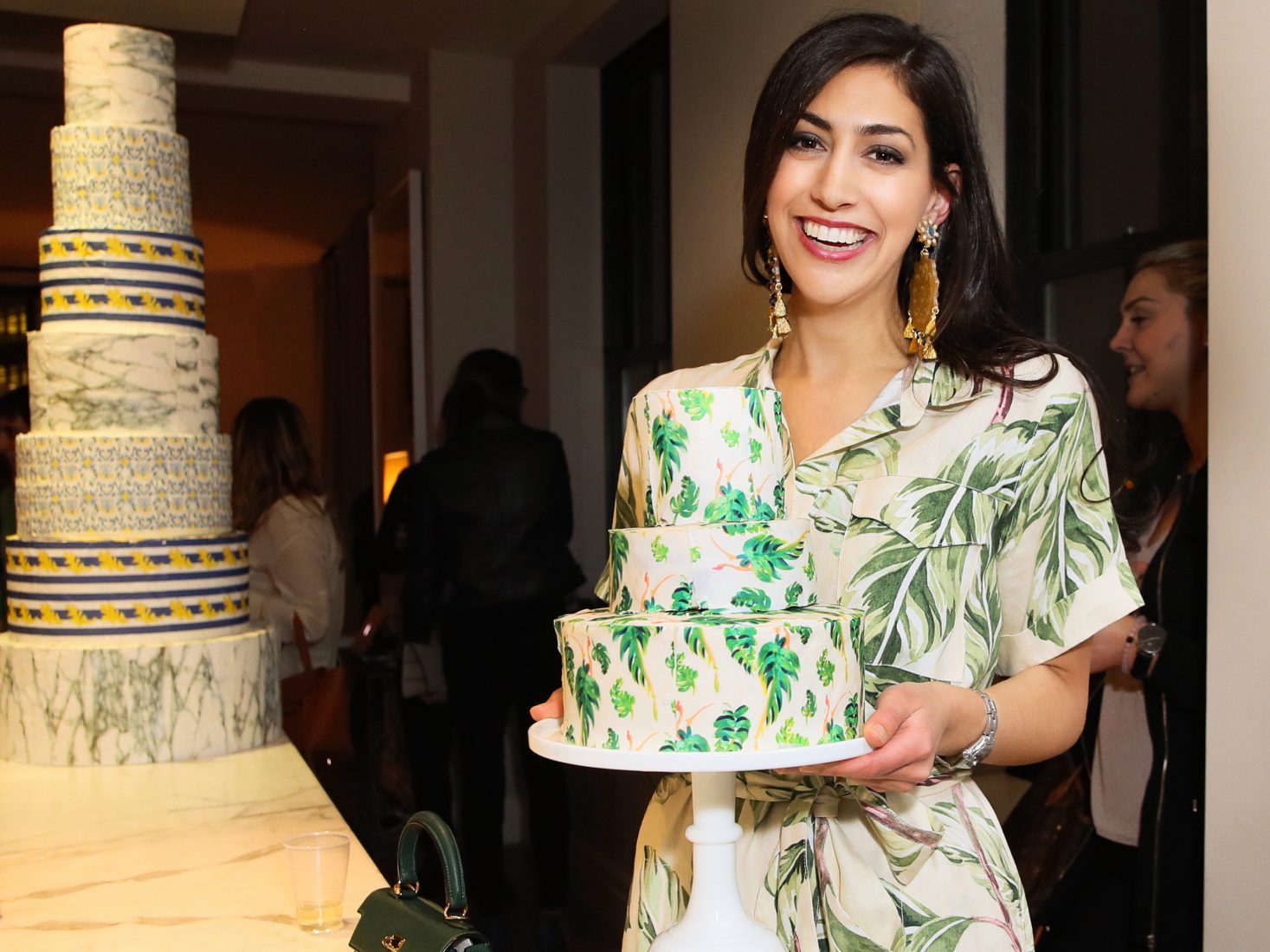
Stephanie Nass, better known as Chefanie, has found a way to combine her loves of art, cooking, and matching through her catering company and inventive products, including Chefanie Sheets that let her easily decorate cakes to match any pattern. Chefanie also runs a private dinner club called Victory Club that combines her cooking with the work of a New York artist for a culturally immersive and delicious evening. We talked to Chefanie about how she started Victory Club, where she would love to host an event, and how membership in the program works.
Downtown: What started first, the catering or Victory Club?
Chefanie: In 2014, I began hosting friends and friends of friends for dinners in my tiny art-filled NYC apartment. Those dinners turned into a roving series of art-inspired meals to which Victory Club members are invited at the beginning of every month. My catering business followed in the same style as Victory Club.
Downtown: Tell us about the first meal, how did it go?
Chefanie: The first meal was 10 people I knew. The dinner was centered around my art work and art collection. It went smoothly and felt natural. People didn’t want to leave at the end of the night.
Downtown: How did you decide to go from your apartment to art spaces?
Chefanie: The events outgrew my apartment, and I wanted each event to showcase new art.
Downtown: How do you choose whom to collaborate with?
Chefanie: I work with spaces, people, and art that I love!
Downtown: How do the menus reflect the spaces/artists?
Chefanie: I create food that is either conceptually or visually inspired by the art in each space. For example, I might serve the artist’s favorite foods or ravioli that looks like a painting.
Downtown: How does membership work?
Chefanie: Members apply here to receive the monthly newsletter. They pay $100 monthly to attend at least 2 events per month. The vast majority of events are gratis for members, but sometimes it is discount codes for partner events. Sometimes we offer passes to art fairs and art shows as well.
Downtown: Does the size of the meals vary?
Chefanie: Yes! It varies based on the size of the venue.
Downtown: Is there something that unifies the whole series?
Chefanie: There are many signature items that unify Victory Club events: there is always food, as well as an art talk, tour, or lecture. When it’s a seated meal, the menus are handpainted, the napkins are embroidered with the Victory Club logo, and there are always warm baked cookies between the entree and dessert.
Downtown: What NYC space are you dying to host a dinner in?
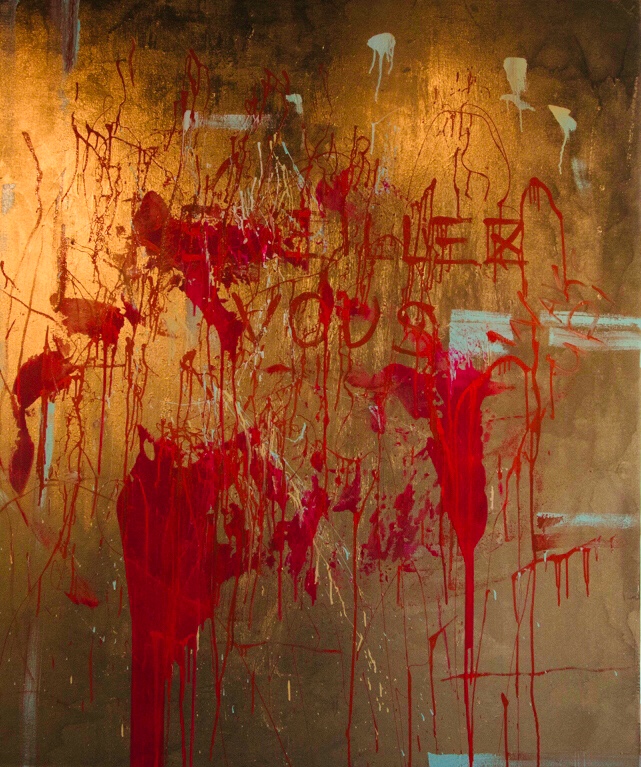
Artwork created by Pierre Fraiture, and Nikolai Fraiture of The Strokes, to benefit Luv Michael Foundation for Autism.
On April 3, Downtown Magazine attended a live art performance by Nikolai Fraiture of The Strokes, and his brother Pierre, a New York City artist. It was a captivating evening.
Jimmy Webb, Dara McQuillen, and David Godlis.
The cool downtown crowd included leather jackets and cool vibes, and Downtown Magazine friends like Jimmy Webb and David Godlis. That made it a thrilling evening all around.
The evening was the kick off for World Autism Awareness Month benefitting Luv Michael, a non-profit organization that trains, educates and employees individuals with autism. Pierre created a painting with the help of his brother, Nik, on the guitar, as well as performance artists who moved with the music.
Q&A with Nikolai Fraiture and Pierre Fraiture
DTM Are you still playing with the band The Strokes, and are you touring?
Nikolai, Yes, and yes The Strokes will be touring this summer.
DTM: It’s interesting, you are a musician with the band, The Strokes, and you are an artist. How did this performance come about and how did you get invoiced in raising awareness about autism?
Pierre, I have a very good relationship with the founders of the Luv Michael, and they gave us an opportunity this past summer to create a show benefitting individuals who have autism. Luv Michael’s mission is to train individuals with autism, and help them enter the work force. So we came up with this idea. We were in the countryside actually in a place called Pine Valley which is our family place in Connecticut. My brother starting playing music and I started painting, and it just jelled, we looked at each other and said do you feel what I feel? Nikolai said yes, all of a sudden a week later the foundation was building a kitchen in Tribeca for their foundation space, I created a painting and it sold for $11,000, and we used this money to help benefit the charity.
Nikolai: it was under construction at the time we kind of used all the elements, the contractor, railings into our show making it site-specific performance we used whatever we could. Just like for tonight’s performance we used the backdrop which is amazing, the memorial, the Oculus, all of this has a lot of meaning for us especially being from New York. It means a lot for us.
DTM Is this something you are going to continue to so for other charities or for Luv Michael?
Nik: It’s going pretty well right now, we have a good relationship and down the road we are not sure – we will do it again but wherever we are performing it’s part of the foundation we partner with, it’s part of the whole package.
Pierre: We are doing 12 different shows in 12 different cities, and this is the launch of that – we have much more planned around the world, we have people interested around the world.
DTM: And each different show you are going to use the elements and create from that?
Nikolai: Yes, every city and every show had a theme, this one was Awakening.
DTM Do you create the themes?
Nikolai: Yes, the next one will be Prophecy, in whatever city or for whatever foundation we partner with, we will find a gallery or space which we preform in, this is where the creative comes in.
Pierre: What’s great is that we’re brothers and we have been dreaming of doing something like this, these are ideas and thoughts we grew up sharing.
Nikolai: It’s been germinating for a long time.
DTM: Have you always been an artist and musician, were you always into art and music?
Nikolai: Yes, he was always into art and I was always into music and literature.
Pierre: We’re French and American so we grew up with wall to wall French books. So at 8 years old, we were picking up Camus, our parents read a lot so we have all of these philosophical ideas we want to share with others.
DTM Nik, you helped paint this artwork with your guitar. Did you plan that?
Nikolai: No, not really. It was spur of the moment. The last painting also benefited Luv Michael and it sold for 11k. But this painting from tonight is very special, as I helped to paint with my Fender guitar. We have a basic structure of what we were going to do, but I did not know that I would sit down in the audience in an empty seat while playing the guitar, many other things that were not really planned. That’s what we are really excited about, we work with other people and they incorporate their own personality into the performance.
Pierre: We also had the best cast, tonight we had Kim Tehan,Bethany Hughes,Laure Gourlant, and Fatou Sidibe.
Nikolai: We wanted it to recall the days of the 60s happenings. For us, this is what’s really exciting, the spontaneousness of this. For me, especially this is exciting. In my band The Strokes, we play a lot of 3-minute pop music whereas this type of art is really freeform, it’s very exciting and new. I’m excited to do more.
DTM: Where are you from?
Nikolai: We grew up in New York City, on the Upper East Side.
DTM: Do you live in NYC now?
Nikolai: Yes, I live in the West Village.
Pierre: I live on the Upper East Side.
DTM: What do think of this area, and the growth and changes downtown since after 9/11?
Nikolai: I mean personally, think it’s amazing, just to see the regeneration. That’s kinda the reason we were really excited about this site, specifically for this project, it’s a different place it feels completely different. It’s great that Rob Marcucci is down here. In a crazy twist of fate, he worked at a video store with us, our local video store on 84th and York. [Rob Marcucci, a childhood friend of Nik and Pierre, works for Silverstein Properties.]
Pierre: We all delivered videos together.
DTM: Rob, what was it like working with Nikolai and Pierre again?
Robert Marcucci: It was so refreshing. They are such good souls, and the kind of friends one hopes to have. So naturally, we were all on the same page with this project. Very good energy. It was a real highlight for me.
DTM: What do you think of their new live performance art?
RM: I purposely shielded myself from what the final performance would be. Of course I knew of the basic outline, but I wanted to be surprised. It was way different from what I expected. Nick’s music and sound design was experimental, much to my pleasure – and very well conceived for the performance. Pierre had a very interesting take on stage, almost like in a somnambulistic state, yet present. His art slowly formed in the same fashion. It was intriguing to follow. The same went for the accompanying performers. Very dreamlike. At first I was unsure of the individual parts of the piece, but they all seemed to blend, ultimately, forming a warm and sincere feeling.
Nikolai, that’s what’s so great about the energy in this building, there was beautiful energy in that video store many years ago, and now here. I think what Rob has done down here is great. I saw a show that he did here a few years ago, I told Rob when the timing is right, we must do something. I’ve never in my life seen a show like the one Rob put on down here a few years back, it was great.
DTM: Why is this area important to you?
Pierre: well, my brother’s band The Strokes broke on September 11, 2001.
Nikolai: The Strokes vinyl album came out on September 11, 2001. The message for the show tonight was Wake Up, it ties right into having an awareness to what’s important.
Pierre: And also, I think, the guitar… I’m just still trying to process this show tonight, it was great.
DTM: Last word for our readers?
Nikolai: We are going to be doing more of these types of performances it’s going to be international we are hoping to get into galleries, yeah, we are really excited about galleries.
Pierre: You know I’ve been doing art since I was a kid, this it’s kind of a step in for me. I’m planning to officially launch myself in the Fall so I’m looking for all opportunities.
Nikolai Fraiture of The Strokes and Pierre Fraiture.
Patti Grabel and I disagree on how we like our matzoh balls. I don’t know what that tells you, but it tells me almost everything I need to know about a person. Patti was happy to share the rest of her story with me over two types of her homemade challah bread pudding, that yes she actually ate. Patti explained how she has gone from stay-at-home mom to unscripted television creator to artist, all inspired by her love of telling stories and cooking.
Patti in the Bloomingdale’s Test Kitchen
Growing up, Patti spent some weekends with her beloved grandmother. Patti says her grandmother “inherently understood that breaking bread with others binds communities, it’s the ultimate act of kindness.” After a homemade dinner on Friday night, Patti and her brother would ride the elevator in their grandmother’s Brooklyn apartment building and check in on neighbors. Their grandmother got to show off her grandchildren and check in with friends while collecting their leftover challah, which she would turn into something amazing.
After soaking the torn bread overnight with cream, butter, eggs, sugar, and vanilla she would start Saturday morning by baking up pan after pan of bread pudding. Patti remembers waking up to the “smell of sunshine.” Her grandmother would return to her neighbors to deliver their leftover challah, now something even more delicious. Through this, Patti “understood that smells and aromas and tastes had this way of just sending messages without words that you’re loved…we knew we were loved the second we walked in her house on Friday night because we could smell the chicken soup.”
When Patti’s grandmother was passing, Patti asked her for the recipe for the bread pudding, but her grandmother told her, “There is no recipe! It’s like life, you’re going to figure it out.” After her grandmother passed, Patti tried relentlessly to recreate the bread pudding. Even if it tasted slightly different each time, the smell was always there and she felt her grandmother’s love and presence in her own kitchen.
Patti’s challah bread pudding
There was one moment when she was stirring the ingredients together that led Patti to a profound realization; “when I was stirring the ingredients together I was reminded that I was stirring in love, that I was infusing love into the dish and that when my kids would taste it they would taste the essence of me.” From a young age, Patti learned to love cooking and entertaining as a way to connect with her friends and family and show them how much she cared.
There was one moment when I was just kind of stirring the pudding and I remembered my grandmother stirring the pudding and I was thinking, wow, this is when you’re adding the love so your hand extends the spoon, extends your hand, which extends your arm, which extends our heart, which extends our soul so it all has to work in unison.
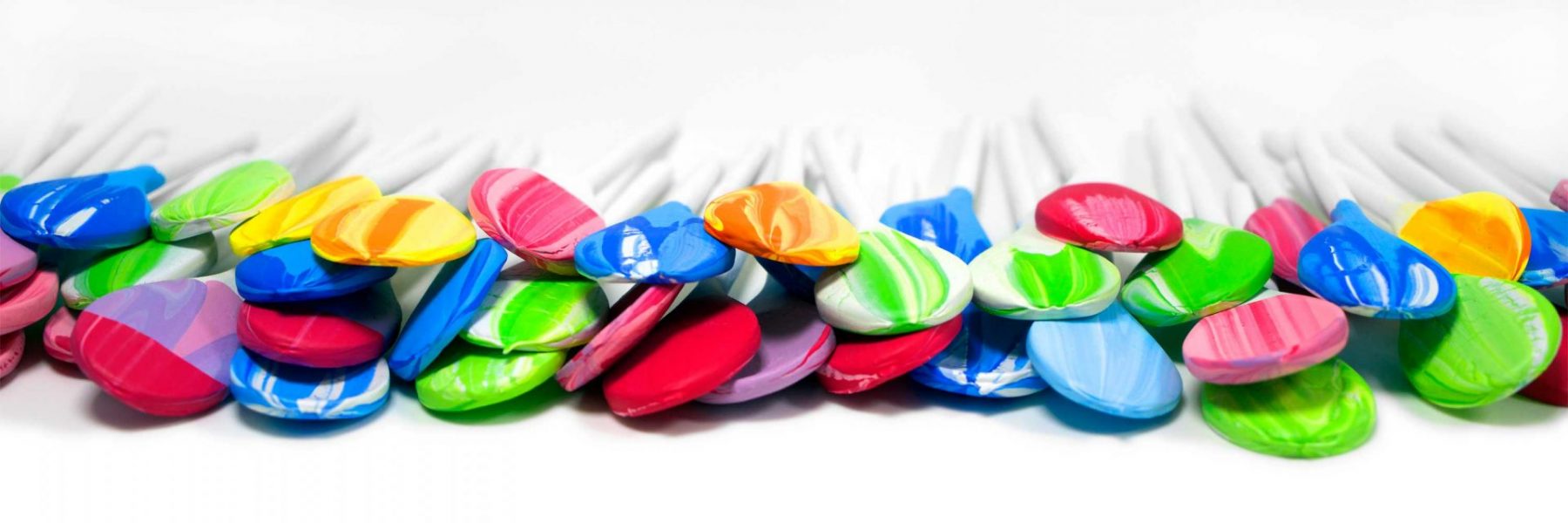
What does any of this have to do with Patti becoming an artist? For years, Patti was writing a story about a woman and wooden spoons – utilitarian utensils with tremendous meaning to her. As the spoon aged and became cracked and imperfect through use without losing its purpose, the woman was able to see herself and her own aging in the same graceful light.
One day the woman in the story goes to cook her signature bread pudding and realizes no one is home to eat it as her children were grown and out of the house. She pauses and realizes that she is finally cooking for herself and she has to figure out who she is if she isn’t doing everything for her kids. She ends up taking all the beloved wooden spoons from her kitchen to her garage and swirling them in cans of paint she finds, stirring almost as if she were cooking. She creates a makeshift clothing line in her backyard and hangs the spoons there and, as they drip, they mimic her tears. “She sees herself in those dripping spoons. There are tears, there’s fear, there’s trepidation, there’s elation, there’s joy, and, eventually, there’s liberation,” Patti recounts. When she finishes and returns to the kitchen the pudding has burnt; but such is life. The woman turns those painted wooden spoons into art and makes a career out of it.
Free Play
As Patti told me about her screenplay, it was very clear to me that she had written the story about herself, but it took her a little longer to admit that to herself. After raising her kids, Patti had a career in unscripted television, prompted by continuing education classes in screenwriting at New York University. The shows she created all centered on strong women, including Suddenly Single, which aired as a pilot on TLC. Her dream was to have a show on the air before she reached 50, and her pilot aired on her 49th birthday. “My kids were in the screening room and happy tears were streaming down. They were so proud of me and for that reason alone all nine years before that, all the hard work and persistence really paid off,” Patti told me. Although it didn’t get picked up, Patti made connections in the industry that allowed her to pitch her ideas to power players in the business.
Finally, Patti realized she needed to live the story she wrote. After receiving constructive but harsh feedback from a respected producer, Patti decided that she had written a character that had gaps because she herself was afraid to live and experience the things that the story was missing. Pretty immediately, Patti did just as her character had done and put spoon to paint. She grew up the daughter of day camp owners and was always crafting, so painting and decorating the spoons came naturally to her. Using her script as her playbook, she created the life she had written but hadn’t dared to live. A gallery owner advised her to photograph the scenes she made with the spoons and blow them up on plexiglass. The results are vibrant, colorful vignettes that tell stories without words.
Hang On
Since she started her art career, Patti’s work has appeared in several commercial galleries, in charity auctions for the Museum of Arts and Design, and in installations at Bloomingdale’s flagship store in New York City. She was connected to their visual arts department and started by reimagining a pair of jeans for the launch of the store’s new denim section. She put 150 metal spoons on the jeans and filled them with vines and faux berries. After the success of her first project, Bloomingdale’s gave her an opportunity she would never have dreamed of, including an on site studio for her to work in. Her task was to apply her artistic practice on three oversized versions of iconic perfume bottle silhouettes. She used fabric and wallpaper with some of her art printed on them along with buckles, words, leaves, chains, and, of course, spoons.
Patti at the MAD Ball
Patti in front of her perfume bottles at Bloomingdale’s
One of the bottles had messages written by Patti on plaques. She wrote things like, “where there are well worn wooden spoons there is love,” “spoons give and receive in a single, humble motion,” and “we feed our children, our children feed themselves, our children feed their children, our children feed us.” Next to the exhibition, Patti left a book of empty pages with the messages about spoons on the top of each page and asked visitors to write what spoons mean to them. She visited Bloomingdale’s each and every day to see what people wrote to her and ended up filling four, thick volumes.
On March 2nd, Patti cooked her bread pudding in the Bloomingdale’s test kitchen in an event sponsored by Le Creuset. She created recipe cards with her artwork and served samples throughout the afternoon surrounded by some of her prints. “It will rain on March 2nd,” Patti predicted, “because my grandmother will be crying tears of joy. She’ll have to stop playing bridge and canasta with all her friends to watch me.” Patti called the event, “Life is a Circle of Spoons.”
Hundreds of spoons later, Patti is only looking forward.
While life can seem like a scary roller coaster ride and we can’t control everything, there are some things we can determine for ourselves. What will you fill your real and metaphorical spoon with? What do you see for yourself as you write a new chapter or head in a new direction? My art celebrates liberation, passion, risk taking, reinvention, spirituality, and the creative spirit.
Patti encourages people to go for what they want, even if they’re afraid or think the field is full. “I love spoons and I love the stories they tell and I guess that’s why it’s sort of working, because I chose an object that was in my hand and I was using it for a good purpose, to cook and feed myself and others. Now I’m using it to help hungry New Yorkers by donating a portion of the proceeds from sales of my prints to City Harvest”
Timeless Beauty
So what’s next? “I guess I’m going back to my original days in television – it’s unscripted!”
Follow Patti on Instagram for more of her story and work.
Yes, Lexus actually runs a restaurant…well, with some help from Union Square Hospitality Group. Intersect by Lexus is comprised of a first floor cafe, second floor fine restaurant and lounge, and third floor exhibition space. Both the chef designing the menu for the restaurant and the contents of the exhibition space will be rotating pretty frequently, so head to the space in the Meatpacking District soon to experience this iteration!
The current art exhibit is called Essential Invisible by Future Wife. The interactive exhibit aims to capture the auras of the guests by using heat sensing cameras and lane departure technology. That might sound super techie, but it’s an insanely fun and visually stimulating experience worth the visit alone.
After you’ve worked up an appetite running around the exhibition, head downstairs to the main dining room, which currently features Global Chef-In-Residence Gregory Marchand of the restaurant Frenchie in Paris and London and recent recipient of a Michelin Star at the Paris location. He brings his style of infusing classic dishes with subtle international flair to the Big Apple for a limited time only.
Dishes include Halibut a la Grenobloise, Terrine, and Lamb Ragu along with a show stopping Yuzu Mont Blanc for dessert. If you’re intimidated by dinner, head over for the excellent two course lunch for $35 including tip. Lunch features a sparse but impeccably done lobster roll with brioche so rich it’s almost custard and fried chicken with jalapeño aioli and a bacon scone (which you can also purchase to go downstairs at the cafe).
There are subtle reminders of the luxury brand throughout the space, from the wall of toy cars outside the bathroom to the spoke theme running through the two floors. Make sure you head over before the restaurant and art space switch over in March!
Intersect by Lexus 412 W 14th Street
Gallery 8 AM – 11 PM
Café 8 AM – 7 PM
Cocktail Lounge Sunday–Wednesday: 11:30 AM – 10:00 PM Thursday–Saturday: 11:30 AM – 11:00 PM
The Sylvia Wald & Po Kim Gallery and Donghwa Cultural Foundation in NoHo, New York is now presenting the CONFLUENCE Benefit Exhibition. This junction of talent is equal rivers merging culture, memory, and tradition with art innovation converging in confluence. When two or more rivers intersect at a certain point, these bodies of water may converge and become a source of a new river. Sometimes a stark visual contrast between the two rivers continues, side by side, for miles – never mixing during that span, yet harmoniously flowing in coexistence until ultimately becoming one body of water. This exhibition, Confluence, aims to capture the peaceful, balanced river of creativity in the spirit of artists. This group show is comprised of eight working Korean and American painters and sculptors. Fine oils, acrylics, mixed media, Hanji paper, glass, photography, stone, and resin mediums are the painter’s extension to canvas and sculptor’s pedestals shown with unique expressions. “By bringing together artists from Korea and the US, distinct in their artistic styles, we aim to create a harmonious East and West dialog while celebrating cultural diversity through the arts. The exhibition is homage to this natural phenomenon as a confluence of both culture and art.” says curator Odelette Cho.
The Sylvia Wald & Po Kim Gallery is a 501(c) (3) non-profit organization. It was founded by Korean-born artist Po Kim and his American artist wife, Sylvia Wald. In addition to preserving, maintaining and perpetuating the legacy of the founders’ uniquely accomplished artistic careers; the foundation aims to promote East-West cultural harmony through the arts by sponsoring and hosting temporary art exhibitions and other artistic events of established and emerging artists.
Yong R. Kwon
Sylvia Wald & Po Kim Gallery
417 Lafayette Street
7th Floor
Gallery Hours: Tuesday–Saturday 11 AM to 6 PM
The Confluence Exhibit runs from November, 15th 2018 to January 22, 2019
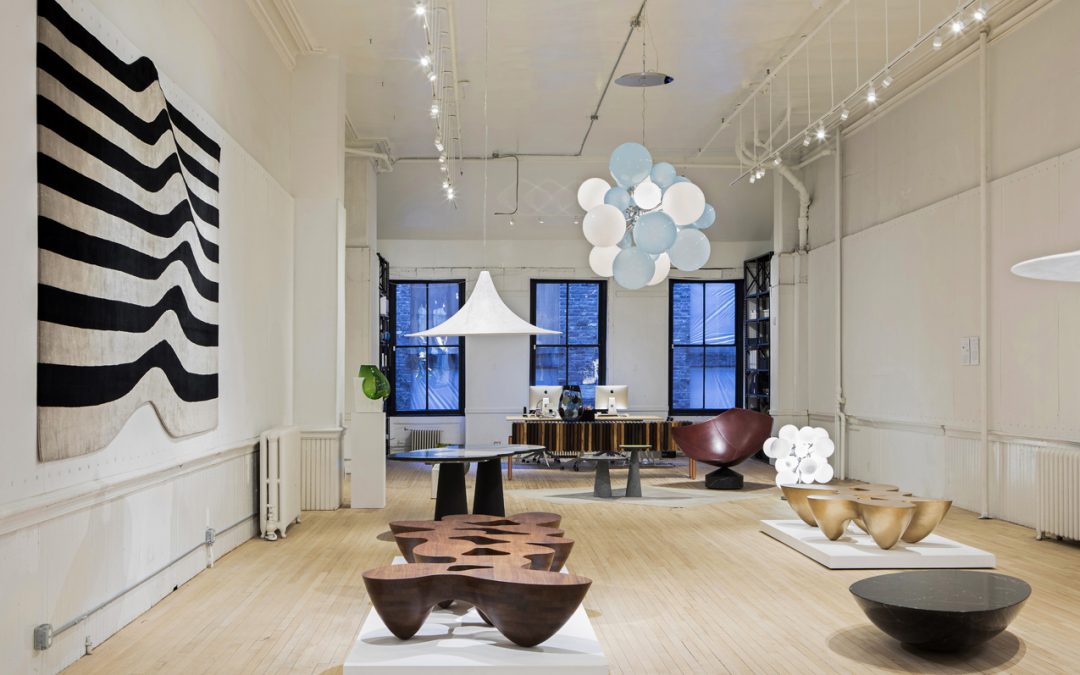
"Immersion" exhibition of work by Emmanuel Babled at Twenty First Gallery.
“Immersion” exhibition of work by Emmanuel Babled at Twenty First Gallery. Photograph by Costas Picadas.
Tribeca is a growing mecca for the art and design-minded. Over the last year an influx of galleries and concept houses have opened, not the least of them being Twenty First Gallery. When gallery founder Renaud Vuaillat decided to make the jump from Chelsea to Tribeca earlier this year, he brought an unexpected depth to the neighborhood. Limited-edition collections, made-to-order pieces, and an ever-changing display of art and furnishings created by a beautifully curated roster of fascinating artists line the floors of Twenty First Gallery.
Eclipse Mobile by Anne et Vincent Corbiere
DOWNTOWN: When and why did you decide to move your gallery, Twenty First Gallery, to Tribeca from its previous destination in Chelsea?
Renaud Vuaillat: We moved from Chelsea’s townhouse last year to open a vast, welcoming space implanted in the heart of New York’s most dynamic neighborhood in term of design and contemporary art. What sought a place that would shape the identity of the gallery, and that we could play with and infinitely rearrange. That is what we found at 76 Franklin Street. The space is half industrial and half dance training room—and it perfectly enhances the work of our artists.
DOWNTOWN: What can you tell us about yourself?
Renaud Vuaillat: As a gallery owner, I have a well-defined taste and knowledge in design and art, along with a great understanding of how to run a business, a process I learned over the years. What’s more, I relate well to people, including with the artists whose work I showcase—I have very close relationships with many of them. I also make sure to always be understanding and reliable—that is a key to Twenty First Gallery, along with functioning well, and of course, you always need a good sense of humor.
DOWNTOWN: How has your past experience helped differentiate Twenty First Gallery from other galleries in the neighborhood?
3 Petites Fleurs by Helene de Saint Lager.
Renaud Vuaillat: Before I opened my own business in New York, I had a lot of experience in France. Thanks to my years working in the Serpette Flea Market and at my gallery in Saint-Germain des-Prés, I became acquainted with a large and diverse group of talented people, including artists such as Hubert Le Gall. I also developed a refined and eclectic taste for contemporary decorative arts. As a result, the selection of French artists I represent in New York are quintessential to the art world.
DOWNTOWN: Can you show us an example of a made-to-order piece you have created?
Renaud Vuaillat: One project we loved being a part of was the renovation of the Kennedy’s “Winter White House,” in Palm Beach by a famous New York interior design firm. The 11-bedroom, Mediterranean-style villa had 17 living rooms and was quite a design challenge, as it was an historical, landmarked property in need of a complete interior renewal.
We contributed to this project by providing two very special pieces made by French artist Erwan Boulloud. They consisted of a pair of brass cabinets, called Extralucide, decorated with rock crystal inlays delicately running from top to bottom. To open each cabinet, you had to secretly push one of the semi-precious stones, giving the design a magical, mysterious resonance.
DOWNTOWN: You recently curated a space in the prestigious Salon + Art & Design for the second year in a row. Tell us about that experience and your Golden Eye installation.
L’Eternel Printemps Cabinet, by Hubert Le Gall. Edition of 8, signed and numbered.
Renaud Vuaillat: The Salon Art + Design is a very special and eclectic event. Each year is a fabulous challenge and we were once again very enthusiastic and proud to rise to it. This year’s booth showcased great pieces composed of bronze such as the Hierophane Mirror by Erwan Boulloud which centered both the booth and the astonishing Eternel Printemps Cabinet by Hubert Le Gall. Complementing the bronze works were white marble pieces including the Diaphane Mirror by Beatrice Serres and the Supernova Lamp by Emmanuel Babled. The palette of white and gold formed a beautiful rhythm between the two.
DOWNTOWN: What are some of the more unique pieces you have on display in your showroom right now?
Renaud Vuaillat: We are currently presenting the work of artist Emmanuel Babled in an exhibition called Immersion. Among his installed works are exclusive pieces that we love: an amazing Quark coffee table made of elm wood that is over 11 feet long; two Supernova ceiling lights carved in marble floating in the air; the Jangada armchair made of leather and marble which in combination resembles the sail of traditional Brazilian fishing boats. They are part of an organic, dream-like world you want to dive in.
DOWNTOWN: How do you source your artists and designers?
Bougeoir Chardon by Hubert Le Gall.
Renaud Vuaillat: Each new acquaintance comes with a story. Some date back to my years in Paris, some are from New York. Whether we meet through a recommendation, an unexpected opportunity, a finding in design school, or through a design fair or via social media, each collaboration is a new adventure, and no path resembles another.
DOWNTOWN: What are some staple designers you like to carry and why?
Renaud Vuaillat: We represent internationally acclaimed designers such as Hubert Le Gall, a renowned French artist, and Renaud’s oldest collaboration. However, my passion for discovering talent makes me feel that the term “staple designer” does not quite correspond to Twenty First Gallery’s outlook. Each of our artists are chosen for their unique aesthetic, hence the eclectic range of designers we are proud to represent.
DOWNTOWN: We are quite obsessed with Hubert Le Gall’s and Erwan Boulloud’s pieces. What draws you to their work?
Renaud Vuaillat: With his unique, whimsical and humorous approach to design, Hubert Le Gall is definitely a must-have. His poetic and playful pieces have shaped my collections throughout the years. That is why we are so excited to showcase his first solo exhibition in the U.S. next May at the gallery.
OSMOSI 5 furniture by Emmanuel Babled at Twenty First Gallery.
When Renaud met Erwan, he was struck by a piece that defines Boulloud’s work and talent. The Metempsychose cabinet was a mix of a sculpture and abstract painting. It had the look of a primitive art piece but it was still a functional cabinet—a rare and complex one. This surely was the right call as Erwan’s work has continued to evolve in a very promising way.
DOWNTOWN: What is next for Twenty First Gallery?
Renaud Vuaillat: Twenty First Gallery is currently working on finding new talent, which is key to the forward-thinking ideal behind Twenty First, some of whom you will probably soon hear of.
Renaud Vuaillat, owner and founder of Twenty First Gallery.
We would also love to exhibit a rotation of the gallery’s roster through chosen themes to create a discussion surrounding the works of various artists. Not to forget our very special solo exhibitions, which will undoubtedly give the gallery an amazing start to 2019. As mentioned before, we will host an exhibition dedicated to Hubert Le Gall’s work at the gallery. Opening on February 7th, the exhibition will present a range of work exploring the progression of the artist’s career over the past 25-years, drawing a faithful portrait of Le Gall, along with presenting his new book, Fabula, which retraces his fabulous collaboration with the American collector, Pamela Mullin. Finally, look out for Twenty First Gallery at international art fairs.