Categories
Art Culture Featured NYC

Tix on Sale for Jean-Michel Basquiat: King Pleasure Exhibit

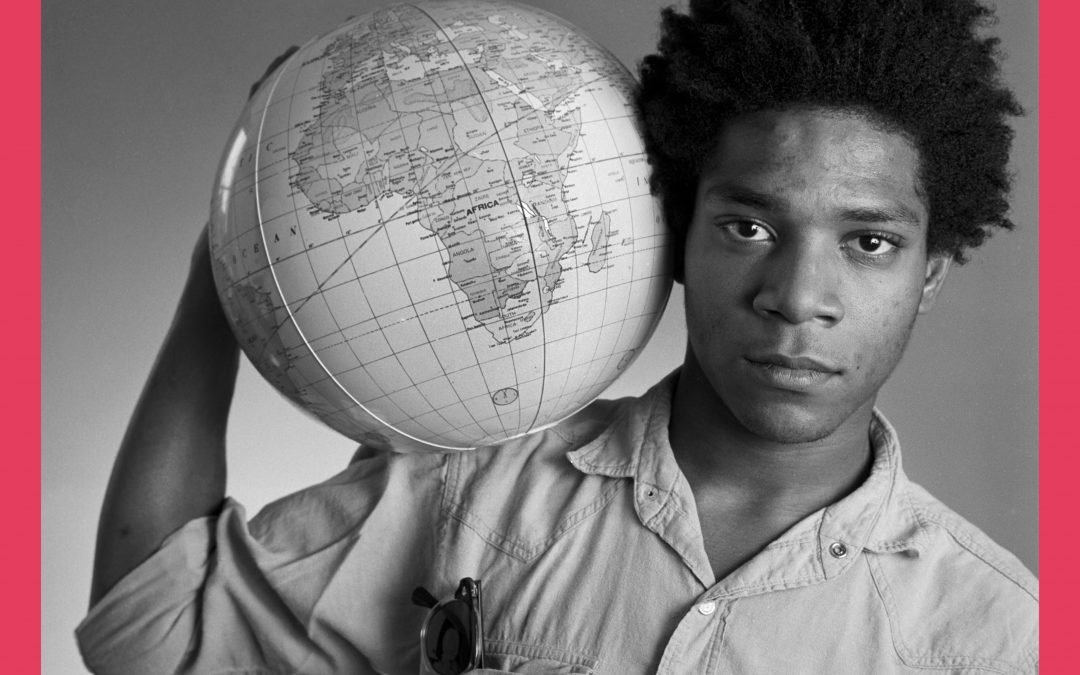
Poster/design: Christopher Makos

Tickets are on sale now for the much anticipated Jean-Michel Basquiat: King Pleasure exhibit, opening April 9, at RXR’s Starrett-Lehigh Building in West Chelsea.

The exhibit, which will span over 15,000 square feet, will feature over 200 never before and rarely seen paintings, drawings, ephemera and artifacts. All of the work comes from the family’s collection. Jean-Michel Basquiat: King Pleasure© will also feature recreations of his NYC artist studio on Great Jones St. and the Michael Todd VIP Room of NYC’s iconic Palladium nightclub for which Jean-Michel created two paintings.

Charles the First, 1982, The Estate of Jean-Michel Basquiat, Licensed by Artestar, New York


The family commissioned internationally acclaimed architect David Adjaye to be the exhibition’s designer. He is the founder of Adjaye Associates, which operates globally, and designed The National Museum of African American History & Culture in Washington, DC. The exhibition’s identity has been created by Abbott Miller of visionary design firm Pentagram. He has previously collaborated with cultural clients including the Guggenheim Museum, the Art Institute of Chicago, and the Metropolitan Museum. Rizzoli Electa will release the accompanying book, also titled Jean-Michel Basquiat: King Pleasure©, to coincide with the exhibition. The book was authored by Jean-Michel’s sisters Lisane Basquiat and Jeanine Heriveaux and his stepmother Nora Fitzpatrick.

The address of Starrett-Lehigh Building is 601 W. 26th Street. Tickets can be purchased at kingpleasure.basquiat.com Follow on the exhibit’s Instagram page for more.

Categories
Art

Chinon Maria at the World Trade Center

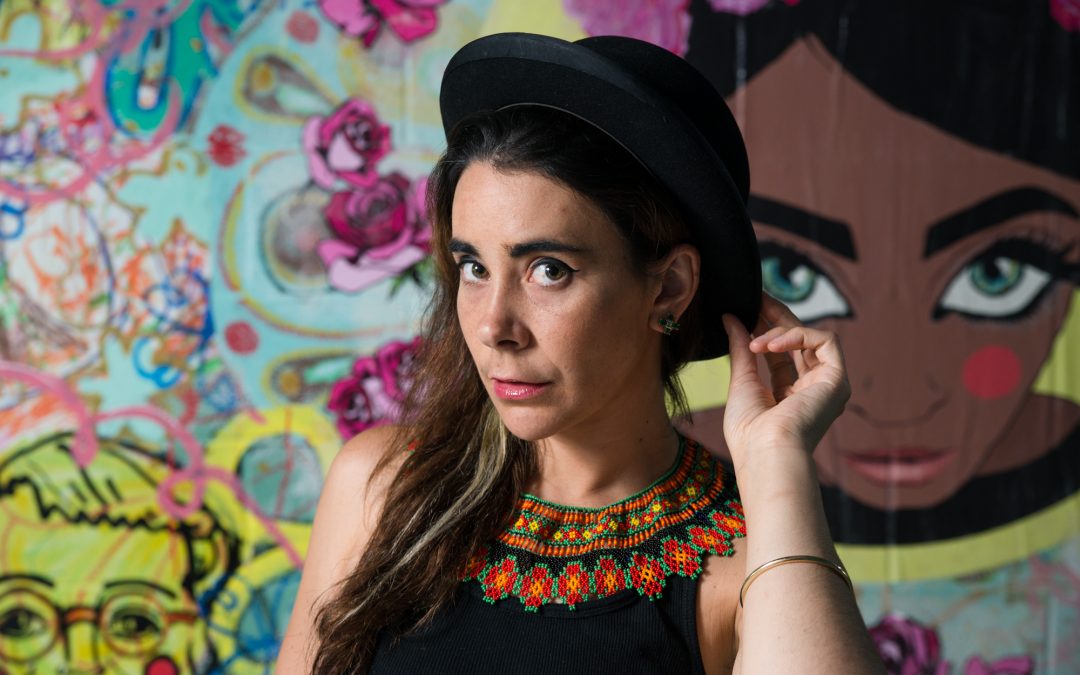
Artist Chinon Maria at the World Trade Center’s New Gallery

CREATING PUBLIC ART in the World Trade Center has been one of the most humbling and emotional experiences of my life,” says Colombian-born street artist Chinon Maria at the World Trade Center

Chinon has four large-scale murals that call the World Trade Center home. Her latest, One World, Our Childrenwill be placed at the future site of 5 WTC and features faces of nine refugee girls from around the globe. Maria asked 1,500 children from 40 countries to mail drawings and descriptions of their dreams for the future, which she incorporated into the mural, with the help of 350 local student volunteers.

Drawing Inspiration Worldwide

“I like to think New York has a place for all these cultures, and all these ideas that I love from all over the world,” Chinon explains. “My artwork is vibrant, colorful, hopeful with an underlining message of unity, healing, and social activism.”

Chinon’s high-energy work has been comissioned for public spaces around the world, and always within her preferred medium—public domain.

“Public art is so important to me, that accessibility, you can’t put a price tag on it,” she says. “It has the ability to actually change space with positive reinforcement and the resurgance of hopeful attitudes.

Taking It Home to New York

“While new projects take her to Mexico and beyond, it’s in lower Manhattan where she feels most at home and spiritually connected.

“In Downtown, you can walk on any block and at any moment you can see people from all over the world and that’s, for me, really inspiring as an artist.”

Art’s transformative power is especially meaningful to Maria’s downtown work., as she aims to positive contribute to the area’s rebirth.

“Art has a power to bring together people from different cultures to identify with a piece of work, to enjoy a piece by just being able to see it on the street and getting the community involved,” Chinon says.

Murals at 4 World Trade Center

To do just this for 4 World Trade Center, Chinon wanted her mural to depict the rich history of New York City in an inviting way, and also sat down with children from the community to talk about the future of the city.

“It was not only 9/11, the tragedy that happened here,” she says. “There were so many other things that have made this city what it is today—good and bad—so I wanted to make sure we could honor that through a piece of artwork.”

“To end it on a hopeful note, I worked with community children to say the future of New York City is going to be bright, and beautiful, and filled with diversity and color.”

Visit the work of artist Chinon Maria at the World Trade Center at wtgallery.com/chinon-maria

Categories
Art Culture Featured News

David Byrne’s ‘How I Learned About Non-Rational Logic’ Exhibit Opens at Pace Gallery

David Byrne’s How I Learned About Non-Rational Logic exhibition runs at Pace Gallery Feb. 2-March 19.On the wall, Human Content.

David Byrne, lead singer/songwriter for The Talking Heads, and currently starring on Broadway in the smash musical American Utopia, continues to keep busy, exploring different art mediums. During the pandemic, Byrne created a series of drawings, that are featured in a new book out Feb. 16, A History of the World (in Dingbats): Drawings and Words (co-authored with Alex Kalman) . In conjunction with the book release, Pace Gallery presents a collection of Byrne’s work in a new exhibit, How I Learned About Non-Rational Logic, open Feb. 2-March 19.

David Byrne, Hot Bread Delivery, 2020.

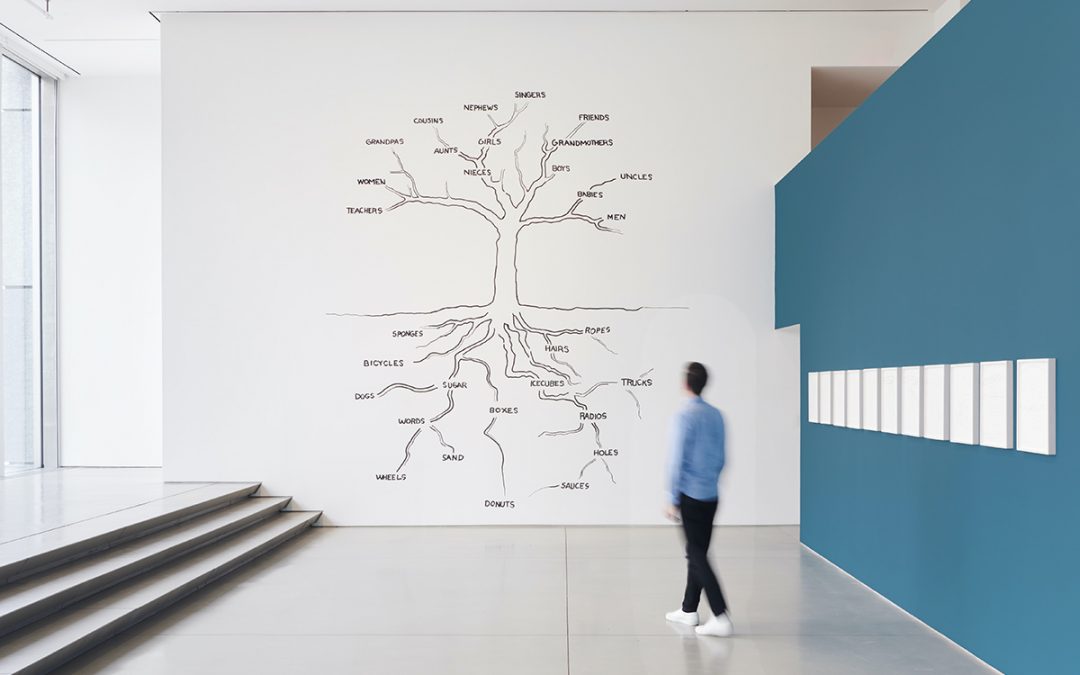
The exhibit incorporates Byrne’s pandemic doodles, along with a collection of playful, thematic tree drawings from the early 2000s, and a selection of chair drawings from 2004-2007. The ‘dingbat’ doodles made during quarantine, were a means for Byrne to cope with boredom, anxiety, and isolation, offering a way to express hope, desire for connection, a bit of wicked sense of humor, and the power of community.

Of his tree drawings, Byrne has described them as ” faux science, automatic writing, self-analysis, satire, and maybe even a serious attempt at finding connections where none were to exist. And an excuse to draw plant-like forms and diagrams.”

David Byrne’s Girl Head Chair drawing.

Of his surreal chair drawings, Byrne has said, “Maybe they are portraits, maybe self-portraits, maybe portraits of my interior state. Maybe they are also possible practical furniture design. Maybe all of the above at once.”

On Monday, Feb. 7, at 7pm, Byrne with speak with documentary filmmaker John Wilson at Pace Gallery. The conversation will later be shown on HBO. Tickets to the event are sold out, but it will be live streamed.  See more details about the program here: https://www.pacegallery.com/events/how-we-learned-about-non-rational-logic/.

Pace Gallery is located at 540 W. 25th Street. For more information, visit pacegallery.com.

Categories
Art Culture Movies NYC

City of Change

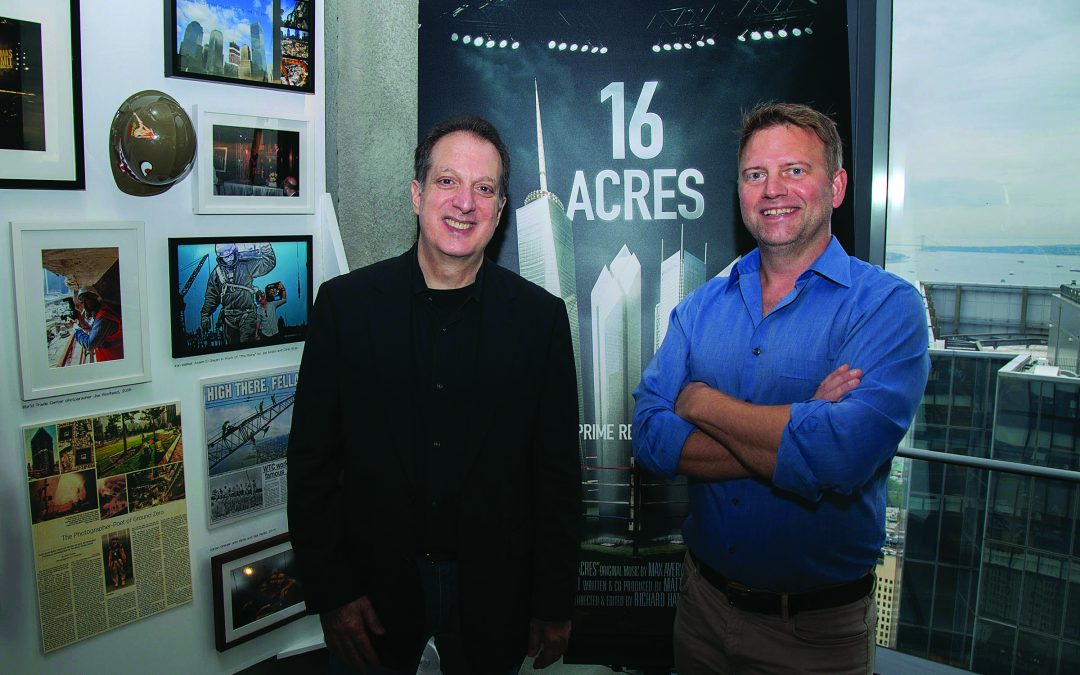
The production team behind 16 Acres, Mike Marcucci (left) and Matt Kapp, are working on a sequel documentary. Photo by Joe Woolhead.

The sequel to the Downtown documentary—16 Acres—will show the dramatic changes in Lower Manhattan

THOUGH THE TWIN TOWERS COLLAPSED IN ONLY SECONDS, it took more than 10 years to rebuild One World Trade Center, once known as the Freedom Tower. Nearly another 10 years since the release of 16 Acres, a documentary directed by Richard Hankin and produced by Mike Marcucci and Matt Kapp, and the cityscape continues to evolve, with the team now working on a sequel film.

16 Acres

In those first years following 9/11, it was unclear whether another World Trade Center would ever be built in Lower Manhattan. Contentions rose as many residents, family members, and friends of victims advocated against rebuilding on what they viewed as sacred ground. Larry Silverstein, having purchased the Twin Towers only six weeks before the attack, became a focal point for rebuilding tensions, and yet his determination and investment to erect a new World Trade Center campus is now recognized as a catalyst of Lower Manhattan’s revitalization today. 16 Acres, released in 2012, detailed the events, discussions, and expectations at Ground Zero’s 16-acre campus in the first 10 years following 9/11. From the first town halls hosted in Lower Manhattan to receive stakeholder input on rebuilding plans, to the push-pull of the architectural design and build process that continues today, the film navigates the many dynamics that come with building on “the most famous construction site in the world,” as Marcucci calls it.

Though Larry Silverstein has served as a driving force in restoring Lower Manhattan these past 20 years, 16 Acres explores the considerable resistance he faced, both from the local community as well as heads of agencies. “A lot of New Yorkers really just tuned out. They weren’t returning, it wasn’t a very happy place. There was a lot of conflict, sadness,” Marcucci recalls, pointing to local reluctance to ever attempt revitalization following the aftermath of 9/11. As Kapp adds, “all you heard was bad news here.”

Yet the documentary highlighted a distinctly New York-type resiliency that manifested through the prolonged design and build process for the World Trade Center. From the give-and-take between competing visions by master planner Daniel Libeskind and lead designer David
Childs, to the extensive permitting and revisions mandated by the many agencies involved, the story behind Ground Zero is at once complex and yet steadfastly geared towards the ending we now know today: four World Trade Center towers, coupled with a 9/11 Museum and Memorial and a transportation hub built to draw people in. “If you’re a New Yorker, you can’t not want to be involved in the telling of this story,” Kapp emphasizes.

Today, Marcucci and Kapp are working together to film a sequel to 16 Acres, a documentary exploring downtown’s historic past and inevitably bright future. “We’re also going to look at the past and project the future a little bit, all based on what’s happening now. So, it’s the story of downtown, more than anything,” Marcucci says.

Starting with what was known as “Radio Row” in the 1920s, to the future of living and working with downtown’s changing demographics, the sequel sets out to offer a broad look at the history of Lower Manhattan while building on how recent events, such as 9/11, Hurricane Sandy, and COVID-19, will affect the culture here moving forward. Yet the two producers remain upbeat about downtown’s future. Marcucci notes, good or bad, “there’s always change. It seems downtown is destined for more of that.”

16 Acres can be streamed on Epix, DirectTV, Paramount Plus, Apple TV, Amazon Prime, and Vudu. 16acresthesequel.com DT

Categories
Art Culture Lifestyle Living NYC Theater

Signs of the Times

Broadway SIGNs.
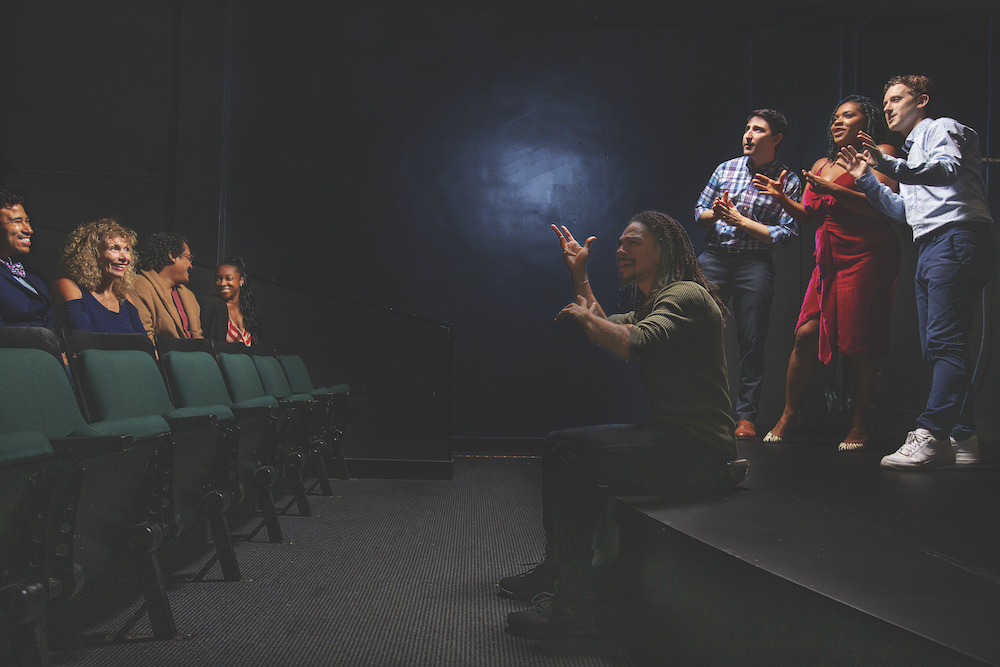
SIGNmation showcases deaf talent with Broadway SIGNs. Photo by Steve Thornton.

DEAF AND HARD-OF-HEARING AUDIENCE MEMBERS recently gathered at Off-Broadway’s Triad Theatre for Broadway SIGNs! theatrical showcase R-E-S-P-E-C-T!, featuring song, dance, storytelling, and more. In the front row, American Sign Language (ASL) interpreters voiced for deaf artists as they took the stage. Hosted by Mervin Primeaux-O’Bryant, the show featured performances by artists of all backgrounds, from Broadway’s Treshelle Edmond and Amelia Hensley, to ASL rap performer and ASL instructor Gabriel Silva, to Sunshine 2.0, a performance troupe debuting from Rochester’s National Technical Institute for the Deaf.

Broadway SIGNs! productions offer collaborations for deaf artists and Broadway talent to promote ASL and deaf culture in the performing arts. The showcase is a regular event, pulling together performers from the deaf and hard-of-hearing performance community. SIGNmation was founded in 1990 by Jo-Ann Dean, inspired by a stage door encounter with Tony-winning deaf actress Phyllis Frelich in New York City.

“She invited me to Deaf West Theatre,” explains Dean. “Upon meeting incredible deaf and ASL artists, I sought a way to bring ASL intomainstream culture, to give artists a platform and to promote the visibility of ASL on stage, in theatre, and in film, and champion accessibility to the arts.” Dean is now a coproducer on A Commercial Jingle for Regina Comet starring Alex Wyse, Ben Fankhauser, and Bryonha Marie Parham with book and lyrics by Wyse & Fankhauser. As the story goes, two nobodies dream of writing one hit song for everybody, sung by one aging diva.

The musical comedy lead producer Cody Lassen has opened doors to new producers and welcomes some of Broadway’s first ASL-interpreted performances for the musical. Dean and SIGNmation welcome Wall Street to sponsor accessibility as stages reopen.

Edmond, 31, who has performed in Broadway productions of Spring Awakening and Children of a Lesser God, was given her own day of recognition in 2016 by the City Council of Los Angeles, which designated September 28 as “Treshelle Edmond Day.” This year, she performed a one-woman show in New York City called “Light Up Within,” which follows her journey to find her identity.

“It means the world to me that I was provided a platform to perform in American Sign Language,” she says. “I love that SIGNmation believes in culturally-accessible content for arts, theatre, film, and television to make sure everyone is included.”

Gabriel Silva, who performed Empire’s “Chasing the Sky” at the showcase, is also a father and teacher with the Sign Language Center, an educational program owned and run by Alan Roth and taught exclusively by deaf instructors. It is also a sponsor of Broadway SIGNs!

“I never planned to teach,” he says, until Roth saw him perform and asked him to teach one class. “One class became two, and then three and four. It was like a new undiscovered talent that I didn’t know I had.” But Silva remains a performer first and foremost, including in LA with Dean’s ASL Cabaret. This year marked his first Broadway SIGNs! performance. “I always knew I was talented,” says Silva, “but I wasn’t sure how to show the world. SIGNmation has given me a platform to grow as an artist and opportunities to meet and collaborate with other deaf artists.” He continues, “I’m forever appreciative for Jo-Ann and everything she does for us as a community.” DT

For more information, visit signmation.com

RESOURCES

SIGNmation

signmation.com

A Commercial Jingle for Regina Comet

reginacomet.com

Sign Language Center

signlanguagecenter.com

New York Deaf Theatre

newyorkdeaftheatre.org

Hands On

handson.org

New York Metro RID

nycmetrorid.org

Categories
Architecture Art Culture Living News NYC Outdoor Uncategorized

Sky Light

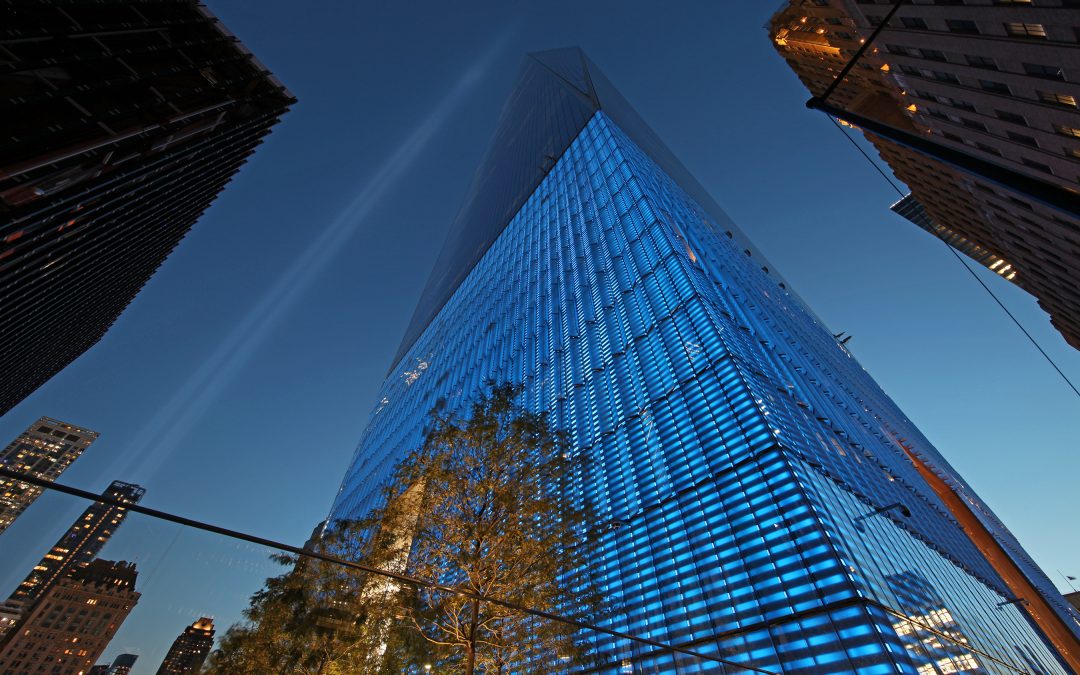
Twenty years later, Tribute in Light helps New York City heal. Photo by Joe Woolhead.

IN NEW YORK, art isn’t limited to the galleries and theaters; it overflows into the streets, draping itself across the city’s skyline. Architects, artists, social organizations, and New York’s many public agencies each play a hand in building the immersive installations that speak towards some of today’s most pressing topics. New York-born architect and artist Gustavo Bonevardi is recognized for his many public projects exploring the impact local and global crises have on our population, and in New York today he is perhaps best known, along with creative partner John Bennett and lighting designer Paul Marantz, as among the artists behind Tribute in Light, an annual light projection commemorating the anniversary of 9/11. Today managed by the 9/11 Memorial & Museum, Tribute in Light was conceived with the support of the Municipal Art Society as two beacons echoing the Twin Towers as they defined New York City’s skyline. Though the two light beams don’t represent the actual size of the towers, which were each an acre in size, the gap between the beams and the net acreage the installation occupies is approximate to the size of the towers. “What we’ve settled on is to create not the buildings themselves, but the void between those,” Bonevardi notes, emphasizing “this tension between these two vibrating pillars.” With the beacons of light reminiscing what the Twin Towers represented, Bonevardi adds that, “to my mind, it always seemed like the World Trade Center towers were sort of like a gateway, like a door to the city,” symbolizing open arms to the millions passing through each year. In the 20 years that Tribute in Light has taken place, it has acquired a steadfast following that looks to those lights each year, recalling that same message the towers once represented.

Tribute in LIght
Tribute in Light. Photo by Joe Woolhead.

Yet, Bonevardi hopes that the installation looks less at what was, and more at what could be. The Freedom Tower now erected serves as a new vision for the city’s reception of travelers and immigrants alike. Lower Manhattan on its broader spectrum has transformed from a once “beautiful and haunting” evening ghost town, as Bonevardi describes it, to a thriving neighborhood accommodating both residential and commercial tenants collaborating together to build a culture of arts, activism, shopping, and dining.

Gustavo Bonevardi
Gustavo Bonevardi. Photo by Ann Foker.

“I think that’s what New York is, it’s always fresh and new and vibrant,” Bonevardi notes, adding that when it comes to downtown’s future, “I expect it to be something unexpected. I expect to be surprised somehow. I mean, the city is constantly reinventing itself.” His most recent proposal, Missing, explores what traces the COVID-19 pandemic left on cities through footsteps echoing the many who passed away these nearly two years. Whether through such unexpected displays of resilience or delicate works of art, Bonevardi and the many other artists across New York show that this city champions perseverance and adaptability above all, underscoring what it takes to be a New Yorker.

Learn more and view a selection of Bonevardi’s works at gustavobonevardi.com.