

by Jo-Ann Dean | Mar 21, 2026 | Culture, Theater
Ethan Slater stars Marcel Marceau in Marcel on the Train. Photos by Emilio Madrid, presented by Classic Stage Company.
Tony Award–nominated Ethan Slater stars as Marcel Marceau in the world premiere of Marcel on the Train, presented by Classic Stage Company. Co-written by Marshall Pailet (Who’s Your Bagdaddy, Private Jones) and Ethan Slater (SpongeBob SquarePants, the Broadway Musical, Wicked) and directed by Pailet, the Off-Broadway production is a sold-out hit.
History remembers Marcel Marceau as the world’s greatest mime. Before the spotlight, he was a young man in Nazi-occupied France who guided Jewish children to safety with courage and imagination. Marcel on the Train reveals the man behind the invisible mask during the shadows of World War II.
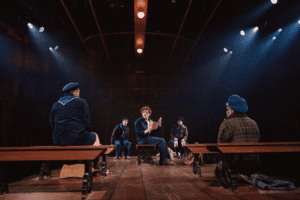
Marcel on the Train superbly cast adults as the young children who enter stage with only a backpack as sole belongings. Maddie Corman (Accidentally Brave) is Etiennette, a quiet traumatized girl who does not speak, Tedra Millan (Leopoldstat) Bethe is a cynical articulate teen who only sees death around her, Max Gordon Moore (Tammy Faye) is Adophe, an analytical boy and frenemy of Henri. Alex Wyse (Good Night, Oscar) is a standout as Henri, a brazen and cocky child who owns it. Understudies for the young female roles are Rora Brodwin (A Modest Proposal), and for the boys roles are Harrison Bryan (A Patron of the Arts), and Josh Odsess-Rubin (Miracle on 55th Street) plays Everyone Else and Adolpe. Aaron Serotsky (August: Osage County) is Everyone Else/The Man in astonishingly diverse roles and dialects including the Nazi officer and Georges.
Ethan Slater and Marshall Pailet are a writing and directing team to watch in a play that pivots predominantly on a few set changes, mostly through shadow and light and a set of benches to denote the bare train car the cast occupies. Marcel on the Train origins began with Slater researching Charlie Chaplain when he googled “Jewish mime” and Marcel Marceau’s name popped up, to his surprise. He noted a mere three paragraphs on Marceau’s role in the French resistance as a young man who saved Jewish orphans using pantomime to keep them entertained in crossing the Alps to freedom. Slater was hooked, and in his commutes to New York City he would write Marcel on the Train.
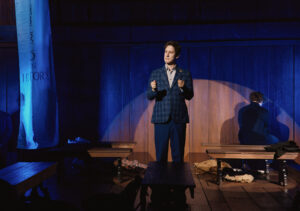
Slater told DOWNTOWN Magazine once he conceived the play he immediately contacted Marshall to congratulate him on the birth of his son, and popped the idea of a collaboration. Together they birthed an amazing homage to Marceau who in his lifetime never spoke about this period in his life publicly. Only stating, “The people who came back from the camps were never able to talk about it. My name is Mangel. I am Jewish. Perhaps that, unconsciously, contributed toward my choice of silence.” His father in the play refuses to leave his country and dies in Auschwitz.
Classic Stage Company (CSC) theater is the perfect setting for a play that commands intimacy. We are consciously drawn into the train by Slater as Marceau with his eye contact to the audience. He is Marceau. In a post show talkback, the duo talk about creating the children’s characters with the intention of making him as uncomfortable as possible as stowaways confined in the train car. The act of hiding lent only space and light to be used by Marcel to comfort the formidable personalities intensely performed by the innocents they cast.
Slater and Pailet also shared Marceau turned down a book deal about his role in the French Resistance that has recently been annotated in a book posthumously published last year. It is the only documentation of the account in French on record of his trips in saving over 70 Jewish children. He was a member of the Oeuvre de Secours aux Enfants, a relief group that smuggled children out of Nazi occupied France, and authentically depicted in Marcel on the Train.
A striking scene when the Nazi Officer (Aaron Serotsky) enters the train car, Marceu (Slater) coaches the children to state they are scouts on a trip, and tired from their journey. In a game of cat and mouse, the officer plays both god and monster, he notices a chalk drawing on the train car that somehow saves them and becomes the question amongst the children.
Slater uses the stage, the air and light to break the fourth wall silently in a game with Etienette (Maddy Corman) who communicates with Marceau in gestures. What is drawn in the air we believe at the front of the stage, is a game of tic-tac-toe, each stroke a reveal is simultaneously drawn in chalk backstage. The childlike drawing on the train’s door depicts both the horror and the salvation that is larger than life. Each nuance is deftly directed by Pailet with an artistic reflection on anti-semitism. Historically and dramatically without words ever being spoken.

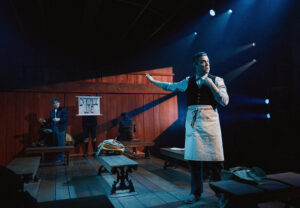
Scott Davis’ impeccably sparse scenic design of benches that rise from the floor boards when the children enter and Studio Luna’s lighting and shadows are both visual layers that enhance the story and emotions of Marcel on the Train. The creative team for Marcel on the Train includes Sarah Laux (Costume Design), Jill BC DuBoff (Sound Design) and Geoff Josselson (Casting). All worked in unison beautifully to fulfill the artistic vision of the writers as vignettes just like Marceau’s performances, glimpses of life told through the eyes of a childlike man, his beloved Bip.
The physicality of Ethan Slater is a marvel to watch on stage from the opening sequence to his becoming Marcel Marceau. As we later watch the children grow, scenes flip to the future. The passage of time is depicted by signage hung and underscored by a spotlight, giving a nod to silent film slates on film. Slater transfixes the audiences with his vignettes of Bip Chasing Butterflies center stage. In a classic scene Slater as Marceau, entreating the children to walk during the Alps crossing, takes a handful of snow, becomes the mime with a splash of white face seen by the audience and entertains the children to safety.
Marcel on the Train’s cast will take a final bow on March 22nd at Classic Stage Theater, this writer sincerely hopes the play will transfer to Broadway on yet another stage. The message both Marshall Pailet and Ethan Slater conveyed in their interviews as fathers and as artists of Jewish heritage is that “Adults in society have the responsibility to care for all children. They deserve to grow up and have a life.” Marcel on the Train is ever so relevant now in its depiction of hope and that the arts and its humanity live on.
Classic Stage Company partnered with What Will the Neighbors Say? Co-Artistic Directors James Clements and Sam Hood Adrain for a dynamic post show events deepening the engagement with Marcel on the Train. Art heals and can save lives. The talkbacks and workshops offered as companions to the play gave insight to the political art of mime and resistance, for both young and old.
Hands On ASL Interpreted Performances
Two sold out performances were provided with American Sign Language interpretation, by Hands On interpreting for theater. Hands On is a nonprofit arts service founded by Executive Director Beth Prevor and facilitated by Director of Programs Dylan Geil. Marcel on the Train Interpreting Deaf Mentor Alexandria Wailes, Deaf Director of Interpreters Diana Abayeva and outstanding interpretation by Craig Vogel, Amy Meckler and Mark Weinglass for this performance. Hands On mission is to ensure the Deaf community’s participation in New York City’s performing arts, theater, dance and film culture. Indeed the loudest resistance begins in the quietest of places. DTM